ChatGPT Sponsored Agents
OpenAI's conversational ad format — a shopper taps a relevant ad and opens a clearly labeled chat with a business-sponsored AI agent that answers questions and links to the site, being tested with select US advertisers.
Last verified · 2026-10-23 · by Moe Ameen
Published 2026-09-17 · Updated
Short answer
ChatGPT Sponsored Agents is an ad format OpenAI announced on September 16, 2026. After seeing a relevant ad, a user can open a clearly labeled chat with a business-sponsored AI agent, ask follow-up questions, and follow a link to the business's site. OpenAI keeps that chat separate from ChatGPT's own answers. It's being tested with select advertisers in the United States.
Key takeaways
- A Sponsored Agent is a labeled chat with a brand's AI agent, opened from a ChatGPT ad.
- It launched as a US test with select advertisers on September 16, 2026.
- It shipped with an Ads Manager plugin in ChatGPT, AI-suggested ad creative, and HubSpot and Shopify integrations.
- The agent is only as good as the product content behind it, and OpenAI doesn't write that for you.
What are ChatGPT Sponsored Agents?
ChatGPT Sponsored Agents is OpenAI's conversational advertising format, announced September 16, 2026. When an ad is relevant to what a user is asking, they can tap it and open a clearly labeled conversation with a business-sponsored AI agent — spelling out what matters to them, asking follow-up questions, and clicking through to the business's website when they're ready.
OpenAI keeps that conversation distinct from ChatGPT's own independent answers and separate from the user's original chat, so the agent is unmistakably the brand talking rather than the neutral assistant. Its example is a shopper asking a furniture brand's agent about a table's dimensions, how many people it seats, and how to care for it.
It shipped inside a broader ad update: natural-language campaign management through an Ads Manager plugin in ChatGPT, AI-suggested copy and imagery generated from your landing pages, and an opt-in text-customization feature that adapts headlines and descriptions to a conversation's context and translates ad copy into a user's preferred language. OpenAI also named HubSpot as its first CRM partner and Shopify as its first ecommerce partner, with a ChatGPT Ads app in the Shopify App Store that runs ads from a merchant's Shopify Catalog.
At announcement, Sponsored Agents were being tested with select advertisers in the United States, and OpenAI did not publish pricing or a buying model for the format. It is a distinct unit from the existing labeled sponsored ad card, which is a one-way placement rather than a conversation. As an early test, availability and behavior will change — confirm current specifics on OpenAI's advertising pages.
The clean framing for a creator or brand: a Sponsored Agent is a conversational front-end over your product knowledge, not a content engine. It talks; it doesn't produce the material it talks from, and it can't make the video, carousels, or blog posts that build your presence elsewhere. Its usefulness turns entirely on the depth and freshness of the content behind it.
What can you do with a ChatGPT Sponsored Agent?
- A clearly labeled, two-way conversation between a shopper and your business-sponsored AI agent, opened from a relevant ChatGPT ad
- Answers to real pre-purchase questions — dimensions, compatibility, comparisons, care, returns — inside ChatGPT, with a link out to your site
- AI-assisted campaign management and creative suggested from your existing landing pages
- Automatically customized and translated ad copy adapted to each conversation and language (opt-in)
- Campaign, lead, and catalog operations connected through HubSpot and Shopify
- Note: the agent answers only from the content you provide — it generates no video, carousels, blog posts, or cross-platform content of its own
Where does a ChatGPT Sponsored Agent get its answers?
A Sponsored Agent is a mouth without a library. It can hold a conversation, but every answer it gives has to come from content you've already produced — and it makes none of that content itself, nor anything for the surfaces beyond ChatGPT where the same buyer scrolls. That gap is where Kompozy does the work. Kompozy is a full AI content generation and multi-platform publishing engine, so from one Persona Brief that pins your voice and banned words it produces the answerable library an agent draws on: Blog Articles written as direct answers to each buyer question, brand-exact Carousel Posts and Infographic Photos laying out specs and honest comparisons, Quote Graphics, and Text Posts — the concrete, current material that lets an agent settle a decision instead of deflecting to "check the website."
Then it does the two things the agent structurally can't. First, it generates net-new formats no ad agent produces — avatar-narrated Persona Shorts and other video that answer the same buyer questions on camera, plus images and newsletters — so your presence exists as more than text an agent can quote. Second, it publishes that whole set across the eight social platforms plus blog and email through Autopilot, behind a per-post review gate, which builds the off-ChatGPT footprint that earns you an organic mention when a user asks the assistant for a recommendation — the unpaid counterpart to the agent slot. Kompozy won't build your Sponsored Agent or bid in OpenAI's Ads Manager; it produces and maintains the content that determines whether the agent, and the free mention beside it, are any good.
- Inventory the questions a buyer asks before purchasing, then generate a direct-answer set for each in Kompozy from one Persona Brief — a blog FAQ page, a specs carousel, a comparison, a short video.
- Publish that set across the eight social platforms plus blog and email with Autopilot, so the answers exist in the multiple legible places a model reads.
- Keep it current: refresh prices, SKUs, and specs on a cadence so an agent (or an organic answer) never quotes a dead option — the review gate catches stale or invented facts before they ship.
- When you can run a Sponsored Agent, point it at the content you've built so its conversation answers from an accurate, on-brand library rather than thin marketing copy.
- Track which buyer questions ChatGPT still answers with someone else, and generate the content to close each gap.
What does this look like in Kompozy?
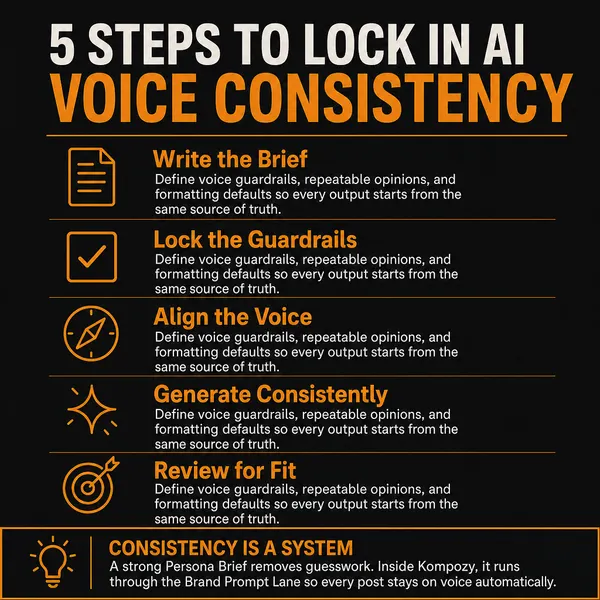
A real infographic photo made in the Kompozy workspace. It's the kind of specs-and-answers asset that gives a brand's agent, and its feeds, something concrete to point to.
Who is this for, and who should skip it?
Best for:
- Brands with considered purchases where buyers ask a lot of questions first
- US advertisers already in OpenAI's test or on its waitlist
- Shopify and HubSpot users who want ChatGPT Ads inside tools they already use
Not ideal for:
- Most businesses right now. It's a limited US test
- Brands with thin product content. The agent has little to answer from
- Anyone looking for a content creation tool. The agent talks; it doesn't make posts
Frequently asked questions
What are ChatGPT Sponsored Agents?
They're OpenAI's conversational ad format, announced September 16, 2026. A user who taps a relevant ChatGPT ad can open a clearly labeled chat with a business-sponsored AI agent, ask follow-up questions, and click through to the site. The conversation is kept separate from ChatGPT's own answers, and at announcement it was a US test with select advertisers.
Does OpenAI create the content the agent answers from?
No. A Sponsored Agent is a front-end over your product knowledge — it answers only from the content you've made available. OpenAI supplies the conversational slot and some AI creative tooling; the depth, accuracy, and freshness of the underlying content is yours to produce. A content engine like Kompozy generates and maintains that material at scale.
How is a Sponsored Agent different from a ChatGPT ad card?
The existing ChatGPT Ads unit is a one-way labeled card at the bottom of an answer. A Sponsored Agent is a two-way, labeled conversation with a business's AI agent. The card earns a click; the agent tries to answer a shopper into a decision — which is why it depends far more on the content behind it.
Can I run a Sponsored Agent for my business now?
Not generally. At announcement OpenAI described it as being tested with select advertisers in the United States, so most businesses cannot buy one yet. The useful move is to prepare the product content an agent — and ChatGPT's organic answers — would draw on, and confirm access on OpenAI's advertising pages.
How do we know this?
We checked every figure, date, and price on this page against the sources listed below on 2026-10-23, including OpenAI's September 16, 2026 announcement and its advertising principles. Kompozy plan, format, and platform details come from kompozy.io and kompozy.io/pricing.
Sources
- OpenAI — Reimagining advertising with AI (read 2026-10-23)
- OpenAI — Our approach to advertising and expanding access (read 2026-10-23)
- Kompozy — Home (platforms, formats, Persona Brief, autopilot) (read 2026-10-23)
Related tools
- ChatGPT Ads — OpenAI's advertising product — labeled sponsored units placed at the bottom of relevant ChatGPT answers, bought through a self-serve Ads Manager on a cost-per-click or reach basis.
- ChatGPT Free & Go (India) — OpenAI's entry ChatGPT tiers in India — a cheap, fast drafting assistant that, since August 27, 2026, shows labeled ads at the bottom of answers for logged-in adults.
- ChatGPT — OpenAI's AI assistant for writing, ideas, and images — which, since late July 2026, refuses direct requests to write "in the style of" a specific named author.
- ChatGPT Pro — OpenAI's top individual ChatGPT plan — $200/month for the highest message limits and priority access to its most advanced models and tools.
- GPT-6 Sol and Luna — OpenAI's cost-optimized GPT-6 models — Sol for complex coding and knowledge work, Luna for cheap high-volume tasks — launched September 22, 2026 with fewer mistakes at roughly half the price of the GPT-5.6 tier.