Grok 4.7
xAI's most powerful model for coding and knowledge work, trained on longer reinforcement learning runs and better at checking its own work.
Last verified · 2026-10-23 · by Moe Ameen
Published 2026-09-21 · Updated
Short answer
Grok 4.7 is xAI's flagship model for coding and knowledge work, released September 21, 2026. It has a 500,000-token context window and costs $2.00 per million input tokens and $6.00 per million output through the xAI API, doubling past 200,000 tokens. xAI reports gains over Grok 4.6 on every launch benchmark it published, including 71.0% on DeepSWE v1.1. It writes text and code and generates no images or video.
Key takeaways
- Grok 4.7 shipped September 21, 2026 as xAI's top model for coding and knowledge work.
- API price: $2.00 input, $0.50 cached input, $6.00 output per million tokens; $4.00/$12.00 at 200K+.
- xAI's own benchmarks: CursorBench 4.0 46.3%, DeepSWE v1.1 71.0%, Terminal-Bench 4.0 37.6%.
- It reads text and images and writes text, so any media has to come from somewhere else.
What is Grok 4.7?
Grok 4.7 is xAI's newest flagship model, released on September 21, 2026 and positioned as its most powerful model for coding and knowledge work. It is a general-purpose reasoning model — text and image input, text output — trained with longer reinforcement learning runs on a harder mix of tasks. xAI says it works longer on difficult problems, checks its own work more carefully, manages long context better, and was trained to natively understand the Grok Bot harness for conversational and knowledge-work tasks.
xAI's launch benchmarks show gains over 4.6 across coding, agentic, and knowledge evals rather than a single headline win. CursorBench 4.0 rises to 46.3% (from 40.4%), DeepSWE v1.1 to 71.0% at high effort (from 65.2%), Terminal-Bench 4.0 to 37.6% (from 20.3%), EEBench to 64.0% (from 53.0%), HealthBench Professional to 56.7% (from 48.5%), and the Harvey Legal Agent benchmark to 19.6% (from 15.8%). These are xAI's own numbers; wait for independent evaluations before treating any single comparison as settled.
The model has a 500,000-token context window and configurable reasoning effort up to an "xhigh" level. API pricing is $2.00 per million input tokens, $0.50 per million cached input, and $6.00 per million output, with a faster variant at roughly double the speed and double the price. Once a request crosses the 200,000-token threshold, the whole request bills at double ($4.00 input, $12.00 output). One practical note: at high effort it reasons at length, so output-token cost (the expensive side of the bill) can climb on long tasks. It is available through the xAI API, Grok Build, Cursor, and third-party coding harnesses and cloud platforms.
For creators, the framing is unchanged from 4.5 and 4.6: Grok 4.7 is a model, not a content app. Its coding and knowledge-work strength means it reads dense sources and reasons over them well — it does not generate images or video, design or caption anything, or publish to any platform. It is the reasoning-and-drafting layer, not the production-and-distribution one.
What can you make with Grok 4.7?
- Self-checked research briefs from a dense source — a report, whitepaper, transcript, or long thread ingested into the 500K window
- Scripts, hooks, outlines, and long-form drafts from a rough idea or a pasted document
- A repurposing plan that maps one long article or webinar into angles across formats
- Summaries, key-point extractions, and angle ideas pulled from large source material
- Whole-project code and long agentic tool-use chains for the technical side of a project
How does Kompozy turn a Grok 4.7 brief into finished content?
The upgrade in Grok 4.7 that matters for content is knowledge-work depth: it ingests a large, messy source — a quarterly report, a 90-minute webinar transcript, a research thread — into its 500K window and returns a careful, self-verified brief. That makes it the ideal front end for a research-to-content run. The catch is that a brief is not content. Grok 4.7 renders no pixels, holds no brand template, and publishes nowhere.
Kompozy is the production layer on the other side of that brief. Drop Grok 4.7's summary or key-points into Kompozy as a source, and the engine turns one dense input into a whole content series: a HeyGen persona/avatar short with auto-captions that explains the finding, a brand-exact carousel through HyperFrames that breaks it into slides, quote cards pulling the sharpest lines, an infographic poster, a blog article, and a newsletter — every piece in your voice via the Persona Brief. Then autopilot schedules and publishes the set across the eight social platforms plus blog and email from one queue. Grok 4.7 does the reading and reasoning; Kompozy does the making and shipping. You are not wiring Grok into Kompozy. Kompozy runs its own generation, so the Grok 4.7 brief goes in as raw material and the engine takes it the rest of the way.
- Feed a dense source — report, transcript, long article — into Grok 4.7 and ask for a self-checked brief plus a batch of angles.
- Drop that brief and the angles into Kompozy as sources.
- Pick the formats each angle needs — persona short, carousel, quote card, infographic, blog, newsletter.
- Let Kompozy generate each in your brand voice via the Persona Brief, with branded captions and design.
- Schedule and autopilot-publish the whole series across eight platforms plus blog and email.
What does this look like in Kompozy?
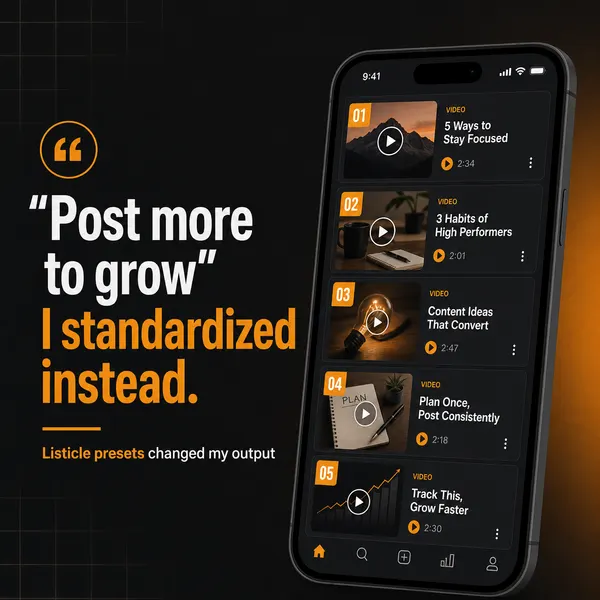
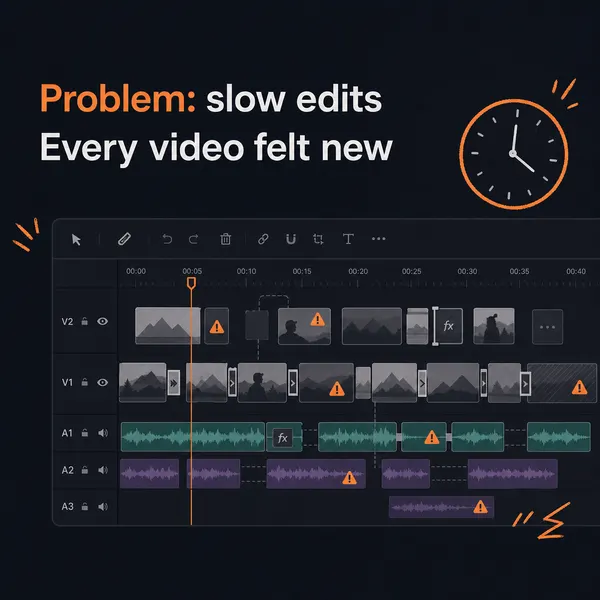
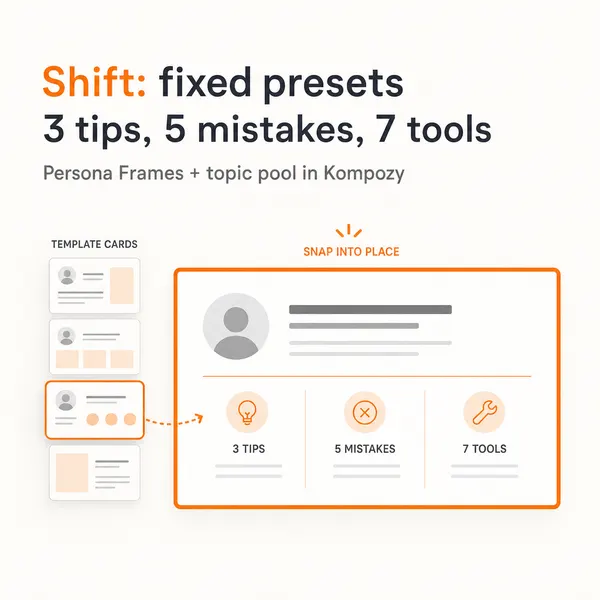
A real five-slide Carousel generated in the Kompozy workspace. This is the kind of slide set a research brief can turn into. We did not make it from a Grok 4.7 output.


Who is this for, and who should skip it?
Best for:
- Developers and analysts who need a long-context model for coding and dense research
- Creators who want a careful brief or script drafted from a long source before production
- Teams already working in Cursor or Grok Build
Not ideal for:
- Anyone expecting images, video, or audio; Grok 4.7 outputs text only
- Budget-sensitive long jobs, since high-effort reasoning produces many output tokens at $6.00 per million
Frequently asked questions
What is Grok 4.7?
Grok 4.7 is xAI's flagship model released September 21, 2026 — a general-purpose reasoning model (text and image input, text output) positioned as its most powerful model for coding and knowledge work. It has a 500,000-token context window, and is reachable via the xAI API, Grok Build, Cursor, and third-party coding harnesses and cloud platforms.
How much does Grok 4.7 cost?
Via the xAI API, Grok 4.7 is $2.00 per million input tokens, $0.50 per million cached input, and $6.00 per million output. Once a request crosses 200,000 tokens, the whole request bills at double ($4.00 input, $12.00 output), and a faster variant costs about double the standard rate on top of that. High-effort reasoning generates a lot of output tokens, so budget for the tokens it produces, not just the ones you send.
How is Grok 4.7 different from Grok 4.6?
xAI trained it with longer reinforcement learning runs on harder tasks, and says it is better at checking its own work, managing long context, and working inside the Grok Bot harness. xAI reports gains across its coding, agentic, and knowledge-work launch benchmarks.
Can Grok 4.7 create social media videos or images?
No. Grok 4.7 reasons over text and images and writes text and code; it generates no images, video, or audio and publishes nothing. To turn its research and drafts into finished, scheduled posts, pair it with a content engine like Kompozy that generates the media and publishes across platforms.
How do I use Grok 4.7 for content?
Use its knowledge-work strength to read a dense source and return a self-checked brief plus a batch of angles, then paste that into Kompozy, which generates persona video, carousels, images, blogs, and newsletters in your brand voice and publishes them across eight platforms plus blog and email.
How do we know this?
We checked every figure on this page against the sources listed below on 2026-10-23 and removed or corrected any claim we could not confirm. Benchmarks and release details come from xAI's announcement; context window and token prices come from xAI's model docs. Benchmark scores are xAI's own and have not been independently re-run by us. Kompozy plan and format details come from kompozy.io and kompozy.io/pricing.
Sources
- xAI — Grok 4.7 (read 2026-10-23)
- xAI Docs — Models and pricing (read 2026-10-23)
- Artificial Analysis — Grok 4.7 (read 2026-10-23)
- Kompozy — Home (formats and platforms) (read 2026-10-23)
Related tools
- Grok 4.6 — xAI's agent-focused flagship model — tuned for long-running agents, coding, and turning product ideas into working interactive prototypes.
- Grok 4.5 — xAI's new flagship model — a fast, lower-cost reasoning model for coding, knowledge work, conversation, and multimodal understanding.
- GPT-5.6 Sol — OpenAI's flagship GPT-5.6 tier — a frontier reasoning, writing, and tool-orchestration model that reads reference images and drives multi-tool creative pipelines, but generates no media itself.
- Claude Opus 5 — Anthropic's frontier Claude model — deep reasoning, agentic coding, vision, and a 1M-token context, positioned near Fable 5 intelligence at half the cost. A text-output model, not an image, audio, or video generator.
- Grok Bot — xAI's assignable AI teammate — you delegate multi-step tasks and it works them on a cloud computer, operating apps like a person.
- GPT-6 Sol and Luna — OpenAI's cost-optimized GPT-6 models — Sol for complex coding and knowledge work, Luna for cheap high-volume tasks — launched September 22, 2026 with fewer mistakes at roughly half the price of the GPT-5.6 tier.