Tencent Hy4 preview
Tencent Hunyuan's open-source, next-generation MoE model — 770B total parameters, ~49B active, and a 1M-token context — released August 28, 2026 and built for coding, agentic engineering, analysis, and research.
Last verified · 2026-10-23 · by Moe Ameen
Published 2026-08-29 · Updated
Short answer
Tencent Hy4 preview is an open-source large language model from Tencent's Hunyuan team, released on August 28, 2026. It is a mixture-of-experts model with 770 billion total and 49 billion active parameters and a context window over 1 million tokens. It targets coding, office work, and scientific research. API pricing starts at $0.834 per million input tokens. It outputs text and code only.
Key takeaways
- Hy4 preview has 770B total and 49B active parameters and a context window over 1M tokens.
- The weights are open on Hugging Face, ModelScope, GitCode, and CNB, with an FP8 variant.
- API pricing: $0.834 per million input tokens and $2.501 per million output tokens.
- Tencent's own blind evaluation scored 2.99 out of 4.00; treat vendor figures as unconfirmed.
- Use it upstream for drafts; publishing the result takes a separate content tool.
What is Tencent Hy4 preview?
Tencent Hy4 preview is a large language model from Tencent's Hunyuan team, released and open-sourced on August 28, 2026. It is a mixture-of-experts (MoE) design with 770 billion total parameters and roughly 49 billion active per token, paired with a context window Tencent describes as exceeding 1 million tokens. It is aimed at productivity and technical work — software engineering (debugging, long-context code tasks), office and financial analysis, game development, and scientific research such as AI R&D and physics simulation — rather than at chat or creative content.
Tencent published the model weights openly on Hugging Face, ModelScope, GitCode, and CNB, alongside a lower-precision Hy4 preview-FP8 variant. It also ships inside Tencent products including WorkBuddy, CodeBuddy, Yuanbao, and ima, and is available via API through Tencent Cloud TokenHub and OpenRouter, with pricing listed around $0.834 per million input tokens and $2.501 per million output tokens and a limited free window at launch. Treat those numbers as an early snapshot and confirm them on Tencent Cloud.
On capability, Tencent reports gains across a set of engineering benchmarks and an internal blind evaluation averaging 2.99 out of 4.00 across 203 tasks judged by 163 experts — figures that are the vendor's own and await independent verification. The most distinctive claim is agentic: Tencent says Hy4 participated in optimizing its own training methods, data strategies, and evaluation, and autonomously tuned its inference for a reported 31.8% throughput improvement.
Hy4 is a text-in, text-out reasoning engine, not a content studio. It produces text and code — no images, video, audio, captions, or publishing. Its strength is digesting large or technical inputs and drafting from them, which makes it a capable front end. Turning that text into finished, on-brand, published content is a separate job.
What can you make with Tencent Hy4 preview?
- Structured briefs and outlines distilled from a huge or highly technical source — a research paper, a codebase, an earnings call — using its 1M-token context
- Plain-language explanations of complex material (scientific, financial, engineering) that a general audience can follow
- Long video scripts, teaching outlines, and hook variations reasoned over a large body of source material
- Working automation code — scrapers, ingestion scripts, small tools — to feed a content pipeline
- Agentic, multi-step research or refactor runs a creator-developer can wire into their own stack
- Text and code only — Hy4 generates no images, video, or audio
Where does Hy4 stop and a content tool take over?
Hy4's sharpest edge for creators is translation: it can take something dense and authoritative — a technical whitepaper, a compliance doc, a quarter of financials — and reason across the whole thing in one pass to produce an accurate, plain-language draft. That is a hard, valuable step, and it is where expert-led content usually stalls. But Hy4 stops at correct text on a screen. It cannot put a face on that explanation, break it into a scroll-stopping visual sequence, or get it in front of anyone. That downstream half is exactly what Kompozy is built for, and the pairing plays to each tool's strength.
Take the explainer Hy4 drafted from your technical source and drop it into Kompozy. Because the hardest content to make watchable is the dry, expert kind, Kompozy's most useful moves here are the ones Hy4 can't touch: a Persona Short narrates the concept on camera with a face-locked HeyGen avatar, a brand-exact Carousel walks the complex point through step by step, and Quote Graphics lift the one line worth remembering — while a matching Blog Article and Email Newsletter go long for the audience that wants depth.
Every piece is rewritten under a Persona Brief so authoritative source material lands in your voice, not the model's, then Autopilot schedules and publishes the set across the eight social platforms plus blog and email behind a per-post review. For privacy-sensitive teams, Hy4's open weights mean the drafting can happen on your own infrastructure before Kompozy handles the production and distribution. Hy4 makes the hard idea correct and clear; Kompozy makes it watchable, on-brand, and everywhere.
- Point Hy4 at a dense or technical source and use its 1M-token context to produce an accurate, plain-language brief or script.
- Drop the strongest draft (or the raw source) into Kompozy as a source and pick your formats.
- Generate a persona/avatar short that narrates the concept, a carousel that breaks it down, quote graphics, plus a blog and newsletter — all in one Persona Brief voice.
- Let Kompozy reframe each asset per platform (9:16, 1:1, 16:9) so one idea fits every feed.
- Review each piece in the per-post queue, then let Autopilot schedule and publish across the eight social platforms plus blog and email.
What does this look like in Kompozy?
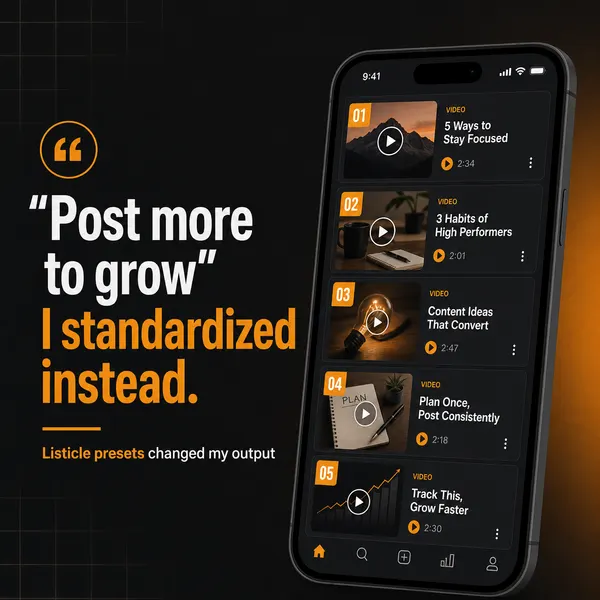
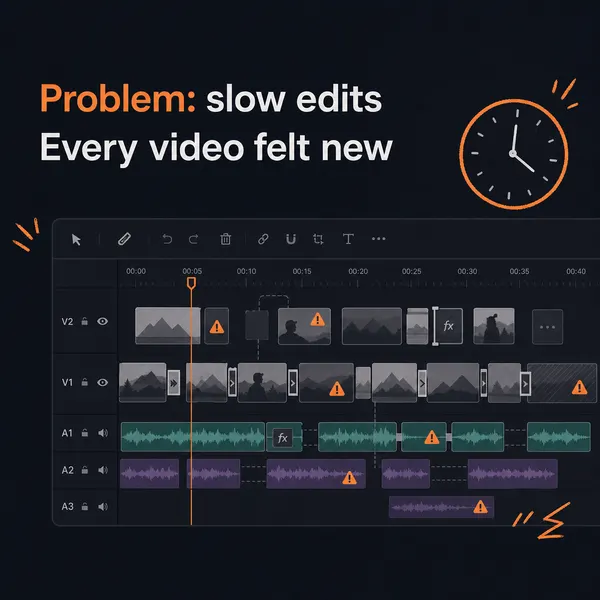
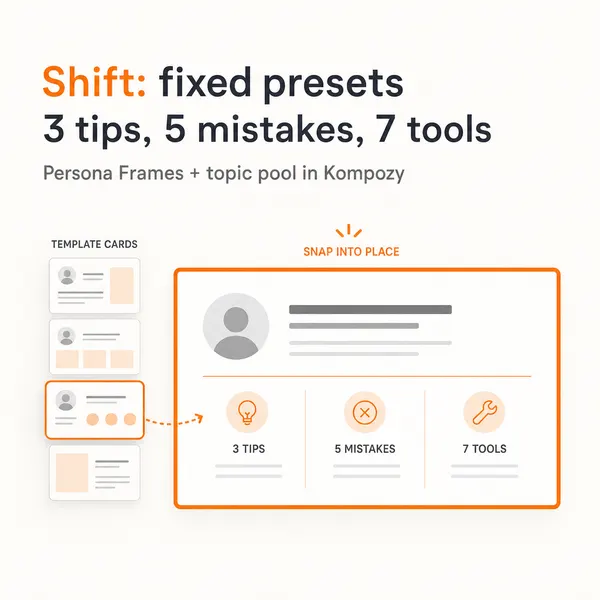
A carousel from the Kompozy workspace. Breaking a dense idea into slides like this is the step Hy4 does not do. The slides are not about Hy4.


Who is this for, and who should skip it?
Best for:
- Developers and analysts who need long-context reasoning over code, papers, or financial documents
- Teams that want open weights they can run on their own infrastructure
- Experts who need a dense source turned into a plain-language draft
Not ideal for:
- Anyone who needs images, video, or audio; Hy4 outputs text and code only
- Writers who want polished English short-form voice out of the box
- Non-technical users who want a finished, published post without extra tools
Frequently asked questions
What is Tencent Hy4 preview?
Hy4 preview is Tencent Hunyuan's next-generation large language model, released and open-sourced on August 28, 2026. It uses a mixture-of-experts architecture with 770 billion total parameters (about 49 billion active) and a context window exceeding 1 million tokens, built for coding, agentic engineering, office and financial analysis, game development, and scientific research.
Can Hy4 preview generate images or video?
No. Hy4 is a text-in, text-out model — it outputs text and code only, with no images, video, or audio. To turn its scripts and briefs into visual content you pair it with a generation-and-publishing engine like Kompozy, which makes persona/avatar video, carousels, images, quote graphics, blogs, and newsletters.
How much does Hy4 preview cost, and is it open source?
Tencent open-sourced the model weights (plus an FP8 variant) on Hugging Face, ModelScope, GitCode, and CNB. API access was listed around $0.834 per million input tokens and $2.501 per million output tokens via Tencent Cloud TokenHub and OpenRouter, with a limited free window at launch. Confirm the license and current pricing on Tencent's pages.
Is Hy4 preview good for writing social content?
It is tuned for engineering and analysis rather than English short-form voice, so it works best as an upstream drafting and research brain — especially for turning technical or long source material into a clear draft. For on-brand captions, formatting, and distribution, hand that draft to a content engine like Kompozy.
How do I turn a Hy4 draft into published content?
Draft or summarize in Hy4, then bring the text into Kompozy as a source. Kompozy generates 20 formats from that one input — persona/avatar video, carousels, quote graphics, photo posts, a blog, and a newsletter — holds a consistent voice and face across them via the Persona Brief, and schedules and publishes across eight social platforms plus blog and email.
How do we know this?
We checked every figure and vendor claim on this page against the sources listed below on 2026-10-23, including parameters, context window, pricing, the blind-evaluation numbers and the 31.8% throughput claim in Tencent's release, and the open weights and FP8 variant on the Hugging Face model card. Kompozy plan and product details come from kompozy.io and kompozy.io/pricing.
Sources
- Tencent — Tencent Releases and Open-Sources Tencent Hy4 preview (read 2026-10-23)
- Hugging Face — tencent/Hy4-preview model card (read 2026-10-23)
- Kompozy — Home (platforms, outputs per source, Persona Brief, review queue) (read 2026-10-23)
- Kompozy — The Cheat Sheet (18 content formats) (read 2026-10-23)
Related tools
- DeepSeek V4 Pro 0813 — The general-availability build of DeepSeek's flagship model — a 1.6-trillion-parameter mixture-of-experts LLM with a 1M-token context, MIT-licensed weights, and API pricing well under Western frontier models.
- GLM-5.3 — Z.ai's coding and agent model, released August 14, 2026. It reuses the same 743B-parameter base as GLM-5.2 and gets its gains entirely from scaled post-training, with a 1-million-token context and a jump in long-horizon coding and cybersecurity work.
- Kimi K3 — Moonshot AI's new flagship frontier model — a very large, long-context, natively multimodal model that reads images and reasons over million-token inputs, positioned as the largest open-weight model from China.