The honest Claude Docs & Slides alternative (2026) for creators who need to publish, not make office files
Claude Docs and Slides build documents and decks; Kompozy builds and publishes social content. The honest 2026 breakdown of when each tool is the right call.
Published 2026-09-16 · Updated
Short answer
Claude Docs and Claude Slides, announced September 16, 2026, are beta tools in paid Claude plans that build documents and decks inside a conversation. Decks download as PowerPoint or PDF and live at a shareable link. They make office files, not posts. Kompozy is the alternative when you need video, carousels, blogs, and newsletters published across platforms.
Key takeaways
- Docs and Slides roll out to Pro and Max first, then Team and Free plans.
- Claude Pro is $20 a month; Max is $100 or $200 a month.
- Neither tool captions, reframes, schedules, or publishes social content.
- Kompozy can turn a deck's content into carousels, clips, a blog, and a newsletter.
If you searched for a "Claude Docs alternative" or a "Claude Slides alternative," you are probably in one of two camps. Either you want a different AI document-and-deck maker, or you have realized the deck is not the deliverable your audience ever sees — the posts are — and you are looking for the tool that produces and publishes those. This page is honest about which camp Kompozy serves: the second one. These are not the same kind of tool.
Claude Docs and Claude Slides, launched in beta on September 16, 2026, are excellent at what they do: describe a report or a presentation and Claude builds an editable file inside the conversation, teammates add notes and comments on it, and decks download as PowerPoint or PDF. For internal deliverables — a pitch deck, a lead-magnet PDF, a client report — that is a genuine time-saver, and I am not going to pretend otherwise.
I run Kompozy, and the honest framing is that these two tools barely overlap. A document or a deck is an artifact a person opens and reads. Social content is an artifact a feed serves to an audience that never opens your file. Claude makes the first kind; Kompozy makes the second — video, images, carousels, blogs, newsletters, and text posts in your brand voice, scheduled and published across nine platforms.
Everything below is grounded in what each tool actually does as of 2026-09-16 — Claude Docs and Slides from Anthropic's launch materials, Kompozy from our own product and pricing page. No fabricated weaknesses: Claude's limits for social content are simply that social content was never its purpose. If after reading you conclude Claude plus a separate publishing tool is all you need, that is a fair call.
What does Claude Docs and Slides do?
Claude Docs and Claude Slides are two tools inside the unified Claude app that generate and edit office-style files from a conversation. Claude Docs drafts and revises documents — you ask for one and keep working on it collaboratively, with Claude drafting sections, asking clarifying questions, and commenting on editorial choices while colleagues edit the same file. Claude Slides builds presentations you can edit slide by slide, present directly from Claude, or download as a PowerPoint or a PDF. Anthropic folded Claude Design into the conversation too. They shipped as Anthropic merged Claude Cowork into the main Claude app: there is no longer a chat-versus-Cowork mode to pick, and every conversation keeps the context, skills, and connectors you already have. The tools are in beta on paid plans, rolling out to Pro and Max first on web, desktop, and mobile, then Team and Free. The positioning is a move onto office-suite turf — Claude now builds the documents and decks Microsoft 365 and Google Workspace are organized around. What they do not do is generate social video, write platform captions, build carousels for a feed, reframe an asset per platform, govern a brand voice across formats, or schedule and publish anything.
Why do people look for a Claude Docs and Slides alternative?
People look past Claude Docs and Slides for content work for one plain reason: they were built to make files, not posts. If your bottleneck is "I need ten captioned vertical videos, three carousels, a blog draft, and a newsletter shipped across six platforms this week," these tools do none of it. Claude will happily build you a beautiful deck about your topic — but a deck is a single artifact in one aspect ratio, with no captions, no per-platform sizing, and no audience attached, and it stays a file on your drive until you do something else with it. There is also a shape mismatch. A creator operation runs on a produce-and-distribute loop: one idea becomes many formats, each sized and captioned for its destination, scheduled across platforms, all in one governed voice. A document-and-deck generator has no concept of that loop — no persona layer, no banned-word filter, no carousel or quote-card builder, no video renderer, and no publishing queue. None of that makes Claude Docs and Slides weak; it makes them a different category. If your work is producing and distributing content, you need a content engine, and that is the comparison this page exists for.
How do Claude Docs and Slides compare with Kompozy feature by feature?
| Feature | Claude Docs & Claude Slides | Kompozy | Note |
|---|---|---|---|
| AI document generation & collaborative editing | Yes | Partial | Claude Docs wins for office documents. Kompozy drafts content — captions, scripts, blogs, newsletters — not general office docs. |
| AI presentation / deck generation | Yes | No | Claude Slides builds and exports decks. Kompozy does not make slide presentations — it makes feed-native posts. |
| Download decks as PowerPoint / PDF | Yes | No | Claude's core strength. Kompozy publishes to platforms, it does not export office file formats. |
| One shareable link per doc or deck, editable from a phone | Yes | No | Claude Docs and Slides live at a shareable link. Kompozy shares published posts, not document links. |
| AI short-form / persona / clip video | No | Yes | Kompozy renders captioned Persona, avatar, and clip video. Claude Docs and Slides generate no video. |
| AI carousel / quote-card / image generation | No | Yes | Kompozy builds brand-exact carousels and quote graphics via HyperFrames. Claude makes documents, not feed graphics. |
| Platform-native caption / copy generation | No | Yes | Kompozy writes per-platform copy in your voice. Claude writes document prose, not social captions. |
| Persona Brief / brand-voice governance across formats | No | Yes | Kompozy enforces tone and banned words across every output. Claude has no cross-format social-brand layer. |
| Per-platform reframing (9:16, 1:1, 16:9) | No | Yes | Kompozy sizes each output per destination. A deck is one aspect ratio. |
| Multi-platform scheduling & publishing | No | Yes | Kompozy schedules and publishes to 9 platforms. Claude Docs and Slides post nowhere. |
| Multi-format fan-out from one source | No | Yes | Kompozy fans a long source, like a 60-minute episode, into 25-35 outputs across five buckets. Claude produces one document or deck at a time. |
| Shared editing and comments | Yes | Partial | Claude Docs lets you and teammates edit and comment on the same doc; Kompozy has a per-post review pipeline rather than a shared document canvas. |
How much do Claude Docs and Slides cost compared with Kompozy?
| Tier | Claude Docs & Claude Slides plan | Claude Docs & Claude Slides price | Kompozy plan | Kompozy price |
|---|---|---|---|---|
| Entry | Claude Pro (includes Docs & Slides beta) | $20/mo | Kompozy Starter | $199/mo (5,500 credits) |
| Mid | Claude Max | $100–$200/mo | Kompozy Pro | $499/mo (18,000 credits) |
| Top | Claude Team / Enterprise | Team per-seat; Enterprise custom | Kompozy Enterprise | Contact Sales |
What do Claude Docs and Slides do well?
- Genuinely capable AI document and deck generation from a conversation, backed by frontier Claude reasoning.
- Decks download as PowerPoint or PDF, so the output is portable, not locked in.
- Shared editing: teammates leave notes, you leave comments for Claude, and Claude revises the same file.
- Bundled into a paid Claude plan you may already hold — no separate subscription for the feature.
- The merged, mode-free app is simple: describe the job and Claude picks the right tool.
- Documents and decks live at shareable links and stay editable from a phone.
Where do Claude Docs and Slides fall short?
- Not a content tool: no social video, no carousels or quote cards, no caption burn-in.
- No multi-platform scheduling or publishing — it produces files and links, not posts.
- No persona or brand-voice layer governing tone across social formats.
- A deck or doc is one artifact in one aspect ratio, not a fan-out of platform-native posts.
- A gradual beta metered by your Claude plan's usage limits rather than content volume.
- Depth against mature office suites (Microsoft 365, Google Workspace) is new and unproven.
When should you pick Claude Docs and Slides?
- Your job is a document or a deck. Reports, pitch decks, and lead-magnet PDFs are exactly what Claude Docs and Slides are built for. Kompozy does not compete for that work.
- You need collaboration inside one file. Claude drafting and revising while teammates comment on the same document is a genuine strength; a content engine is the wrong shape for that.
- You already pay for Claude and want AI office tools. Docs and Slides are bundled into your plan, so they are free upside for document-and-deck work without another subscription.
- You want output in standard office formats. PowerPoint and PDF downloads mean a Claude-made deck drops straight into existing workflows.
When should you pick Kompozy instead?
- You need to publish content, not produce office files. Kompozy renders video, images, carousels, blogs, and newsletters and ships them across nine platforms — Claude stops at the exported file.
- You want short-form or avatar video from an idea or a deck. Kompozy generates captioned Persona, avatar, and clip video. Claude Docs and Slides generate no video at all.
- You publish across multiple platforms on a schedule. Kompozy schedules and fans output across nine platforms from one queue with Autopilot. Claude has no publishing layer.
- You enforce one brand voice across every format. A Persona Brief governs tone and banned words across clips, images, text, blogs, and newsletters. Claude has no cross-format social-brand layer.
- You want one source turned into many posts. Kompozy fans a long source, like a 60-minute episode, into 25-35 outputs across five buckets. Claude produces one document or deck at a time.
Can you pair Claude Docs and Slides with Kompozy?
Here is the clean way to think about it, because these two tools barely overlap. Claude Docs and Slides make the internal artifact — the report someone reads, the deck someone presents. Kompozy makes the external artifact — the captioned video, the brand-exact carousel, the blog, the newsletter, the platform-native text post that a feed serves to an audience who will never open your PowerPoint. A deck is not a content calendar, and no export button turns it into one.
The reason this is an "alternative" page at all is that creators sometimes land on Claude Slides hoping it will run their content, and it cannot: there is no caption engine, no per-platform reframing, no video renderer, and no scheduler inside a document-and-deck generator. If producing and shipping content is your bottleneck, that is the whole job Kompozy does.
And the two pair cleanly — draft the webinar deck or the research report in Claude, export it, and let Kompozy fan its contents into a published, on-brand week: every slide a carousel panel or a clip, the full doc a blog and a newsletter, all in one voice via the Persona Brief, scheduled across nine platforms behind a review gate.
Start on Kompozy Starter at $199/mo (5,500 credits) and keep using Claude for the documents and decks it is genuinely great at. You are not replacing your document tool — you are buying the content engine that turns what it makes into distribution.
What does this look like in Kompozy?
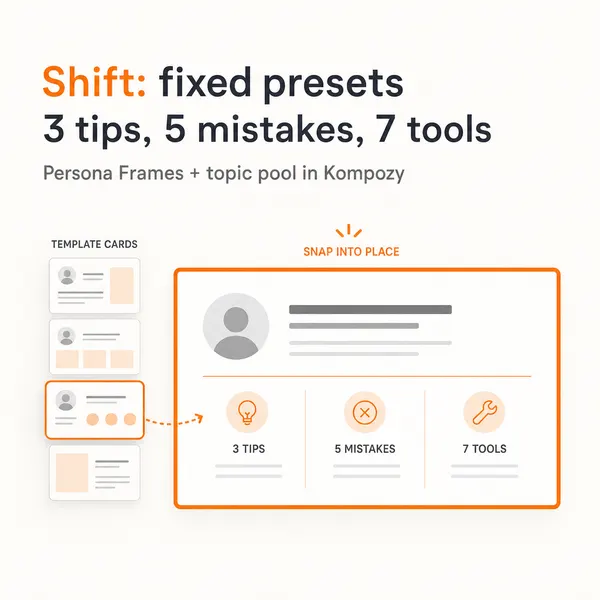
A five-slide carousel from the Kompozy workspace. The points in a slide deck can end up like this, sized and branded for a feed instead of a projector.




Who is this for, and who should skip it?
Best for:
- Creators who need to publish content, not produce office files
- Teams that want a webinar deck or report turned into a week of posts
- Brands publishing across several platforms in one voice
Not ideal for:
- Anyone whose deliverable is a report, deck, or PDF (use Claude)
- Teams that need shared editing and comments inside one file
- People who already pay for Claude and only need documents
Frequently asked questions
Are Claude Docs and Slides content creation tools?
Not in the social-media sense. They generate documents and decks — files you download or share by link. They do not produce social video, carousels, captions, or scheduled posts. For that you need a content engine like Kompozy.
Can Claude Docs or Slides post to social media?
No. There is no publishing or scheduling layer inside them. They produce deliverables in a file or a shareable link; posting to TikTok, Instagram, LinkedIn, or anywhere else is a separate job. Kompozy is the tool that captions, reframes, schedules, and publishes across nine platforms.
Claude Docs & Slides vs Kompozy — which should a creator use?
Use Claude for the document-and-deck step: reports, pitch decks, lead-magnet PDFs. Use Kompozy to produce and publish content — video, images, carousels, blogs, newsletters — across nine platforms in your brand voice. Many creators use both, for different halves of the workflow.
How do I turn a Claude Slides deck into social posts?
Bring the deck's content into Kompozy as a manual source. Kompozy fans each slide's point into a carousel panel, quote graphic, text post, or clip, turns the full deck into a blog and a newsletter, and can deliver it as captioned Persona video — all in one voice via the Persona Brief — then schedules and publishes across nine platforms.
How much do Claude Docs and Slides cost versus Kompozy?
Docs and Slides are bundled into paid Claude plans (Pro from $20/mo, Max $100–$200/mo) and metered by that plan's usage limits. Kompozy is a content generation and publishing engine on its own plans — Starter at $199/mo and Pro at $499/mo — covering many formats plus multi-platform publishing. They price different jobs; confirm current figures on claude.com/pricing and kompozy.io/pricing.
How do we know this?
We checked every price, date, and feature claim about Claude Docs and Slides on this page against the sources listed below on 2026-10-23 and corrected the ones that had changed. Kompozy plan details come from kompozy.io/pricing and kompozy.io/faq.
Sources
- Claude — Cowork is now just Claude (read 2026-10-23)
- Claude — Pricing (read 2026-10-23)
- Kompozy — Pricing (read 2026-10-23)
- Kompozy — FAQ (read 2026-10-23)
- AI Content Repurposing — The complete methodology for turning one source into 25-35 pieces of native-format content across every platform — without producing AI slop.
- Autonomous Content Creation — Most "autonomous" AI content is slop.
- AI Brand Voice & Persona — Without a Persona Brief, every AI output averages to the LLM default voice.