The honest Qwen3.8-Omni-Flash alternative (2026) for creators who need finished, published content, not a model that only reads media
Qwen3.8-Omni-Flash reads audio and video but outputs text — it can't brand, render video, or publish. Kompozy generates and ships to 9 platforms.
Published 2026-09-18 · Updated
Short answer
Qwen3.8-Omni-Flash is Alibaba's omni-modal understanding model: it reads text, images, audio and video in one request and returns text. It does not generate video, images or posts. If you want a different comprehension model, pick another model. If you were trying to build a content workflow, Kompozy is the alternative, turning what a model surfaces into published video, carousels, blogs and newsletters.
Key takeaways
- Qwen3.8-Omni-Flash is an API model on Alibaba Cloud Model Studio.
- It returns text; spoken output needs the separate qwen3.8-omni-flash-realtime model.
- It is not a video generator, unlike the similarly named Gemini Omni Flash.
- Kompozy cuts clips and builds posts from the recording a model like this reads.
If you searched "Qwen3.8-Omni-Flash alternative," start with what it actually is, because that decides whether this page helps you. It is Alibaba's omni-modal understanding model: it takes text, images, audio, and video in a single request. It reads media and returns text. If what you want is a cheaper or more capable model to comprehend audio and video, the honest answer is another model — not Kompozy.
But a lot of people typing "alternative" were not shopping for a model. They wired a multimodal model into a content workflow and hit the wall every understanding model hits: it reads your recording, surfaces the quotes and clip moments, and then stops. I run Kompozy, so weigh that, but the framing is plain — Qwen3.8-Omni-Flash and Kompozy are not the same category. One is a comprehension engine that returns text; the other is a full content generation-and-publishing engine that treats a model like Omni-Flash as one interchangeable, swappable input.
There is also a naming trap worth clearing up. Qwen3.8-Omni-Flash is not a video generator — that is Google's similarly named Gemini Omni Flash. Qwen's model is on the intake side: it watches and listens and describes, it does not render. For spoken audio output, Alibaba points to a separate realtime variant, qwen3.8-omni-flash-realtime. So if you came expecting it to make clips, that alone may be why you are looking for an alternative.
Everything below is reconciled against Qwen's launch details, plus Kompozy pricing from our own page, checked on 2026-09-18. Where Omni-Flash is the better tool for a job, this page says so.
What is Qwen3.8-Omni-Flash?
Qwen3.8-Omni-Flash comprehends multimodal input and reasons over it. In one request it takes text, images, audio, and video together and returns text. Alibaba Cloud Model Studio lists it for audio and video analysis and text generation through the Chat Completions and Responses APIs. What it does not do is anything past the text. There is no image, carousel, or video output, no spoken audio (that needs the separate realtime variant), no brand-voice system, no persona or face-lock to hold a recurring identity, no captions, no per-platform reframing, no review step, and no scheduling or publishing. It is a component — a very cheap, capable one for understanding media — that produces text for a human or another system to turn into content and distribute.
Why do people look for a Qwen3.8-Omni-Flash alternative?
You look past an understanding model the moment "read this footage" stops being your bottleneck. Even Omni-Flash's best output is text about your media: a transcript, a list of quotes, a set of clip timestamps. There is no voice locked to your brand, no video or carousel, no captions, no sizing per platform, and no way to publish. Once comprehension is automated, that step stops being where your time goes. Everything that turns understanding into a post you can ship is still on you. There is also an operational cost people underweight. Accessing Omni-Flash through the API still leaves you needing separate tools for images, video, captions, scheduling, and publishing — plus the glue between them. For a solo creator or a small team, assembling and maintaining that pipeline is the actual project, and it competes with the work of making content. The alternative worth considering is not another model to bolt on; it is an engine where generation across every format, brand governance, review, and multi-platform publishing already come as one system — and where the model underneath is swappable. That is Kompozy: run Omni-Flash on your side to read the footage, then let the engine do the finishing and shipping.
How do Qwen3.8-Omni-Flash and Kompozy compare feature by feature?
| Feature | Qwen3.8-Omni-Flash | Kompozy | Note |
|---|---|---|---|
| Understanding audio & video input | Yes — its core strength | Ingests sources to generate from, not a raw comprehension API | Omni-Flash is purpose-built to read and reason over media; that is the job it wins. |
| Long-context multimodal reasoning | Yes — mixed text, image, audio, and video input | Ingests full recordings as sources | Omni-Flash wins as a way to comprehend mixed media in one request. |
| Outputs beyond text (video, image, carousel) | No — text output only | 20 formats across video, image, and text from one brief | |
| Generated speech / voiceover | No — audio output needs the separate realtime variant | Yes — HeyGen native TTS in persona video | Standard Omni-Flash returns text; Alibaba routes audio output to qwen3.8-omni-flash-realtime. |
| Brand-voice governance | No | A Persona Brief plus a banned-word filter govern every generation | |
| Consistent recurring persona / face-lock | No — no identity system | An AI Influencer persona pool with Gemini face-lock keeps one identity across posts | |
| Branded captions / per-platform reframe | No | Burns in captions and sizes 9:16 / 1:1 / 16:9 per destination | |
| Long-form clip detection & cutting | Can surface clip moments as text | Cuts and renders Clipped Shorts from the footage | Omni-Flash can tell you where the clips are; Kompozy actually cuts and finishes them. |
| Pre-publish review gate | No — raw output | Per-post review pipeline before Autopilot schedules | |
| Multi-platform publishing + scheduling | No | Publishes to 9 platforms plus Mailchimp and GHL/WordPress with autopilot | |
| Access | API via Alibaba Cloud Model Studio | Sign-in app; AI costs covered by plan credits | Omni-Flash is a developer API; Kompozy is a finished tool. |
| Setup / maintenance burden | Cheap API now, plus a separate content stack to assemble | One system; nothing to stitch together |
How much do Qwen3.8-Omni-Flash and Kompozy cost?
| Tier | Qwen3.8-Omni-Flash plan | Qwen3.8-Omni-Flash price | Kompozy plan | Kompozy price |
|---|---|---|---|---|
| Entry | QwenCloud API (pay-per-token) | Pay-per-token (see Alibaba Cloud Model Studio pricing) | Starter | $199/mo (5,500 credits) |
| Mid | Higher API volume (audio/video input) | Scales with input volume | Pro | $499/mo (18,000 credits) |
| Top | Model Studio / Qwen Studio at scale | Usage-priced, plus an assembled content + publishing stack | Enterprise | Contact Sales |
What does Qwen3.8-Omni-Flash do well?
- Genuinely omni-modal input — reads text, images, audio, and video together in a single request.
- Alibaba Cloud recommends it for audio and video analysis, through both the Chat Completions and Responses APIs.
- Has a realtime sibling, qwen3.8-omni-flash-realtime, for when you need spoken audio output.
- Available on Alibaba Cloud Model Studio, so teams already on Alibaba Cloud can call it without a new vendor.
- Fits pipelines where a model reads media and passes text to the next step.
- Backed by Alibaba's Qwen, an established lab whose models have kept pace with frontier releases.
Where does Qwen3.8-Omni-Flash fall short?
- Outputs text only — no images, video, carousels, or any visual format a social feed needs; it understands media, it does not make it.
- No spoken output from the standard model; audio replies need the separate realtime variant.
- It is a developer API, not an app, so someone has to build the workflow around it.
- No brand-voice system, so consistency across a batch of content is entirely on you.
- No captions, per-platform reframing, review gate, scheduler, or publishing — nothing past the text.
- Benchmark and pricing claims were largely vendor-reported at launch, pending independent testing.
When should you pick Qwen3.8-Omni-Flash over Kompozy?
- Your bottleneck is understanding audio and video, not making anything. Omni-Flash reads audio and video directly and returns text, which suits transcription and analysis of recordings.
- You need to comprehend mixed inputs at once. One request can carry text, images, audio, and video together.
- You are building an agent that reads media and then acts. It returns text an agent can act on, so it fits pipelines where a model reads multimodal input and then calls functions.
- Cheap, high-volume media understanding is the task. Per-token API pricing suits comprehending audio and video at scale — a job a finished-content engine is priced differently for.
When should you pick Kompozy instead of Qwen3.8-Omni-Flash?
- You need finished posts, not a transcript. Kompozy turns one recording into Clipped Shorts, avatar video, carousels, quote graphics, a blog, and a newsletter — formats a comprehension model cannot produce.
- Brand consistency matters. A Persona Brief, banned-word filter, and Gemini face-lock keep voice and identity identical across every asset, which a raw model leaves to you.
- You want to publish everywhere on a schedule. Kompozy schedules and fans content to 9 platforms plus email and blog with autopilot; Omni-Flash has no publishing at all.
- You want cheap ingestion AND finished output without re-plumbing. Keep Omni-Flash as your understanding layer on your own account and feed its output into Kompozy, which handles branding, format generation, and distribution.
Should you use Qwen3.8-Omni-Flash, Kompozy, or both?
Kompozy is a full AI content generation and 9-platform publishing engine, not a model. Qwen3.8-Omni-Flash is a genuinely useful one — omni-modal, long-context, and cheap at understanding media — but it lives at the very front of the content pipeline: it reads and reasons, then hands the rest to you. Because it automates comprehension, the value has moved to everything after the transcript. The gap between "I understand what's in this recording" and "I have on-brand posts live across every platform" is the entire job, and that gap is what Kompozy fills.
From one input — a recording Omni-Flash just read, or an idea — Kompozy generates 20 output formats: HeyGen avatar Persona Shorts, Clipped Shorts cut from long-form, fal.ai VFX hooks, face-locked Persona Photos, brand-exact carousels, quote cards, blog articles, and email newsletters — all governed by a Persona Brief and a banned-word filter, all routed through a per-post review gate, then scheduled and published to Instagram, Facebook, TikTok, YouTube, LinkedIn, X, Pinterest, and Threads, plus Mailchimp and GHL/WordPress, on autopilot.
Because Kompozy treats the underlying model as an interchangeable component, a model like Omni-Flash is something you run alongside it rather than something you rebuild your pipeline around. The model reads the raw material; the finished, on-brand, everywhere-at-once output is the product.
What does this look like in Kompozy?
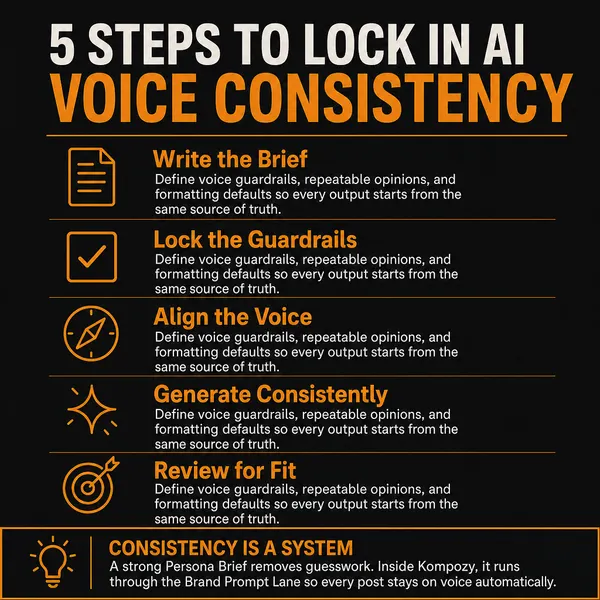
This infographic photo post came straight out of the Kompozy workspace. It is here to show the format, not anything about Qwen3.8-Omni-Flash, and it was not made for a client.
Who is this for, and who should skip it?
Best for:
- Creators who have transcripts and clip timestamps but no finished posts
- Brands that need one voice and face across every asset
- Teams that want publishing and scheduling without building a pipeline
Not ideal for:
- Developers who need cheap media understanding at scale (use the model)
- Teams building agents that read media and call functions
- Anyone who only needs transcription or analysis of recordings
Frequently asked questions
Is Kompozy a replacement for Qwen3.8-Omni-Flash?
Not a like-for-like one — they are different categories. Omni-Flash is a model that reads audio and video and outputs text; Kompozy is a generation-and-publishing engine that turns an idea or a recording into video, images, carousels, blogs, and newsletters and ships them across 9 platforms. If you only need a cheap model to comprehend media, another model is the closer swap. If you were trying to build a content workflow, Kompozy is the finished tool.
Can I use Qwen3.8-Omni-Flash and Kompozy together?
Yes, and it is often the best setup. Use Omni-Flash to read a long recording cheaply and surface the quotes and clip moments, then drop the source into Kompozy. Kompozy rewrites it in your Persona Brief voice, generates a full multi-format batch, runs each asset through a review gate, and publishes on a schedule. The model comprehends; Kompozy finishes and distributes.
Does Qwen3.8-Omni-Flash generate video like Gemini Omni Flash?
No. Despite the similar name, Qwen3.8-Omni-Flash reads audio and video and returns text — it is an understanding model. Google's Gemini Omni Flash generates and edits video. Kompozy generates the video, images, and carousels a social feed needs from what a model like Omni-Flash surfaces.
Qwen3.8-Omni-Flash is cheap — why pay for Kompozy?
Because a cheap understanding model is not a finished workflow. With Omni-Flash you still need separate tools for images, video, captions, scheduling, and publishing, plus the glue between them. Kompozy is one managed system that does all of it.
Is Qwen3.8-Omni-Flash open-weight?
Alibaba Cloud Model Studio offers it as an API model, and we found no open-weight release for it. Check Qwen's materials for any later release, and confirm current pricing on Alibaba Cloud.
How do we know this?
We checked every price, date, figure and competitor claim on this page against the sources listed below on 2026-10-23, and corrected or removed anything we could not confirm. Model availability and modalities come from Alibaba Cloud Model Studio's model list. We removed launch benchmark and price figures we could not confirm on a live page. Kompozy plan details come from kompozy.io/pricing.
Sources
- Alibaba Cloud Model Studio — Models (read 2026-10-23)
- Kompozy — Pricing (read 2026-10-23)
- Kompozy — FAQ (read 2026-10-23)
- AI Content Repurposing — The complete methodology for turning one source into 25-35 pieces of native-format content across every platform — without producing AI slop.
- Autonomous Content Creation — Most "autonomous" AI content is slop.
- AI Brand Voice & Persona — Without a Persona Brief, every AI output averages to the LLM default voice.