The honest ScrollEd alternative (2026) for educators and creators who want to publish learning short-form, not just consume it
ScrollEd is a TikTok-style learning feed you consume. Kompozy is the engine creators use to make and publish educational short-form across nine platforms.
Published 2026-09-20 · Updated
Short answer
ScrollEd is a learning app that turns textbooks and PDFs into a swipeable feed of AI video, audio, text and quizzes. It is built for people who want to learn inside the app, and it publishes nothing to your own channels. If you want to make and publish educational short-form under your own name, Kompozy is the alternative: it generates clips, avatar video, carousels and posts and publishes them across nine platforms.
Key takeaways
- ScrollEd turns a textbook or PDF into a swipeable feed of AI video, audio, text and quizzes that you consume in its app.
- Its plan: a free feed, a paid ScrollEd Pro tier and annual licenses for schools and training teams.
- As of 2026-10-23 its site still listed the app as coming soon to the App Store.
- Kompozy is for producing learning content and publishing it to your own accounts on nine platforms.
If you searched "ScrollEd alternative," it's worth separating two very different things you might mean, because they lead to opposite answers. ScrollEd — the bootstrapped Palo Alto app TechCrunch profiled on September 20, 2026 — turns textbooks and PDFs into a swipeable, TikTok-style feed of AI-generated video, audio, and quizzes, under the line "depth scrolling instead of doom scrolling." If what you want is another app to learn inside, the alternatives are other consumption products — Google's NotebookLM, Quizlet, Khan Academy, educational YouTube — and this page won't pretend Kompozy is one of them. It isn't a learning feed.
But a lot of people who reach a tool like ScrollEd aren't learners — they're educators, coaches, and explainer creators who see the format and think "I want to make that." And ScrollEd doesn't help with that at all. It's a closed consumption app: content lives inside its feed, it doesn't export finished posts to TikTok, YouTube, or Reels, and you build no owned audience there. If your goal is to produce short-form learning content and publish it under your own name, ScrollEd was never the tool — no matter how good its feed is.
Kompozy is the alternative for that job. It's a content generation and publishing engine: from one teaching source it generates the educational formats that travel — clips, persona/avatar video, concept carousels, quote graphics, blogs, newsletters — under one brand voice, and publishes them across nine platforms. This page compares the two honestly, which mostly means being clear that they don't compete — one is a place to consume learning, the other is the operation that produces and distributes it — and pointing you to the right one for what you actually want.
Everything below reflects ScrollEd as described around its September 2026 profile and its own materials, verified against TechCrunch and ScrollEd's site. Its site still listed the app as coming soon to the App Store when we checked on 2026-10-23, so features and pricing may change, so confirm current specifics on ScrollEd's site.
What does ScrollEd do?
ScrollEd converts a source document — a textbook, a PDF, notes — into a vertical, social-style feed of AI-generated video, audio, text, and interactive quizzes. It uses a two-axis, patent-pending mechanic: swipe up for a new topic, sideways to drill deeper into the current one, through multi-level "scrolls" that build from a hook to fuller context. It attaches source citations to claims and inserts retrieval-practice quizzes to reinforce retention, under the line "depth scrolling instead of doom scrolling." Commercially it plans a free consumer feed, a paid ScrollEd Pro subscription, and annual institutional licenses for schools and corporate training with engagement analytics and progress tracking. Crucially, it is a consumption product: you learn inside the ScrollEd app. It does not generate content for you to publish, and it does not distribute anything to your own channels.
Why do creators look for a ScrollEd alternative?
Because if you're a creator, ScrollEd only solves the half of the problem you don't have. You don't need somewhere to watch a learning feed — you need to produce one and get it in front of your audience. ScrollEd makes AI lessons for a learner to scroll inside its app; it writes no captions for a TikTok, cuts no clip from your lecture for YouTube Shorts, builds no carousel for LinkedIn, films no on-brand presenter, and posts to nothing you own. The same instinct that makes ScrollEd appealing — dense material belongs in short, captioned, quiz-friendly clips — is exactly the content an educational creator is trying to ship, just on the open platforms instead of in a walled feed. There's also the ownership problem: any audience ScrollEd builds is ScrollEd's, not yours. You'd look past it not because it's a weak learning app, but because your real job is producing and distributing your own educational short-form, and that's a job a consumption app doesn't attempt.
How do ScrollEd and Kompozy compare feature by feature?
| Feature | ScrollEd | Kompozy | Note |
|---|---|---|---|
| Consume a swipeable learning feed | Yes — core product | No | ScrollEd's genuine strength; Kompozy is a production-and-publishing engine, not a place to learn. |
| Retrieval-practice quizzes on lessons | Yes | No | A ScrollEd learning feature; not what a content engine does. |
| Source citations attached to claims | Yes | N/A | Sensible for a learning app; Kompozy governs brand voice, not lesson sourcing. |
| Turn a document into short-form video | In-app feed only | Publishable posts | ScrollEd keeps it inside its app; Kompozy makes clips and video you post to your channels. |
| Publish to TikTok, YouTube, Reels | No | Yes | The core distinction — ScrollEd publishes nothing to your channels; Kompozy fans across platforms. |
| Persona / avatar video from a script | No | Yes | Persona Shorts and Persona Frames front a consistent face-locked presenter; ScrollEd has no such creator output. |
| Carousels, images, quote graphics | No | Yes — HyperFrames | Kompozy builds brand-exact carousels, photo posts, and quote graphics; ScrollEd builds none for you. |
| Blog + email newsletter generation | No | Yes | One teaching source becomes a blog and a newsletter in Kompozy; not a ScrollEd function. |
| Brand-voice governance | No | Persona Brief | Kompozy locks your voice and banned words across every output; ScrollEd has no creator brand layer. |
| Multi-platform publishing & scheduling | No | Yes — 9 platforms | Autopilot schedules across the eight social platforms plus blog and email behind a per-post review gate. |
| You own the audience | No — inside ScrollEd | Yes | Kompozy posts to your accounts; a ScrollEd audience belongs to ScrollEd. |
| Institutional distribution + engagement analytics | Yes (planned) | No | ScrollEd's licensing pitch to schools and L&D; a different purpose from a creator content engine. |
How much does ScrollEd cost compared with Kompozy?
| Tier | ScrollEd plan | ScrollEd price | Kompozy plan | Kompozy price |
|---|---|---|---|---|
| Entry | ScrollEd free consumer feed | Free (learner-facing) | Kompozy Starter | $199/mo (5,500 credits) |
| Mid | ScrollEd Pro | Paid subscription (price not yet published) | Kompozy Pro | $499/mo (18,000 credits) |
| Top | ScrollEd institutional license | Annual license (custom) | Kompozy Enterprise | Contact Sales |
What does ScrollEd do well?
- A genuinely learning-first design — retrieval-practice quizzes and cited claims, not just autoplaying clips
- A novel, patent-pending two-axis feed: swipe up for a new topic, sideways to go deeper
- An explicit anti-doomscroll thesis: "depth scrolling instead of doom scrolling"
- Turns your own textbook or PDF into a digestible feed, not only a fixed catalog
- A sensible three-part model with clear institutional value (distribution + engagement analytics)
- Credible founding team and early validation (Startup Battlefield 200, an NSF I-Corps cohort)
Where does ScrollEd fall short?
- A consumption app only — it publishes nothing to your channels and builds no audience you own
- Not yet on the App Store as of 2026-10-23, so there is no independent evidence of accuracy or learning outcomes yet
- AI-generated lessons carry hallucination risk in an educational context; source-checking is still being built
- Lesson library is still being expanded, so breadth is limited early
- Pricing not finalized at the time of the September 2026 profile
- No creator features: no captions for social, no clipping, no carousels, no scheduling, no brand-voice layer
When should you pick ScrollEd over Kompozy?
- You want to learn a subject in a swipeable feed. That is ScrollEd's core job — turning a document into short, quiz-backed segments to consume.
- You prefer depth scrolling over doomscrolling. The anti-doomscroll thesis and two-axis feed are built exactly for self-directed learners.
- You're a school or L&D team distributing material. ScrollEd's institutional licensing adds engagement analytics and progress tracking — Kompozy is not that.
- You want retrieval practice and cited lessons. Quizzes and source citations are learning features Kompozy doesn't provide, because it isn't a learning app.
When should you pick Kompozy over ScrollEd?
- You want to produce learning content, not just consume it. Kompozy turns one teaching source into clips, video, carousels, and posts; ScrollEd only builds a feed to scroll.
- You need to publish to TikTok, YouTube, Reels, and LinkedIn. Autopilot schedules and publishes across nine platforms; ScrollEd publishes nothing to your channels.
- You want to own your audience. Kompozy posts to your own accounts; any audience inside ScrollEd belongs to ScrollEd.
- Brand consistency matters. A Persona Brief locks voice and banned words across every output; ScrollEd has no creator brand layer.
- You need video, carousels, blogs, and newsletters from one source. Kompozy fans a single lesson into every format your audience actually sees; ScrollEd makes none of them for you.
Are ScrollEd and Kompozy rivals?
The honest close is that ScrollEd and Kompozy aren't rivals — they sit on opposite sides of the same idea, and picking "an alternative to ScrollEd" usually means you're a creator, not a learner. ScrollEd is a well-designed place to consume AI-generated lessons.
It leaves the entire producer's job — filming, captioning, clipping, designing, branding, scheduling, and publishing to the platforms your students actually use — untouched, because it isn't trying to do it. That job is what Kompozy automates.
From one teaching source and under a single Persona Brief, it generates Clipped Shorts, captioned Persona Shorts fronted by a face-locked avatar, brand-exact Carousel Posts that break a concept into slides, quote graphics, a blog, and an email lesson, then Autopilot publishes the batch across the eight social platforms plus blog and email behind a per-post review gate. Use ScrollEd to study; use Kompozy to teach at scale and keep the audience.
What does this look like in Kompozy?
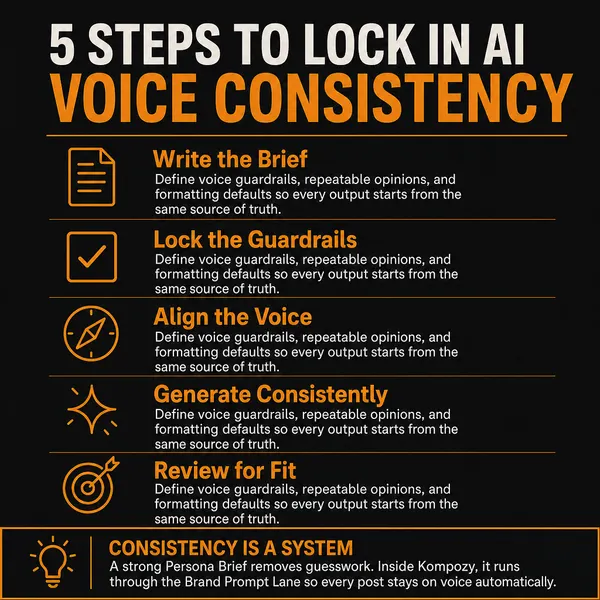
A real infographic from the Kompozy workspace, showing the format Kompozy uses to break an idea into one visual. It was not made about ScrollEd or for any customer.
Who is this for, and who should skip it?
Best for:
- Educators and explainer creators who want to publish short-form lessons under their own name
- Coaches who need one teaching source turned into clips, carousels, a blog and a newsletter
Not ideal for:
- Learners who want an app to study in: ScrollEd, NotebookLM or Quizlet fit better
- Schools or L&D teams that need engagement analytics on assigned material
Frequently asked questions
Is Kompozy an alternative to ScrollEd?
Not directly — ScrollEd is a learning-consumption app and Kompozy is a content generation and publishing engine. They serve opposite roles. If you want another app to learn inside, look at NotebookLM, Quizlet, or Khan Academy; if you want to produce and publish your own educational short-form, that is Kompozy.
Can ScrollEd publish my content to TikTok or YouTube?
No. ScrollEd is a closed consumption app — content lives inside its feed and it does not export or publish posts to TikTok, YouTube, Reels, or your own channels. To make and distribute your own educational short-form across platforms, you use a tool like Kompozy.
How much does ScrollEd cost versus Kompozy?
ScrollEd plans a free consumer feed, a paid ScrollEd Pro subscription (price not yet published), and annual institutional licenses — priced for learners and organizations. Kompozy is a content plan for creators — Starter at $199/mo (5,500 credits) up through Pro and Enterprise. They price different things.
When should I use ScrollEd instead of Kompozy?
When your goal is to learn: turning a textbook or PDF into a swipeable, quiz-backed feed to study from, or as a school or L&D team distributing material with engagement analytics. ScrollEd is built for consuming learning content; it just doesn't produce or publish content for a creator.
Can I use ScrollEd and Kompozy together?
You can — they don't overlap. Learn a subject on ScrollEd, then use Kompozy to teach it: bring your own source in, and Kompozy generates clips, a persona/avatar short, carousels, quote graphics, a blog, and a newsletter under one brand voice and publishes them across nine platforms, so your lessons reach your own audience.
How do we know this?
We checked every figure on this page against the sources listed below on 2026-10-23 and corrected or removed any we could not confirm. Kompozy plan details come from kompozy.io/pricing.
Sources
- TechCrunch — ScrollEd wants to turn textbooks into TikTok (read 2026-10-23)
- ScrollEd — Official site (read 2026-10-23)
- Kompozy — Pricing (read 2026-10-23)
- AI Content Repurposing — The complete methodology for turning one source into 25-35 pieces of native-format content across every platform — without producing AI slop.
- Autonomous Content Creation — Most "autonomous" AI content is slop.
- AI Brand Voice & Persona — Without a Persona Brief, every AI output averages to the LLM default voice.