Content repurposing for authors
Repurpose book content, drafts, research notes, and reader Q&A into the platform that drives book sales, speaking invitations, and the next contract.
Last verified · 2026-10-23 · by Moe Ameen
Published 2026-05-22 · Updated
Short answer
Content repurposing for authors means treating the book, its research notes, cut drafts, podcast interviews and reader questions as source material for a newsletter, quote carousels, short clips and essays that run between launches. Start the newsletter 12-24 months before launch, plan launch week 90 days out, and keep re-cutting book themes afterward. Kompozy turns chapters and interviews into scheduled posts; it does not write the book or handle PR.
Key takeaways
- Start the newsletter 12-24 months before launch. It takes the longest to build.
- Nonfiction usually leans on LinkedIn and a newsletter. Fiction leans more on BookTok.
- Treat every podcast appearance and speaking gig as a content shoot.
- Keep publishing between books, because readers drift when the author goes quiet.
- Check your publishing contract before you post full chapters on Substack.
Publishing has changed. A big factor in whether a book sells, gets reviewed, and earns out an advance is whether the author shows up with an audience. Publishers expect platform; agents expect platform; readers expect access. Authors who treat content as separate from the book are progressively losing visibility to authors who treat the book as one node in a larger content engine.
The good news: the source content for authors is unusually rich. Book chapters, drafts, research notes, reader questions, interviews, and event recordings all repurpose into newsletter, social, podcast, and Substack content. The bottleneck is the same as every other ICP — workflow.
This playbook covers what to repurpose pre-launch, during launch, and in the long tail. It covers the platform-priority for nonfiction (LinkedIn + newsletter > anything else) and for fiction (different mix). It covers the realistic outcomes for book sales, speaking, and next-contract leverage.
Why do authors repurpose content?
Books have a brutal long-tail problem: attention peaks around launch, and the next book can be years away. Without an engine that runs between launches, an author audience decays. Repurposing turns the book into the source content for years of derivative output.
The second reason is platform leverage. An active newsletter and a steady social presence give an author something concrete to show a publisher, an agent or an event organizer in the next negotiation. The book is the credential; the platform is the asset.
What source content do authors already have?
Source type: Book chapters, research notes, drafts that did not make the book, reader questions, podcast interviews, speaking engagements, related essays
Typical cadence: One book every 2-4 years; continuous content between launches
Effort before tooling: Book is the existing investment; content layer pulls from existing material
What can authors produce from that source content?
Video
- 60-90 second key-idea explainer Reels and Shorts
- 5-10 minute YouTube deep-dives on book chapters
- Author interview clips from podcast appearances
- Event and speaking footage cut into clips
Image
- Book quote carousels with branded visual identity
- Chapter-by-chapter summary carousels
- Behind-the-scenes writing process graphics
- Reader review and endorsement graphics
Text and social
- X/Threads ideas pulled from the book
- LinkedIn long-form essays expanding book chapters
- Substack/newsletter excerpts
- Bluesky and Threads conversational drops
Blog
- 2,000-3,500 word essays on book themes
- Companion content for each chapter
- Reader question deep-dives
- Research process and origin-story posts
Newsletter
- Weekly newsletter on book themes and current applications
- Subscriber-only chapter previews and cuts
- Q&A reader-question editions
- Reading list and recommendation digests
What is the 8-step repurposing workflow for authors?
- Build the newsletter from day one of writing the book. The newsletter is the single highest-leverage asset for authors. Start it 12-24 months before launch. People who subscribed before launch already want to hear from you, and cold ad traffic does not.
- Pre-launch: tease chapters and themes. In the 6 months before launch, drip excerpts, behind-the-scenes content, and research notes. Build the audience to a place where launch week converts at scale.
- Launch week: maximum coordinated push. Launch week is the densest content cycle of the entire book lifecycle. Podcast tour, social blitz, newsletter, paid amplification, partner cross-promotion. Plan it 90 days in advance.
- Post-launch: long-tail content engine. After launch, repurposing keeps the book alive for years. Re-cut book themes with new hooks every 3-6 months. Plenty of readers find a book long after launch week.
- Speaking and podcast as content sources. Every podcast appearance and speaking gig can feed weeks of clips and posts. Treat these as content shoots, not just promotional appearances.
- Reader Q&A as content. Reader emails, DMs, and event questions are content gold. Build a Q&A series — both as newsletter and as YouTube/Reels.
- Research-process and origin-story content. Readers are fascinated by the writing process and where ideas came from. Behind-the-scenes content sells the book and builds intimacy with the audience.
- Cross-promote to next book early. 6-12 months before the next book, start weaving themes into newsletter and social. Buyers of book #1 are the highest-converting audience for book #2 — keep them warm.
Which tools do authors use for content repurposing?
| Role | Options |
|---|---|
| Writing | Scrivener, Notion, Google Docs |
| Recording | Loom, Riverside, iPhone for casual |
| Editing | Descript, CapCut, Adobe Premiere |
| Newsletter | Substack, Beehiiv, ConvertKit |
| Scheduling | Kompozy, Buffer, Typefully |
| Design | Canva, Figma, Adobe Express |
| Book sales tracking | Bookreport, Publisher reports, Amazon Author Central |
How much does content repurposing cost authors per month?
DIY / Low end
$50-$200/mo — Google Docs, Loom, CapCut, Substack, free Buffer
Solo operator / Mid range
$300-$700/mo — Kompozy Starter ($199), Beehiiv paid, Descript, paid scheduling, retained editor occasional
Team / High end
$1,500-$5,000/mo — Kompozy Pro, full editorial assistant, retained book PR, paid newsletter growth, retained video editor
What mistakes do authors make when repurposing content?
- Treating the book as the marketing — the book sells itself only for already-famous authors
- Starting the newsletter at launch instead of 12-24 months before
- Stopping the content engine after launch — book sales decay without sustained content
- Spreading too thin across 5+ platforms — newsletter + 1-2 social channels is enough
- Refusing to repurpose the same idea multiple times — most readers miss the first version
- Treating podcasts as one-shot interviews instead of source material for clips and posts
What results can authors realistically expect?
- A warm audience built before launch tends to make launch week stronger, but absolute numbers vary enormously with publisher support and category
- Long-tail sales after launch tend to hold up better for authors who keep publishing, with the newsletter doing most of the work
- Speaking and consulting opportunities tend to compound — event organizers can read your ideas before they ever book you
- Honest caveat: this does not turn a weak book into a bestseller. Content amplifies; it does not manufacture. The book itself still has to deliver.
Where does Kompozy fit for authors?
Kompozy handles the production tax of running an author content engine — turning book chapters and podcast appearances into clips, carousels, newsletter sections, and scheduled social presence across platforms. The Persona Brief preserves the author voice, which matters more for authors than almost any other ICP because the voice IS the product.
Starter at $199/mo fits an author between launches; Pro at $499 covers active launch cycles and book tours; Enterprise (Contact Sales) fits authors with multiple book franchises or speaker businesses. Kompozy does not write the book — but it takes on much of the content production that pulls writers away from the next book.
What does this look like in Kompozy?
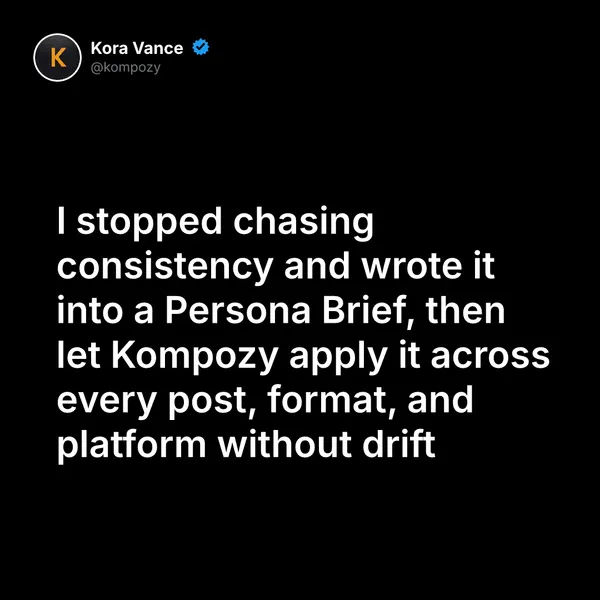
A real Quote graphic generated in the Kompozy workspace, shown as an example of the quote-card format this playbook suggests for book lines. It was not made for this page or from any real book.
Who is this for, and who should skip it?
Best for:
- Nonfiction authors building a platform for the next deal, speaking or consulting
- Authors with a backlist, research notes or interviews they can mine between launches
- Writers who want a newsletter and one or two social channels without losing writing time
Not ideal for:
- Authors who need book PR, media pitching or a podcast tour booked. That still takes a publicist or direct outreach
- Anyone expecting content to rescue a weak book. Content amplifies; the book still has to deliver
- Authors whose contracts restrict publishing excerpts, until they confirm what is allowed
Frequently asked questions
How long before book launch should I start building the platform?
Aim for at least 12 months, ideally 24. The newsletter takes the longest to build, so start it as early as you can.
Newsletter vs social for authors?
Newsletter is the asset. Social drives newsletter signups. A big social following with no list is fragile, because on launch day you cannot reach those people on your own terms.
Does TikTok matter for authors?
BookTok is real for fiction, especially YA and adult fiction. For nonfiction, LinkedIn and YouTube are usually a better first bet than TikTok. Mix depends on category.
Should I publish my chapters on Substack?
Selective excerpts yes; full chapters depends on contract. Some publishers love it, others restrict it. Check your contract before committing.
Is paid amplification worth it for book launches?
Some, especially BookBub for ebook discounts and paid newsletter shoutouts. Cold Meta ads are a much harder sell without an existing audience.
How do I handle the 18-24 month gap between books?
That is when content keeps the audience warm. Treat the between-book period as the most important content phase — readers can drift fast.
Can Kompozy help with book PR?
Kompozy is the content engine, not the PR layer. Book PR (media pitches, podcast tour booking) still requires either retained PR or direct outreach by the author or agent.
How do we know this?
We checked every figure and vendor fact on this page against the sources listed below on 2026-10-23, and took out outcome numbers we could not trace to a source. Kompozy plan prices come from kompozy.io/pricing. The budget bands are our own planning ranges, not quoted prices. The BookBub Featured Deals and Book Report descriptions, and the free-tier claims for Substack, Loom, CapCut and Buffer, were read off each vendor page that day.
Sources
- Kompozy: Pricing (read 2026-10-23)
- BookBub Partners: BookBub Featured Deals (read 2026-10-23)
- Book Report: Sales reporting for authors (read 2026-10-23)
- Substack: About (read 2026-10-23)
- Loom: Pricing (read 2026-10-23)
- CapCut: Pricing (read 2026-10-23)
- Buffer: Pricing (read 2026-10-23)