The 2026 content repurposing strategy that scales beyond 100 posts/month
The strategy behind content repurposing operations that scale past 100 posts/month: what to repurpose, where to publish, when to recycle, and what to cut.
Last verified · 2026-10-23 · by Moe Ameen
Published 2026-05-22 · Updated
Short answer
A content repurposing strategy that scales past 100 posts a month rests on three commitments: one genuinely good source piece every week, a bucket sweep that turns every source into video, image, text, blog and newsletter outputs, and a distribution horizon of at least 12 months. Grade each source A, B or C, give the best ones the full sweep, recycle only top performers at 90 days, and cut formats that stop working.
Key takeaways
- Commit to one strong source piece per week, for at least 12 months.
- Run the full sweep on every good source: video, image, text, blog, newsletter.
- Grade sources A/B/C and spend effort to match; cut C-pieces without guilt.
- Recycle only your top 10% of clips, at the 90-day mark.
- Kill a format after a sustained 50%+ engagement drop that two hook and caption tests did not fix.
Most "repurposing strategies" you find online are output checklists — 30 ways to repurpose a podcast, 47 ways to repurpose a blog post, the listicle pattern. Output checklists are tactics, not strategy. A strategy answers the hard questions: what should you repurpose, what should you cut, where should you publish, when should you recycle, and what is the kill criterion when a format stops working.
This page is the strategic frame for the cluster. Every other page in the /content-repurposing/ section answers a tactical question. This one answers the strategic ones. Read it first if you are setting up a repurposing operation from scratch, or as a quarterly checkpoint if you are already running one.
What strategic question does repurposing answer?
Repurposing is not a production efficiency. It is a distribution strategy that happens to require production work upstream. The mistake most operators make is treating it as the former — looking at it as "how do I produce more outputs per hour" — when the strategic question is "how do I reach every platform my audience uses with native-quality content, sustained for the next 12 months."
Framing it as distribution changes the inputs. It pushes you toward sustained one-per-week source cadence (rather than burst recording for two weeks then nothing), toward platform-native polish (rather than maximum output count), and toward owned-domain outputs (rather than maximum platform spread).
What are the three commitments of a repurposing strategy?
Commitment 1: one weekly source piece that is genuinely good
Commit to one source piece per week minimum, for 12+ months. Not three per week, not one per month. The reason: one per week produces enough material to feed every platform without burning out the recording calendar, and 52 reps per year is enough for the editorial taste loop to actually compound.
The "genuinely good" filter matters. A weekly podcast that is mostly small talk and no quotable lines produces 52 weeks of forgettable derivative content. The source piece needs to have a hook, a payoff, and at least 3-5 quotable moments per hour. If your weekly source is not clearing that bar, fix the source before scaling the repurposing.
Commitment 2: bucket sweep on every source
Every source piece produces outputs in every applicable bucket — video, image, text, blog, newsletter. Not just clips. The reason: each bucket reaches a different layer of the audience funnel. Video reaches top-of-funnel awareness, image reaches mid-funnel save/share behavior, text reaches dwell-time engagement, blog reaches search-driven discovery, newsletter reaches your owned distribution channel.
Skipping a bucket because "we don't have time" is the quiet way these operations stall. A video-only or text-only operation leaves whole layers of the funnel unreached. The full sweep covers all of them from the same source.
Commitment 3: 12-month minimum horizon
Repurposing returns are non-linear. The first months often show very little. The compound effects (a follower base, the odd clip that takes off, inbound DMs, revenue you can trace to social) take longer to arrive. Quitting in month 3 because "this is not working" throws away the work just before it can pay off.
What should you repurpose, and what should you cut?
Not every source piece deserves the full bucket sweep. The honest strategic move is to grade every source piece A/B/C after recording and adjust the downstream investment.
- A-pieces (top 20% of sources by quality): full bucket sweep, 25-40 derivative outputs, 90-day recycle cycle.
- B-pieces (middle 60%): partial bucket sweep, 15-25 derivative outputs, no recycle.
- C-pieces (bottom 20%): clip-only, 5-10 derivative outputs, no recycle. Or skip repurposing entirely and use the source as practice reps.
The discipline is to actually cut the C-pieces. The temptation is "we recorded it, we should milk it." The reality is that low-quality outputs in your feed drag the algorithmic weighting of your account down, so a C-piece that produces 10 ignored posts is worse than no posts at all.
Which platforms should you prioritize for repurposing in 2026?
Eight platforms matter for repurposing in 2026. The strategic move is to weight them by where your specific audience is, not by absolute platform size. A B2B SaaS audience lives on LinkedIn + X + YouTube; a fitness coach audience lives on Instagram + TikTok + YouTube Shorts; a real estate audience lives on Facebook + Instagram + TikTok. Generic "every platform" advice fails because it ignores the audience overlap with each platform's demographic profile.
The 2026 weighting we use as a baseline before adjusting for ICP: YouTube long-form (highest evergreen value), TikTok (highest velocity), Instagram Reels (highest cross-platform reach for creator economy), LinkedIn (highest B2B intent), X (highest founder-led visibility), Threads (rising, low cost to test), Facebook Reels (worth it if your audience already lives on Facebook), and YouTube Shorts (cheap to ride on the back of the long-form). Bluesky, Pinterest, and Rumble are tier-2 platforms worth posting to but not optimizing for.
When should you recycle old content?
On platforms with weak surfacing of older content (TikTok, Instagram Reels, YouTube Shorts), top-performing clips can be re-published at the 90-day mark with minimal risk and meaningful reach upside. The threshold for "top performing" is roughly the top 10% by views on the original publish.
The strategic discipline is to NOT recycle the bottom 90%. The temptation is to refill the calendar with old work because new production is expensive. The cost is brand dilution — recycled mid-tier content reads as filler.
When should you kill a format or platform?
A format or platform is dead for your audience when (a) the rolling 90-day average engagement rate has dropped by more than 50% vs the prior 90-day baseline, (b) the drop is sustained across 4+ consecutive weeks, and (c) you have tested at least two variations of hook style and caption style without recovery. When all three conditions hit, cut the format or platform and redeploy the saved time to a different one.
Most operators do not cut. They keep posting because the calendar feels lighter without it. That habit wastes more time than almost anything else in a repurposing operation.
What does a 100-posts/month repurposing operation look like?
A repurposing operation that ships 100+ posts per month at the platform-native polish bar runs on 4-6 source pieces per week (one A-piece, two B-pieces, one C-piece on a typical week), full bucket sweep on the A and B-pieces, clip-only on the C-pieces, distributed across 6-8 platforms with platform-native captioning. It is a real part of one operator's week, even with a tool stack like Kompozy + CapCut + Buffer doing the mechanical work. Kompozy plan prices are listed at kompozy.io/pricing.
Scaling past 100 posts per month into 200+ requires either an assistant or a second source-content producer (a second podcast, a second YouTube channel). Throwing more output count at the same source pool diminishes returns sharply past 100 posts.
What does this look like in Kompozy?
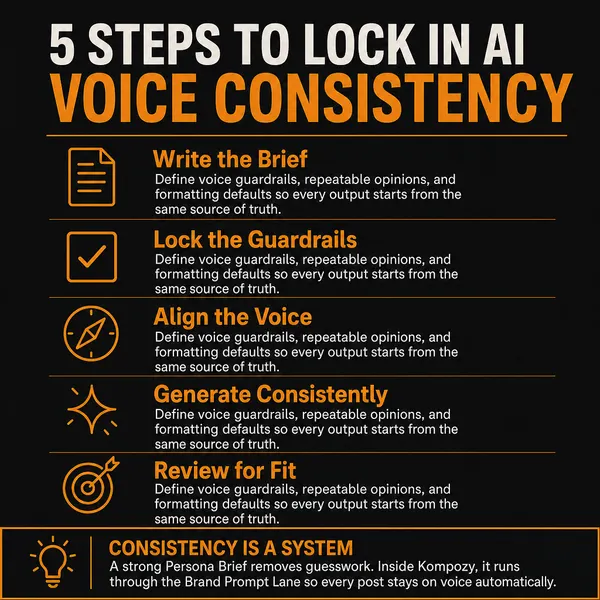
A real output from the Kompozy workspace in the infographic photo post format, one of the outputs this workflow calls for. It shows the format, not a piece made from this page's example.
Who is this for, and who should skip it?
Best for:
- Creators and brands setting up a repurposing operation from scratch.
- Operators already shipping content who want a quarterly checkpoint and kill criteria.
- Teams with one recurring source, such as a weekly podcast, video or livestream.
Not ideal for:
- Anyone expecting results in 30 days; this plan assumes a 12-month horizon.
- Accounts without a weekly source piece, which need a recording habit before a repurposing strategy.
- Teams that want paid ads to replace organic distribution.
Frequently asked questions
Should I repurpose old content from before I had a strategy?
Yes, but limited. Pull the top 10-20 historic pieces by engagement, run them through the bucket sweep, and ship the derivatives. Do not try to repurpose your entire back catalog — the time is better spent on new sources.
How do I know if my source content is good enough to repurpose?
Listen to or watch one full episode and count quotable moments. A good source has 3-5 per hour. Less than that and the source needs work before the repurposing investment makes sense.
Is video always higher leverage than audio?
For repurposing, yes. Video sources unlock every output bucket; audio sources require an extra step (avatar layer or audiogram conversion) to produce vertical clips. If you have the choice, record video.
Should I match my competitors' platform mix?
No. Match your audience, not your competitors. Competitors with different audience overlaps are publishing on different platforms for legitimate reasons that do not apply to your account.
How long before I see meaningful results?
Expect months, not weeks. Engagement spikes tend to show up before the compounding inbound does, and anyone promising results in 30 days is selling you something.
What is the strategic role of paid amplification?
Paid is a separate budget line from organic repurposing. Use it to amplify your top 1-2 outputs per month on the platforms where your cost per thousand impressions is lowest. Do not use it as a substitute for sustained organic repurposing — the audiences acquired through paid alone churn fast.
Should the strategy change if I have a personal brand vs a company brand?
The buckets are the same; the editorial bar differs. Personal brands tolerate a wider range of outputs because audiences expect personality variance. Company brands need tighter brand voice consistency, which means fewer C-pieces ship and the editorial pass is more rigorous.
How do we know this?
We checked every figure on this page against the sources listed below on 2026-10-23. Kompozy plan prices, credits and platform counts come from kompozy.io/pricing. The grading rules, recycle window and kill criteria are our operating rules for this strategy, not measured results.
Sources
- Kompozy — Pricing (read 2026-10-23)