Local SEO signals for AI search in 2026: how reviews, reputation, and listings decide which businesses ChatGPT, Perplexity, and Gemini recommend
For twenty years local SEO answered one question: where do you rank in the map pack? In 2026 there is a second question stacked on top of it, and the answer is often different — when someone asks ChatGPT, Perplexity, or Gemini to recommend a plumber, a dentist, or a coffee shop near them, which single handful of businesses does the assistant name? The data says the two answers diverge more than anyone expected: SOCi's 2026 Local Visibility Index found ChatGPT recommends only 1.2% of brand locations, against a 35.9% appearance rate in Google's local 3-pack. AI local search is an order of magnitude more selective, and it selects on signals that look familiar but behave differently. Reviews stop being a dial you turn up for a better rank and become a pass/fail gate — SOCi found the locations ChatGPT recommends average 4.3 stars. Listing accuracy stops being hygiene and becomes an entity-identity problem, because an assistant that finds two different phone numbers for you may not be confident you are one business. This guide is the practitioner's map of those signals: the six signal groups that feed local ranking, which of them the AI layer reads hardest, the review and reputation thresholds that decide eligibility, why a business that wins the map pack can still be invisible to an assistant, and the concrete checklist for getting named — ending with the one part of the problem, cross-surface consistency and content volume, that most local operators cannot solve by hand.
Published 2026-08-03 · Updated
Short answer
Local SEO signals for AI search are the reviews, listings and business data that ChatGPT, Perplexity and Gemini check before naming a business. AI is far more selective than the map pack: SOCi's 2026 Local Visibility Index found ChatGPT recommends 1.2% of brand locations, against a 35.9% appearance rate in Google's local 3-pack. The locations it recommends average 4.3 stars, and consistent name, address and phone details help it trust you.
Key takeaways
- SOCi found ChatGPT recommends 1.2% of brand locations versus 35.9% appearing in the 3-pack.
- ChatGPT-recommended locations average 4.3 stars, so review quality matters as much as volume.
- In retail, only about 45% of top map-pack brands were also the ones AI recommended.
- Identical name, address, phone and hours everywhere help an assistant treat you as one business.
- Whitespark ranks being open at the time of search among the top five local pack factors.
How selective is AI local search compared with the map pack?
Local search used to have one scoreboard: your position in Google's map pack. In 2026 there are two, and they do not agree. The second scoreboard is the AI one — the single short list an assistant reads back when someone asks ChatGPT, Perplexity, or Gemini for "a good dentist near me" or "best coffee in this neighborhood." And the striking finding from the year's local-search studies is how much narrower that list is. SOCi's 2026 Local Visibility Index, which covered more than 350,000 locations, found ChatGPT recommends just 1.2% of brand locations, against an average 35.9% appearance rate in Google's local 3-pack. SOCi puts AI visibility at roughly 30 times more selective than traditional local search.
The signals it selects on look familiar — reviews, reputation, listings, business data — but they behave differently in the AI layer than in the blue links. In classic local SEO, more of a good signal usually means a better rank. In AI local search, several of the most important signals act like gates: you clear a threshold and become eligible to be named, or you do not and you are excluded entirely, regardless of how well you rank in the map pack. This guide walks the signal set the way a practitioner has to think about it now — what feeds local ranking overall, which parts the AI layer reads hardest, the review and reputation thresholds that decide eligibility, why map-pack wins do not carry over, and the checklist that actually moves the needle. It sits alongside the broader picture in SEO in the age of AI Overviews and AI search visibility; this one is the local-specific cut.
What changed about local search in 2026?
Local intent is not a niche of search, and the AI layer is not sitting off to the side of it: assistants now answer the same near-me questions that send customers to physical businesses. When an AI Overview or an assistant answers "where should I go" in place, the old assumption — rank in the pack, get the click — breaks exactly the way it broke for informational search, except the stakes are a booking or a walk-in rather than a pageview.
The second change is who does the choosing. Google's map pack is an algorithm ranking known local entities against a query. An AI assistant is a model assembling a recommendation from whatever it can find and trust about your business across the open web — your site, your Google Business Profile, your reviews, and third-party directories — and then deciding whether it is confident enough to say your name. That shift, from ranking to trusting, is why the signals reorganize. The assistant is not asking "who ranks highest?" so much as "who can I confidently vouch for?" — and the answer to that question runs on reputation and data integrity more than on any single on-page trick.
What are the six local ranking signal groups?
Local ranking in 2026 is usefully broken into six main signal groups: Google Business Profile, on-page, reviews, links, behavioral, and citations (listing consistency). Their relative weight tells you where to spend. Whitespark's 2026 Local Search Ranking Factors survey ranks Google Business Profile signals as the heaviest group, reports that review and behavioral signals gained importance, and finds citation signals still trending down. That is the traditional local ranking picture, and it is still the base — you do not get to skip it for the AI layer, you build the AI layer on top of it.
What the AI layer changes is the emphasis. Assistants lean disproportionately on the two groups that answer "can I trust this and is it really one business": reviews and citation consistency. Google Business Profile completeness feeds them because it is the cleanest structured description of you that exists. On-page content and links matter because they let an assistant corroborate what you do and where, which is the specificity that gets a source named — the same dynamic covered in why specific, detailed content earns AI citations. The practical read: keep the whole six-group program healthy for the map pack, but understand that reviews and listing integrity are the signals doing the heavy lifting for whether an assistant will speak your name.
How do reviews affect AI local recommendations?
This is the single most important mental shift for AI local search. In the map pack, review volume, velocity, recency, ratings, and owner responses all feed a ranking — more and better generally moves you up a gradient. In AI recommendation, the same 2026 studies suggest reviews behave more like a pass/fail threshold. The reported pattern: SOCi found the locations ChatGPT recommends average 4.3 stars, which suggests assistants lean heavily toward well-reviewed businesses and rarely name poorly rated ones.
Treat that as directional, not a published switch. It comes from a vendor index, results vary by category and geography, and no assistant documents a hard cutoff. But the shape of the finding is robust and it changes what you do. If reviews are a gate, the goal is not "accumulate reviews forever for incremental rank"; it is "clear the threshold, then keep the reputation healthy." That means a steady review-acquisition habit to push volume past the floor, defending the average rating rather than chasing raw count, and responding to reviews consistently — the response rate itself is a signal that you are an active, real business both to the algorithm and to the model summarizing you. Owner responses, review recency, and the actual sentiment and keywords inside review text all feed how an AI describes you, not just whether it names you.
Why does NAP consistency matter for AI search?
The second gate is quieter and more technical, and it is where a lot of otherwise-strong local businesses lose. An AI assistant builds its picture of you by pulling from many sources — your website, your Google Business Profile, review platforms, and directory listings — and it has to decide that all of those references point to one business before it can confidently recommend that business. When your name, address, and phone number (NAP) are identical everywhere, that decision is easy. When a single directory has an old phone number, or your address is written three slightly different ways across the web, you get entity fragmentation: the assistant is no longer sure the reviews on one profile belong to the same business as the listing on another, and confidence — the thing recommendation runs on — drops.
The accuracy problem is concrete: SOCi's 2026 index found data errors, such as wrong hours and addresses, in the business information AI engines return, particularly on ChatGPT and Perplexity. You cannot change how each assistant sources its data, but you can remove the ambiguity it has to resolve: audit your NAP across your site, Google Business Profile, and every major directory until it is byte-identical; keep hours current in both your profile and any schema markup so they never contradict each other; and fix the stale citations that fragment your identity. This is unglamorous cross-surface hygiene, and it is one of the highest-leverage things you can do, because it raises the model's confidence in every other signal you have. It is the local version of the entity-consistency argument in clear, consistent messaging as an AI-optimization input.
How do freshness signals affect local AI visibility?
Beyond reviews and NAP, the AI layer rewards businesses that visibly look active and current, and this is where behavioral and freshness signals come in. Whitespark's 2026 survey ranks whether your business is open at the time of search among the top five local pack factors, which means inaccurate hours do not just annoy customers — they cost you rankings during the exact hours you are open. Regular Google Business Profile posts, fresh photos, and a steady cadence of new reviews all signal a live business rather than a dormant listing, and local results increasingly favor the profiles that keep interacting. Freshness matters for AI citations too, a pattern explored in content refresh, brand mentions, and AI citations.
The reputation point compounds the review-gate one. Reviews are not only a count and a rating; they are the raw text an assistant reads to describe you and to match you to a query. A business with 200 reviews that repeatedly mention "same-day repair" or "gluten-free menu" gives the model specific, quotable substance to name it for those exact searches. Thin, generic, or stale reputation gives it nothing to work with even when the star rating clears the bar. So the reputation goal is two-sided: enough volume and rating to pass the gate, and enough specificity in the actual content — reviews, profile, posts, on-page copy — for the model to know what you are the right answer to.
Why don't map-pack wins carry over to AI search?
A business dominating the map pack is not automatically safe in AI search: SOCi found only about 45% overlap, in retail, between the brands most visible in traditional local search and the ones AI engines recommend. The overlap is real but far from complete, and the businesses that fall through the gap usually do so for one of the reasons above — review volume under the assistant's floor, fragmented NAP data that undercuts the model's confidence, or a presence so concentrated inside Google that an assistant assembling from the wider web cannot corroborate them. Combine that with the selectivity numbers (1.2% of locations recommended by ChatGPT versus a 35.9% 3-pack appearance rate) and the message is that AI local visibility is a separate objective you have to target deliberately, not a byproduct of ranking well.
The strategic implication is the same one playing out across all of search: being present and consistent across more than one surface is now the defensible position, because any single intermediary can reprice your reach with a product decision. For local businesses that means the map pack, the AI assistants, and an owned presence you control all matter, and the through-line that feeds all three is a consistent, specific, active identity across the web. That wider argument — that the durable asset is presence you own rather than reach any one platform grants you — is the subject of AI visibility beyond SEO.
What belongs on a local AI search checklist?
Turned into a to-do list, the signals sort into five moves. First, reviews: build a repeatable acquisition habit to push volume past the practical floor for your category, defend the average rating, and respond to reviews consistently — response rate is itself a signal. Second, listings: audit NAP across your site, Google Business Profile, and every directory until it is identical, and kill the stale citations that fragment your identity. Third, profile freshness: keep hours accurate (open-now is a ranking factor), post regularly, and refresh photos so the profile reads as a live business. Fourth, corroboration: build a specific, consistent presence beyond Google — pages and content that describe what you do and where — so assistants can verify you from multiple sources. Fifth, measurement: track whether the assistants actually name you, because map-pack rank no longer proves AI visibility; the tooling and method are in AI search visibility.
Notice which of those five a local operator can do inside existing tools and which one is the bottleneck. Review acquisition, NAP cleanup, and profile upkeep are discrete, finite tasks — hard, but boundable. The fourth move, building a consistent and specific presence across the web at a cadence that keeps corroborating your identity, is not finite. It is a content-production problem, and it is the one that quietly stalls, because it asks a business that exists to serve customers to also behave like a publisher across several platforms at once.
Where does Kompozy fit in local AI search?
Kompozy does not collect your reviews, manage your Google Business Profile, or fix your directory listings — those core local signals come from review-acquisition discipline and a listings/NAP tool, and nothing here replaces them. Where Kompozy fits is the fourth move above: the cross-surface, specific, consistent presence that raises an assistant's confidence in your identity and gives it substance to name you for. That is a content-generation and publishing problem, and it is the one most local businesses cannot staff by hand — which is exactly where an engine earns its place instead of adding noise.
Kompozy is a full AI content generation and multi-platform publishing engine — 20 output formats across 9 social platforms plus blog and email. For local corroboration, that means the specific, location-aware content an assistant can verify you from — blog articles about what you do and the areas you serve, text and image posts, short-form video — produced at a cadence one owner could not hold, and pushed to your blog and social surfaces from one place. The part that matters most for the entity problem is consistency by construction: everything the engine produces is governed by a Persona Brief that fixes voice and positioning, and HyperFrames renders brand-exact styling, so the same recognizable business answers on every surface. Cross-surface coherence is precisely what the AI layer reads as trust, and it is hard to maintain by hand across a dozen channels — which is the specific thing the engine removes.
Autopilot then schedules and publishes that spread across the supported platforms plus blog and email from one queue, behind a per-post review gate so a person signs off before anything ships — no small consideration when the content is representing a real local business. The realistic framing: Kompozy will not raise your star rating or dedupe your NAP, and it cannot force an assistant to recommend you. What it removes is the volume-and-consistency ceiling that keeps most local operators from building the corroborating presence AI search rewards — so the review, listings, and profile work you do actually gets amplified by a steady, on-brand footprint across the web instead of being the only thing you have. For the broader capability picture, see AI content engines for social media and the production argument in building an automated social content engine.
What decides whether an AI assistant recommends a local business?
Local SEO signals for AI search are the same raw materials as classic local SEO — reviews, reputation, listings, business data — reweighted for a layer that is roughly an order of magnitude more selective and that decides by trust rather than by rank. Reviews act as a gate: clear a minimum rating and volume, respond consistently, or be excluded. Listings act as an identity check: keep name, address, phone, and hours identical everywhere or watch the assistant lose confidence you are one business. Freshness and specificity give the model something concrete to name you for. And a map-pack win no longer carries over automatically, so AI local visibility is a target you aim at on purpose. Get the review, NAP, and profile fundamentals to threshold — then build the consistent, corroborating presence across the web that turns eligibility into a recommendation, because that presence, not any single ranking, is what an assistant reads before it says your name.
What does this look like in Kompozy?
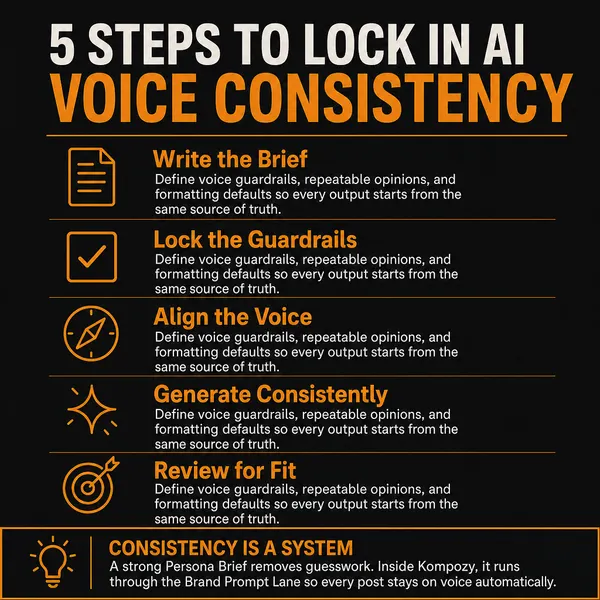
A real infographic photo post from the Kompozy workspace. It shows one of the image formats a local business can publish to keep a consistent presence across platforms.
Who is this for, and who should skip it?
Best for:
- Local businesses that rank in the map pack but never appear in AI answers
- Multi-location brands with inconsistent listings across directories
- Owners ready to build a steady review and content habit
Not ideal for:
- Businesses wanting a guaranteed AI recommendation; no assistant publishes a cutoff
- Anyone needing review collection or listing cleanup; that takes a reviews or listings tool, not Kompozy
- Businesses without a physical location or service area
Frequently asked questions
What are the local SEO signals for AI search?
They are the same broad inputs that drive traditional local ranking — Google Business Profile completeness, reviews, on-page content, links, behavioral engagement, and citation consistency — but weighted differently by AI assistants. Whitespark's 2026 Local Search Ranking Factors survey ranks Google Business Profile signals as the heaviest group, with review signals gaining weight. For the AI layer specifically, reviews (volume, average rating, recency, owner responses) and listing accuracy (identical name, address, and phone everywhere) matter most, because assistants use them as trust and identity checks before deciding whom to name.
How many reviews do you need to be recommended by AI search?
There is no official number, and no assistant publishes a cutoff. What the data does show is that rating matters: SOCi's 2026 Local Visibility Index found the locations ChatGPT recommends average 4.3 stars. Read that as a sign that assistants favor well-reviewed businesses, and aim for steady review volume, a high average rating, and consistent owner responses.
Why does my business rank in the map pack but not appear in ChatGPT?
Because AI search is far more selective and reads different signals. SOCi's 2026 index found ChatGPT recommends 1.2% of brand locations against a 35.9% 3-pack appearance rate, and in retail only about 45% of the brands most visible in traditional local search were also the ones AI engines recommended. The common gaps are review volume below the assistant's threshold, inconsistent name/address/phone data that fragments your business's identity across sources, and a thin or inconsistent presence outside Google that leaves the assistant unable to corroborate who you are.
Do listings and NAP consistency still matter for AI search?
More than ever. AI assistants assemble a picture of your business from your site, your Google Business Profile, reviews, and directories, and they lean on that data being consistent to be confident it all refers to one entity. A single wrong phone number or an address variation across directories can fragment that identity and lower the assistant's confidence. SOCi's 2026 index also found data errors, such as wrong hours and addresses, in AI engines, particularly ChatGPT and Perplexity, so keeping the underlying data clean is the highest-leverage fix.
How do you get a local business recommended by AI search?
Get the fundamentals to a threshold, then build corroboration. Push review volume and average rating as high as you honestly can and respond to reviews consistently; make your name, address, phone, and hours identical across your site, Google Business Profile, and every directory; keep the profile complete and current, because open-now and accurate hours are now direct ranking signals; and build a consistent, specific presence beyond Google — content, mentions, and pages that describe what you do and where — so assistants can corroborate your identity and authority from more than one source.
How do we know this?
We checked every figure and named fact on this page against the sources listed below on 2026-10-23, and removed or rewrote anything we could not confirm. AI visibility figures come from SOCi's 2026 Local Visibility Index (via SOCi's announcement and Localogy's report), and ranking-factor findings from Whitespark's 2026 Local Search Ranking Factors survey. Kompozy product details come from kompozy.io.
Sources
- SOCi — In AI-driven discovery, few brands are chosen, most disappear (2026 Local Visibility Index) (read 2026-10-23)
- Localogy — SOCi's LVI report reveals how AI is rewriting local search visibility (read 2026-10-23)
- Whitespark — 2026 Local Search Ranking Factors (read 2026-10-23)
- Kompozy — homepage (formats, 9 platforms, review gate) (read 2026-10-23)
Get started → · ← All guides · Compare Kompozy vs other tools