How to build an Instagram caption strategy that scales (2026)
Build an Instagram caption strategy that scales: define your pillars, build a hook bank and CTA rotation, write per-format, then batch and test the system.
Last verified · 2026-10-23 · by Moe Ameen
Published 2026-08-30 · Updated
Short answer
An Instagram caption strategy that scales starts with three to five content pillars and the keywords people search for each one. Build a hook bank for first lines and a rotation of calls to action, give each post one job, and write captions per format. Instagram Search matches captions and hashtags, so put the keyword in the caption, use up to five hashtags, and batch-write a week at a time.
Key takeaways
- Start every caption from a pillar and the phrase people would type to find it.
- Put the hook and the main keyword in the first line.
- Instagram caps posts at five hashtags, and Mosseri says hashtags don't increase reach.
- Give each post one job: reach, saves, comments or a click.
- Batch a week of captions at once so the voice stays consistent.
Anyone can write one good Instagram caption. The hard part — the part that actually decides your reach — is writing a good caption on every post for months without it decaying into "loved making this one 🙌." That decay is the real enemy. Instagram Search matches what people type against captions, hashtags, usernames, bios, and places, so a calendar of weak captions is a calendar of posts search can't place. The fix is not more inspiration; it's a system that removes the blank page.
This walkthrough builds that system. You'll define the content pillars every caption starts from, build a hook bank and a CTA rotation so the first and last lines stop being guesswork, set the front-load rule that gets posts found, write captions per format instead of pasting one everywhere, then batch and test so the whole thing runs on a bad day.
For the why behind the shift — Instagram's own caption guidance and the move to caption-as-ranking-signal — read the Instagram caption strategy guide first; this page is the build.
How do you build an Instagram caption strategy, step by step?
- Define 3–5 content pillars and their keywords. A caption written from nothing takes forever and drifts off-topic. Start instead from a short set of pillars — the recurring themes your account is actually about (e.g. "small-space organizing," "budget meal prep," "first-time buyer tips"). For each pillar, list the two or three phrases a real person would type to find it. Now every caption begins with a known topic and a known keyword set, which is what lets Instagram Search place the post and what stops you staring at a blank field.
- Build a hook bank of first-line patterns. Instagram tucks longer captions behind "…more," so the first line is the part people actually see before they decide to keep reading. Keep a running file of opening patterns that have worked — the mistake list ("3 lighting mistakes killing your photos"), the before/after, the specific number, the contrarian claim, the direct question. When you write, pull a pattern and fill it with the pillar's keyword instead of inventing a hook cold. The rule the whole strategy hangs on: the hook and the main keyword share the first line, always.
- Set a CTA rotation instead of one default close. Ending every post with "link in bio" trains your audience to ignore the close. Build a small rotation tied to what each post is for: save ("Save this for your next grocery run"), comment ("Comment your city and I'll add it"), share, or a specific click. A specific CTA gives people something to do; a vague one like "let me know your thoughts" mostly gets skipped. Assign one CTA per post — never three — and cycle them across the week so saves, comments, and clicks all get worked.
- Assign each post a single job before writing. A caption built to be found (keyword-forward, descriptive) reads differently from one built to pull comments (a question, an open loop). Doing both in one caption usually does neither. So at the calendar level, tag each slot with its primary job — reach via search, saves as a reference, comments for community, or a click to convert — and let that pick the hook pattern and the CTA. Most feed and Reel posts should lean discovery-first, since that's where ranking changed.
- Write the caption per format, not one line for all. The same idea needs a different caption as a Reel, a carousel, and a photo post. A Reel caption supports what's on screen and repeats the topic in words so audio, on-screen text, and caption all agree; a carousel can carry a per-slide caption for extra context; a photo post leans harder on the caption to carry the story. Write to the format's shape rather than pasting one caption across all three — matching the post's structure is part of getting it found.
- Write real alt text and plain on-screen text. Instagram says to put keywords and hashtags in the caption, not the comments, because that is what Search matches against. Beyond the caption, write real alt text that describes the image instead of leaving it auto-generated (it's what screen-reader users hear), and make any on-screen text state the topic in plain words so viewers know what the post is about at a glance.
- Batch a week (or month) of captions at once. Writing captions one post at a time is where the system decays. Sit down with your pillars, hook bank, and CTA rotation and draft a full week or month in one session — assembly, not invention: pick the pillar, pull a hook, write the body in the pillar's keywords, attach the job's CTA. Batching keeps voice consistent, spreads your CTAs deliberately, and means a busy week doesn't force you back into lazy one-liners.
- Measure the right signals and feed winners back. Judge captions by the jobs you gave them, not by likes. In Insights, watch reach from non-followers (are discovery captions pulling in new people), saves and shares (is the body worth keeping), and profile taps or link clicks (did the CTA land). Search your own target keywords inside Instagram to see whether you surface. Move the openings and keyword framings that get you found into your hook bank, and retire the ones that don't — that loop is what compounds.
What caption mistakes cost you reach on Instagram?
- Spending the first line on a warm-up ("It's been a wild week…"). The keyword that would've gotten you found is now hidden behind "…more" and never read first. Lead with the topic.
- Keyword stuffing. Instagram matches on meaning, so "best coffee best coffee best coffee" reads as spam and adds nothing. Use each keyword once, naturally.
- Treating hashtags as the strategy. Instagram now caps posts at five hashtags, and Adam Mosseri has said they don't increase reach. A few relevant tags categorize a post; they don't drive discovery. Put the reach work in the caption.
- One caption pasted across every format. A Reel, a carousel, and a photo post need captions shaped to each; pasting one signals low effort and misses format-specific surfaces like per-slide carousel captions.
- Skipping the job assignment. A caption with no decided purpose ends up generic — vaguely engaging, not searchable, not converting. Decide reach vs. saves vs. comments vs. click first.
- Judging by likes. Likes don't tell you whether a caption did its job; if you optimize captions to likes you're steering by the wrong gauge. Use reach from non-followers, saves, and clicks.
- Rewriting the whole system off one post. Caption data needs a few weeks to mean anything — change patterns on trends, not on a single result.
Where does Kompozy fit in an Instagram caption strategy?
You just built a system — pillars, a hook bank, a CTA rotation, a job per post. The catch is that a system only helps if it's actually run every week, and hand-running it is where most creators quit by week three. Kompozy is a full content generation and multi-platform publishing engine, and the practical thing it does here is run the framework you just designed so it doesn't decay.
Point it at a source and it batches a month at once, drafting each post's caption from your encoded rules rather than from a blank field — the front-load-the-hook rule enforced automatically, and a banned-word filter that kills the "so excited to share" openers that waste the first line.
The part that's hard to do by hand is variety across a calendar: 30 captions written in one sitting tend to sound identical. Because Kompozy generates each caption with its post and per format, a Reel, a Carousel with per-slide context, a Text Post, and a photo post each get a caption shaped to that format and its job — not one line pasted across all four — so the calendar keeps range instead of flattening.
A per-post review gate is where your judgment stays in: drop in the specific keyword, sharpen a hook, or add a first-hand detail before it ships. Then autopilot spaces the approved posts across the 9 platforms Kompozy supports, with your CTA rotation already spread across the week.
The honest boundary: Kompozy won't do your keyword research or invent the point of view only you have — the pillars and the specific thing worth saying are yours. It removes the throughput wall of producing a fresh, on-brand, searchable caption for every post, in every format, on a cadence. Starter ($199/mo for 5,500 credits) fits a solo creator running one account's calendar; Pro ($499/mo for 18,000 credits) suits a brand or agency running caption systems across many accounts and formats; Enterprise is available through Contact Sales.
What does this look like in Kompozy?
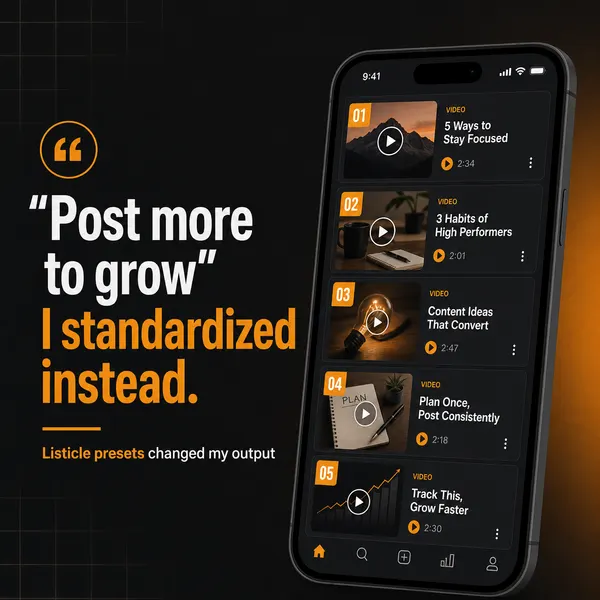
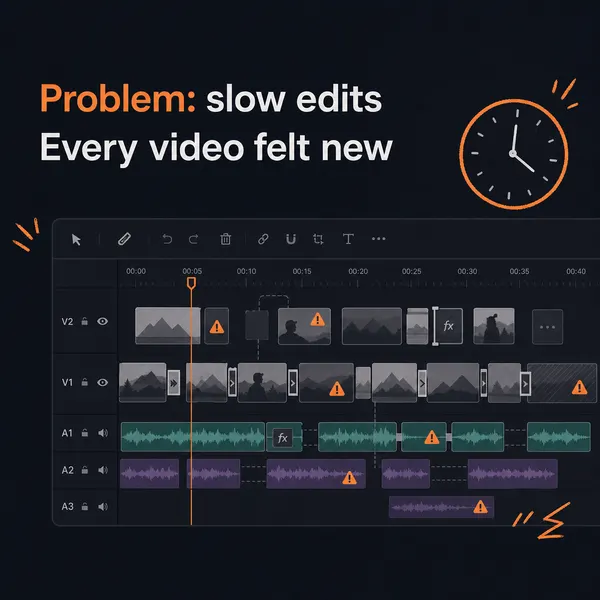
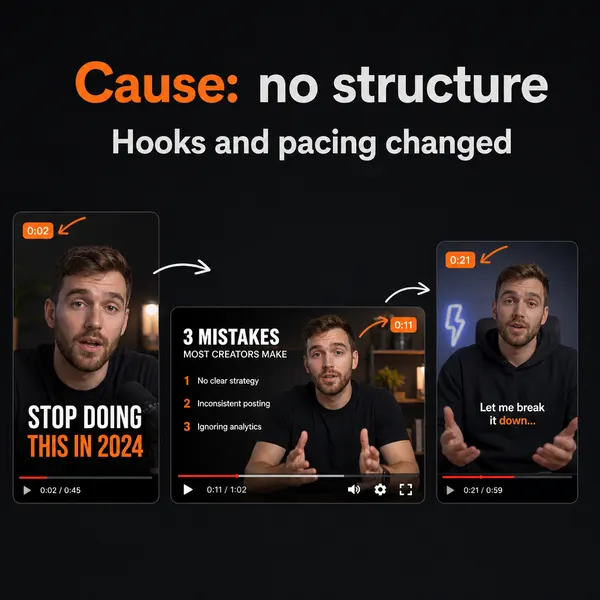
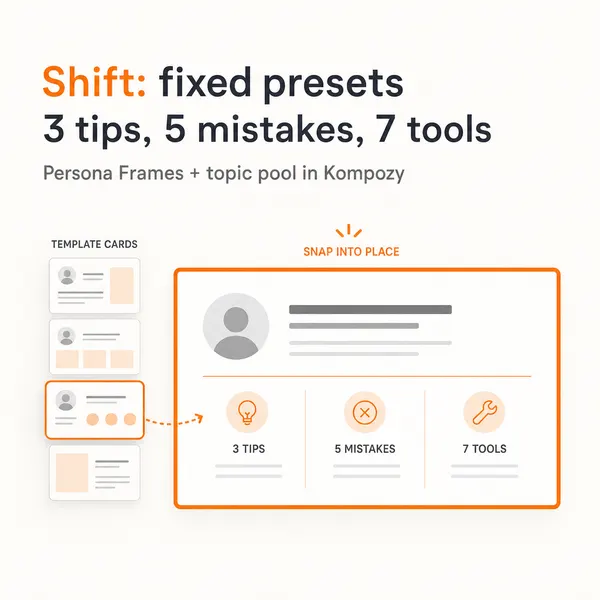
A real five-slide carousel from the Kompozy workspace, a format where captions and per-slide text work together. It's a format sample, not from any Instagram account on this page.
Who is this for, and who should skip it?
Best for:
- Accounts posting several times a week whose captions have slid into filler.
- Brands that want posts found through Instagram Search.
- Teams with more than one person writing captions.
Not ideal for:
- Accounts that post rarely. A system is overkill for a few posts a month.
- Anyone expecting hashtags to do the reach work. Instagram says they won't.
Frequently asked questions
What is an Instagram caption strategy?
It's a repeatable system for writing captions instead of improvising each one: a set of content pillars with keywords, a hook bank for first lines, a CTA rotation, a job assigned to each post, and a consistent voice. The system removes the blank page so you can write captions that get found and get read across a whole calendar, not just on the days you feel inspired.
How do I write Instagram captions faster without them getting worse?
Batch them from a system. With pillars, a hook bank, and a CTA rotation in place, writing a caption becomes assembly — pick the pillar, pull a hook pattern, write the body in that pillar's keywords, attach the CTA the post's job needs. Drafting a week or month in one session keeps voice consistent and stops the slow decay into filler one-liners that happens when you write post-by-post.
How many hashtags should I use in 2026?
Up to five precise, relevant ones, used to categorize the post rather than drive reach. Instagram caps posts at five hashtags and says a few targeted tags beat many generic ones, so a wall of generic tags does nothing and can read as spam. Put the discovery work in keyword-rich caption text and treat hashtags as a light categorization layer.
Should every caption be optimized for search?
No — assign each post one primary job. Most feed and Reel posts should lean discovery-first because that's where ranking changed, but a deliberate engagement caption on a community post or a tight conversion caption on an offer post beats forcing search framing everywhere. Decide the job at the calendar level, then let it pick the hook and CTA.
How do we know this?
We checked what this page says about Instagram Search and hashtags against the sources listed below on 2026-10-23, and rewrote or removed any figure we couldn't confirm there. Kompozy plan details come from kompozy.io/pricing.
Sources
- Instagram — Breaking down how Instagram Search works (read 2026-10-23)
- Social Media Today — Instagram implements new limits on hashtag use (read 2026-10-23)
- Kompozy — Pricing (read 2026-10-23)
Related tutorials
- How to write Instagram captions that rank and get reach (2026)
- How to add a different caption to each Instagram carousel slide (2026)
- How to batch 30 days of Instagram content in one day (2026)
- Best time to post on Instagram (2026 data + finding your own window)
- How to schedule Instagram posts (Meta Business Suite + tools)
- How to generate scroll-stopping Instagram posts with AI (2026)