How to optimize content for AI search (2026)
Optimize content for AI search as a repeatable workflow: build a prompt panel, write self-contained chunks, back claims with sources, then measure and refresh.
Last verified · 2026-10-23 · by Moe Ameen
Published 2026-09-01 · Updated
Short answer
To optimize content for AI search, run it as a loop. Record what ChatGPT, Perplexity, Gemini and Google AI Overviews say for your buyers' questions, give each question its own self-contained answer that opens plainly, back it with sourced facts, add matching schema and a named author, echo the claim on social, then re-run the same questions and refresh what slips.
Key takeaways
- Baseline first. Without it you cannot tell whether an edit worked.
- One question, one self-contained answer that still makes sense when quoted alone.
- In the GEO study, citations and statistics lifted visibility by up to about 40%.
- Only 12% of AI assistant citations ranked in Google's top 10 in Ahrefs' study.
- Search Console counts AI Overviews and AI Mode inside the regular Performance report.
This is the workflow version of AI search content optimization — not a one-time fix on a single URL, but the repeatable process a content team runs on everything it publishes so AI answer engines (ChatGPT, Perplexity, Google AI Overviews, Gemini) retrieve, trust, and quote it.
The reason it has to be a workflow is mechanical: an answer engine does not rank your page, it breaks content into chunks, retrieves the ones most relevant to a question, and cites the passages it can lift and attribute cleanly. So optimizing content means producing self-contained, evidence-backed answer units across your whole topic map, shaping each to the query, publishing them where engines look, and keeping them fresh.
The levers are measured, not guessed. The Princeton-led GEO study presented at KDD 2024 found that adding cited statistics and quotations to a source raised its visibility in generative engine answers by up to about 40 percent, while keyword stuffing scored below the unedited baseline on the study's main measure. Work these steps as a loop you re-run each cycle: baseline what the engines say now, produce optimized chunks, distribute them across surfaces, measure, and refresh.
If you are fixing one existing page rather than building a process, start with optimize a page to get cited by AI search; if you are not sure a crawler can even reach your content, do the technical pass in make content visible to AI search first.
What is the first step in optimizing content for AI search?
- Build a prompt panel and baseline it. Start with the exact questions your buyers actually ask an assistant — full, conversational queries, not head keywords. Curate a fixed list of them (this is your prompt panel), then run each through ChatGPT, Perplexity, Gemini, and Google's AI Overviews and record who gets cited and what the answer says. This is your control and your target list in one: it shows where you already appear, which competitor currently wins each question, and exactly which passage of theirs the model lifted.
- Map one question to one answer unit. Turn the panel into a content map where each specific question gets its own self-contained answer unit — a chunk, a section, or a page committed to that one question. Engines match passages to precise phrasing, so a unit pointed at one exact question gets pulled for it, while a page hedging across five broad topics matches none of them cleanly enough to quote. This is also where you spot the gaps: questions in your space that nothing you own answers yet.
- Write each unit as a liftable, self-contained chunk. Draft each answer so it stands alone. Open with the answer stated plainly in the first sentence or two, then support it, and keep the block focused: a few short paragraphs on one topic. Repeat the subject noun instead of leaning on "it" or "this," so a quote pulled out of context still parses. The test: could this exact block, pasted into an answer with none of the surrounding page, be correct on its own? If not, restructure it until it can.
- Back every claim with a sourced, verifiable fact. This is the highest-leverage content edit and the one the GEO research isolated. Walk each unit and swap generic assertions for specific, attributable ones: a number with a date and source, a direct quotation, a precise spec, a first-hand result. A sentence that could sit unchanged on a competitor's page is not citable; one that could only be true on yours is. Verify every fact against a primary source before it ships — a wrong number an engine repeats destroys the trust you are building.
- Fit the shape to the question, then mark it up. Match each chunk's format to its query type: a table for a comparison, a list for a set of specifics, numbered steps for a procedure, a single clear sentence for a "what is the number" question, video for a demonstration. Then give the retriever a labeled version with schema that reflects the visible content — Article, FAQPage for a real question set, HowTo for a procedure, plus Organization and author markup. Details in structuring content with Markdown and using schema markup.
- Strengthen entity and author trust signals. Off a ranked results list, models infer trust from entity signals. Put a named author with a real, linked bio on the content, make the organization behind it clear, and describe who you are the same way everywhere the engines look — consistency across sources is what an engine reads as authority. Where you can, add a corroborating third-party mention or a link to primary evidence you produced, because consensus across sources turns a lone claim into a durable citation.
- Publish the same answer across surfaces. One page rarely wins alone. Google's AI Overviews already cite social posts as sources (a BrightEdge study counted Facebook in 19.5 million of them), so echo each load-bearing claim, as a discrete liftable unit, beyond your own domain — a social post, a carousel card isolating the key stat, a short where a named expert says it on camera. The same true, specific claim showing up on several independent surfaces is cited more reliably than it is on one optimized page. See optimize social content for AI search.
- Measure against the panel, then refresh on a cadence. Re-run your prompt panel after publishing and compare to the baseline: track citation rate, share of voice against competitors, prompt coverage, and whether the engine describes you accurately. Google Search Console counts AI Overviews and AI Mode appearances inside its regular Performance report. Then re-date and re-verify on a schedule, because a unit you optimize once and abandon can lose citations to a competitor who refreshes theirs. This is a loop, not a project; run a periodic GEO content audit to decide what to refresh next.
What mistakes waste an AI search content workflow?
- Over-fragmenting for machines. Shredding a page into a heading per sentence, forced lists, and bolted-on Q&A reads as robotic and puts readers off. Structure for reader clarity first and let machine legibility follow. If a division feels forced to a human, it is too fragmented.
- Treating AI search like a slightly different Google. Keyword stuffing scored below baseline in the GEO study, while added evidence lifted visibility. Optimizing only for rank also misses most citations: in Ahrefs' study of 15,000 long-tail queries, just 12% of AI assistant citations ranked in Google's top 10.
- Getting specific without verifying. New topics are where models hallucinate confident falsehoods; a wrong stat you publish and an engine repeats damages the exact trust that earns citations. Check every number, date, and quote against a primary source.
- Optimizing one hero page instead of the topic map. Engines cite the unit that matches the exact question, and there are many exact questions — a single great page cannot cover them, so the work is a library of answer units, not one showpiece.
- Skipping the baseline. Without recording what the engines cite before you edit, you cannot tell whether a change worked. The prompt panel is the measurement instrument; build it first.
- Treating it as done. Freshness decays and competitors refresh, so a content library you optimize once and never revisit steadily loses the citations you won. Re-date and re-verify on a cadence.
Why does the AI search content loop stall, and where does Kompozy fit?
The steps above describe a loop, and the honest problem with a loop is that it only pays off if it actually runs every cycle — produce fresh answer units, shape each to its query, publish them across surfaces, then come back and refresh before they go stale. Doing that once is a good week's work; doing it continuously, across a whole topic map, is where content teams quietly fall back to publishing the occasional page and the optimization decays. That cadence is the specific thing Kompozy runs. It is a full generation-and-publishing engine, not an analytics tool or a repurposing app, and it does not replace your prompt panel or your judgment about what is true — it clears the production queue the workflow generates, on a schedule, so the loop keeps turning instead of stalling out after cycle two.
Concretely, hand it a proven-demand question from your panel and one sourced answer, and it produces the spread of units that step maps out: a Blog Article carrying the full self-contained passage, brand-exact Carousels and Quote Graphics that isolate each key statistic as its own liftable card, Text Posts for the feeds engines now read, and a Persona Short where your named expert says it on camera — YouTube mentions being the factor most correlated with AI brand visibility in an Ahrefs study of 75,000 brands. One Persona Brief governs all of it, so the entity, the numbers, and the one-line positioning stay identical across every surface, which is the consistency an engine reads as authority and the thing that fractures when many units are written by hand.
The part that keeps the loop alive is the schedule. Autopilot publishes the set across nine social platforms plus blog and email on a recurring cadence, behind a per-post review gate where a human confirms every fact before it ships — the accuracy check that matters most when the goal is being the source an engine quotes correctly, and the same cadence that keeps the library fresh so recency never turns against you. The honest boundary: Kompozy will not build your panel, decide what to say, or force an engine to cite you, and over-fragmenting for machines is a mistake no tool prevents. What it removes is the production ceiling that makes running the workflow every cycle impractical, so measurement and response move at the same speed. Starter ($199/mo for 5,500 credits) fits a solo operator running one topic cluster; Pro ($499/mo for 18,000 credits) suits a team producing across every surface each cycle; Enterprise is available through Contact Sales for agencies running AI-search content programs across many clients.
What does this look like in Kompozy?
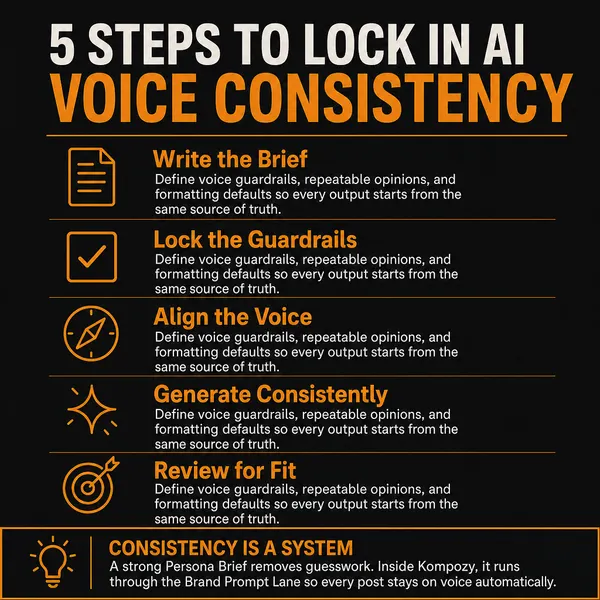
An infographic photo post generated in the Kompozy workspace. It shows how one sourced statistic can become its own liftable card.
Who is this for, and who should skip it?
Best for:
- Content teams publishing across a whole topic, not one page.
- Brands with first-hand data or sourced facts to put in each answer.
- Teams that will re-run the same questions every cycle.
Not ideal for:
- Fixing a single page. Use the single-page guide instead.
- Anyone wanting Kompozy to build the prompt panel or decide what is true.
Frequently asked questions
How do you optimize content for AI search?
Run it as a workflow, not a one-off. Build a prompt panel of the exact questions buyers ask an assistant and baseline who gets cited; map each question to a self-contained answer unit; open every unit with a plain answer and back it with a sourced fact; shape each chunk to its query and add schema; strengthen author and entity trust signals; echo the claim across surfaces; then measure against the panel and refresh on a cadence.
Is optimizing content for AI search different from SEO?
Yes, in its unit. SEO optimizes a whole page for a keyword and a ranking position; AI search content optimization optimizes the passage, because engines retrieve discrete chunks and quote the ones they can lift and attribute. For Google AI Overviews rank still helps, but for AI assistants the link to rank largely breaks. In Ahrefs' study of 15,000 long-tail queries, only 12% of their citations ranked in Google's top 10, so passage structure and specificity carry more weight.
How long should a content chunk be for AI search?
Aim for focused, self-contained blocks, a few short paragraphs on one topic, opening with the answer stated plainly. The goal is a passage a model can lift whole and quote correctly with none of the surrounding page attached. Do not fragment past what reads naturally to a person, though: over-optimized, machine-shaped content reads badly to the people you want to convince.
What single change helps most?
Replacing generic claims with specific, sourced ones. The Princeton-led GEO study found adding cited statistics and quotations lifted a source's visibility in generative engine answers by up to about 40 percent, while keyword stuffing scored below the unedited baseline. A verifiable, attributable fact is a self-contained unit a model can quote and stand behind; a generic sentence is interchangeable with countless others.
How do I know if it worked?
Compare against the baseline you captured first. Re-run the same prompt panel through ChatGPT, Perplexity, Gemini, and Google AI Overviews after publishing, and check whether you now appear and are quoted accurately. Track it as an ongoing loop — citation rate and share of voice against competitors on your prompt set — rather than a one-time check, and use Search Console's Performance report, which folds in AI Overviews and AI Mode, as a supporting signal.
How do we know this?
We checked every figure and product claim on this page against the sources listed below on 2026-10-23, and removed or reworded claims we could not verify. GEO figures come from the KDD 2024 paper, ranking overlap and video correlation from Ahrefs, social citations from BrightEdge, and Search Console reporting from Google Search Central. Kompozy plan details come from kompozy.io/pricing.
Sources
- arXiv: GEO: Generative Engine Optimization (Aggarwal et al., KDD 2024) (read 2026-10-23)
- Ahrefs: AI search overlap study (15,000 long-tail queries) (read 2026-10-23)
- Ahrefs: Top brand visibility factors in ChatGPT, AI Mode and AI Overviews (75k brands) (read 2026-10-23)
- BrightEdge: Google AI cites Facebook in 19.5 million AI answers (read 2026-10-23)
- Google Search Central: AI features and your website (read 2026-10-23)
- Kompozy: Pricing (read 2026-10-23)