An AI-Generated Poster Won the Ohio State Fair's Contest and Its $1,000 Prize — Then the Fair Moved to Ban AI
In summer 2026, an AI-generated poster took first place in the Ohio State Fair's poster contest without breaking its rules, drawing backlash from artists and prompting the Fair to say it will prohibit AI in future contests.
2026-08-03 · by Moe Ameen
Published 2026-08-03 · Updated
Short answer
An AI-generated poster won the Ohio State Fair's 2026 poster contest and its $1,000 first prize. Organizers said the winner broke no rules, but fairgoers objected, and NBC4 noted flags with the wrong number of stars and stripes and other labeling mistakes. The Fair then said it will reconsider its rules and prohibit AI in future poster contests.
Key takeaways
- An AI-generated poster won first place and $1,000 in the Ohio State Fair's 2026 poster contest.
- Fair organizers said the winning artist broke no contest rules by using AI.
- The poster showed flags with the wrong number of stars and stripes, plus other labeling errors.
- The Fair says it will prohibit AI in future poster contests.
What happened with the AI poster at the Ohio State Fair?
The Ohio State Fair's annual art poster contest, which started in 2024, picked a poster made with generative AI as its 2026 winner, and the $1,000 first prize went with it. This year's theme was America's 250th birthday along with the Fair itself. NBC4 identified the winner as Christin Billips of Westerville. In the poster's description, the artist wrote: "I gave it a retro fair feel with American flag elements to represent the 250th birthday of the USA." Organizers said the artist declined to talk to reporters.
Fair organizers said the winner did not break the contest's rules by using AI. That did not settle the reaction. Fairgoers pushed back online and in person, and NBC4 pointed out the common AI errors in the image: American flags with the wrong number of stars and stripes, plus other labeling mistakes. Victoria Douglas, an art educator who judged the contest, told NBC4: "I think it undermines the work that goes into making art."
The Fair's response was to change the rules going forward. A sign under the winning poster said organizers will reconsider the rules and prohibit AI in future contests. Organizers said they are committed to celebrating Ohio artists and pointed out that several other Fair competitions, including the fine arts exhibition, the mural contest and plein air painting, already don't permit AI. Nobody broke a rule here. The Fair just decided this was not a result it wanted to repeat.
Why does the Ohio State Fair AI poster matter for creators?
- Generative image quality crossed a threshold in public. Even with obvious AI errors, like flags with the wrong number of stars and stripes, the poster still took first place under human judging. The output no longer has to be flawless to win against people.
- Following the rules didn't defuse the backlash. The winning artist broke no contest rule, and the controversy landed anyway. Being allowed to use AI is not the same as audiences accepting it.
- The tell-tale errors are the real quality gap. Wrong flag counts and broken text are exactly what a raw prompt-to-image tool ships when nothing checks the output. For anything with your name on it, the missing step is brand control plus a human review pass, not a better prompt.
- Rules are tightening fast. The Fair went from allowing AI in its poster contest to saying it will prohibit it, in a single cycle. Contests, platforms, and clients are re-drawing the line in real time, so creators using AI should expect the goalposts to keep moving.
- Winning the frame isn't the same as shipping finished work. A one-off poster that wins a prize is a single file. The harder, more valuable job — turning a strong visual into on-brand content that reaches an audience — is a separate problem the contest never touched.
How can Kompozy help you use AI images without shipping errors like these?
The lesson isn't "AI art wins now" — it's that raw generation ships exactly the flaws this poster got dinged for: a flag with the wrong number of stars, text the model couldn't spell, details no one checked before it went public. A prompt-to-image toy hands you one file and walks away. The gap between that and work you'd put your name on is brand control and a review pass, and that gap is the whole reason Kompozy exists as a generation-and-publishing engine rather than a prompt box. Where this poster needed legible, on-brand text, Kompozy's Infographic Photo and Carousel Posts render dense copy through HyperFrames so your headline, labels, and brand frame come out pixel-exact instead of garbled — and every asset passes through a per-post review pipeline where you catch the wrong-flag mistake before it publishes, not after a fairground crowd does.
The other half is what a contest never tests: distribution. A winning frame is one download; a creator needs that idea working across every surface. Point Kompozy at one source — an image, a Persona Brief, a campaign angle — and it generates the native spread: Photo Posts and Quote Graphics for the image feeds, Persona Shorts and avatar video the frame alone can't reach, plus a Blog Article and Email Newsletter, then Autopilot schedules and publishes the batch across the eight social platforms plus blog and email behind that same review gate. Rules aside, the Ohio result showed the model can produce a winning image and still embarrass you on the details; Kompozy is the layer that keeps the brand exact, keeps a human in the loop, and turns the one good frame into finished content everywhere it needs to be.
What are the key facts about the Ohio State Fair AI poster?
- Summer 2026: an AI-generated poster won the Ohio State Fair's poster contest, taking first place and a $1,000 prize.
- Fair organizers said the winning artist broke no contest rules by using AI.
- The poster carried common generative-AI errors — flags with the wrong number of stars and stripes, other labeling mistakes — which fueled artist backlash.
- The Ohio State Fair says it will reconsider the rules and prohibit AI in future poster contests, after allowing it this year.
What does this look like in Kompozy?
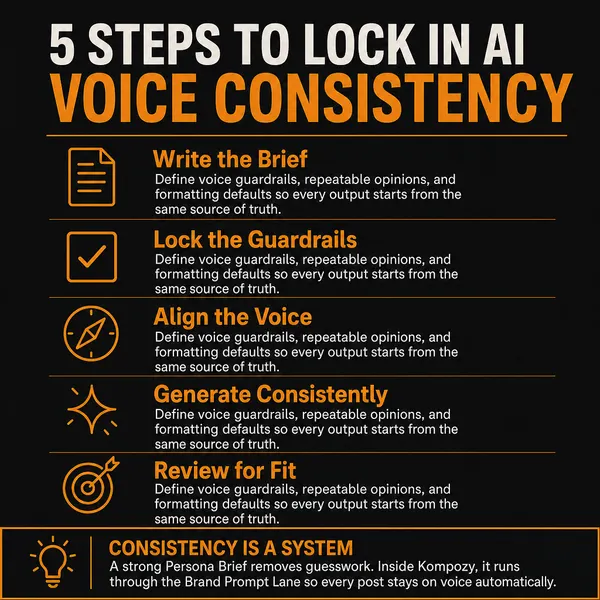
An infographic photo post from Kompozy. Its text is rendered inside a fixed brand frame, which is how Kompozy avoids garbled labels. It was not made for the Ohio State Fair.
Who is this for, and who should skip it?
Best for:
- Creators who use AI images and want a reminder to check text and details before posting.
- Contest organizers and brands writing AI rules for submissions.
Not ideal for:
- Artists entering contests that ban AI. The Fair says its poster contest will.
- Anyone looking for proof that AI art always loses. This poster won.
Frequently asked questions
Did the AI poster break the Ohio State Fair contest rules?
No. Fair organizers said the winner did not break the rules of this year's contest by using AI. The Fair later said it will reconsider those rules and prohibit AI in future poster contests, but that change applies going forward, not to this result.
What was wrong with the winning AI poster?
Coverage pointed to the errors generative image models still produce: American flags with the wrong number of stars and stripes, plus other labeling mistakes. None of it disqualified the entry, but it became the focus of the backlash — the poster won despite carrying visible AI mistakes.
How much did the AI poster win?
The first-place prize was $1,000. This year's theme was America's 250th birthday along with the Ohio State Fair itself, and the AI entry took the top spot.
How can a creator use AI images without shipping the errors this poster had?
The flaws — wrong flag counts, broken text — come from raw prompt-to-image tools that output one unchecked file. The fix is brand-controlled generation plus a human review pass. An engine like Kompozy renders posters and carousels with pixel-exact text and brand framing through HyperFrames, routes every asset through a per-post review pipeline before publishing, and then distributes the finished piece across platforms — so mistakes get caught before an audience sees them.
How do we know this?
We checked every figure, date and quote on this page against the sources listed below on 2026-10-23, and removed or rewrote claims we could not confirm. Kompozy plan and format details come from kompozy.io/pricing.
Sources
- ABC6 — AI contest poster at Ohio State Fair causes controversy after winning 1st place (read 2026-10-23)
- NBC4 — AI poster causes controversy in Ohio State Fair contest (read 2026-10-23)
- Kompozy — Pricing (read 2026-10-23)
Related news
- ByteDance Releases Seedream 5.0 Pro, a "Design-Aware" Image Model That Splits a Render Into Editable Layers
- Where YouTube's AI Disclosure and Likeness Rules Stand in 2026: Label Realistic AI, and Only Depict Faces You Control
- YouTube Clarifies Its AI "Slop" Rules: Three Kinds of Content That Can't Be Monetized