BulkPublish Opens Its Publishing Stack to AI Agents: 51 Operations Across 15 Networks via API and MCP
Announced September 3, 2026, BulkPublish exposed its full social publishing stack — single posts, media uploads, recurring queues, feed automation, and analytics — to autonomous agents through a REST API, Python and Node SDKs, and a Model Context Protocol server.
2026-09-03 · by Moe Ameen
Published 2026-09-04 · Updated
Short answer
On September 3, 2026, BulkPublish opened its whole social publishing stack to AI agents. It describes 51 publishing operations across 15 networks, from single posts and media uploads to recurring queues, RSS automation and analytics. Agents connect through a REST API, Python and Node SDKs, or an MCP server, on every plan. BulkPublish posts what it is given but does not create content.
Key takeaways
- BulkPublish opened its publishing stack to AI agents on September 3, 2026.
- It covers 51 operations across 15 networks, including Telegram, Tumblr, Discord and Mastodon.
- Access is through a REST API, Python and Node SDKs and an MCP server, on every plan.
- The free plan allows 30 API requests a day; paid plans raise the limits.
- It publishes content it is handed. It does not generate the video or images.
What did BulkPublish open up to AI agents?
On September 3, 2026, BulkPublish announced it had opened its entire social publishing stack to AI agents, giving autonomous software the same programmatic access a human gets from the scheduling dashboard. The company frames it as agent-first rather than a bolt-on: everything the web app can do — single posts, media uploads, recurring queues, feed-driven automation, and post-level analytics — is now callable through an API on every plan.
BulkPublish describes the surface as 51 publishing operations across 15 networks, covering Facebook, Instagram, X/Twitter, TikTok, YouTube, LinkedIn, Threads, Bluesky, Pinterest, Google Business Profile, Mastodon, Discord, Telegram, Tumblr, and Snapchat. Access runs through a REST API with bearer-token keys, official Python and Node/TypeScript SDKs, and a Model Context Protocol (MCP) server that exposes the operations as tools an assistant like Claude can call in natural conversation — scheduling posts, uploading media, checking analytics, and managing channels without a browser session. There is a free tier with published rate limits alongside paid tiers for higher throughput.
Founder Muhammad Azeem summed up the design shift: "We stopped designing for the person clicking buttons and started designing for whatever is calling us." He added that "an agent should not have to imitate a human to post something. If it can reason about the content, it should be able to publish the content."
Treat exact operation counts, network coverage, rate limits, and pricing as a launch-window snapshot — an early-stage developer product like this moves fast. Confirm any single figure against BulkPublish's own docs before building against it.
Why does agent-first publishing matter for creators?
- Agent-native publishing is becoming a category. When a scheduler ships an MCP server and SDKs aimed at agents rather than a dashboard, it signals that "the software that posts for you" is shifting from a person clicking buttons to a program calling an API.
- It lowers the floor for building your own posting automation. A developer or an agent can now draft, queue, and publish across many networks with a token and a few calls — no browser automation, no human in the scheduling UI.
- Network breadth is wide but shallow on creation. Fifteen networks including Telegram, Tumblr, Discord, and Mastodon is broad reach, but the API moves content it is handed — it does not produce the video, image, or carousel that goes out.
- The bottleneck moves, it does not disappear. Once publishing is a single API call, the hard part is no longer distribution — it is generating a steady stream of on-brand content worth distributing.
- MCP is quietly becoming the connective tissue. An agent that can already reason and draft can now publish through a standard tool interface, which makes the "generate on-brand content" step the remaining gap in an otherwise end-to-end agent workflow.
How can creators act on this with Kompozy?
The news here is a pipe getting wider, and it is worth being precise about what that changes. BulkPublish is a publishing API: hand it a finished post and a token and it ships to fifteen networks, on a schedule, with analytics back. What it does not do — by design — is make the post. An agent still has to arrive with the caption, the video, the carousel, the thumbnail. That is exactly the half Kompozy owns: it generates the finished formats — captioned Persona Shorts and avatar video, Carousel Posts and Photo Posts rendered brand-exact via HyperFrames, Quote Graphics, Text Posts, Blogs, and Newsletters — then schedules and publishes them across the nine social platforms plus blog and email on Autopilot, all held to one voice by your Persona Brief. BulkPublish makes distribution a solved problem for developers; Kompozy makes the content that distribution needs, and ships it too.
There is also the timely move: "a social scheduler just went agent-native" is a story your developer- and marketer-adjacent audience is reacting to this week. Drop your take into Kompozy and one idea becomes a week of posts — a Carousel on what agent-first publishing means, a captioned Persona Short explaining MCP in plain English, Quote Graphics pulling Azeem's "designing for whatever is calling us" line, a Text Post for X and LinkedIn, and a Blog Article for the long-tail search — every piece on brand and published everywhere at once. For related shifts, see our coverage of Snapchat's third-party ads MCP server and Hootsuite's July 2026 update. If you are weighing a raw publishing API against a done-for-you engine, the Kompozy vs BulkPublish alternative page lays out the choice.
What are the quick takeaways?
- September 3, 2026: BulkPublish opened its full publishing stack to AI agents, framed as agent-first rather than a dashboard add-on.
- The surface is described as 51 publishing operations across 15 networks (including Telegram, Tumblr, Discord, Mastodon, and Snapchat), via a REST API, Python and Node SDKs, and an MCP server.
- Agents can draft, queue, publish, upload media, run recurring queues and RSS feed automation, and read post-level analytics — no browser session needed.
- There is a free tier with published rate limits plus paid tiers for higher throughput; keys use a bearer-token format.
- The API publishes content it is handed but does not generate it. Kompozy is the engine that produces the on-brand video, carousels, and images — and publishes them across platforms too.
What does this look like in Kompozy?
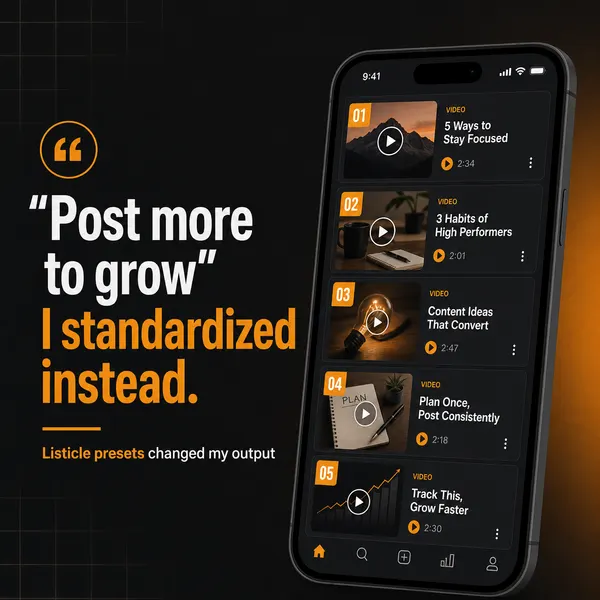
A carousel generated in Kompozy, the kind of finished asset a publishing API has to be handed.


Who is this for, and who should skip it?
Best for:
- Developers building agents that need to post across many networks
- Teams that already have finished content and want API-driven scheduling
- Anyone who needs networks like Telegram, Discord or Mastodon
Not ideal for:
- Creators who need the content itself made, since BulkPublish only distributes
- Non-technical users who would rather not work with APIs or MCP
- Heavy API users on the free plan, which caps requests at 30 a day
Frequently asked questions
What did BulkPublish announce for AI agents?
On September 3, 2026, BulkPublish opened its entire social publishing stack to AI agents, giving autonomous software the same programmatic access a person gets from the dashboard. It described the surface as 51 publishing operations across 15 networks, reachable through a REST API, official Python and Node/TypeScript SDKs, and a Model Context Protocol (MCP) server that exposes the operations as tools an assistant like Claude can call directly.
Which platforms does BulkPublish support?
BulkPublish lists 15 networks, including Facebook, Instagram, X/Twitter, TikTok, YouTube, LinkedIn, Threads, Bluesky, Pinterest, Google Business Profile, Mastodon, Discord, Telegram, Tumblr, and Snapchat. Treat exact coverage as a moving target for an early-stage product and confirm against BulkPublish's own documentation before building against it.
Does BulkPublish generate content?
No. BulkPublish is a publishing and scheduling API — it moves and schedules content it is handed and reports analytics back, but it does not generate the video, image, carousel, or caption itself. Producing the finished, on-brand assets is a separate job, which is what a content engine like Kompozy does before handing posts off to be published.
How is Kompozy different from BulkPublish?
BulkPublish is a developer-facing publishing API and MCP server — you or your agent bring finished posts and it ships them across networks. Kompozy is a content generation and publishing engine: it produces the on-brand Shorts, avatar video, carousels, images, blogs, and newsletters from a single source, then schedules and publishes them across nine social platforms plus blog and email. One distributes what you give it; the other makes the content and distributes it.
How do we know this?
We checked every figure, date, quote and product claim on this page against the sources listed below on 2026-10-23, and removed or rewrote anything we could not confirm. Launch details and quotes come from the IT Business Net release. Network list, MCP support and free-plan limits were read off bulkpublish.com. Kompozy platform and format details come from kompozy.io.
Sources
- IT Business Net — BulkPublish opens its entire publishing stack to AI agents (read 2026-10-23)
- BulkPublish — Homepage, networks and pricing (read 2026-10-23)
- Kompozy — Pricing and plans (read 2026-10-23)
Related news
- Snapchat Opens Its Ad Platform to Third-Party AI Agents With an Official Ads MCP Server
- Hootsuite Ships Its July 2026 Update: Wisdom AI Citations, LinkedIn Post Metrics, and TikTok Mobile Publishing
- Buffer Sets February 1, 2027 as the Retirement Date for Its Legacy REST API and Moves Developers to a New GraphQL API