Google Admits Its Search Console AI Search Reporting Is Inadequate — No Clicks, No Real Position, No Queries
Google's John Mueller agreed with an SEO who called the generative AI performance report an inaccurate snapshot, conceding that position inside AI answers is 'hard to do in a way that makes it useful' and is tracked only as a block.
2026-09-13 · by Moe Ameen
Published 2026-09-13 · Updated
Short answer
Google's John Mueller agreed in September 2026 that Search Console's generative AI report gives a weak picture of AI search performance. The report counts impressions in AI Overviews and AI Mode but shows no clicks, no click-through rate and no queries. Mueller said position inside AI answers is "hard to do in a way that makes it useful," so Google tracks it as a block.
Key takeaways
- Search Engine Journal reported on September 13, 2026 that John Mueller agreed the AI report falls short.
- The report went worldwide on August 31, 2026 and shows impressions only.
- No clicks, no CTR, no per-link position and no query data.
- Mueller offered to discuss better position tracking with the team but promised no new metrics.
- Use it as a rough "are we showing up" check and judge results on channels that report clicks.
What did Google admit about Search Console's AI reporting?
Google's generative AI performance report in Search Console — the report that finished rolling out to sites worldwide on August 31, 2026 — is meant to show how often your pages appear inside AI Overviews and AI Mode. On September 13, 2026, Search Engine Journal reported that Google Search Advocate John Mueller had publicly agreed with SEOs who argue that the report gives an inaccurate picture of how a site actually performs in AI search.
The exchange started on Reddit, where a site owner argued that the report still leans on the old "ten blue links" concepts of impressions and position, which map badly onto an AI answer where a link can be cited inside a synthesized paragraph, hidden behind a "show more" expander, or shown without ever being scrolled into view. Mueller did not push back.
He said position "is hard to do in a way that makes it useful, so we're currently tracking it like we do for many search features (as a block)," and noted that "search results pages have a lot of ways for users to interact nowadays, so the old 'position 1–10' is hard to map, or to make useful for site owners." Search Engine Journal's Roger Montti reported the acknowledgment.
Stacked up, the gaps are significant. The report shows impressions but no click counts and no click-through rate, so you can confirm a page picked up AI impressions but not whether anyone clicked. Position inside an AI answer is not broken out — it is folded into a block. And the specific prompts that triggered the appearance are not exposed. Mueller said he was "happy to discuss with the team" what position tracking would actually be useful, but there was no concrete commitment to new metrics.
Treat this as a candid limitation rather than a bug. The first-party AI-visibility scoreboard exists now, and it is better than the nothing site owners had before — but Google itself is saying the numbers on it do not yet answer the questions creators most want answered.
Why does thin AI search reporting matter for creators?
- The one number you can see (impressions) is the one that matters least for revenue. Without clicks, CTR, or position, you cannot tell whether an AI appearance sent a single visitor — so optimizing to that dashboard is optimizing a proxy Google itself calls inadequate.
- No query data means you cannot reverse-engineer which prompts surface you, so the usual keyword-to-content loop that classic Search Console enabled does not work here yet.
- "Position as a block" means two very different outcomes — cited in the answer versus buried under a "show more" — look identical in the report, so you can be praised and penalized by the same row.
- Because the measurement is thin, betting a content strategy on climbing this specific report is fragile. The durable move is broad, substantive presence plus channels where you can actually measure what happens after the impression.
- Owned and social channels still give real feedback — email opens, blog analytics, native platform metrics — so the smart hedge is to keep feeding surfaces you can measure while AI-search reporting matures.
How do you respond to thin AI reporting with Kompozy?
The trap here is spending real effort tuning to a dashboard Google just admitted is inadequate. When the only visible metric is impressions — no clicks, no CTR, no position, no queries — you cannot run the tight measure-and-optimize loop that classic SEO ran on. So the rational response is to stop trying to reverse-engineer an unmeasurable channel and instead do the two things that still work: publish enough substantive, on-brand material that AI answers have something worth citing, and keep landing on channels where the feedback is real. Kompozy is the production engine for exactly that posture. Point it at one source and it generates a batch of genuinely distinct pieces from a single Persona Brief — a long-form Blog Article and text an AI-search engine can actually index and quote, plus Persona Shorts, Clipped Shorts, and brand-exact Carousel posts — instead of you hand-making a corpus big enough to be worth quoting.
Then it publishes where you can see results. Autopilot schedules the batch across the eight social platforms plus a blog and an email newsletter to Mailchimp, behind a per-post review gate. Those surfaces report clicks, opens, saves, and watch time — the after-the-impression signals the AI report withholds — so your read on what's working comes from channels with honest analytics rather than a block-position estimate. Use the Search Console AI report for the one thing it's good at: a coarse "are we being surfaced at all" pulse. Use Kompozy to make sure that being surfaced is backed by a body of work across measurable channels, so a quarter where the AI numbers are murky doesn't leave you flying blind.
What are the quick takeaways?
- On September 13, 2026, it was reported that Google's John Mueller had agreed with SEOs that the Search Console generative AI performance report gives an inaccurate snapshot of AI-search performance.
- Mueller said position inside AI answers is "hard to do in a way that makes it useful" and is tracked as a block.
- The report shows impressions only — no clicks, no CTR, no per-answer position, and no query data.
- Mueller said he is happy to discuss more useful position tracking with the team, but made no concrete commitment to new metrics.
- The creator takeaway: don't over-optimize an admittedly-thin dashboard — publish broadly and lean on channels (blog, email, social) whose analytics actually report clicks and engagement.
What does this look like in Kompozy?
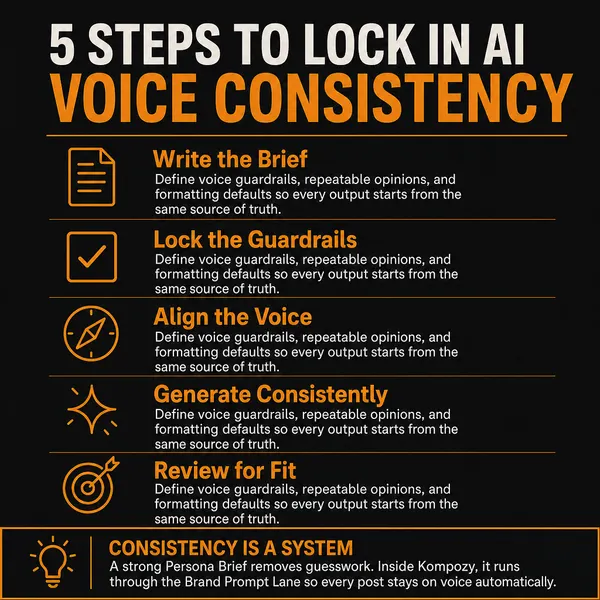
A real infographic photo post from the Kompozy workspace. It is the kind of post that reports real saves and clicks on social, unlike the AI report.
Who is this for, and who should skip it?
Best for:
- SEOs and site owners trying to read the new generative AI report
- Publishers deciding how much to invest in AI search visibility
- Creators who want to know what the report can and cannot tell them
Not ideal for:
- Anyone hoping for a fix date, since Google committed to nothing
- Teams that need click attribution from AI Overviews today
- Sites with too little data to appear in the report at all
Frequently asked questions
Did Google admit its AI Search reporting is inadequate?
Effectively, yes. Search Engine Journal reported on September 13, 2026 that Google Search Advocate John Mueller had agreed on Reddit with SEOs who said the Search Console generative AI performance report gives an inaccurate picture of AI-search performance. He conceded that position inside AI answers is "hard to do in a way that makes it useful," so it is tracked only as a block. He offered to discuss more useful position tracking with the team but did not commit to new metrics.
What data is missing from Search Console's AI performance report?
The report shows impressions — how often your pages appear in AI Overviews and AI Mode — but no click counts, no click-through rate, and no per-answer position (position is folded into a block). It also does not expose the specific prompts that triggered your appearance. So you can see that a page was surfaced, but not whether it earned any clicks or where it ranked within the answer.
Why is position hard to report inside AI answers?
A modern results page and an AI answer offer many ways to interact — a link can be cited inside a synthesized paragraph, tucked behind a "show more" expander, or shown without ever being scrolled into view — so the old "position 1–10" model maps badly onto them. Mueller said Google currently tracks these appearances as a block, the same way it handles many search features, because a single ranked position is not meaningful in that layout.
How should creators respond to thin AI-search reporting?
Don't build a content strategy around climbing a metric Google itself calls inadequate. Instead, publish enough substantive, on-brand material that AI answers have something worth citing, and lean on channels where analytics are real — blog clicks, email opens, and native social engagement. A tool like Kompozy generates a full batch of on-brand content from one source and publishes it across the eight social platforms plus blog and email, so your read on performance comes from measurable channels while AI-search reporting matures.
How do we know this?
We checked every figure, date, quote and product claim on this page against the sources listed below on 2026-10-23, and removed or rewrote anything we could not confirm. Mueller's quotes and the rollout date come from Search Engine Journal; the list of missing metrics comes from Whito's review of the report. Kompozy plan and format details come from kompozy.io.
Sources
- Search Engine Journal — Google admits Search Console reporting for AI search is inadequate (read 2026-10-23)
- Whito — Google will show how often AI mentions your business, not whether anyone clicked (read 2026-10-23)
- Kompozy — Pricing and plans (read 2026-10-23)
Related news
- Google Search Console's AI Performance Report Rolls Out Worldwide — You Can Finally See Your AI Overviews and AI Mode Impressions
- Reddit's Stock Falls After a Record Quarter as Its CEO Warns Google's AI Overviews Made Search Referrals 'Choppy'
- Google Gives Publishers New Controls to Fight AI-Driven Traffic Losses, Led by an Embeddable "Preferred Sources" Button