Hiding Elephant Adds One-Click Social Publishing — by Building on Buffer Instead of In-House
The AI design workspace now takes a finished visual from canvas to a live social post, with AI-written captions and one-click publishing — and it got there by wiring into Buffer's API rather than building platform integrations itself.
2026-07-03 · by Moe Ameen
Published 2026-07-03 · Updated
Short answer
Hiding Elephant, an AI design workspace, added one-click social publishing by building on Buffer's API instead of connecting to each platform itself. Co-founder Daniel Futerman said one Buffer integration reaches all of a customer's linked accounts, and the core build took under a week. The AI writes per-platform captions from the image and brand voice, shorter for X and longer for LinkedIn, then sends posts to Buffer's queue or saves drafts.
Key takeaways
- Hiding Elephant publishes through Buffer's API rather than its own platform integrations.
- Futerman said that avoided separate OAuth flows, rate limits and media specs per platform.
- The core integration took less than a week; most time went to testing and QA.
- Captions are written per platform from the image and the brand voice.
What did Hiding Elephant add?
Hiding Elephant, an AI design workspace that pairs AI image generation with a full vector-editing canvas, added social publishing in a 2026 product update. The pitch is closing the gap between a finished design and a live post: create an on-brand visual on the canvas, and the tool can now write a caption and push the post out to social accounts without leaving the app.
The notable engineering decision is that Hiding Elephant did not build the publishing layer itself. It integrated Buffer's API instead. Co-founder Daniel Futerman framed the reasoning around scope: with Buffer, one integration gives their customers access to all of their linked social accounts, whereas connecting to each platform directly would have meant maintaining separate OAuth flows, rate limits, media specs, and platform-specific APIs.
Offloading that to Buffer let the team focus on what makes Hiding Elephant distinctive — the design and brand-intelligence side. Per the company, the core integration took less than a week to build, with most of the remaining time going to testing, QA, and polishing before launch.
The AI layer does more than move a file. It analyzes the image and combines it with what it already knows about the brand's voice, tone, and visual style to generate platform-specific captions — shorter for X, longer for LinkedIn. A design agency running several brands can set up brand intelligence for each, generate on-brand visuals and captions in each brand's voice, then send everything straight to the Buffer queue or save it as drafts for review.
The company has said future work includes syncing with previous Buffer posts and using hashtag and performance data to feed insights back into captions and brand messaging. Treat exact rollout timing and any pricing as a launch-window detail and confirm on Hiding Elephant's own channels.
Why does Hiding Elephant's Buffer decision matter?
- It confirms a pattern: net-new AI tools increasingly treat multi-platform publishing as a solved problem to plug into (Buffer's API here), not a moat to rebuild — the differentiator moves to what you generate, not how you distribute it.
- For a design-first tool, the smart-build call is honest and worth noting — one Buffer integration beats maintaining a separate API for every platform, and the core work reportedly shipped in under a week.
- The AI caption layer mirrors where the whole field is going: analyze the asset, read the brand voice, and write per-platform copy automatically instead of leaving a blank caption box.
- The reach is bounded by Buffer's surface and by Hiding Elephant's output. It publishes the visuals you design there — it is not clipping long-form video, generating avatar/persona video, or fanning one idea into a blog and newsletter.
- Publishing sits one hop away, behind a third-party queue. That is fine for a design tool, but a creator who wants generation, brand voice, scheduling, and native publishing in one system is buying two products and a handoff.
How do you get generation and publishing in one system?
Hiding Elephant's move is a clean read on where the value sits in 2026: generating an on-brand asset is the hard, differentiated part, so a design tool builds that and rents the publishing. Kompozy takes the opposite bet — it owns both halves natively, which matters the moment your content is more than the visuals a design canvas produces. Where Hiding Elephant designs a still image or graphic and hands it to Buffer's queue, Kompozy is a generation-and-publishing engine: it generates the formats a canvas doesn't — HeyGen persona and avatar video, clipped shorts from long-form, multi-slide carousels rendered brand-exact through HyperFrames, blog articles, and email newsletters — then publishes them itself to nine social platforms plus Mailchimp for email and a blog destination, with autopilot scheduling and a per-post review pipeline. There is no third-party publishing hop to configure or keep in sync.
The caption parallel is the sharpest place to compare. Hiding Elephant's AI reads the image and the brand's voice to write shorter copy for X and longer for LinkedIn — Kompozy does the same job with a persistent Persona Brief that governs voice across every format and adds banned-word filtering, so the copy stays on-brand whether it's a tweet, a carousel caption, a blog intro, or a newsletter section, not just a per-image one-off. And there's a same-week content play in the news itself: "an AI design tool just added social publishing through Buffer" is exactly the kind of story your audience is reading now. Drop your take into Kompozy and it fans one point of view into a blog explainer, a carousel, short captioned clips, and platform-native posts — governed by one Persona Brief — then schedules and ships the set while the story is fresh. If you're weighing the design-plus-Buffer stack against a single engine, our guide to building a social content engine with the Buffer API and our Buffer alternative page make the honest comparison.
What are the key facts about Hiding Elephant's publishing feature?
- Hiding Elephant, an AI design workspace, added social publishing in a 2026 update — designed asset to live post with AI-written captions, in one click.
- It built the feature on Buffer's API rather than in-house: one integration reaches all a customer's linked accounts and avoids maintaining a separate API per platform.
- The AI reads the image plus the brand's voice to write per-platform captions (shorter for X, longer for LinkedIn) and can send to the Buffer queue or save as drafts.
- Co-founder Daniel Futerman said the core integration took under a week; roadmap includes learning from past Buffer posts and performance data.
- It publishes what you design there and stops at Buffer's surface — for avatar video, clipping, carousels, blogs, and native nine-platform publishing in one system, use a generation-and-publishing engine like Kompozy.
What does this look like in Kompozy?
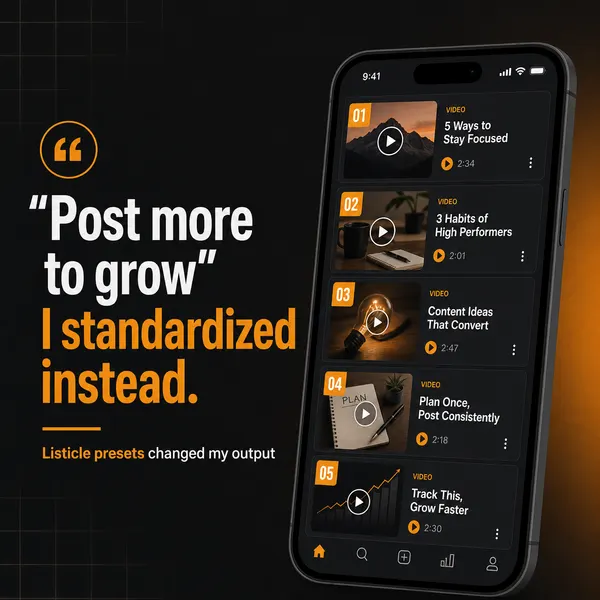
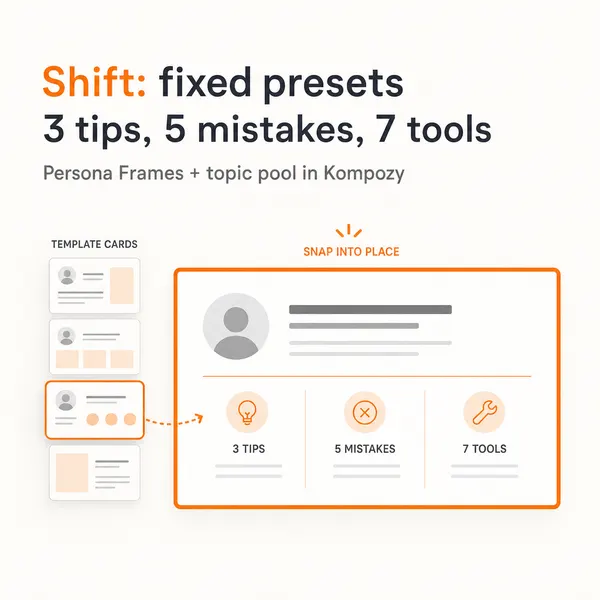
A real five-slide carousel generated in the Kompozy workspace, shown as an example of the format. It wasn't made about this story. A design tool makes one visual; a carousel like this is a different format.



Who is this for, and who should skip it?
Best for:
- Designers and agencies who make visuals in Hiding Elephant and already use Buffer
- Agencies managing several brands with separate voices
- Teams that want captions drafted per platform
Not ideal for:
- Creators who need video, clipping, blogs or newsletters as well as images
- Anyone who wants publishing without a second tool in the chain
Frequently asked questions
What is Hiding Elephant's new social publishing feature?
It lets you take a visual you designed in Hiding Elephant's AI canvas, have the tool write a platform-specific caption from the image and your brand voice, and publish the post to your social accounts in one click — without leaving the app.
Why did Hiding Elephant use Buffer instead of building publishing itself?
Co-founder Daniel Futerman said one Buffer integration gives customers access to all their linked social accounts, while connecting to each platform directly would mean maintaining separate OAuth flows, rate limits, media specs, and platform APIs. Buffer abstracts that away so the team can focus on the design side. The core integration reportedly took under a week to build.
Does Hiding Elephant write the social captions automatically?
Yes. Its AI layer analyzes the image and combines it with what it knows about the brand's voice, tone, and visual style to generate platform-specific captions — shorter for X, longer for LinkedIn — which you can send to the Buffer queue or save as drafts for review.
How is this different from a tool like Kompozy?
Hiding Elephant designs a visual and hands publishing to Buffer's queue. Kompozy is a generation-and-publishing engine: it also generates avatar/persona video, clips long-form, builds brand-exact carousels, blogs, and newsletters, then publishes natively to nine social platforms plus email and blog with autopilot scheduling — no third-party publishing hop, and one Persona Brief governing voice across every format.
How do we know this?
We checked every date, figure and quote on this page against the sources listed below on 2026-10-23, using the article listed below, which quotes co-founder Daniel Futerman, and rewrote or removed anything they didn't support. Kompozy plan and feature details come from kompozy.io/pricing.
Sources
- Spicy Creator Tips — Why Hiding Elephant added social publishing without building it from scratch (read 2026-10-23)
- Kompozy — Pricing (read 2026-10-23)