LinkedIn Reports a 46% Jump in Detected Inauthentic Activity as It Tightens Enforcement
LinkedIn's latest EU DSA disclosure shows detected inauthentic activity up 46% in the first half of 2026, with engagement pods, third-party auto-posting services, and AI-generated engagement all in scope.
2026-09-02 · by Moe Ameen
Published 2026-09-02 · Updated
Short answer
LinkedIn's EU Digital Services Act report shows a 46% rise in detected inauthentic activity in the first half of 2026 compared with the second half of 2025. The targets are engagement pods, external apps that automate posting, and AI slop engagement. LinkedIn also reported 56.5 million active EU users, up 1.4 million. Scheduling original posts through approved tools is not what it is going after.
Key takeaways
- Detected inauthentic activity on LinkedIn rose 46% in H1 2026 versus H2 2025, per its EU DSA report.
- Named targets: engagement pods, external auto-posting apps, and AI-generated "slop" engagement.
- Active EU users hit 56.5 million, up 1.4 million, so this is not a usage collapse.
- If a tool likes, comments or posts by driving your logged-in session, that is the risky kind.
- Original posts on a normal schedule are fine. Faked engagement is what gets caught.
What did LinkedIn report about inauthentic activity?
LinkedIn's latest transparency filing under the European Union's Digital Services Act (DSA) reports a 46% increase in detected instances of inauthentic activity during the first half of 2026 compared with the second half of 2025. The disclosure, surfaced in early September 2026, frames the jump as a result of stepped-up detection rather than a claim that the platform is being overrun — LinkedIn is finding and acting on more of it.
The activity in scope is broad. LinkedIn names AI-generated engagement that adds nothing to the feed ("AI slop"), and it specifically calls out engagement pods — groups that trade coordinated likes and comments to game the feed — and external apps that offer automated posting. Social Media Today also noted that about a million people have reported AI slop on LinkedIn.
The same report puts LinkedIn at 56.5 million active users in the EU for the first half of 2026, up about 1.4 million from the prior period. That context matters: the enforcement increase is not being driven by a collapse in real usage, and Social Media Today puts active users at roughly 30% of LinkedIn's EU member base.
One distinction is worth keeping straight, because it decides who is actually at risk. LinkedIn's enforcement is behavioral, not a blanket ban on automation. It targets tools and accounts that mimic bot-like behavior — fake engagement, session automation, mass connection or DM blasts, and low-effort AI content pushed at volume — not the ordinary act of scheduling original posts. Treat the exact figures and category names as reported in the DSA disclosure; confirm current numbers against LinkedIn's own transparency pages before relying on them.
Why does the crackdown matter for creators?
- If your growth leaned on engagement pods or a tool that likes, comments, or sends connection requests on your behalf, that is exactly the behavior the 46% increase is catching. The risk of a reach penalty or account action is rising, not falling.
- Third-party services that automate posting by driving your logged-in session (browser bots) are a different risk class than API-based publishing. The former looks bot-like to LinkedIn's detectors; the latter is how scheduling is supposed to work.
- AI-generated content is in scope when it reads as slop — high volume, low effort, generic. The lesson from LinkedIn's enforcement year is that using AI is fine; publishing obvious, undifferentiated AI output at scale is what gets flagged.
- Enforcement is behavioral, so the safe path is not "post less" — it is "post original, on-brand content through sanctioned channels and stop faking engagement." Consistency of real posting is not what LinkedIn is hunting.
- This is a durable signal, not a one-week story: DSA reporting recurs, and the trend line across 2026 is more detection, faster flagging, and less tolerance for artificial engagement across LinkedIn and its peer platforms.
How do you keep automating LinkedIn safely with Kompozy?
The trap creators fall into after news like this is to conflate two very different things: automating engagement, and automating publishing. LinkedIn is cracking down on the first — pods, fake likes, mass DM and connection bots, and tools that puppet your logged-in session to look human. It is not banning the act of drafting a post and scheduling it. Kompozy sits cleanly on the safe side of that line, and that is the whole point of using it instead of a grey-hat automation stack.
Kompozy does not touch engagement. It never likes, comments, follows, or DMs on your behalf, and it does not drive your browser session. What it does is generate original content — talking-head Persona Shorts, Carousels, Photo Posts, Text Posts, Blog Articles, and newsletters, each held to one Persona Brief so the output reads as a real voice rather than volume slop — and then publish it through sanctioned integrations rather than session bots. LinkedIn posting runs through official partner infrastructure, and Autopilot schedules the set across the eight social platforms plus blog and email behind a per-post review you control. The reader who just learned their pod or auto-liker is now a liability gets the honest answer here: keep the real thing — original content, published on a real cadence — and drop the behavior LinkedIn is actually flagging.
What are the quick takeaways?
- LinkedIn's EU DSA disclosure, reported in early September 2026, shows detected inauthentic activity up 46% in H1 2026 versus H2 2025.
- In scope: engagement pods, external auto-posting apps, and AI-generated "slop" engagement.
- The platform reported 56.5 million active EU users for H1 2026, up ~1.4 million — so the crackdown is not being driven by falling real usage.
- Enforcement is behavioral: it targets bot-like engagement and session automation, not the ordinary scheduling of original posts.
- The durable move is to stop faking engagement and publish original, on-brand content through sanctioned channels — which is exactly how Kompozy works.
What does this look like in Kompozy?
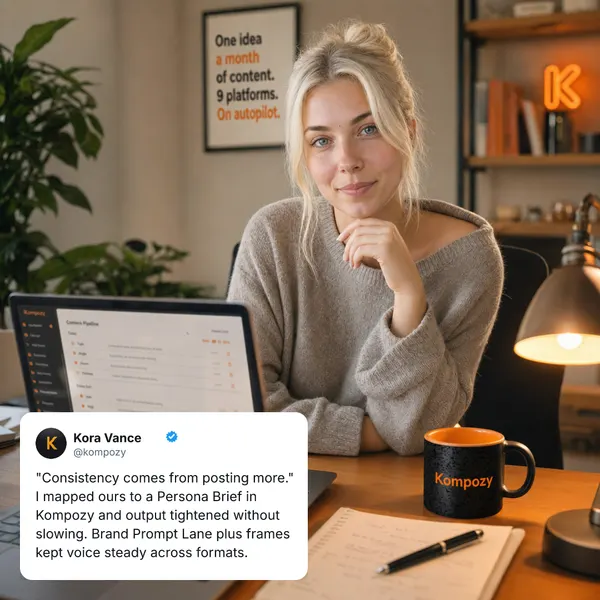
A real persona tweet graphic from the Kompozy workspace. It shows the kind of original, on-voice post that LinkedIn is not targeting.
Who is this for, and who should skip it?
Best for:
- LinkedIn creators who use pods or auto-engagement tools and need to know the risk
- B2B teams that schedule original posts and want to confirm that is still fine
- Agencies auditing which automation tools their clients run
Not ideal for:
- Readers looking for exact enforcement rules, which LinkedIn has not published here
- Accounts that want growth from fake likes or comments, since that is the target
- Anyone outside the EU expecting EU-specific numbers to describe their market
Frequently asked questions
What did LinkedIn report about inauthentic activity in 2026?
In its EU Digital Services Act disclosure surfaced in early September 2026, LinkedIn reported a 46% increase in detected instances of inauthentic activity in the first half of 2026 compared with the second half of 2025. The named targets include engagement pods, external apps that automate posting, and AI-generated "slop" engagement.
Does this mean LinkedIn is banning all automation and scheduling?
No. LinkedIn's enforcement is behavioral — it targets tools and accounts that mimic bot behavior, such as fake likes and comments, engagement pods, mass connection or DM blasts, and services that automate your logged-in session. Scheduling original posts through sanctioned publishing is a different, permitted activity.
Is publishing AI-generated content on LinkedIn now risky?
Using AI to help create content is not itself the problem. The risk is publishing obvious, generic AI output at high volume — the "AI slop" LinkedIn and its members flag. Original, differentiated content that happens to be AI-assisted, posted at a normal cadence, is not what the enforcement targets.
How can I keep automating my LinkedIn workflow safely?
Separate engagement automation (risky) from content automation (fine). Do not use tools that like, comment, follow, or DM for you or that puppet your browser session. Do use a generation engine that creates original posts and publishes them through official integrations on a real schedule — that is the model Kompozy follows.
How do we know this?
We checked every figure, date, quote and product claim on this page against the sources listed below on 2026-10-23, and removed or rewrote anything we could not confirm. LinkedIn's figures come from Social Media Today's write-up of its EU DSA disclosure. Kompozy plan and format details come from kompozy.io.
Sources
- Social Media Today — LinkedIn increases push against inauthentic activity (read 2026-10-23)
- Kompozy — Pricing and plans (read 2026-10-23)
Related news
- LinkedIn Scales Up AI Detection for Automated Content, Blocking Billions of Automation Attempts and Suppressing Reach for Flagged Posts
- LinkedIn Says More Than a Million Members Have Used Its "AI Slop" Report Button — and Flagged Content Now Gets 40% Fewer Views
- Snapchat and LinkedIn Both Cracked Down on AI 'Slop' the Same Week — One in Video, One in Text
- The Reporting on LinkedIn Organic Reach Piled Up in 2026: Reach Is Down, and Outbound Clicks Are Down Harder