DeepSeek V4 Pro 0813 Review (2026): The GA Flagship That Ships Frontier-Class Coding at Open-Weight Prices
DeepSeek V4 Pro 0813 review 2026. Honest scoring on reasoning, coding, context, pricing, open weights — and where a model stops and a content engine begins.
Published 2026-08-12 · Updated
Short answer
DeepSeek V4 Pro 0813 is the August 13, 2026 GA build of DeepSeek's flagship: a 1.6T-parameter open-weight model with a 1M-token context, MIT-licensed weights, and low, high, and max reasoning effort. It scores 87.9 on Terminal Bench 2.1 and 62.7 on DeepSWE, per DeepSeek, and costs $0.66/$1.98 per million tokens off-peak. It writes and codes; it makes no media.
Key takeaways
- 0813 is the GA release of V4-Pro and supersedes the April preview.
- DeepSeek reports 87.9 on Terminal Bench 2.1 and 62.7 on DeepSWE for 0813.
- API price: $0.66/$1.98 per million tokens off-peak, double in weekday peak windows.
- Weights are MIT-licensed on Hugging Face, but self-hosting needs serious hardware.
- It drafts text; Kompozy turns drafts into finished, published media.
DeepSeek V4 Pro 0813, the GA build of DeepSeek's flagship, is the strongest price-to-capability bet in open-weight AI right now. It has a ~1M-token context, MIT-licensed weights, three effort modes, and API rates well under Western frontier models. For reasoning, coding, and long-document work it is an easy recommendation, and self-hosting makes private, high-volume use realistic. Creators should know it writes and reasons but generates no media and publishes nothing.
DeepSeek V4 Pro 0813 is the production release that finally took DeepSeek's flagship out of preview. V4 Pro previewed on April 24, 2026, the smaller V4-Flash tier reached public beta on July 31, 2026, and on August 13, 2026 the Pro tier went GA with the 0813 build — a mixture-of-experts model (roughly 1.6 trillion total / 49 billion active parameters) with a 1M-token context window, a recommended maximum output of 384K tokens, and open weights under the MIT license. On its agent benchmarks DeepSeek reports 87.9 on Terminal Bench 2.1, 62.7 on DeepSWE, and 74.1 on Toolathlon-Verified for 0813, all ahead of the preview, which had posted 80.6% on SWE-bench Verified and 93.5% on LiveCodeBench at max effort.
This review is written by the team building Kompozy, a multi-format content engine that runs its own generation on Claude and OpenAI, not DeepSeek. We are not neutral about content tooling and we will not pretend otherwise. But we run this class of model in production every day, so we are reviewing DeepSeek V4 Pro 0813 on the terms that matter for real work — reasoning and drafting quality, coding, long-context behavior, openness, and cost — not on a leaderboard screenshot.
The honest framing throughout: 0813 is an excellent model, and on price it is arguably the best flagship-class open-weight option available. Where it is the right tool, we say so plainly. Where a creator needs something a language model structurally cannot be — finished media, on a schedule, across platforms — we name the gap and point at the layer that fills it.
What is DeepSeek V4 Pro 0813?
DeepSeek V4 Pro 0813 is the general-availability build of DeepSeek V4 Pro, the flagship tier of the Chinese lab's fourth-generation family. It takes text as input and returns text, and it is tuned for reasoning, coding, and long-context work. The API exposes three reasoning-effort levels (low, high, and max), and DeepSeek's attention design (a compressed sparse variant plus a heavily compressed one) keeps the ~1M-token context affordable, cutting single-token inference compute and KV cache well below the prior V3.2 generation at the million-token setting. It is served behind the deepseek-v4-pro endpoint as DeepSeek-V4-Pro-0813, and the weights are open on Hugging Face under the MIT license, so you can call the hosted API or self-host. What it is not is a media or publishing tool. It generates no images, video, or audio, and it has no design layer, no clip detection, no per-platform captioning, no brand-voice governance, no scheduler, and no platform integrations. It is the reasoning-and-writing layer, and the rest of any content workflow lives elsewhere.
Who is DeepSeek V4 Pro 0813 for?
DeepSeek V4 Pro 0813 fits a wide band of users because that is the point of a cheap, strong, open-weight flagship. Developers building agents and automations get near-frontier coding capability at a price that survives high call volume, plus the option to self-host and a stable version ID to pin against. Knowledge workers get a capable daily driver for analysis, drafting, and research, with a context window big enough to hold a whole document set and a ~384K-token output for large single-call results. Creators and marketing teams get a strong, nearly-free drafting brain for scripts, captions, and long-form copy — provided they understand it produces the words, not the finished post. It is the wrong tool, on its own, for anyone whose actual deliverable is media: video, carousels, branded images, or a scheduled multi-platform calendar. For those jobs the model is one input, and you still need a production-and-distribution layer around it.
How does DeepSeek V4 Pro 0813 score in our review?
| Dimension | Score | Why |
|---|---|---|
| Reasoning & knowledge work | 4.6 / 5 | The max-effort mode is competitive with Western frontier models on hard reasoning; DeepSeek reports 42.7 on HLE without tools and 60.0 with tools for 0813. |
| Coding & agentic ability | 4.7 / 5 | 87.9 on Terminal Bench 2.1 and 62.7 on DeepSWE, per DeepSeek, up sharply from the preview. A genuinely strong, cheap coding and agent brain. |
| Long-context handling | 4.5 / 5 | A ~1M-token window plus a compressed attention design keeps full-transcript and full-document work affordable and coherent; ~384K-token max output. |
| Writing / content drafting | 4.2 / 5 | Strong, controllable drafting — but like any raw model it holds no persistent brand voice, so consistency across a content set depends on your prompting or scaffolding. |
| Pricing & value | 4.9 / 5 | $0.66/$1.98 per million input/output tokens off-peak ($1.32/$3.96 at peak), with cache hits far cheaper, still well below comparable frontier models. The price-to-capability ratio is the headline and it earns it. |
| Openness & self-hosting | 4.6 / 5 | MIT-licensed open weights on Hugging Face mean full control and no per-token bill if you self-host — though the 1.6T flagship needs serious hardware. |
| Availability & access | 4.4 / 5 | A clean first-party API with a stable version ID plus downloadable weights. Now GA, so it is a production-safe pin rather than a moving preview. |
| Content-workflow completeness | 1.5 / 5 | Not a flaw, a category fact: no image, video, or audio generation, no design, no scheduler, no publishing. A model is a fraction of a content pipeline. |
What are the pros and cons of DeepSeek V4 Pro 0813?
Pros
- Frontier-class agentic coding at open-weight prices: 87.9 on Terminal Bench 2.1 and 62.7 on DeepSWE, per DeepSeek.
- $0.66/$1.98 per million input/output tokens off-peak, with cache hits far cheaper, well below comparable Western frontier models.
- MIT-licensed open weights, so you can self-host for private, high-volume drafting with no per-token bill.
- A ~1M-token context and ~384K-token max output hold a full transcript and return a whole batch of drafts in one call.
- Three effort modes let you match cost and depth to the job.
- A stable, versioned GA model ID (DeepSeek-V4-Pro-0813) makes it production-safe to pin in a pipeline.
Cons
- Generates no media — no images, video, or audio — so output is text-only.
- No publishing, scheduling, or platform integration of any kind.
- No persistent brand-voice layer; tone and rules must be re-established per prompt.
- Self-hosting the 1.6T flagship demands serious hardware, so "free" open weights assume you own the compute.
- As a model, it is one input into a workflow you still have to assemble and maintain yourself.
- Some organizations have data-governance or policy concerns about routing content to a China-based API (self-hosting mitigates this).
How much does DeepSeek V4 Pro 0813 cost?
DeepSeek V4 Pro 0813's pricing is the most striking thing about it. On the first-party API it costs $0.66 per million input tokens on a cache miss, $0.022 on a cache hit, and $1.98 per million output off-peak; weekday peak windows (01:00 to 04:00 and 06:00 to 10:00 UTC) cost double. Those rates sit well below comparable frontier models from OpenAI, Anthropic, and Google, and the strong GA-build benchmarks are what make the low price defensible rather than a downgrade. For anyone running a flagship model at volume — agents, automated pipelines, high-throughput drafting — that gap compounds quickly, and the cheap cache-hit rate rewards workloads that reuse a large system prompt or context.
The open-weight story sharpens it further. Because the weights are MIT-licensed and published on Hugging Face, you can self-host and pay nothing per token at all — your only cost is the compute. For a team with the hardware and a privacy or governance reason to keep text in-house, that is a materially different economic model than any closed frontier API offers. The honest caveat is that self-hosting the 1.6T-parameter Pro tier is not trivial; teams without that hardware may lean on the smaller V4-Flash tier for cheap self-hosted volume and reserve 0813 for the hardest work.
As always with a fast-moving model line, treat the figures as a snapshot. DeepSeek has shipped dated builds within the V4 line and now uses peak and off-peak pricing, so verify current API rates and peak windows on DeepSeek's own page before committing budget.
Which use cases does DeepSeek V4 Pro 0813 fit?
| Use case | Fit | Why |
|---|---|---|
| Developer building agents or automations | Strong | Strong agentic and coding results plus rock-bottom per-token cost and a stable version ID — near-frontier capability that survives high call volume. |
| Team that wants to self-host an open-weight flagship | Strong | MIT-licensed weights allow private, no-per-token inference — a real edge over closed frontier APIs, given the hardware. |
| Knowledge worker drafting, analyzing, and researching | Strong | Competitive reasoning at a fraction of the price, with a ~1M-token context for long-document work. |
| Creator drafting scripts, captions, and long-form copy | OK | It writes well and cheaply, but produces words, not finished posts, and holds no persistent brand voice on its own. Good as the drafting layer inside a larger workflow. |
| Marketer who needs finished, scheduled multi-platform content | Weak | A model generates no media and publishes nothing. You would bolt on image/video generation, design, a scheduler, and platform integrations. |
| Organization with strict data-residency requirements | OK | The hosted API is China-based, which some policies exclude, but the open weights let you self-host entirely in your own environment. |
| Coder doing whole-project work | Strong | Strong reported agent-coding scores (62.7 on DeepSWE, 87.9 on Terminal Bench 2.1) plus a max-effort mode make it a strong, cheap engineering brain. |
What are the best DeepSeek V4 Pro 0813 alternatives?
- DeepSeek V4-Flash — the smaller, cheaper tier for high-volume drafting and easier self-hosting; pick Flash for volume, 0813 for the hardest reasoning and coding.
- Claude Opus 5.5 / Fable 5.1 — the current top Anthropic models; the pick when you need maximum capability on the hardest tasks and cost is secondary.
- OpenAI GPT-5.6 — a competing closed frontier family; compare on your specific workload, tooling, and price.
- Kimi K3 / GLM-5.2 — other strong families DeepSeek itself benchmarks against; test them against 0813 on your own prompts.
- Kompozy — not a model but the content engine that runs Claude and OpenAI generation and adds media, design, and multi-platform publishing on top.
Does Kompozy compete with DeepSeek V4 Pro 0813?
Honest positioning: DeepSeek V4 Pro 0813 is a model, and a very good, very cheap flagship one. If your job is to build on a model, draft text, reason over long documents, or self-host for privacy, 0813 is a strong default and this review will not talk you out of it. We run this class of model in production ourselves — though for Kompozy's own generation we use Claude and OpenAI, not DeepSeek.
Kompozy is not a better DeepSeek V4 Pro 0813 — it is the layer above a model. Where 0813 stops at text, Kompozy turns text into finished, on-brand content: it renders Persona Shorts and HeyGen avatar video, carousels, quote cards, and infographics; reframes and captions clips per platform; and generates blogs and newsletters — all governed by a Persona Brief so the voice stays consistent across formats.
Then it schedules and publishes across nine destinations — the eight primary social platforms plus blog and email — on Autopilot with a per-post review pipeline. Pricing is credit-based: Starter $199/mo (5,500 credits), Pro $499/mo (18,000 credits), and a custom, sales-led Enterprise plan.
The clean way to decide: if you want a model to operate — cheaply, or privately via self-hosting — use DeepSeek V4 Pro 0813. If you want finished, on-brand, scheduled content and would rather not assemble a model plus image and video generation plus design plus a scheduler plus nine integrations yourself, use Kompozy. The strongest setup runs both: 0813 as the upstream drafting brain, Kompozy as the production-and-distribution engine.
What does this look like in Kompozy?
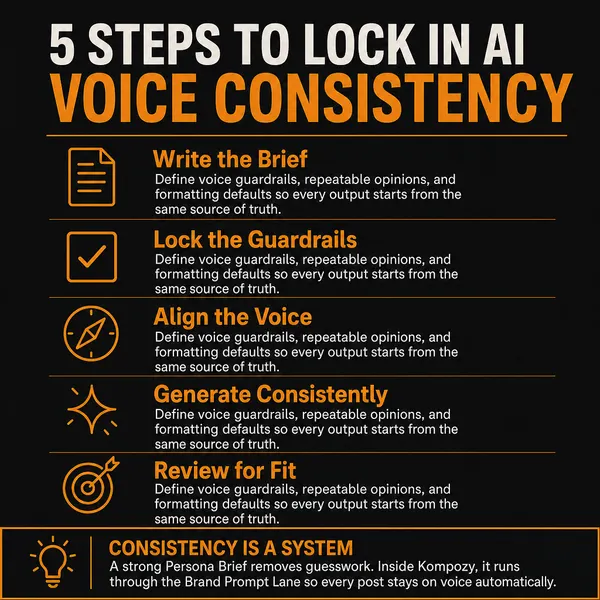
An infographic photo post made in the Kompozy workspace. It shows a format that dense, model-written text can be turned into.
Who is this for, and who should skip it?
Best for:
- Developers who want a stable, versioned model ID for agent pipelines
- Teams with GPU capacity that want an open-weight flagship
- Long-document work that needs a 1M-token context
Not ideal for:
- Anyone who needs images, video, or scheduled posts
- Self-hosters without large GPU clusters (V4.1-Flash is the easier pick)
- Organizations that cannot route data to a China-based API
Frequently asked questions
Is DeepSeek V4 Pro 0813 worth it in 2026?
For model use, yes — it is one of the best price-to-capability bets available. The GA build offers frontier-class reasoning and coding (87.9 on Terminal Bench 2.1 and 62.7 on DeepSWE, per DeepSeek), a ~1M-token context, and MIT-licensed open weights, at API rates well below comparable Western frontier models. For high-volume drafting or private self-hosting, the value is hard to beat. For finished media and publishing, it is the wrong category.
What is the difference between DeepSeek V4 Pro 0813 and V4-Flash?
V4 Pro 0813 is the higher-capability flagship (roughly 1.6T total / 49B active parameters) for the hardest reasoning and coding; V4-Flash is smaller and faster (about 284B / 13B active) for cheap, high-volume work and easier self-hosting. Both share the ~1M-token context and the V4 architecture. Pick 0813 for depth, Flash for volume.
How much does DeepSeek V4 Pro 0813 cost?
On DeepSeek's API it is $0.66 per million input tokens (cache miss), $0.022 on a cache hit, and $1.98 per million output off-peak, with peak hours at double. Because the weights are open under the MIT license, you can also self-host and pay only for your own compute. Confirm current rates on DeepSeek's pricing page.
Can DeepSeek V4 Pro 0813 generate images or video?
No. It is a text-and-reasoning model — it writes, summarizes, reasons, and codes, but it produces no images, video, or audio and publishes nothing. To turn its drafts into published media you pair it with a content engine that renders and publishes, like Kompozy.
Is DeepSeek V4 Pro 0813 open source?
The weights are open under the MIT license and published on Hugging Face, so you can download and self-host the model. That makes private, high-volume drafting realistic with no per-token API fee — though the 1.6T flagship needs substantial hardware, so many self-hosters run the smaller 284B V4-Flash tier for volume.
Is DeepSeek V4 Pro 0813 good for coding?
Yes. On the GA build DeepSeek reports 87.9 on Terminal Bench 2.1, 62.7 on DeepSWE, and 74.1 on Toolathlon-Verified, and the max-effort mode plus open-weight tooling make it a strong, cheap engineering and agent brain. For everyday coding it is competitive with far more expensive closed models.
Should I pick DeepSeek V4 Pro 0813 or Kompozy?
They are not substitutes. DeepSeek V4 Pro 0813 is a model you operate; Kompozy is a content engine that runs Claude and OpenAI generation and adds media, design, and multi-platform publishing. Pick 0813 to build on or draft with; pick Kompozy to produce and ship finished content across platforms. The strongest setup uses 0813 to draft and Kompozy to produce and publish.
How do we know this?
We checked every price, date, benchmark, and feature claim on this page against the sources listed below on 2026-10-23 and corrected the ones that had changed or could not be confirmed. DeepSeek facts come from its release note, change log, pricing page, and the 0813 Hugging Face model card. Kompozy plan details come from kompozy.io/pricing. Ratings are our editorial judgment.
Sources
- DeepSeek API Docs — DeepSeek-V4-Pro GA release (read 2026-10-23)
- DeepSeek API Docs — Change Log (read 2026-10-23)
- DeepSeek API Docs — Models & Pricing (read 2026-10-23)
- Hugging Face — DeepSeek-V4-Pro-0813 model card (read 2026-10-23)
- Hugging Face — DeepSeek-V4-Pro (preview) model card (read 2026-10-23)
- Kompozy — Pricing (read 2026-10-23)
- AI Content Repurposing — The complete methodology for turning one source into 25-35 pieces of native-format content across every platform — without producing AI slop.
- Autonomous Content Creation — Most "autonomous" AI content is slop.
- AI Brand Voice & Persona — Without a Persona Brief, every AI output averages to the LLM default voice.
See DeepSeek V4 Pro 0813 vs Kompozy comparison → · Get Started →