Google Mixboard Review (2026): Honest Verdict on the Nano Banana AI Mood-Board Tool
Google Mixboard review 2026: honest verdict on the Nano Banana AI mood-board tool from Google Labs — strengths, limits, and its September 28 shutdown.
Published 2026-09-02 · Updated
Short answer
Google Mixboard was a free Google Labs mood-board tool that used the Nano Banana image model to turn a prompt into an editable board of images. Google shut it down on September 28, 2026 and said every board, image, upload and prompt would be permanently deleted. It was good for quick visual ideation, but it never captioned, scheduled or published anything, so this review is mostly about what to use instead.
Key takeaways
- Mixboard went offline after September 28, 2026, and Google said all boards, images, uploads and prompts would be permanently deleted.
- While it ran, it was free and fast for exploring a look with natural-language edits on Nano Banana.
- It stopped at the board: no captions, brand voice, scheduling or publishing.
- Nano Banana editing carries on in the Gemini app, and Google Pics or Canva cover the ideation job now.
Mixboard is a fun, fast way to explore a visual direction. Natural-language editing on Nano Banana makes concepting easy, and it was free. It is an ideation scratchpad, though: it exports a PNG or a presentation and stops, with no captioning, brand voice, scheduling, or publishing. One fact decides the verdict. Google shut it down on September 28, 2026 and said it would permanently delete every board, so there is nothing left to adopt.
Google Mixboard is one of the more likeable things Google Labs shipped in the last year: a Pinterest-style AI board where you type an idea and it generates a canvas of visuals you can remix by talking to it. For pure brainstorming — pinning down a palette, a mood, a product concept — it is fast and it is fun, and until now it was free. If you tried it and enjoyed it, that reaction is fair.
This review has to lead with the thing that overrides the rest, though: Google retired Mixboard on September 28, 2026. Google's Labs support page says the site goes offline after that date, shared board links stop working, and all boards, generated images, uploaded assets, and prompt history are permanently deleted. The Mixboard page now just says "The Mixboard experiment has ended." So the honest recommendation is no longer "should you sign up." It is "pick a tool that will still be around."
Even setting the shutdown aside, Mixboard was always a narrow tool by design. It is upstream ideation. It helps you decide what something should look like; it does not produce the finished, on-brand, published content that a creator actually needs to ship. The scores below reflect both realities: strong at concepting, weak at everything downstream, and now sunset.
I run Kompozy, a content generation and publishing engine, so I have a stake in the "what comes after the mood board" question. I have kept the scoring to what Mixboard actually did and did not do — no invented weaknesses — and the Kompozy section is clearly labeled as positioning, not a rating.
What was Google Mixboard?
Mixboard is an experimental AI concepting board from Google Labs. You start from a text prompt or a pre-populated example board, and it generates a board of images to react to. You then mix in your own images, add AI-generated text blocks, and refine everything with natural-language edits plus one-click "regenerate" and "more like this" variations. The image generation and editing run on Nano Banana, Google's Gemini image model, and finished boards export as a PNG or a presentation and can be shared via a link. It launched as a U.S.-only public beta on September 23, 2025 and expanded to more than 180 countries on October 30, 2025. It never left beta, and Google discontinued it on September 28, 2026, about a year after launch. Nano Banana image generation and editing carries on inside the Gemini app.
Who was Google Mixboard for?
Mixboard suited people at the very front of a creative process — someone planning a room redesign, an event theme, a product concept, or a campaign's visual direction who wanted to explore looks quickly without design skills. It was a brainstorming surface, not a production tool, and it fit best when the deliverable was "a clearer idea," not "a finished asset." Since the September 28, 2026 shutdown, though, it fits nobody. The tool and the boards are gone.
How does Google Mixboard score in our review?
| Dimension | Score | Why |
|---|---|---|
| Ideation speed | 4.5 / 5 | Prompt-to-board quickly, with a full canvas of options to react to; genuinely fast for exploring a direction. |
| Image quality (Nano Banana) | 4.2 / 5 | Nano Banana handles complex edits and realistic merges well; quality is a real strength. |
| Natural-language editing | 4.4 / 5 | Typing "combine these" or "make it warmer" works smoothly; no design skills required. |
| Mood-board / concepting workflow | 4.0 / 5 | A clean canvas for mixing generated and uploaded imagery with text blocks. |
| Export & handoff | 2.8 / 5 | PNG or presentation export only — fine for a handoff, thin for a production pipeline. |
| Content production (formats/captions) | 1.0 / 5 | None. It does not make captioned video, carousels, blogs, or platform-ready posts. |
| Scheduling & publishing | 1.0 / 5 | No scheduler and no publishing to any platform whatsoever. |
| Brand consistency & governance | 1.5 / 5 | No persona identity, no brand voice, no banned-word controls across pieces. |
| Longevity & reliability | 1.0 / 5 | Shut down September 28, 2026, with all boards permanently deleted. The deciding factor. |
What were Google Mixboard's pros and cons?
Pros
- Fast, low-friction ideation — a prompt yields a full board of options in seconds.
- Natural-language editing on Nano Banana makes complex edits and merges easy with no design skills.
- Mixes AI-generated visuals with your own uploads and AI text blocks on one canvas.
- One-click "regenerate" and "more like this" make exploring variations effortless.
- It was free during the Labs beta, with a low barrier to trying it.
- Clean, approachable interface aimed at non-designers.
Cons
- Shut down on September 28, 2026, and Google said all boards, images, and prompts would be permanently deleted.
- Purely an ideation tool: no captioned video, no carousels, no blogs, no platform-ready posts.
- No scheduling and no publishing to any platform.
- No brand voice, persona identity, or governance across a set of pieces.
- Export is limited to PNG or a presentation — thin for feeding a real production pipeline.
- Never left beta and was U.S.-first, so it was always an experiment, not a product to depend on.
Was Google Mixboard free?
Mixboard was free. It shipped as a Google Labs beta with no paid tier, which made it easy to try and lowered the stakes of experimenting. On price alone, "free" is unbeatable, and for pure brainstorming that mattered.
But price is not the axis that decides this. A free tool that deletes your work on a fixed date and cannot produce or publish anything is free in the narrowest sense — you still pay in the production and distribution steps it does not touch, and you lose whatever you stored the moment the beta ends. Anyone who used it for more than a quick sketch had to export and move their work before September 28, 2026.
The honest framing: Mixboard was a free ideation utility, and a good one. It was never priced or built to be the tool that turns a concept into a week of on-brand, published content — and with the shutdown, it is no longer a tool to build on at any price.
Which jobs did Google Mixboard fit, and which did it miss?
| Use case | Fit | Why |
|---|---|---|
| Quickly exploring a visual direction or palette | Strong | This is exactly what Mixboard did well — prompt, generate, remix, iterate. |
| Non-designers planning a room, event, or product concept | Strong | Natural-language editing lets anyone shape a look without design skills. |
| Handing a mood board to a designer or producer | OK | PNG and presentation export cover a basic handoff, if a thin one. |
| Producing finished social posts (video, carousels) | Weak | Mixboard makes none of these formats — it stops at a board of images. |
| Maintaining one brand voice across a content set | Weak | No persona identity, brand voice, or governance layer exists. |
| Scheduling and publishing to platforms | Weak | No scheduler and no publishing capability at all. |
| Building a repeatable, durable content workflow | Weak | Google shut it down on September 28, 2026 and deleted the boards. |
What should you use instead of Google Mixboard?
- Google Pics — the sibling Nano Banana image workspace Google is keeping, for editing and generating stills.
- Canva — for turning a concept into designed, branded graphics and simple video.
- Midjourney — for higher-ceiling generative image exploration if quality is the priority.
- Kompozy — the content engine that turns a concept image into finished, on-brand posts published across nine destinations.
How does Google Mixboard compare with Kompozy?
Kompozy and Mixboard live on opposite ends of the same workflow, which is why "Mixboard vs Kompozy" is not really a fair fight — they do different jobs. Mixboard is the front end: it helps you decide what a look should be. Kompozy is the back end: it takes a decided look and turns it into finished, on-brand, published content.
Where Mixboard exports a PNG and stops, Kompozy takes a concept or reference image and renders face-locked Persona Photos, brand-exact carousels through HyperFrames, quote cards, blogs, and newsletters — all held to one Persona Brief so a batch reads as one creator — then schedules and publishes across the eight social platforms plus blog and email.
The other honest difference, sharpened by the shutdown, is durability. Mixboard's boards were deleted after September 28, 2026; Kompozy persists generated media to storage you own. If you liked Mixboard for ideation, keep using something like it for that — but the moment you have a direction you want to ship, the tool that finishes and publishes it is a different category of product. Kompozy is that category.
What does this look like in Kompozy?
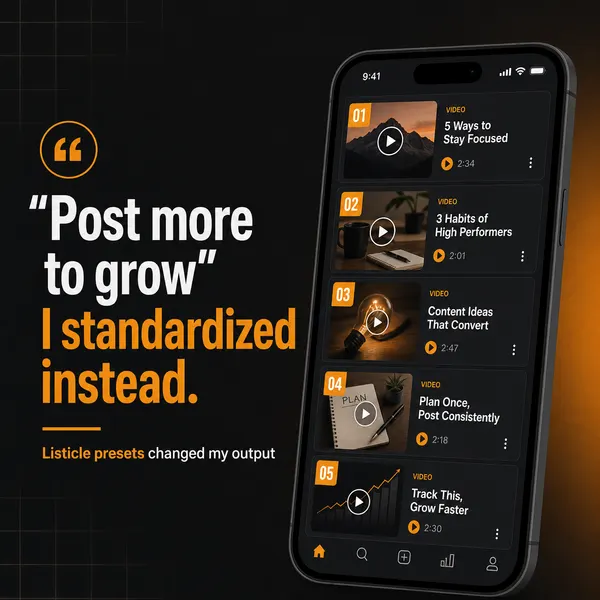
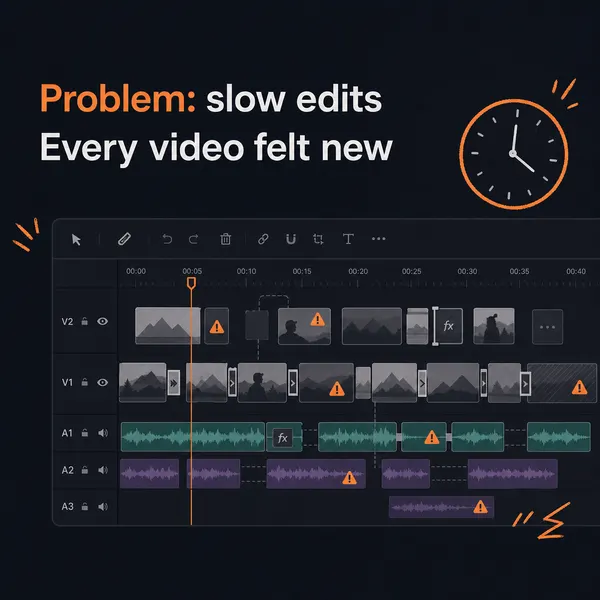
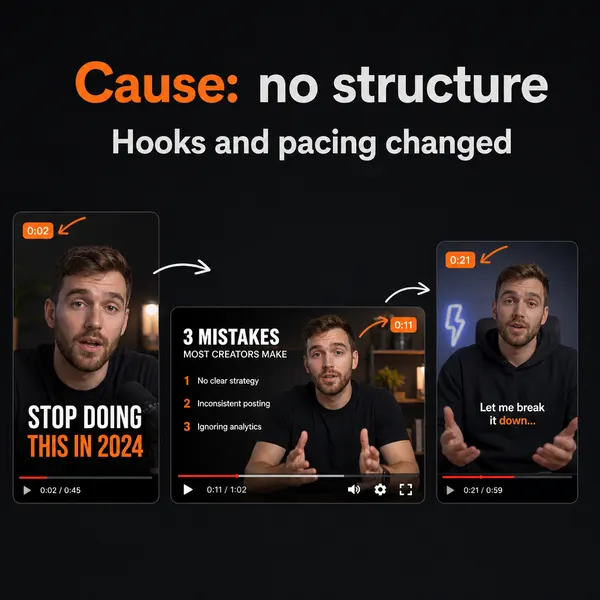
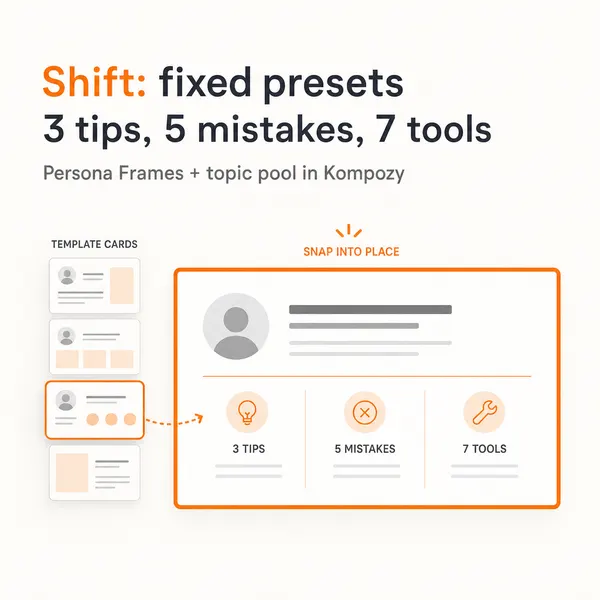
This is a real five-slide carousel made in the Kompozy workspace. It shows the kind of finished, postable format that a mood board like Mixboard does not produce on its own.
Who is this for, and who should skip it?
Best for:
- Former Mixboard users looking for what to use now
- Anyone comparing AI mood-board tools for early visual ideation
- Teams weighing whether a free Labs experiment is safe to build on (this one wasn't)
Not ideal for:
- Anyone hoping to sign up, because the tool is offline
- Creators who need finished, captioned, published posts, where Canva or a content engine like Kompozy fits better
Frequently asked questions
Is Google Mixboard worth using in 2026?
No. Google shut Mixboard down on September 28, 2026 and said all boards would be permanently deleted. For ideation now, use Google Pics or Canva, and use a durable tool for real production.
When did Google Mixboard shut down?
On September 28, 2026. Google's support page says the site goes offline after that date, shared board links stop working, and all boards, generated images, uploaded assets, and prompt history are permanently deleted from Google's servers.
What is Mixboard good at?
Fast, low-friction ideation. You prompt, it generates a board of images, and you remix them with natural-language edits on Nano Banana plus one-click variations. It is strong for exploring a palette, mood, or concept without design skills.
What is Mixboard not good for?
Anything downstream of ideation. It does not make captioned video, carousels, blogs, or platform-ready posts, has no brand voice or governance across pieces, and cannot schedule or publish. Its export is limited to a PNG or a presentation.
Is Google Mixboard free?
Yes, it was free as a Google Labs beta with no paid tier. That said, a free tool that deletes your work on a fixed shutdown date and cannot produce or publish content is only free in the narrowest sense.
What should I use instead of Mixboard?
For ideation, Google Pics (the Nano Banana workspace Google is keeping) or Canva. To turn a concept into finished, published content, a content engine like Kompozy takes a reference image and generates persona/avatar video, carousels, quote cards, blogs, and newsletters, then schedules and publishes across nine destinations.
What model powers Google Mixboard?
Nano Banana, Google's Gemini image model. It powers Mixboard's image generation and the natural-language edits and merges. Nano Banana continues inside the Gemini app after Mixboard is retired.
How do we know this?
We checked every price, date, benchmark and competitor feature on this page against the sources listed below on 2026-10-23 and corrected what had changed. Google's Labs support page confirms the shutdown date and what was deleted. Kompozy plan details come from kompozy.io/pricing. The scores are Kompozy's editorial ratings.
Sources
- Google — Mixboard: a new AI-powered concepting board from Google Labs (read 2026-10-23)
- Google Labs Help — Mixboard shutdown and export (read 2026-10-23)
- Google Labs — Mixboard ("The Mixboard experiment has ended") (read 2026-10-23)
- PPC Land — Google expands Mixboard to 180 countries (read 2026-10-23)
- Touchit — Mixboard AI od Googlu končí (read 2026-10-23)
- Kompozy — Pricing (read 2026-10-23)
- AI Content Repurposing — The complete methodology for turning one source into 25-35 pieces of native-format content across every platform — without producing AI slop.
- Autonomous Content Creation — Most "autonomous" AI content is slop.
- AI Brand Voice & Persona — Without a Persona Brief, every AI output averages to the LLM default voice.