K2 Horizon Review (2026): Honest Verdict on MBZUAI's Six Fully Open AI Models
K2 Horizon review 2026. An honest verdict on IFM's six fully open text models from 0.9B to 375B — openness, reasoning, scale, and where the scope stops.
Published 2026-09-03 · Updated
Short answer
K2 Horizon is a family of six fully open text models from MBZUAI's Institute of Foundation Models, released September 3, 2026 under Apache 2.0 with weights, code, training data and methodology. Sizes run from 0.9B to a 375B mixture-of-experts flagship with a 524,288-token context. Artificial Analysis now scores the 375B at 31, against a 19 median for comparable open-weight models. It makes text, not media.
Key takeaways
- Six models: 0.9B, 3.7B, 7B, 32B, 36B-A4B and the 375B-A23B flagship, built on one recipe.
- Apache 2.0, with weights, code, training data and methodology all published.
- Artificial Analysis lists the 375B at 31 on its Intelligence Index vs a 19 open-weight median (checked October 23, 2026).
- The flagship has a 512K (524,288-token) context and validated vLLM and SGLang recipes.
- Text in, text out: no images, video, audio or publishing.
K2 Horizon is one of the most consequential open releases of 2026: six text models from 0.9B to 375B, shipped fully open (weights, code, training data, and methodology) under Apache 2.0. The family is reproducible and self-hostable, scaling from the edge to a 512K-context flagship. Artificial Analysis now scores the 375B at 31 on its Intelligence Index against a 19 median for comparable open-weight models, which is strong for an open model. It generates no media and publishes nothing, so judge it on text intelligence.
Most coverage of K2 Horizon will land on one line — "the largest fully open AI model just shipped" — over a parameter count. This review goes further. We build a content engine and read model releases for a living, so the goal is to say what K2 Horizon is genuinely good at, where its scope honestly stops, and whether a text-and-reasoning model belongs anywhere in a creator's or founder's stack.
Short version up top: K2 Horizon is a serious open model family. The Institute of Foundation Models (IFM) at MBZUAI released it on September 3, 2026 — six models from 0.9 billion to 375 billion parameters, published fully open under the Apache 2.0 license. "Fully open" is the load-bearing phrase: IFM released not just the weights but the source code, the training data, and the training methodology, which is rarer and more useful than a weights-only drop.
The flagship 375B-A23B ships with a native 524,288-token context, and third-party evaluator Artificial Analysis scores it at 31 on its Intelligence Index against a median of 19 for comparable open-weight models (as listed on October 23, 2026). For an open, reproducible, self-hostable family that spans the edge to the datacenter, that is a strong package.
The honest catch is twofold, and both are category facts rather than flaws. First, scope: K2 Horizon is text-only. It writes, reasons, codes, and uses tools; it generates no images, video, or audio, and it publishes nothing. Second, timing: it launched on September 3, 2026, so tooling, fine-tunes, and independent reproductions are still landing — treat any single benchmark as a launch-window figure until the wider community confirms it.
This review covers what K2 Horizon actually is in 2026, how its openness, reasoning, and scale hold up, where it is honestly the wrong tool, and who should use it versus who should keep looking.
What is K2 Horizon?
K2 Horizon is a family of six open large language models from the Institute of Foundation Models (IFM), the model lab at Mohamed bin Zayed University of Artificial Intelligence (MBZUAI), with teams in Abu Dhabi, Paris, and Silicon Valley. The six share a common architecture and training recipe, which is the point: you can move between sizes and route workloads across the fleet without relearning the model. The 0.9B targets edge deployment; the 3.7B is built to be easy to fine-tune; the 7B is small enough to run on a phone; and the 32B is built for local and on-premises hosting. The two largest are sparse mixture-of-experts designs — the 36B-A4B (about 4B active per token, with a mixture-of-value attention mechanism) and the flagship 375B-A23B (about 23B active per token), engineered for long-horizon agentic work and complex reasoning. What makes the release notable is the openness. Every model is published with weights, code, training data, and methodology under Apache 2.0, which permits unrestricted commercial use and self-hosting, so the models can be reproduced, audited, and adapted rather than merely run. They are text-only — tuned for reasoning, mathematics, coding, agentic tool use, and long context — with the 375B carrying a native 524,288-token (512K) context window. What K2 Horizon does not do is anything beyond text: no image, audio, or video generation, no captioning or design, no scheduler, and no publishing. It is model infrastructure, in the same lane as other open foundation models, not a content product.
Who should use K2 Horizon?
The clearest fit is anyone whose output is text or software: developers and founders who want a capable, low-cost, self-hostable model for drafting, extraction, reasoning, and agentic work; researchers and teams who value a fully reproducible family they can inspect and fine-tune rather than a closed API; and operators who want to route by size — prototype on a 7B, serve on a 36B or 375B, run something on the edge — from one consistent recipe. It is the wrong tool for someone whose actual output is published content — video, images, carousels, social posts — because producing and distributing that content is entirely outside what the model does. Non-technical creators who want a hosted, log-in-and-go experience should also look elsewhere; K2 Horizon is a model you deploy and drive through an API or your own infrastructure, not a finished app.
How does K2 Horizon score in our review?
| Dimension | Score | Why |
|---|---|---|
| Openness & reproducibility | 4.8 / 5 | Fully open — weights, code, training data, and methodology under Apache 2.0. Rare transparency at this scale. |
| Size coverage / fleet design | 4.5 / 5 | Six models from 0.9B to 375B sharing one recipe, so you can route workloads by size with consistent behavior. |
| Reasoning, math & coding | 4.2 / 5 | Tuned for reasoning and agentic tool use; the 375B scores 31 on Artificial Analysis's Intelligence Index, against an open-weight median of 19. |
| Long context | 4.3 / 5 | The 375B ships a native 524,288-token (512K) window, strong for long-document and long-horizon agentic work. |
| Cost / self-hostability | 4.5 / 5 | Apache 2.0 with open weights means self-hosting and unrestricted commercial use — infrastructure cost instead of per-token API fees. |
| Ecosystem & tooling maturity | 3.5 / 5 | Launched September 3, 2026 with day-one inference support, but fine-tunes, quantizations, and independent reproductions are still landing. |
| Benchmark transparency | 4.0 / 5 | Full openness plus a third-party Intelligence Index score help, but broad independent leaderboard results were still early at release. |
| Content / social media production | 1.0 / 5 | Not the product. No image, video, audio, captioning, or design output of any kind. |
| Multi-platform publishing | 1.0 / 5 | K2 Horizon produces text; it does not post. No scheduler, no platform integration. |
What are the pros and cons of K2 Horizon?
Pros
- Fully open under Apache 2.0 — weights, code, training data, and methodology, so it can be reproduced, audited, and self-hosted.
- Six models sharing one architecture and recipe, spanning 0.9B on the edge to a 375B MoE flagship.
- Competitive open-model intelligence: the 375B scores 31 on Artificial Analysis's Intelligence Index versus a median of 19.
- Long context: a native 524,288-token (512K) window on the flagship for long-document and agentic work.
- Unrestricted commercial use and self-hosting shift cost from per-token fees to your own infrastructure.
- Consistent behavior across sizes makes it easy to prototype small and serve large from the same family.
Cons
- Text-only — no image, video, audio, captioning, or design output of any kind.
- No publishing, scheduling, or platform integration; it produces text, not posts.
- Tuned for reasoning and engineering, so it is not built for brand voice or creative copywriting out of the box.
- Brand new (launched September 3, 2026) — fine-tunes, quantizations, and independent evaluations are still early.
- Self-hosting the larger models needs real hardware; the flagship 375B is not a laptop deployment.
- Reaching it means an API or your own infrastructure — a barrier for non-technical creators.
How much does K2 Horizon cost?
K2 Horizon has no subscription: it is released under the Apache 2.0 license, free to download, run, fine-tune, and use commercially. On its own terms that is an aggressive price — a fully open, reproducible model family with nothing withheld — and the openness adds a lever most closed rivals do not: if you have the hardware, you pay infrastructure instead of per-token API fees, which matters most for high-volume drafting, extraction, and agentic work.
The catch is the familiar one for any open model: "free weights" is not "free outcome." Self-hosting the larger models requires real GPUs and operational effort, and the 375B in particular is a datacenter deployment, not a laptop one. For a developer or a team that already runs infrastructure, that math is fine — the model is an input to a process they operate. For someone hoping an open model is a content shortcut, the license is the wrong line item entirely, because no amount of free inference adds media rendering, design, or publishing.
The honest framing on value: K2 Horizon is priced like open, reproducible model infrastructure, and on those terms it is a genuinely good deal. Judge it against other open foundation models and against closed APIs on a total-cost-of-ownership basis, not against a content tool.
Which jobs is K2 Horizon good and bad at?
| Use case | Fit | Why |
|---|---|---|
| Drafting, extraction, and reasoning over text at volume | Strong | This is the model's wheelhouse, and self-hosting makes high-volume runs cost-effective. |
| A reproducible, self-hostable model you can inspect and fine-tune | Strong | Full openness under Apache 2.0 — training data, code, and methodology included — is exactly the use case it is built for. |
| Routing workloads across sizes from the edge to a datacenter | Strong | Six models on one recipe give consistent behavior whether you serve a 7B or the 375B. |
| Agentic, tool-using, long-context tasks | OK | The 375B's 512K context and agentic tuning fit, though you supply the surrounding orchestration. |
| Writing on-brand copy, captions, or scripts as-is | Weak | A base reasoning model is not tuned for brand voice; content has no single right answer to optimize toward without a wrapper. |
| Producing video, images, or carousels for social | Weak | No media generation of any kind. Entirely outside K2 Horizon's scope. |
| Scheduling and publishing across platforms | Weak | No publishing layer and no scheduler. It produces text, not posts. |
| A hosted, no-code tool for non-technical creators | Weak | It is a model you deploy and drive through an API or your own infrastructure — not a log-in-and-go product. |
What are the best K2 Horizon alternatives?
- Kimi K2.7 Code — Moonshot AI's open-weight coding model, a strong pick if your priority is agentic software engineering rather than a general text family.
- DeepSeek open models — another capable open family worth benchmarking against K2 Horizon on your own reasoning and coding tasks.
- Closed frontier APIs (Claude, GPT, Gemini) — if you want managed hosting and top-line quality without operating infrastructure, worth weighing on a total-cost basis.
- Kompozy — a different category entirely: not a model to run, but the content generation and publishing engine that turns text into video, images, blogs, and posts across nine platforms.
Can K2 Horizon run your content operation?
If you arrived at this review wondering whether K2 Horizon can run your content operation, the honest answer is no — and that is a category point, not a criticism. K2 Horizon is a text and reasoning family: open, reproducible, and self-hostable, but with no renderer, no design system, no brand-voice layer, and no scheduler, because it was never meant to be a content tool.
The more interesting signal is what a fully open, multi-size family says about the market: text intelligence is becoming a swappable, commoditized component, which means the durable advantage moves to the workflow wrapped around the model. That is precisely the layer Kompozy occupies.
Where K2 Horizon stops at a block of text, Kompozy turns an idea or a draft into 20 content formats — persona and avatar video, clipped shorts, carousels, quote cards, infographics, blogs, newsletters, and platform-native posts — held to one brand voice through a Persona Brief and scheduled across nine platforms plus email and blog.
Kompozy runs that generation on managed Claude and OpenAI models, so there is nothing to deploy or operate; the model choice is our problem, not yours. For a builder the two are complementary: run K2 Horizon self-hosted for cheap, high-volume drafting or an internal agent, then let Kompozy produce and publish the finished, on-brand content around it. Use K2 Horizon for the text intelligence it is built for, and a content engine for the content.
What does this look like in Kompozy?
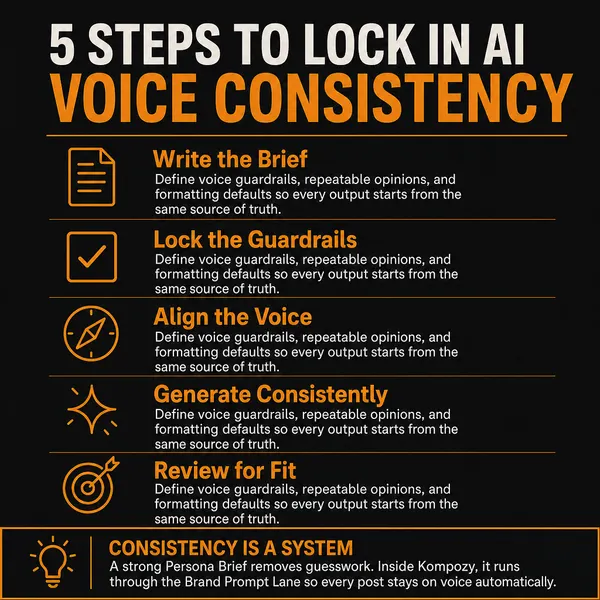
This is a real infographic photo post made in the Kompozy workspace. It shows the kind of finished, postable format that a text model like K2 Horizon does not produce on its own.
Who is this for, and who should skip it?
Best for:
- Developers who want a self-hostable model they can audit and fine-tune
- Teams routing work across model sizes from the edge to the datacenter
- Researchers who need the training data, not just the weights
Not ideal for:
- Non-technical creators who want a log-in-and-go tool
- Teams without GPUs for the larger models, where a managed API is simpler
- Content teams that need video, images or publishing
Frequently asked questions
What is K2 Horizon?
K2 Horizon is a family of six open language models that the Institute of Foundation Models at MBZUAI released on September 3, 2026. They range from 0.9B to 375B parameters and ship under Apache 2.0 with weights, code, training data and methodology. They are text-only.
Is K2 Horizon worth it in 2026?
As an open, reproducible model family, yes. It is worth evaluating if you can self-host or want to inspect the training data. It is not a content tool, since it generates no media and publishes nothing.
How much does K2 Horizon cost?
The models are free under Apache 2.0, including for commercial use. The real cost is hardware, because the 375B flagship is a datacenter deployment rather than a laptop one.
How big is the largest K2 Horizon model?
The 375B-A23B is a sparse mixture-of-experts model with 375 billion total parameters and about 23 billion active per token. It has a native 524,288-token context window.
How does K2 Horizon score on benchmarks?
Artificial Analysis lists the 375B at 31 on its Intelligence Index, against a median of 19 for comparable open-weight models, as of October 23, 2026. Launch coverage quoted a score of 47, so expect the figure to move as the index changes.
Can K2 Horizon generate video or images?
No. It is text-only. To turn its text into published media you need a content engine such as Kompozy on top.
Can I self-host K2 Horizon?
Yes. Apache 2.0 allows self-hosting and commercial use, and the flagship ships with validated vLLM and SGLang recipes. The larger models need substantial GPU hardware.
How do we know this?
We checked every price, date, benchmark and competitor feature on this page against the sources listed below on 2026-10-23 and corrected what had changed. The benchmark figure is the one Artificial Analysis listed on that date. Kompozy plan details come from kompozy.io/pricing. The scores are Kompozy's editorial ratings.
Sources
- Zawya — MBZUAI's Institute of Foundation Models launches K2 Horizon (read 2026-10-23)
- Hugging Face — IFM/K2-Horizon-375B-A23B model card (read 2026-10-23)
- Artificial Analysis — K2 Horizon 375B A23B (read 2026-10-23)
- NYU Shanghai RITS — IFM releases K2 Horizon (read 2026-10-23)
- Kompozy — Pricing (read 2026-10-23)
- AI Content Repurposing — The complete methodology for turning one source into 25-35 pieces of native-format content across every platform — without producing AI slop.
- Autonomous Content Creation — Most "autonomous" AI content is slop.
- AI Brand Voice & Persona — Without a Persona Brief, every AI output averages to the LLM default voice.