Postiz Review (2026): Is the Open-Source AI Scheduler Worth It?
Postiz review (2026): an honest verdict on the open-source, agentic social media scheduler — its AI Smart Agent, 30+ channels, self-hosting, and real limits.
Published 2026-09-01 · Updated
Short answer
Postiz is an open-source, AGPL-3.0 social media scheduler you can self-host for free or use hosted from $29 a month. It publishes to more than 30 platforms, includes a public API, MCP server and CLI on every plan, and adds capped AI images, short AI videos and long-video clipping. It schedules well, but it has no avatar video, brand-exact carousels or governed brand voice.
Key takeaways
- Hosted plans: Standard $29 (5 channels), Team $39 (10), Pro $49 (30), Ultimate $99 (100). Yearly saves about 20%.
- Every plan has a 7-day trial and includes the API, MCP server and CLI.
- Self-hosting is free under AGPL-3.0, and the project says it does not gate features.
- AI video clipping runs 60 to 600 minutes a month by plan; Standard includes no AI images.
- There is no avatar video, brand-exact carousel, blog or newsletter generation.
Postiz is a good open-source scheduler with hard-to-beat value. You get a Smart Agent you chat with to draft, generate, and schedule, a public API and MCP server, and full AGPL-3.0 self-hosting where the free version is the same product as the paid one. It reaches more networks than most rivals. Its AI is post-level assist plus a capped clipping allowance: the AI images and short clips are generic, and there's no avatar video, brand-exact carousel, or governed brand voice.
Postiz is an open-source social media scheduling tool from the Gitroom team, pitched in 2026 as an "agentic" scheduler: you manage your posting through a chat assistant instead of clicking through forms. It publishes to a broad set of networks, ships a visual calendar, team collaboration, analytics, a public API, and — the differentiator — it's fully self-hostable under AGPL-3.0, with the company stating there is no difference between the hosted and self-hosted versions. This review judges it honestly on what it's built for, then marks the line where its job ends.
The headline feature is the Smart Agent. Rather than fill out a post form, you tell it what you want in plain language — "draft a LinkedIn post about our launch, make a matching image, and schedule it for Tuesday" — and it drafts the copy, generates a visual, and queues the post.
In 2026 Postiz also leaned into the agentic framing at the protocol level: it exposes an MCP server and a CLI, so an external agent like Claude or ChatGPT can list your connected accounts, create posts, upload media, and schedule content on your behalf. For a developer or automation team wiring social posting into n8n, Make.com, or a custom agent, that surface is a real edge.
Two things frame the verdict. First, Postiz is deep on scheduling, distribution breadth, and developer control, and deliberately light on content generation — its AI drafts captions, makes generic images, produces short clips, and cuts long videos into shorts within a monthly minute allowance, but it does not generate avatar/persona video, build brand-exact carousels, or govern a consistent brand voice.
Second, the open-source model is a genuine, not cosmetic, advantage: you can self-host the whole thing for free, own your data, and audit the code. The scores below rate it for what it is — a strong, agentic, open-source scheduler — and score its content-generation depth honestly, because that's where a buyer expecting a full creation engine will be disappointed.
What is Postiz?
Postiz is an open-source, self-hostable social media scheduling platform licensed under AGPL-3.0. You connect your accounts and use a visual calendar plus a chat-driven Smart Agent to draft posts, generate images and short AI clips, schedule across channels, and read basic analytics. It publishes to a wide roster of networks — Instagram, TikTok, YouTube, LinkedIn, X, Facebook, Pinterest, Threads, Bluesky, Mastodon, Reddit, Discord, and more — which is broader channel coverage than most managed schedulers. Team, Pro, and Ultimate plans add unlimited team members, and every plan exposes a public API; there's also a Node SDK, an n8n node, and Make.com integration for automation. Its 2026 agentic push adds an MCP server and CLI so external AI agents can drive it. What Postiz is not is a content-generation engine. Its AI is post-level assist: it drafts captions and hashtags, makes text-to-image visuals (allowances scale by plan), produces short generic video clips, and clips long videos into shorts within a monthly allowance, but it has no HeyGen-style avatar or talking-head video, no face-locked persona for visual consistency, no brand-exact carousel builder, and no governed brand-voice layer with banned-word rules. It also doesn't write full blog articles or email newsletters. It schedules and lightly assists; producing a deep, on-brand, multi-format content set from one source is out of scope by design.
Who should use Postiz?
Postiz fits a scheduling-first operator who wants breadth, control, and a low bill: a solo creator or small brand posting the same content across many networks, a developer or automation team wiring social publishing into agents and workflows, and privacy-conscious or budget-conscious teams who'd rather self-host for free than pay a managed SaaS. Its sharpest fit is "I already make my content and I want to schedule it everywhere, ideally from a chat prompt or an API." It's a weaker fit for anyone whose actual bottleneck is producing content: if you need one source turned into captioned short-form clips, avatar video, brand-exact carousels, a blog, and a newsletter in a consistent voice, Postiz's post-level AI won't get you there — it's a scheduler with a chat layer, not a creation engine.
How does Postiz score in our review?
| Dimension | Score | Why |
|---|---|---|
| Scheduling & visual calendar | 4.4 / 5 | A clean calendar, cross-posting, and queue management — the core job, done well and without friction. |
| Channel coverage | 4.5 / 5 | Reaches a broad set of networks including the awkward ones (Mastodon, Bluesky, Discord, Reddit) — wider than most managed schedulers. |
| Smart Agent (chat-driven scheduling) | 4.0 / 5 | Drafting, generating, and scheduling from natural language is genuinely convenient and lowers the click-count for routine posting. |
| AI content-generation depth | 3.3 / 5 | Generic AI images and short clips plus metered long-video clipping; no avatar video, brand-exact carousels, or governed brand voice. |
| Open-source & self-hosting | 4.7 / 5 | Fully self-hostable under AGPL-3.0 with parity to the hosted version — you own your data and can audit the code; a real, rare edge. |
| Developer surface (API, MCP, SDK, n8n) | 4.5 / 5 | A public API, MCP server, CLI, Node SDK, and n8n/Make integrations make it the most automation-friendly scheduler in its class. |
| Team collaboration | 3.9 / 5 | Unlimited team members from the Team plan up, with commenting and scheduling permissions; solid for small teams, lighter on approval depth. |
| Analytics | 3.5 / 5 | Basic performance dashboards cover the essentials but don't replace a dedicated analytics tool. |
| Pricing & value | 4.3 / 5 | Paid plans from $29/mo with a 7-day trial, plus a free self-hosted option — strong value, especially for developers and budget-conscious teams. |
| Brand consistency / persona governance | 2.3 / 5 | No Persona Brief, face-lock, or banned-word layer — nothing to keep generated output on one brand across formats. |
What are the pros and cons of Postiz?
Pros
- Fully open-source and self-hostable under AGPL-3.0, with the free self-hosted build matching the paid product — you own your data and can audit the code.
- Broad channel coverage across mainstream and niche networks (Bluesky, Mastodon, Discord, Reddit included) — wider than most schedulers.
- The Smart Agent lets you draft, generate a visual, and schedule from a single natural-language prompt.
- A genuine developer surface: public API, MCP server, CLI, Node SDK, and n8n/Make.com integrations for automation.
- Strong price-to-value — paid plans from $29/mo with a 7-day trial, and free if you self-host.
- Unlimited scheduled posts on every plan, plus unlimited team members on the team-and-up plans.
- Agentic-ready: external agents like Claude or ChatGPT can run it end to end over MCP and the CLI.
Cons
- AI is mostly post-level assist: clipping is capped by monthly minutes, and there is no avatar/persona video or brand-exact carousel builder.
- The AI images and short clips are generic text-to-image/video, with no face-lock or brand template system.
- No governed brand voice — no Persona Brief or banned-word layer to keep generated output on-brand.
- It writes captions and short posts, not full blog articles or email newsletters.
- AI allowances are capped per plan; the $29 Standard plan includes no AI images and 3 AI videos a month.
- Self-hosting is free but requires you to run and maintain the infrastructure yourself.
- Analytics are basic and won't replace a dedicated reporting tool.
How much does Postiz cost?
Postiz has one of the friendliest pricing stories in the category. Paid plans on postiz.com start at Standard around $29/month (5 channels), rising through Team (~$39, 10 channels), Pro (~$49, 30 channels), and Ultimate (~$99, 100 channels); annual billing discounts the monthly rate by roughly 20%, and there's a 7-day free trial on every plan. Higher tiers add unlimited team members and larger AI image and video allowances, while the entry plan is a solo plan with limited AI generation. Confirm the current tiers, channel counts, and AI allowances on postiz.com, since a fast-moving open-source product adjusts them.
The move that reframes the whole pricing conversation is self-hosting: because Postiz is AGPL-3.0 and the self-hosted build has parity with the hosted one, you can run the entire product for free on your own infrastructure. For a developer or a team comfortable with a Docker deployment, that turns "which plan" into "do I want managed convenience or zero recurring cost," which almost no competitor offers. The honest caveat is that free self-hosting is free in dollars, not in time — you own the deploy, updates, and uptime.
As a value proposition, Postiz is priced as a scheduler, and for scheduling it's excellent value. What the price does not buy is deep content generation. The AI here assists a post; it doesn't produce a source-to-everywhere content set. A generation engine like Kompozy meters a different unit — generated-and-published output across formats, credit-based tiers from $199/mo — so the two aren't a like-for-like comparison. Postiz is priced to distribute what you make; Kompozy is priced to make it.
Which jobs is Postiz good and bad at?
| Use case | Fit | Why |
|---|---|---|
| Scheduling the same content across many networks | Strong | Broad channel coverage plus a clean calendar is exactly the product, and it reaches more networks than most rivals. |
| Self-hosting a scheduler for data ownership or budget | Strong | AGPL-3.0 with hosted-version parity means you run the full product for free on your own infrastructure. |
| Wiring social posting into agents and automation | Strong | A public API, MCP server, CLI, and n8n/Make integrations make it the most automation-friendly scheduler in its class. |
| Drafting and scheduling a post from a chat prompt | Strong | The Smart Agent drafts copy, makes a visual, and queues it from one natural-language request. |
| Turning a long video into vertical short-form clips | OK | AI video clipping exists, capped at 60 to 600 minutes a month by plan, without branded captions or a persona layer. |
| Producing avatar video, brand-exact carousels, or a blog/newsletter | Weak | No persona/avatar video, HyperFrames-style carousels, or long-form written formats — its AI is post-level. |
| Enforcing one brand voice across generated output | Weak | No Persona Brief, face-lock, or banned-word governance to keep output consistent. |
What are the best Postiz alternatives?
- Buffer — a polished, managed scheduler for solo operators and small teams; simpler and cloud-only, without Postiz's self-hosting or developer surface.
- Hootsuite — the enterprise scheduling and social-inbox suite for larger teams, with deeper analytics but a much higher price and no open-source option.
- Mixpost / other self-hosted schedulers — the closest peers if open-source self-hosting is the priority, though Postiz's agentic layer is more developed.
- Buffer or Hootsuite for managed scheduling, but neither generates content beyond light AI assist.
- Kompozy — not a scheduler rival so much as the generation engine Postiz lacks: it produces 20 formats from one source and publishes across eight social platforms plus blog and email.
How does Postiz compare with Kompozy?
Kompozy is not a head-to-head competitor to Postiz, and pretending otherwise would be dishonest. The clean way to see the relationship is by what each is built to do. Postiz is a scheduling-and-distribution tool with a chat layer: its strengths are channel breadth, self-hosting, an agentic API, and low cost, and it does that lane well. Kompozy is a content-generation engine: it produces 20 output formats — clips, avatar video, brand-exact carousels, images, blogs, newsletters — governed by a single brand voice, then publishes them. Postiz assists and ships a post; Kompozy makes the content.
That's exactly why they can pair. If Postiz is already your scheduler — especially self-hosted — Kompozy is the upstream factory that fills its queue with real production instead of one-off AI captions. Kompozy takes one source and generates Clipped Shorts with branded captions, Persona and HeyGen avatar cuts, Carousels via HyperFrames, Quote Graphics, a Blog Article, and an Email Newsletter, all held to a Persona Brief and banned-word filters so a batch reads as one brand.
Where they overlap is publishing, and it's a fair trade: Postiz reaches more raw social networks, while Kompozy publishes across eight social platforms plus blog and email behind a per-post review with reframing and captioning built in. If you only need to schedule, Postiz is a legitimately excellent, low-cost pick. If your bottleneck is producing enough on-brand content to fill the schedule, that's Kompozy's lane.
What does this look like in Kompozy?
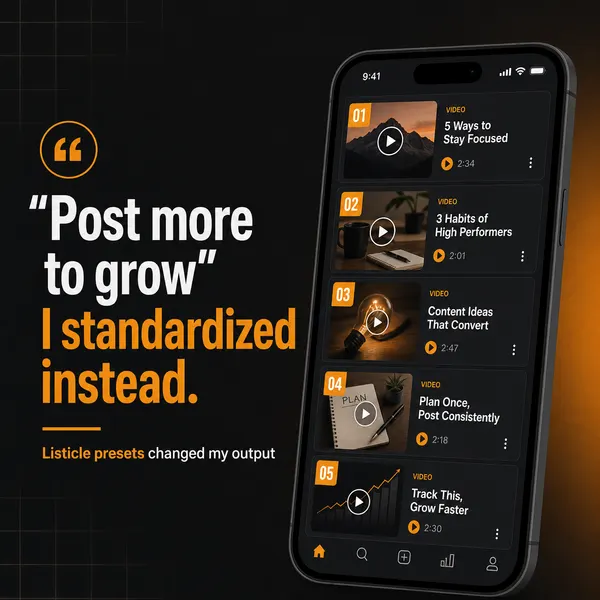
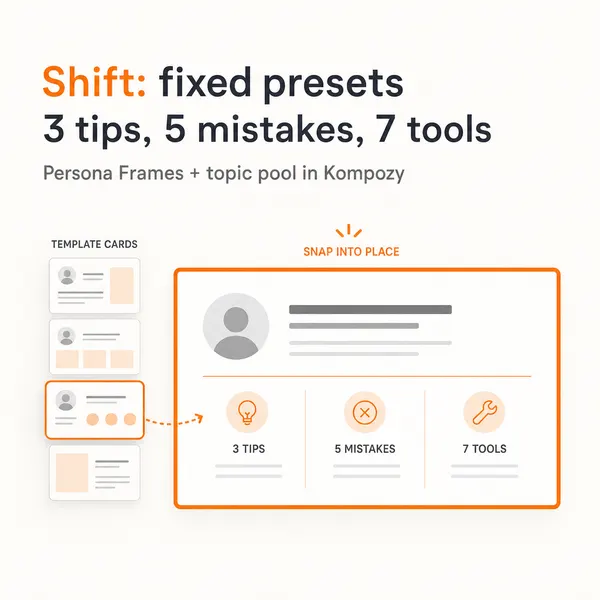
A real five-slide carousel generated in Kompozy. It is here to show what a finished, ready-to-post piece looks like, which is the part a scheduler like Postiz leaves to you.



Who is this for, and who should skip it?
Best for:
- Developers and automation teams wiring posting into agents or n8n
- Budget- or privacy-minded teams that can self-host
- Creators who post the same content to many networks
Not ideal for:
- Teams that want the free option but can't maintain their own servers
- Brands that need a governed voice and persona across formats
- Creators who need blogs, newsletters or avatar video made for them
Frequently asked questions
Is Postiz worth it?
For scheduling, yes. It is open source, reaches more than 30 platforms, has a real API and MCP surface, and you can self-host it for free. Its AI is mostly post-level help, with no avatar video, brand-exact carousels or governed brand voice.
How much does Postiz cost?
Hosted plans are Standard at $29 a month (5 channels), Team at $39 (10), Pro at $49 (30) and Ultimate at $99 (100). Yearly billing saves about 20%, and every plan has a 7-day trial. Self-hosting is free.
Is Postiz really open source and self-hostable?
Yes. It is licensed under AGPL-3.0, and the project says it does not gate features between the hosted and self-hosted editions. If you self-host, you run and maintain the servers yourself.
Can Postiz clip long videos into shorts?
Yes, within limits. Its AI video clipping turns long videos into short clips for TikTok, Reels and Shorts, with 60 to 600 minutes a month depending on plan. It has no avatar or talking-head video.
Can AI agents run Postiz?
Yes. Every plan includes an MCP server, CLI and API, and Postiz lists Claude, ChatGPT, Cursor and other agents. You can ask an agent to draft a post, make an image and schedule it.
Postiz vs Buffer: which should I pick?
Buffer is a managed, cloud-hosted scheduler that is simple to start with. Postiz reaches more networks, has a deeper developer surface and can be self-hosted for free. Neither one generates deep, multi-format content.
How does Postiz compare to Kompozy?
Postiz schedules and lightly assists. Kompozy turns one source into 20 formats, including clips, avatar video, carousels, blogs and newsletters held to one brand voice, then publishes them. Use Postiz to schedule and Kompozy to make what fills the schedule.
How do we know this?
We checked every price, date, benchmark and competitor feature on this page against the sources listed below on 2026-10-23 and corrected what had changed. The live pricing page shows an AI video clipping allowance, so the old "no clipping" claims were corrected. Kompozy plan details come from kompozy.io/pricing. The scores are Kompozy's editorial ratings.
Sources
- Postiz — Pricing (read 2026-10-23)
- Postiz — Home (read 2026-10-23)
- GitHub — gitroomhq/postiz-app (read 2026-10-23)
- Buffer — Pricing (read 2026-10-23)
- Kompozy — Pricing (read 2026-10-23)
- AI Content Repurposing — The complete methodology for turning one source into 25-35 pieces of native-format content across every platform — without producing AI slop.
- Autonomous Content Creation — Most "autonomous" AI content is slop.
- AI Brand Voice & Persona — Without a Persona Brief, every AI output averages to the LLM default voice.