Vormly Review (2026): Honest Verdict on the All-in-One Multimodal AI Creation Platform
Vormly review 2026: honest scoring on model breadth, the routing layer, Canvas Agent, music and 3D generation, pricing, and who should actually use it.
Published 2026-09-02 · Updated
Short answer
Vormly is a good multimodal generation studio: one workspace and one credit balance cover image, video, music and 3D across 15 model series from 12 AI labs, with agent skills and a canvas agent to cut down on prompting. A free tier gives 10 credits a day and Pro is $15 a month. It stops at the asset, with no brand voice, scheduling or publishing.
Key takeaways
- Vormly covers image, video, music and 3D in one workspace.
- One balance pays for 15 model series from 12 labs, including Veo, Kling, Midjourney and Suno.
- Free gives 10 credits a day; Pro is $15 a month, or $9 a month billed yearly, for 1,500 credits.
- Its editor resizes designs per social platform, but it has no brand voice or publishing.
Vormly is one of the cleaner multimodal generation studios to launch in 2026. It puts image, video, music, and 3D in one workspace, with 15 model series from 12 AI labs on one credit balance, plus ready-made agent skills and a canvas agent that lower the prompt-craft barrier. It stops at the asset, with no brand voice, persona identity across posts, scheduling, or publishing. Treat it as an excellent asset factory.
Vormly answers a real and specific pain: creators have been switching tools every time the thing they are making changes — an image today, a video tomorrow, a track or a 3D model after that. It puts text-to-image, text-to-video, text-to-music, and text-to-3D in one workspace and lets you pick from 15 model series across 12 AI labs on one balance. On top of that sit ready-made agent skills for common jobs, an agent that plans multi-step design work on an open canvas, and a Chrome extension that pulls the prompt out of any image.
This review scores whether that workspace earns your time and who it actually fits. The disclosure upfront: I run Kompozy, a content engine, which sits on a different floor of the stack than Vormly — I do not compete on multimodal model access and have no reason to talk it down. The honest read is that Vormly does its job, broad and easy multimodal generation, genuinely well, and does little downstream of the render beyond resizing for social.
Two caveats shape the scoring. First, Vormly is new, and its model list, credit amounts, and pricing move quickly; we re-checked everything here against vormly.ai on 2026-10-23. Second, Vormly is a generation studio. Its editor can resize a design for each social platform, but captioning, brand governance, scheduling, and publishing stay outside it.
What is Vormly?
Vormly is an all-in-one multimodal AI creation platform. From one workspace you generate across four modalities — image (text-to-image, image-to-image, editing, background removal, upscaling), video (text-to-video, image-to-video, frame-based and video-to-video), music, and 3D — and one credit balance covers 15 model series from 12 AI labs (named examples include GPT Image, Nano Banana, Veo, Midjourney, Suno, and Tripo 3D), so you pick a model without signing up with each lab. Around raw generation, Vormly adds three things that push toward finished-feeling output: agent skills (ready-made setups for jobs like an Amazon listing set, a lifestyle scene, or a logo), the Vormly Agent, which plans a piece of work from start to finish on an open canvas, and an editor that changes only the part you describe, resizes a design for each social platform, and cuts video on a timeline. It is a generation and design studio, and it stops at the asset. There is no brand-voice layer, no scheduler, and no publishing.
Who is Vormly for?
The clear fit is creators, designers, and marketers who want broad multimodal generation without app-switching or prompt-craft: one place to make an image, a clip, a music bed, and a 3D model, with one balance and ready-made agent skills doing the setup for you. It suits people who value having music and 3D alongside image and video — a rarer combination than most tools offer — and anyone who wants a canvas agent to assemble a design rather than hand-tune every prompt. Where it fits poorly: a creator, brand, or agency whose real need is finished, on-brand content shipped across platforms every week. Vormly gets you the asset; turning that into a governed, captioned, scheduled set of posts — and holding one consistent identity across them — is entirely on you.
How does Vormly score in our review?
| Dimension | Score | Why |
|---|---|---|
| Multimodal range (image/video/music/3D) | 5.0 / 5 | Image, video, music, and 3D in one workspace is genuinely rare — most tools cover one or two of these, not all four. |
| Model breadth | 4.5 / 5 | 15 model series from 12 AI labs, including Veo, Kling, Midjourney, and Suno, on one credit balance. |
| Agent & skills | 4.0 / 5 | Ready-made agent skills and a multi-step design agent lower the prompt-craft barrier from a blank box to a described outcome. |
| Ease for non-technical creators | 4.0 / 5 | Agent skills and the canvas agent make it approachable, though it still returns raw assets rather than ready-to-publish posts. |
| Pricing & value | 4.0 / 5 | A free daily quota plus paid plans from $15/mo (advertised $9/mo annual); fair for the generation breadth on offer. |
| Model choice control | 4.5 / 5 | You pick the model yourself, so power users keep control over which engine runs each job. |
| Brand voice / content governance | 1.0 / 5 | None — it renders raw output with no tone, persona, or banned-word control across pieces. |
| Content formatting & repurposing | 1.5 / 5 | The editor can resize a design for each social platform, but there is no one-source-to-many fan-out into a blog and newsletter. |
| Publishing & distribution | 1.0 / 5 | No scheduler and no publishing — it posts to nothing. |
What are the pros and cons of Vormly?
Pros
- Image, video, music, and 3D generation in one workspace — a rare four-modality range
- One credit balance covers 15 model series from 12 AI labs, with no separate sign-ups
- Agent skills and the canvas agent lower the prompt-craft barrier to a described outcome
- Music and 3D outputs open raw material most content tools cannot make
- Free daily quota to start, with straightforward paid plans from $15/mo
- A Chrome extension that extracts a prompt from any image speeds up remixing
Cons
- Outputs raw assets only — no video captions, brand-formatted carousels, or ready-to-publish posts
- No brand-voice, persona identity, or banned-word governance across outputs
- No one-source-to-many fan-out into a blog and newsletter
- No scheduler and no publishing — it posts to nothing
- Choosing among so many models is on you, which is extra homework for beginners
- Output is one-off by nature — nothing keeps a set of posts looking like one consistent creator
How much does Vormly cost?
Vormly's pricing is fair for a multimodal generation studio. A free tier gives a small daily credit quota (non-accumulating) plus free generations on starter image, video, and music models, which is a genuine way to try all four modalities before paying.
Paid plans open at $15 per month for an individual creator (advertised at about $9/month billed annually) and unlock watermark-free downloads, more monthly credits, and more storage; higher-usage Ultra tiers scale credits and storage for power users and teams, and every paid plan includes access to all models and the design agent at no surcharge. Because credit costs ride the underlying models, effective value depends on which modalities you lean on; confirm current numbers on vormly.ai.
The metering model suits its audience. If you generate across image, video, music, and 3D, paying one credit-based bill for all four beats stacking four separate subscriptions, and the free daily quota keeps light use genuinely cheap.
The honest critique is the one that applies to any pure-generation tool: the bill you see is the render bill, not the cost of shipping content. Rendering an asset is the cheap, measurable line; the expensive part — turning that asset into formatted, on-brand, published posts, consistently, week after week — is work Vormly does not do and does not price, because it is out of scope. For a solo creator making assets, that is exactly right. For a content team, the generation savings are real but small next to the pipeline you still have to build or buy on top.
Which use cases does Vormly fit?
| Use case | Fit | Why |
|---|---|---|
| Generating across image, video, music, and 3D in one place | Strong | The four-modality workspace is exactly what Vormly is built for, and few tools match the range. |
| Trying many models without separate sign-ups | Strong | One credit balance covers every model series, so you can switch engines without provider-hopping. |
| Assembling a design without prompt-craft | Strong | Agent skills and the canvas agent turn a described outcome into an asset without hand-tuned prompts. |
| Rendering a one-off clip, image, track, or 3D model | Strong | A single workspace gets you a finished raw asset in any of the four modalities. |
| Keeping a set of posts on-brand and consistent | Weak | No brand voice or persona identity — nothing holds one look and voice across a set of renders. |
| Turning one source into a week of content | Weak | No fan-out, formatting, or repurposing — you build all of it downstream. |
| Publishing on-brand posts across platforms | Weak | No scheduler, no publishing, and no brand governance; distribution is entirely yours. |
| Non-technical creator wanting finished posts fast | OK | The agent and skills are friendly, but the output is still a raw asset, not a ready-to-publish post. |
What are the best alternatives to Vormly?
- Kompozy — best if you want finished, on-brand content generated and published across platforms, not raw multimodal renders
- Node-based tools such as ComfyUI — best if you want to chain many models into custom workflows
- OpenRouter — best if you want a developer-first multi-model API rather than a visual creator studio
- Pollo AI — best if you want another multi-model creative platform with a similar all-in-one pitch
How does Kompozy compare to Vormly?
This is an altitude comparison, not a head-to-head. Vormly and Kompozy sit on different floors of the same building: Vormly is a generation studio that renders an asset across four modalities, and Kompozy is a brand-and-distribution system that takes an asset and turns it into a governed, scheduled, multi-platform week of content. In principle the two are complementary — a Vormly render is a perfectly good input to a Kompozy pipeline.
The sharpest difference is what happens after the render. Vormly's agent skills and canvas agent make a single asset well; they do not caption a clip, hold one voice across a hundred posts, atomize one idea into a blog and newsletter, or publish anywhere.
That is the whole of what Kompozy does: a Persona Brief governs tone and banned words, Gemini face-lock and the persona pool hold one identity across every piece, and outputs ship as Persona Shorts, carousels, quote cards, blogs, and newsletters — sized per platform and published across nine destinations on Autopilot. Where Vormly is broader on raw generation (and adds music and 3D that Kompozy does not make), Kompozy is deeper on turning any asset into a consistent, published content operation. Vormly is where you make the shot; Kompozy is where one shot becomes a week of on-brand posts.
What does this look like in Kompozy?
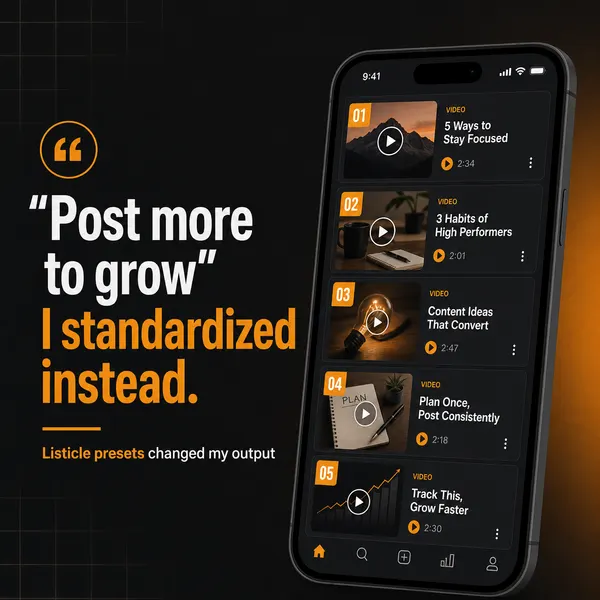
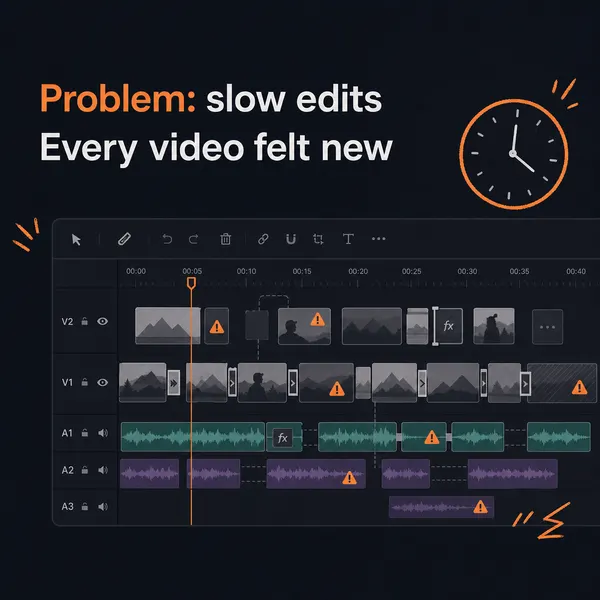
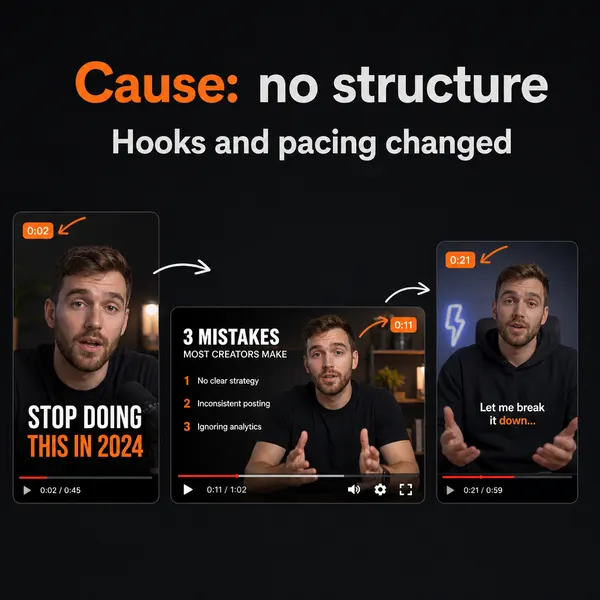
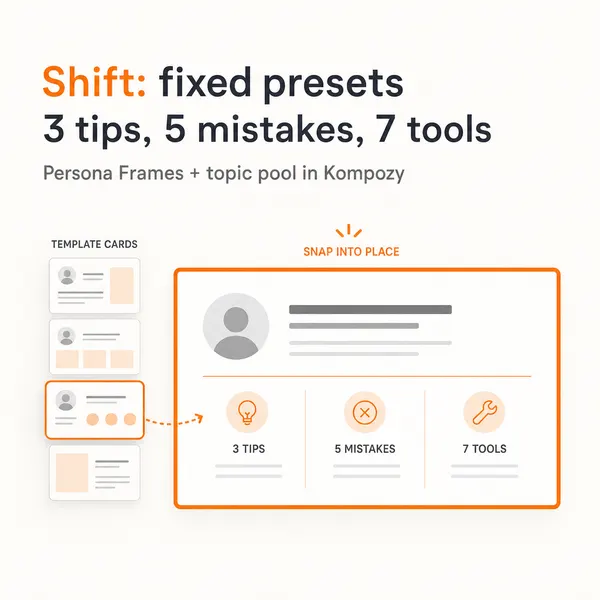
A five-slide carousel generated in the Kompozy workspace. Vormly makes single assets; Kompozy turns an idea into a branded set like this and publishes it.
Who is this for, and who should skip it?
Best for:
- Creators who want image, video, music and 3D without four subscriptions
- Designers who would rather describe an outcome to an agent than tune prompts
- E-commerce sellers who want ready-made skills for listing images and product scenes
Not ideal for:
- Brands that need one voice and persona across a week of posts
- Teams that need scheduling and publishing
- Anyone who wants one source turned into a blog and newsletter
Frequently asked questions
Is Vormly worth it in 2026?
For creators and designers who want broad multimodal generation — image, video, music, and 3D — in one workspace with one credit balance and a canvas agent, yes; it consolidates a real amount of tool-switching. It is less worth it as a content tool, because it outputs raw assets and does nothing downstream: no brand voice, scheduling, or publishing.
What is Vormly?
Vormly is an all-in-one multimodal AI creation platform. It generates image, video, music, and 3D from one workspace, with 15 model series from 12 AI labs (including Veo, Kling, Midjourney, and Suno) on one credit balance, plus agent skills, a canvas agent, and a prompt-extracting Chrome extension.
How much does Vormly cost?
Vormly has a free daily quota (about 10 non-accumulating credits a day plus free generations on starter models). The Pro plan is $15/month, or $9/month billed annually ($108 a year), with 1,500 credits, with higher-usage Ultra tiers for power users and teams. Because credit costs ride the underlying models, confirm current pricing on vormly.ai.
What is the Vormly Agent?
The Vormly Agent works with you on an open canvas and plans a piece of work from start to finish, so you describe an outcome and it assembles the asset instead of making you hand-tune each prompt. Vormly says talking to it is free; you pay only for what it generates. It does not publish the result.
Can Vormly publish my content to social media?
No. Vormly renders raw assets — images, clips, music, and 3D models — and stops there. Its editor can resize a design for each social platform, but it has no brand voice or scheduler. To turn a Vormly render into on-brand posts and publish across platforms, you need a content engine like Kompozy.
Vormly vs Kompozy — which should I use?
They do different jobs. Use Vormly to generate multimodal assets across many models in one workspace; use Kompozy to turn an asset into captioned, brand-consistent posts fanned into carousels, blogs, and newsletters and published across nine destinations. Many creators pair them — generate in Vormly, ship with Kompozy.
What are Vormly's main limitations?
It is a generation and design studio with no content layer — no brand voice, no persona identity across posts, no scheduler, and no publishing. Output is one-off by nature, so nothing keeps a set of posts consistent.
How do we know this?
We checked every price, date, benchmark and feature claim on this page against vormly.ai and its pricing page on 2026-10-23, and rewrote or removed any we could not confirm. Kompozy plan details come from kompozy.io/pricing.
Sources
- Vormly — Home (read 2026-10-23)
- Vormly — Pricing (read 2026-10-23)
- Kompozy — Pricing (read 2026-10-23)
- AI Content Repurposing — The complete methodology for turning one source into 25-35 pieces of native-format content across every platform — without producing AI slop.
- Autonomous Content Creation — Most "autonomous" AI content is slop.
- AI Brand Voice & Persona — Without a Persona Brief, every AI output averages to the LLM default voice.