TL;DR: "Social media competitor analysis" is three jobs under one label: benchmarking your engagement, cadence, and follower growth against named rivals; tracking their share of voice; and working out which of their posts earn reach. A tool built for one is usually shallow at the others. This list sorts the eight that matter in 2026 by the job you have, with verified prices, the limit on each, and the gap every tool leaves for you.
Most "competitor analysis tools" roundups are affiliate lists that blur three distinct jobs into one ranking. Benchmarking answers "how do my numbers compare to five named competitors?" — engagement rate, posting frequency, follower growth, side by side. Share-of-voice listening answers "how much of the conversation in my category is about them versus me?" — mentions, sentiment, and reach across social, news, and forums, most of it on accounts you do not own. Content analysis answers "which of their specific posts and topics actually win, and why?" A benchmarking specialist is usually thin on listening; an enterprise listening suite is overkill if you only need a weekly scoreboard. This roundup sorts the field by that split, with prices re-checked on each vendor's pricing page on October 23, 2026 — most of these tools price per seat or per tracked competitor and change tiers often, so confirm the current numbers on each vendor's pricing page before you buy.
I build Kompozy, so here is the boundary up front, stated plainly: Kompozy is not a competitor analysis tool and it is listed last, framed as exactly that. It does not benchmark accounts, track share of voice, or grade a rival's posts — for that, use one of the eight below. What every tool on this list has in common is the thing none of them do: they tell you the gap (they post five Reels a week to your two; their carousels out-engage your single images; they own the conversation on a topic you have never touched) and then hand you a dashboard and a to-do list. Closing that gap is a production problem, and that is the one job Kompozy is built for. For adjacent categories see /roundups/best-social-listening-tools-2026 for pure share-of-voice monitoring, /roundups/best-social-media-analytics-tools-creators-2026 for your own-channel numbers, and /roundups/best-social-media-management-tools-2026 for the all-in-one scheduler-plus-analytics suites.
#1 · Competitive social benchmarking — the specialist · $239/mo Drive (10 companies; annual −15%)
Rival IQ
Verdict: Best purpose-built tool for scoring your social performance directly against named competitors.
Best at: Rival IQ exists to do one job well: put your engagement rate, posting frequency, and follower growth next to a set of named competitors across five major social networks, with automated head-to-head insights and industry benchmarks so "are we winning?" gets a number instead of a hunch. The Drive plan tracks 10 companies with six months of history; higher tiers track up to 40 companies with up to 24 months of history. For the pure benchmarking job it is the cleanest, most focused tool here.
Limit: It is a scoreboard, not a listening suite: benchmarking is deep but off-network mention tracking and share of voice are not its strength, and entry pricing starts at $239/mo — steep for a solo creator who just wants a weekly comparison. It reports; it produces nothing.
#2 · Cross-platform competitive analytics for agencies · From $82/mo Adapt (Predict $199/mo)
Socialinsider
Verdict: Best value for agencies that need competitor benchmarking plus content-pattern analysis across many profiles.
Best at: Socialinsider is a benchmarking and analytics tool tuned for social leaders and agencies: it aggregates non-owned competitor data across Facebook, Instagram, X, LinkedIn, YouTube, and TikTok, runs post-level competitor analysis, and surfaces the content patterns and themes driving a rival's results over time. The $82/mo Adapt plan covers 20 profiles with three months of history; the $199/mo Predict tier covers 40 profiles, a full year of data, and 5 seats — strong coverage per dollar for multi-client reporting.
Limit: Its edge is benchmarking and content analytics, not real-time listening or sentiment across news and forums — pair it with a listening tool for that. Like the others, it stops at the report; nothing gets made or scheduled.
#3 · All-in-one management with competitive reports + listening · $199/seat/mo Standard (annual)
Sprout Social
Verdict: Best when competitor analysis needs to live inside the same platform you publish and reply from.
Best at: Sprout folds competitive analysis into a full management suite — competitor reports (from the Professional plan), cross-network analytics, and social listening as a paid add-on — alongside publishing and a unified inbox. For a team that wants benchmarking, listening, and day-to-day posting in one login rather than three tools, it is the strongest single platform.
Limit: Cost: Standard is $199 per seat per month, competitor reports start on Professional ($299), and Listening is a paid add-on, so it gets expensive fast for a small team. It is a monitoring-and-management platform — it does not generate the content the analysis says you are missing.
#4 · Enterprise share of voice + consumer intelligence · Custom (enterprise, contact sales)
Brandwatch
Verdict: Best for enterprise share-of-voice and sentiment analysis across the whole conversation, not just social profiles.
Best at: Brandwatch is the heavyweight for the listening job: it measures share of voice, tracks competitor sentiment, and visualizes consumer intelligence across social, news, blogs, and forums at a scale a benchmarking tool cannot match. When the question is "how much of the category conversation do we own versus our rivals, and how is that trending?", it is the most complete answer here.
Limit: It is enterprise software with quote-based pricing and a real learning curve — overkill and out of budget for solo creators and most small teams, who are better served by a lighter listening tool. And it analyzes the conversation; it does not create anything to change it.
#5 · SEO-side competitor intelligence + social tracking · Social Toolkit Base $20/mo; Pro $40/mo
Semrush Social
Verdict: Best when you need to see competitors' social AND their search/content strategy in one place.
Best at: Semrush is a search and content intelligence platform first, with a Social Toolkit bolted on: its Social Tracker monitors a rival's audience size, posting frequency, engagement, and top posts, while the core Semrush suite exposes the SEO and content strategy behind their reach. The Social Toolkit Pro plan ($40/mo) tracks 20 competitor profiles; Base ($20/mo) tracks 10. It is the pick when social is only half the competitive picture you need.
Limit: Social is not Semrush's core — its social benchmarking is shallower than Rival IQ or Socialinsider, and the full competitive value (traffic, keywords, content gaps) requires the far pricier main Semrush subscription on top. It informs strategy; it produces no posts.
#6 · Content-level competitor analysis · $199/mo Content Creation ($159 annual)
BuzzSumo
Verdict: Best for reverse-engineering which of a competitor's content actually gets shared and links.
Best at: BuzzSumo answers the content question the analytics tools skip: what specific articles, posts, and topics from a competitor earn the most engagement, shares, and backlinks. Its Content Analyzer, Trending Feeds, and Question Analyzer let you study a rival's (and a whole category's) best-performing content so you can plan yours against proven demand rather than guesses. The best tool here for content strategy driven off competitor evidence.
Limit: It is a content-research tool, not a social-profile benchmarking dashboard — it will not give you a rival's engagement-rate scoreboard across platforms — and the entry Content Creation plan is one seat at $199/mo. It shows you what content wins; making that content is on you.
#7 · Competitor watchlist + industry benchmarking · Part of Hootsuite plans (Standard from $99/user/mo, billed annually)
Perch by Hootsuite
Verdict: Best for a simple named-competitor watchlist and industry-average benchmarking inside Hootsuite.
Best at: Hootsuite's competitive analysis lets you watch up to 5 competitors on Standard and up to 20 on Advanced and Enterprise, and its industry benchmarking compares your growth, engagement rate, and posting frequency with your industry's average. A route into structured competitor benchmarking if you already run Hootsuite.
Limit: The competitor watchlist is small on Standard, and Hootsuite's competitive-analysis page does not list which social networks it covers, so confirm your platforms before you buy. Reporting only; no content output.
#8 · Free high-level growth tracking · Free (paid ad-free membership available)
Social Blade
Verdict: Best free way to spot-check any public account's follower and view growth without an account.
Best at: Social Blade is the free baseline: type any public handle on YouTube, Instagram, TikTok, Facebook, or Twitch and get its follower counts, growth trends, and estimated performance, no login or connection required. (Its site lists YouTube, Instagram, TikTok, Twitch, and Facebook, not X.) For a fast, zero-cost read on how a competitor is growing — or a channel you are researching before a deeper analysis — nothing is quicker.
Limit: It is high-level and public-metrics only: no engagement-rate benchmarking, no content analysis, no share of voice, and estimates (especially earnings) are rough. A spot-check tool, not a strategy platform — and, like every tool here, it produces nothing.
#9 · Not a competitor analysis tool — the engine that closes the gap the analysis reveals · $199/mo Starter (not a competitor analysis tool)
Kompozy
Verdict: Not for the analysis itself — the production engine you point at the gap once a tool above has found it.
Best at: Listed last on purpose: Kompozy does not benchmark accounts, track share of voice, or grade a rival's posts — use one of the eight tools above for that. It is the answer to what those tools expose and cannot fix. Competitor analysis almost always returns the same verdict: they publish more, in formats you are not making, more often than you. Kompozy is built to close exactly that gap — from one Persona Brief and a face-locked AI Influencer persona it generates 20 output formats (persona and avatar shorts, clipped verticals, brand-exact HyperFrames carousels, quote graphics, photo posts, a blog, a newsletter), matches the cadence a benchmarking report shows you are losing on, and publishes across the eight social platforms plus blog and email on one credit line. The analysis tells you what to change; this is the engine that changes it.
Limit: It is genuinely not a competitor analysis tool — it has no benchmarking dashboard, no share-of-voice tracking, and no competitor watchlist, and it never will. Do the analysis in Rival IQ, Socialinsider, or Brandwatch first; bring the answer here to act on it. If all you need is a scoreboard, you do not need Kompozy.
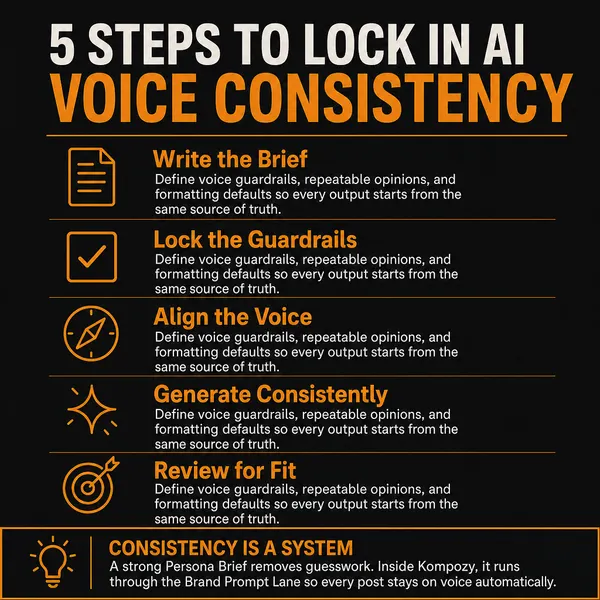
More →An infographic photo post generated in the Kompozy workspace. It shows the kind of format Kompozy produces when a competitor gap points to posting more often or in new formats.
What is the best social media competitor analysis tool in 2026?
It depends on which job you mean. For benchmarking your numbers against named competitors, Rival IQ is the purpose-built specialist, with Socialinsider the best value for agencies and Perch by Hootsuite a lighter option for teams already on Hootsuite. For share of voice and sentiment across the wider conversation, Brandwatch leads at the enterprise level. For studying which of a competitor's content actually wins, BuzzSumo. For social plus SEO in one view, Semrush. Sprout Social is best when you want analysis inside the same platform you publish from, and Social Blade is the free spot-check. Pick by the job you actually have.
What are the three kinds of social media competitor analysis?
Benchmarking compares measurable performance — engagement rate, posting frequency, follower growth — between your accounts and named rivals (Rival IQ, Socialinsider, Perch). Share-of-voice listening measures how much of the conversation in your category is about each brand, across social, news, and forums, with sentiment (Brandwatch, and the listening features in Sprout Social). Content analysis reverse-engineers which specific posts, topics, and formats drive a competitor's reach and shares (BuzzSumo, and post-level views in Socialinsider). Most tools lead on one and are shallow on the others, so many teams pair a benchmarking tool with a listening tool.
Is there a free social media competitor analysis tool?
Partly. Social Blade is genuinely free for high-level growth tracking of any public account — follower counts, view trends, estimated performance — with no login. Semrush's Social Toolkit and several benchmarking tools offer free trials, and native platform analytics let you see your own numbers to compare by hand. But real competitor benchmarking (engagement-rate comparisons, industry averages) and share-of-voice listening are paid features across Rival IQ, Socialinsider, Brandwatch, and the rest — free tiers give you a snapshot, not an ongoing competitive dashboard.
How much do social media competitor analysis tools cost?
They range widely by job. Benchmarking specialists: Rival IQ from $239/mo, Socialinsider from $82/mo, Perch inside Hootsuite plans from $99/user/mo (annual), and Semrush's Social Toolkit from $20/mo. Content analysis: BuzzSumo from $199/mo. All-in-one with analysis built in: Sprout Social at $199/seat/mo. Enterprise listening: Brandwatch is quote-based. Social Blade is free for basic tracking. Most price per seat or per tracked competitor, so confirm the current tier on each vendor's page before buying.
Why is Kompozy listed last and not ranked #1 on this list?
Because it is not a competitor analysis tool and it would be dishonest to rank it as one — it has no benchmarking dashboard, no share-of-voice tracking, and no competitor watchlist. For the analysis itself, use Rival IQ, Socialinsider, Brandwatch, BuzzSumo, or another tool above. Kompozy is the step after: competitor analysis almost always concludes that rivals publish more, in more formats, more often than you, and closing that gap is a production problem. Kompozy generates 20 content formats from one Persona Brief and publishes them across the eight social platforms plus blog and email on one credit line — the engine you point at the gap once a tool above has found it.
We re-checked every price, plan limit, and figure on this page against the vendor pages listed below on October 23, 2026, and rewrote or removed any we could not confirm (the old Perch network and price claims and Social Blade's X history). Kompozy plan details come from kompozy.io/pricing.