Best AI content tools for marketing agencies (2026 stack)
Agency AI content stack for 2026: multi-brand workspaces, per-client Persona Briefs, white-label reporting, pricing for 5/15/50+ client tiers compared.
Published 2026-05-19 · Updated
Short answer
Agencies with a growing client list need a separate workspace, Persona Brief and banned-word list per client, plus a credit budget they can track per client. A practical stack is Kompozy Agency (5 workspaces) or Enterprise for fan-out, OpusClip or Submagic for clips, HeyGen Business ($149 a month plus $20 a seat) for avatars, and Metricool for scheduling. Small agencies often do fine on specialists alone.
Key takeaways
- An agency plan needs per-client workspaces; extra seats on one shared workspace are not enough.
- Brand-voice bleed between clients is the failure to design against.
- Kompozy Agency includes 5 workspaces; Enterprise sets the count by contract.
- Metricool offers white label only on its Custom plan.
- Stay on specialist tools until one strategist can no longer hold every client voice in their head.
Agencies sit on a structural fault line. Clients still expect daily presence across several platforms, but agency hourly rates make manual operator work uneconomic once the client list grows. The shops that adapted rebuilt the workflow around tools that can hold several brand identities without bleeding voice, banned terms or visual style across client boundaries.
This spoke is the practical version of "what should an agency actually buy". It separates agencies that need orchestration (a workspace per client, a Persona Brief per client, a credit budget per client) from agencies that are better off on a stack of specialists. It covers agency-tier requirements, the published pricing for each category leader (re-checked on vendor pricing pages on 2026-10-23), and which tools fit client onboarding, brand-voice setup, multi-brand approval, client-facing reporting and delivery.
Not every agency benefits from orchestration. A small shop running a few retainers can run OpusClip, Buffer, Canva and a shared doc and ship cleanly. Agencies with a long client list and several operators are the ones squeezed by per-client tool sprawl, and they are the ones whose unit economics change when they consolidate the fan-out layer.
Why is buying AI tools for an agency different from buying for a creator?
Most AI content tools sell themselves to individual creators. The tier they price as "Business" is usually a creator plan with two seats stapled on. That is not an agency tier. An agency tier has to solve five problems a creator plan never sees: brand-voice isolation across clients, per-client credit attribution for pass-through billing, white-label reporting, OAuth-per-client publishing into client-owned social accounts, and approval workflows that surface a curated batch to the client rather than the raw model output.
When a vendor says "team seats included", ask the next question: do those seats share one workspace, one Persona Brief, one credit pool and one banned-word list? If yes, that is a creator plan with several operators, not an agency plan. Brand-voice bleed is a common reason agencies abandon a single-workspace tool. One operator copies a Persona Brief from Client A to Client B, forgets to update the banned-word list, and the agency ships a LinkedIn post for an HR-tech client in the real-estate-investor language of the previous brief.
The agency-fit screen is unforgiving. If the tool cannot hold five clients without operators having to manually swap context, it is a creator tool with seats. Treat it accordingly.
What does an agency-tier AI content tool need?
- Workspace-per-client isolation — separate Persona Brief, separate brand assets, separate banned-word list, separate topic pool, separate pipeline. One workspace per client means zero cross-contamination by construction.
- Per-workspace credit attribution — ability to see this month's spend by client so retainers reflect actual cost. Shared credit pools across clients lead to billing disputes the first time a high-volume client crosses the average.
- White-label reporting — PDF or CSV exports of output volume, approval rate, publish rate, and platform performance per client, brandable with agency logo, no vendor watermark.
- OAuth-per-client publishing — ability to publish to client-owned Facebook pages, LinkedIn pages, Instagram business accounts, X profiles, and YouTube channels without re-authing the agency's root account.
- Approval workflows — staged review where the agency strategist sees raw output first, curates, and the client only sees the pre-curated weekly batch. Sending raw model output to clients destroys trust faster than any other agency mistake.
- Team roles with the right granularity — strategist (can edit Persona Brief, all workspaces), account manager (can approve in assigned workspaces), client reviewer (read + comment, no edit).
- Per-client billing exports — for pass-through invoicing, the tool must let the agency export "this client used $X of credits this month" without manual log scraping.
- Brand-asset library per client — logos, fonts, color palettes, b-roll, voice samples scoped to a workspace, not a global library where assets from Client A surface in Client B's pipeline.
Which tools fit agencies of each size?
The right stack depends on how many client brands you carry, how many operators you have and how much format variety each client needs. Below is the fit matrix, with prices re-checked on 2026-10-23. Pick the column that matches your agency, then read down.
| Capability | Small agency, one or two operators | Growing agency, several operators | Large agency, many operators |
|---|---|---|---|
| Multi-brand fan-out | Specialists per format (OpusClip, HeyGen, Buffer); orchestration is often overkill | Kompozy Agency ($999/mo, 5 workspaces, multi-brand operator tools) | Kompozy Enterprise (custom credit pools, SSO) |
| Clipping / shorts | OpusClip Pro ($29/mo, 2-user packs up to 4 users) | OpusClip Pro or Submagic Business ($69/mo, unlimited users) | Submagic Business or OpusClip Business (custom, unlimited seats) |
| Avatar video | HeyGen Creator ($29/mo) or skip | HeyGen Business ($149/mo + $20/seat) | HeyGen Enterprise (custom) |
| Scheduling | Buffer Team ($10/channel/mo) | Metricool Advanced (from $53/mo, 15 to 50 brands by tier) or Buffer Team | Sprout Social Advanced ($399/seat/mo) or Hootsuite Enterprise (custom) |
| Reporting | Native platform analytics | Metricool reports (white label is on its Custom plan) | Sprout Social plus your own BI layer |
| Persona / brand voice | One Persona doc per client in Notion | A Kompozy workspace per client, each with its own Persona Brief | Kompozy Enterprise with workspace count set by contract |
| Approval / review | Loom + shared doc | Kompozy pipeline review + client sign-off outside the tool | Kompozy + Sprout Social approvals |
The honest read on this table: if you run a handful of clients with one or two operators, you probably do not need orchestration yet. The time saved does not exceed the setup overhead, and you will spend the first month tuning Persona Briefs you could have held in your head. The break point comes when one strategist can no longer keep every brand voice in working memory, and a single bleed incident costs more than the tooling.
What do agency-tier AI content tools cost?
Pricing for the agency or business tier of each category leader, read off the vendor's pricing page on 2026-10-23. Seat and credit caps are the vendor's published numbers. Where a vendor publishes only "custom" or "contact sales", that is what the row says.
| Tool | Agency / business tier | Monthly cost | What the pricing page lists |
|---|---|---|---|
| OpusClip | Business | Custom (Pro is $29/mo) | Pro: 2-user packs up to 4 users, 100GB storage. Business: customized storage, unlimited seats |
| HeyGen | Business | $149/mo + $20/seat | 1,500 credits/mo, team members added per seat, API available |
| Submagic | Business | $69/mo ($41/mo billed yearly) | 100 videos/mo up to 30 minutes each, unlimited users, 100 API minutes/mo |
| Synthesia | Enterprise | Custom | SAML/SSO, unlimited personal avatars, 240+ stock avatars, brand kits, dedicated CSM |
| ElevenLabs | Business | $990/mo | 6M credits/mo, 10 workspace seats, 10 Professional Voice Clones |
| Hootsuite | Enterprise | Custom | Unlimited social accounts, custom seats, advanced listening |
| Buffer | Team | $10/mo per channel | Unlimited team members, content approval workflows |
| Sprout Social | Advanced | $399/seat/mo | Top published self-serve tier; Premium Analytics and Listening are add-ons from Standard up |
| Later | Scale | $110/mo ($82.50/mo billed yearly) | 6 social sets (48 profiles), 4 users |
| Metricool | Advanced / Custom | From $53/mo (Custom on request) | Advanced: up to 15-50 brands, team and client management, post approvals. White label on Custom |
| Repurpose.io | Agency | $179/mo | 25 connected accounts per network, unlimited published videos |
| Jasper | Business | Custom | Unlimited brand voices, knowledge and audiences, API access |
| Copy.ai | Growth | $1,000/mo | 75 seats, 20K workflow credits/mo |
| Castmagic | Business & Scale | From $699/mo | Custom volume, more seats and storage, dedicated support |
| Kompozy | Agency / Enterprise | $999/mo (Agency) · custom (Enterprise) | 55,000 credits/mo, 5 workspaces and multi-brand operator tools on Agency; custom credit pools, SSO and enterprise API keys on Enterprise |
Read this table for what it says about category economics, not just sticker price. Social-management suites (Hootsuite, Sprout Social, Later) price scheduling and reporting per seat or per social set. Avatar video (HeyGen, Synthesia) prices by credits or minutes with team tiers on top. Clipping (Submagic, OpusClip) is the cheapest layer. The generation layer is the one category where a single purchase can replace several specialist subscriptions plus the strategist hours those specialists used to consume.
Compare your stack against the full 2026 comparison before committing to a renewal. Agencies often overbuy on social management and underbuy on the generation layer that would let them drop one of those tools.
Which tool handles each stage of the agency lifecycle?
Every agency runs the same five workflows: client onboarding, brand-voice setup, multi-brand approval, client-facing delivery and reporting. The tools that handle each one well are not the same tools, and agencies that force one tool to do all five tend to stall.
| Workflow | What it requires | Best 2026 tooling | Why |
|---|---|---|---|
| Client onboarding | Intake form, brand-asset upload, kickoff doc, Persona Brief draft | Notion or Airtable + Kompozy Persona Brief import | Notion holds the unstructured intake; Kompozy holds the structured Persona Brief used by every downstream generation |
| Brand-voice setup per client | Voice samples, banned-word list, allowed cultural references, sample-output review | Kompozy Persona Brief + per-workspace banned-word list | The banned-word list per workspace is the single most underrated agency feature — it is the gate that stops the cross-contamination bleed |
| Multi-brand fan-out | One source asset (recording, article, prompt) turned into native outputs for each client's platforms | Kompozy multi-workspace fan-out, or OpusClip per client (clipping only) | Specialist tools make you repeat the source ingest per client; a generation engine takes one source and writes per Persona Brief |
| Multi-brand approval | Strategist pre-review, then client weekly batch review, then publish queue | Kompozy pipeline (raw → review → approved → scheduled) + Loom for client async reviews | Two-stage review is non-negotiable; agencies that send raw model output to clients lose retainers |
| Client-facing deliverables | Per-client report with agency branding | Metricool Custom (white label) or your own reporting template | Metricool lists white label on its Custom plan only; Advanced does not include it |
| Reporting | Monthly retainer report: output volume, approval rate, publish rate, platform performance | Metricool or Sprout Social exports + your own retainer sheet | No single tool produces a complete agency retainer report; agencies build it from several exports |
The pattern across this table: orchestration plus one or two specialists plus one scheduling-and-reporting layer. Three categories of tools, not nine. Agencies that proliferate beyond three categories are usually compensating for a brittle Persona Brief — the cure is a better brief and a tighter banned-word list, not a fourth tool category.
Which AI content tools support white-label reseller branding?
Client-facing branding matters more for agencies than for any other buyer, because the client should not see a vendor brand in deliverables. Most tools in this stack are operator-facing; only a few sell a real white-label option.
- Metricool Custom: the pricing page lists a White Label option and a dedicated account manager on the Custom plan. Advanced does not include white label.
- Sprout Social: Premium Analytics is sold as an add-on from Standard up. Ask sales what client-facing branding your plan includes.
- Hootsuite Enterprise: custom pricing and terms; branding options are a contract question.
- Kompozy: no white-label client portal. Operators work in the dashboard; clients see the approved posts on their own accounts.
- Repurpose.io Agency: published outputs land on client-owned accounts, so the vendor brand never reaches the client's audience, but the agency-facing dashboard is Repurpose-branded.
- OpusClip, Submagic, HeyGen: operator-facing tools in this stack. The agency uses the output, not the dashboard, with clients.
The practical move: pick one tool with real white label for client-visible reports (Metricool Custom is one option) or build your own branded template, and accept that every other tool in the stack is operator-facing. Clients should never see your Kompozy or OpusClip dashboard; they see the approved batch and the agency-branded monthly report.
What are the unit economics of an agency AI stack?
The tooling line is rarely what decides agency margin. Spread across a full client book, an agency-tier stack is a small fraction of what clients pay in retainers, so cutting a tool saves little.
The constraint is strategist hours per client. On an unorchestrated stack (a specialist per format, per client) a strategist runs out of capacity after a few clients because every client means re-ingesting sources and switching context in several tools. On an orchestrated stack with a workspace per client, the same strategist reviews instead of re-producing, so their client capacity rises. That gain shows up in gross margin, not in the tooling line.
Run the math with your own numbers. Take monthly retainer revenue, subtract tooling and loaded strategist cost, and compare two cases: today's stack, and a stack where one strategist handles more clients because fan-out is automated. If the orchestrated case lets you defer a strategist hire, that deferral is usually worth far more than the subscription. If it does not, stay on specialists.
Which multi-brand pitfalls catch agencies off guard?
- Persona Brief copy-paste contamination. Operators copy a brief from Client A to Client B, forget to swap the banned-word list, and ship a post for Client B that uses Client A's industry jargon. Fix: start every brief from a blank template; the workspace-per-client tool should enforce this by giving each new workspace a blank Persona, not a clone.
- Credit pool conflicts. Sharing one credit pool across many clients leads to billing disputes the first time a high-volume client goes over the average. Fix: give each client its own workspace and track usage per workspace, then reconcile monthly.
- OAuth expiration cascades. Client-side social connections expire or get revoked, and you find out when a scheduled post fails. Fix: keep a connection-health checklist per client and re-authorize before tokens lapse rather than waiting for the publish queue to error.
- Brand-asset drift. Clients update logos, fonts, and color palettes without telling the agency. Fix: quarterly brand-asset audit per client; require client sign-off on the brand-asset file as part of every retainer renewal.
- Reporting that obscures operator overhead. White-label reports should highlight what the tool produced (output volume, platform performance), not what the agency operator did (hours, internal review counts). Reverse this and clients will start questioning the retainer the moment a junior strategist takes over.
- Disclosure drift. Clients increasingly assume AI is in the loop and want to know where. Be explicit in the retainer about which steps are AI-assisted and which are human-led; ambiguity breaks trust faster than honest disclosure.
- Single point of failure on the orchestration layer. If your generation tool has an outage, the fan-out stalls. Fix: keep one specialist (OpusClip for clips, HeyGen for avatar) as a manual fallback and document the manual workflow so operators can ship without the orchestration layer for a few days.
When should agencies NOT buy orchestration tooling?
Orchestration is not free. Setting up a workspace per client means writing the Persona Brief and banned-word list, uploading brand assets, connecting accounts and running the first approval cycle. For an agency with a few clients and one operator, that setup is rarely repaid before the subscription renews.
Stay on specialists if you carry only a few clients, you have one operator who knows every brand voice, your formats are concentrated (mostly clipping, or mostly carousels, not the full fan-out), and your retainers do not require branded client reporting. Under those conditions OpusClip Pro, Buffer Team and a shared Notion are the right answer. Migrating before you have the client volume to absorb the setup is a common reason agencies abandon AI tooling.
The migration triggers are concrete: your client list outgrows what one strategist can hold in their head, you hire a second strategist, or a top client asks for a branded monthly report. Any one of those is the signal to move to orchestration. None of them? Stay on specialists.
What does a reference agency stack look like?
A reference stack for a growing agency with a strategist, a few account managers and full-format fan-out (text, image, video, clips and email) looks like this:
- Orchestration: Kompozy Agency ($999/mo, 55,000 credits, 5 workspaces, multi-brand operator tools), one workspace per client with its own Persona Brief and banned words. Move to a custom Enterprise plan when you need more workspaces or credits.
- Clipping specialist: OpusClip Pro ($29/mo) or Submagic Business ($69/mo, unlimited users) for heavier clipping.
- Avatar video: HeyGen Business ($149/mo + $20/seat, 1,500 credits). In Kompozy, avatar video runs on your own HeyGen account.
- Scheduling and reporting: Metricool Advanced (from $53/mo), or Metricool Custom if you need white-label reports.
- Async client review: a screen-recording tool such as Loom.
- Documentation and intake: Notion or a similar shared workspace.
- Starting cost at entry list prices for Kompozy Agency, OpusClip Pro, HeyGen Business and Metricool Advanced: $1,230/mo, before extra seats, channels and higher Metricool tiers.
Cross-reference: the tool stack blueprint walks through assembling a stack from scratch, and the founder-led marketing spoke covers the same orchestration question from the solo-founder side. For per-tool head-to-heads, see Kompozy vs OpusClip and Kompozy alternatives. Kompozy pricing lists the Agency and Enterprise tiers in full.
What should you demand from any new tool you adopt?
- Show me a workspace-switch — does Persona context bleed between workspaces? If the demo cannot prove isolation, the tool is not agency-ready.
- Export per-client credit usage for last month — if this requires a CSV scrape from a log, the tool does not have agency-grade attribution.
- White-label a PDF report — if the vendor logo cannot come off, do not put it in front of clients.
- Show OAuth-per-client publishing — connect two different Facebook pages from two different clients in the same demo. If the second connect overwrites the first, the tool is single-tenant.
- Show me the approval queue UI — can a client reviewer leave comments without seeing the underlying generation prompts or the agency's Persona Brief? If no, the tool exposes your IP to the client.
- Ask for an agency reference customer running a client list like yours on the tool today. If the vendor cannot name one, you will be the test case.
What does this look like in Kompozy?
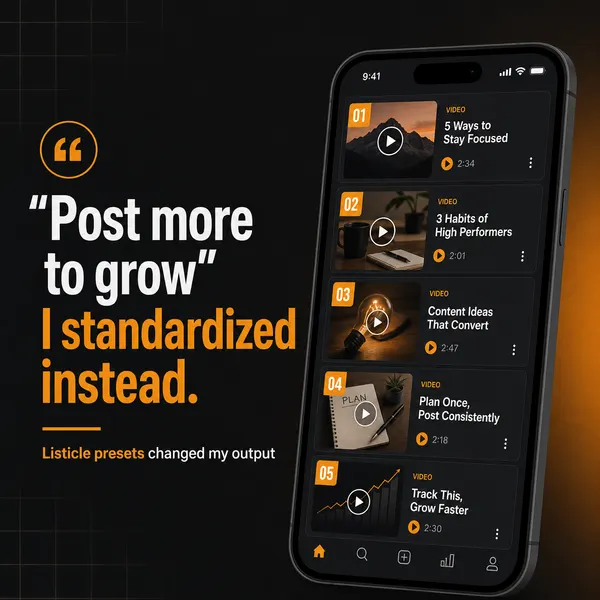
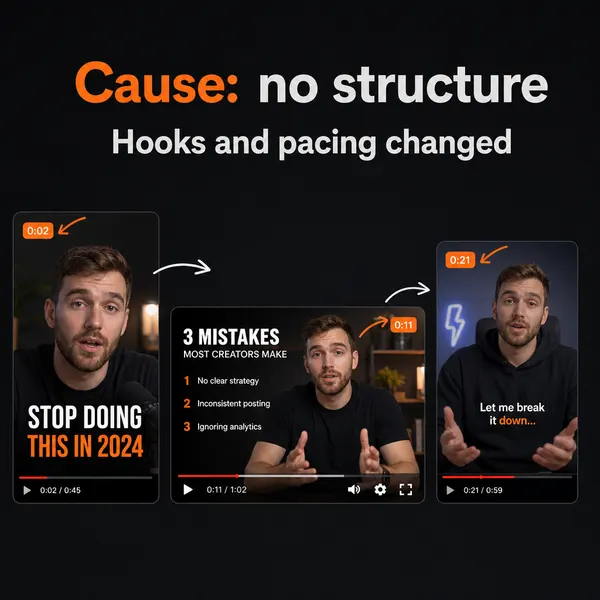
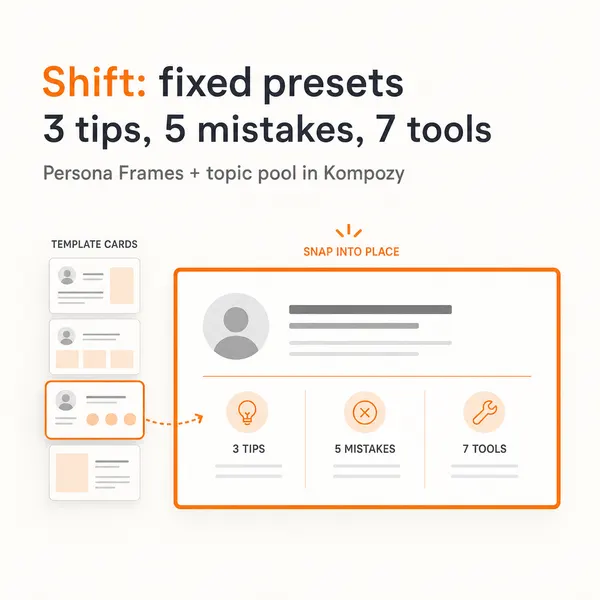
A five-slide carousel generated in the Kompozy workspace. Agencies produce this format per client, each from that client's own Persona Brief.
Who is this for, and who should skip it?
Best for:
- Agencies with several operators producing content for many client brands
- Shops that need per-client voice rules and usage tracking
- Teams consolidating a sprawl of per-client tools
Not ideal for:
- Small agencies with a few clients and one operator
- Agencies that need a fully white-labeled client portal from Kompozy, which it does not offer
- Shops focused on one format, such as clipping only
Frequently asked questions
What makes a tool agency-ready?
Separate workspaces per client, each with its own Persona Brief, banned words, brand assets and connected accounts, plus usage you can attribute per client and an approval step before anything goes out.
How many client workspaces does Kompozy include?
Kompozy Pro includes 2 workspaces and Agency includes 5, with multi-brand operator tools. Enterprise is custom, with the workspace count set by contract.
Which tools offer white-label reports?
Metricool lists a White Label option on its Custom plan. Kompozy does not offer a white-label client portal, so agencies usually brand their own reports.
When should an agency move off specialist tools?
When the client list outgrows what one strategist can keep in their head, when you hire a second strategist, or when clients start asking for branded monthly reporting.
Should agencies disclose AI use to clients?
Yes. Say in the retainer which steps are AI-assisted and which are led by people. Clear disclosure protects trust better than leaving clients to guess.
How do we know this?
We checked every price and plan detail on this page against the vendor pricing pages listed below on 2026-10-23, and removed figures we could not confirm. Kompozy plan details come from kompozy.io/pricing.
Sources
- Kompozy: Pricing (read 2026-10-23)
- OpusClip: Pricing (read 2026-10-23)
- HeyGen: Pricing (read 2026-10-23)
- Submagic: Pricing (read 2026-10-23)
- Synthesia: Pricing (read 2026-10-23)
- ElevenLabs: Pricing (read 2026-10-23)
- Hootsuite: Plans (read 2026-10-23)
- Buffer: Pricing (read 2026-10-23)
- Sprout Social: Pricing (read 2026-10-23)
- Later: Pricing (read 2026-10-23)
- Metricool: Pricing (read 2026-10-23)
- Repurpose.io: Pricing (read 2026-10-23)
- Jasper: Pricing (read 2026-10-23)
- Copy.ai: Pricing (read 2026-10-23)
- Castmagic: Pricing (read 2026-10-23)
Which other AI content tools guides should you read next?
- AI content tools comparison 2026: 40+ tools across 8 categories — The complete decision matrix — clipping, captioning, repurposing, voice cloning, avatars, scheduling, brand voice, end-to-end. Pricing, plan tiers, and the tool that wins each category.
- The 6-tool AI content stack we actually use at Kompozy — Transparent breakdown of the exact 6-tool stack — what we use, what we replaced, and what we built instead.
- Best AI content tools for founders and CEOs — Founder-led marketing on a 15-minute-a-day budget. The 6-tool stack that scales your voice across 9 platforms without losing it.
- Credit-based vs seat-based AI tool pricing: which wins for your team — Per-seat pricing is dying in the AI era — here is the math on why credit-based wins for teams generating 100+ outputs a month.
- Best AI content tools for podcasters in 2026 — The 8-tool stack podcasters actually use — transcription, clipping, audiogram graphics, shownotes, and cross-platform fan-out.
- Best AI content tools for YouTube creators in 2026 — AI clipping, thumbnail generation, A/B testing, Shorts repurposing, and channel automation tools for YouTubers in 2026.
Which related topic clusters cover this from another angle?
- Autonomous Content Creation — How Kompozy autopilot really works: one workspace switch that approves and schedules generated posts, the checks that run before they publish, and a 14-day ramp for turning it on.
- AI Content Repurposing — The complete methodology for turning one source into 25-35 pieces of native-format content across every platform — without producing AI slop.