AI content creation in 2026: the honest guide
What AI content creation is in 2026 — the AI-assisted workflow, what AI is good and bad at, the authenticity bar, and whether Google penalizes AI content.
Last verified · 2026-10-23 · by Moe Ameen
Published 2026-06-02 · Updated
Short answer
AI content creation means using generative models like ChatGPT, Claude and Gemini to speed up ideation, drafting, editing and repurposing. The approach that holds up in 2026 is AI-assisted: a person still checks the facts, adds real experience and keeps the voice. Google does not penalize content for being AI-generated. What it targets is pages mass-produced without adding value, which can break its spam policy on scaled content abuse.
Key takeaways
- Let AI handle ideas, first drafts, edits and repurposing. Keep a person on facts, opinion and voice.
- Google's guidance targets mass-produced pages that add nothing, not the use of AI itself.
- In Sprout Social's Q1 2026 survey, 56% of social users said they see AI slop often or very often.
- Google does not require an AI label for ranking. FTC and platform rules on synthetic media are separate.
AI content creation has gone from novelty to default. The question is no longer "should I use AI" but "how do I use it without producing the generic, soulless output that audiences and search engines have learned to filter out."
This guide is the honest version. AI content creation in 2026 is AI-assisted, not AI-autonomous: the workflow that actually works keeps a human in the loop for the judgment calls — accuracy, original insight, brand voice — while AI handles volume, drafts, and reformatting. The creators and brands getting hurt are the ones who removed the human entirely and published at scale.
We'll cover what AI content creation actually is, the workflow that works, what AI is genuinely good and bad at, the authenticity bar you can't skip, and the single most misunderstood topic in the space — whether Google penalizes AI content. (The popular answer is subtly wrong, and we'll show you exactly what Google's official guidance says.)
What is AI content creation in 2026?
AI content creation is the use of generative models — large language models like GPT, Claude, and Gemini, plus image, audio, and video generators — to assist or accelerate the content lifecycle. In practice that means ideation, drafting, editing, summarizing, and repurposing one asset into many. The defining reality of 2026 is that it is assisted, not autonomous: the most effective and defensible workflows keep a person in the loop, because using AI no longer sets anyone apart on its own. What separates good AI content from slop is the human judgment layered on top.
Which AI content workflow works?
A reliable AI content workflow has four stages, and the human matters most at the last one.
- Ideation — use AI to brainstorm topics, angles, and outlines. This is where AI shines: overcoming the blank page and generating more directions than you would alone.
- Draft — generate a first draft or section. Treat the output as raw material, not a finished product.
- Edit — refine, restructure, and tighten. More of the real work now happens here, in shaping AI output rather than generating it.
- Human review — the non-negotiable final gate: fact-check every claim, add original experience and opinion, enforce brand voice, and strip anything generic. This is the stage that separates content worth publishing from AI slop.
What is AI good at in content creation?
- First drafts and beating blank-page paralysis
- Volume tasks: outlines, summaries, meta descriptions, subject lines, variations
- Repurposing one asset into many formats and platforms
- Ideation — generating more angles than a single person would
What is AI bad at, and why do humans stay in the loop?
- Original experience, firsthand expertise, and genuine opinion — the things that make content credible
- Factual accuracy — models hallucinate, so every claim needs human verification
- True brand voice and nuance — defaults to a generic average without strong steering
- Anything where being wrong is costly: legal, medical, financial, or hard statistics
What is "AI slop" and how do you avoid it?
"AI slop" is mass-produced, low-value AI content published to game volume or search rather than to help a reader. It is now a real audience problem. In Sprout Social's Q1 2026 Pulse Survey of 2,250 social media users in the US, UK and Australia, 56% said they see AI slop on their feeds often or very often, and Sprout's 2026 content strategy report says consumers want brands to make human-generated content their top priority. The bar is simple to state and hard to clear: AI may assist, but anything you publish must add unique value, verified accuracy, and a human point of view. Content that reads like it could have been generated by anyone, about nothing in particular, fails this bar — and audiences increasingly recognize it on sight.
Does Google penalize AI content?
No. Google does not penalize content for being AI-generated, but it does act on mass-produced pages that add nothing. Here is what Google's official guidance says (per "Google Search's guidance on using generative AI content on your website," checked October 23, 2026): Google does not prohibit AI content outright. What it penalizes is using generative AI "to generate many pages without adding value for users," which "may violate Google's spam policy on scaled content abuse." The focus is on whether content meets quality standards, not on how it was produced.
The important correction: the widely-repeated line that Google "rewards quality content however it's produced," and the E-E-A-T framing, do not appear on that specific official AI-content page — they come from older Google communications and SEO commentators. So the safe, accurate statement is: Google does not penalize AI content for being AI-generated; it penalizes low-value, mass-produced content under its scaled-content-abuse policy. The practical takeaway is identical to the authenticity bar above — value and quality are what get measured, and "we used AI" is neither a shield nor a penalty.
Do you have to disclose AI content?
For SEO/ranking purposes, Google does not require you to label content as AI-written — though its guidance does suggest giving users context about how content was created as a best practice. Disclosure obligations can exist under other regimes (the FTC for commercial reviews and endorsements, and platform-specific rules for synthetic media of real people), which are separate from Google SEO. See our content disclosure rules guide for the platform-by-platform breakdown.
What is the bottom line on AI content creation?
AI content creation in 2026 is a force multiplier, not a replacement for thinking. Use it to move faster through ideation, drafts, and repurposing; keep a human on accuracy, insight, and voice. The teams winning with AI are not the ones generating the most content — they are the ones using AI to produce more genuinely useful content, faster, with the human judgment that makes it worth a reader's time still firmly in place.
What does this look like in Kompozy?
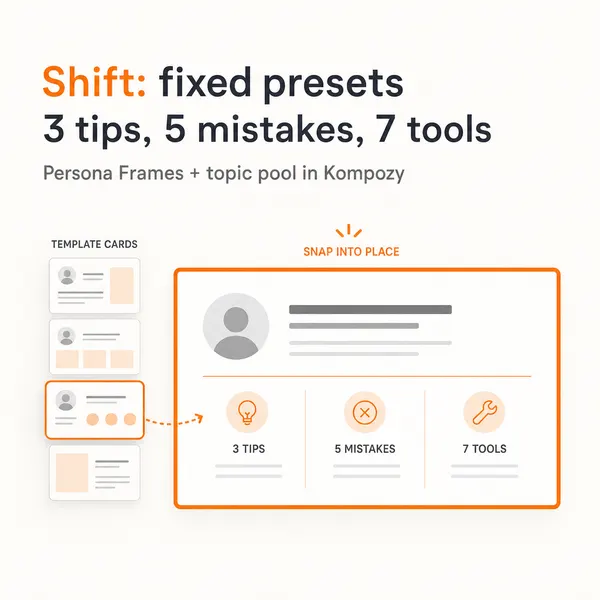
A five-slide carousel generated in the Kompozy workspace. It shows the kind of first draft AI can produce in one pass, which is where the human review step in this guide begins.




Who is this for, and who should skip it?
Best for:
- Marketers and creators who want to use AI without publishing generic filler
- Teams trying to work out how much to worry about Google and AI content
- Anyone willing to fact-check and edit what the model writes
Not ideal for:
- Publishers who want to auto-generate pages at volume with no review, which is what Google's scaled content abuse policy covers
- Legal, medical or financial content that nobody qualified will check
- Readers who need the platform-by-platform disclosure rules (the disclosure rules guide covers those)
Frequently asked questions
What is AI content creation?
It is using generative AI models to assist or accelerate the content lifecycle — ideation, drafting, editing, summarizing, and repurposing. In 2026 the effective approach is AI-assisted, not autonomous: AI handles volume and drafts while a human handles accuracy, insight, and voice.
Does Google penalize AI-generated content?
No — Google does not penalize content for being AI-generated. Per its official guidance on generative AI content, it penalizes low-value, mass-produced content under its "scaled content abuse" spam policy. The focus is on quality and value, not the production method. Using AI is neither a shield nor an automatic penalty.
Is AI content creation worth it?
Yes, as a force multiplier. AI speeds up ideation, first drafts, and repurposing. But the value comes only when a human reviews for accuracy, adds original insight, and enforces voice. Removing the human entirely produces "AI slop" that audiences and search engines filter out.
Do I have to disclose that I used AI to write content?
For Google SEO, no — there is no ranking requirement to label AI-assisted content, though giving readers context is a best practice. Separate disclosure rules can apply: the FTC for commercial reviews/endorsements, and platforms like TikTok, Meta, and YouTube for synthetic media depicting real people or events.
How do we know this?
On 2026-10-23 we checked every figure and quote on this page against the sources listed below, including Google's current guidance page and Sprout Social's survey release. We removed marketer-survey percentages we could not trace to an original survey.
Sources
- Google Search Central — Google Search's guidance on using generative AI content on your website (read 2026-10-23)
- Google Search Central Blog — Google Search's guidance about AI-generated content (Feb 2023) (read 2026-10-23)
- Sprout Social — Social media is now the top source for breaking news (Q1 2026 Pulse Survey release) (read 2026-10-23)
- Sprout Social — The 2026 Social Media Content Strategy Report (read 2026-10-23)
- FTC — FTC's Endorsement Guides: What People Are Asking (read 2026-10-23)
- YouTube Help — Disclosing use of altered or synthetic content (read 2026-10-23)
- TikTok — Community Guidelines: Integrity and authenticity (read 2026-10-23)
- Meta — Our approach to labeling AI-generated content and manipulated media (read 2026-10-23)