AI content calendar: how 2026 creators plan 90 days in 90 minutes
How to build an AI-assisted content calendar that ships: pillar structure, batch planning, the 90-minutes-for-90-days workflow, and where AI helps.
Last verified · 2026-10-23 · by Moe Ameen
Published 2026-05-22 · Updated
Short answer
An AI content calendar starts with 3 to 5 pillar topics that you choose yourself. AI then generates topic angles for each pillar and hook variants for each post. With the workflow on this page, one 90-minute session plans 30 to 90 days: lock pillars, brainstorm angles, slot them into the calendar, pick formats and build a hook bank. Leave about 20% of slots open for news and trends.
Key takeaways
- You choose the 3 to 5 pillars. AI fills in angles and hooks once the pillars exist.
- One 90-minute planning session can map 30 to 90 days of posts.
- Rotate pillars and formats so no two posts in a row repeat either one.
- Keep about 20% of slots open for news, trends and replies to comments.
- Keep the plan somewhere you open every week, like Notion or Airtable, and schedule from there.
The content calendar is the single most important tool a working creator owns and the most commonly skipped step. Creators without calendars post when they feel inspired, run out of ideas, post inconsistently, and lose the algorithmic compounding that makes short-form work. Creators with calendars post on schedule, never run out of ideas, and let the algorithm reward consistency. AI does not change which one wins — it makes building the calendar a 90-minute job.
The failure mode with AI content calendars is the same as every other AI content failure: asking the AI to do strategic work it cannot do. "Give me a content calendar for my business" produces 30 generic post ideas that any competitor could have generated. "Give me 30 angles on the pillar I have already picked, for the audience I have already identified" produces a list you can actually use. The split between strategic (yours) and operator (AI) work is the entire game.
This page is the working 90-day calendar workflow. The pillar structure, the batch-planning method, the AI prompt patterns that produce usable angles, the spacing and format rules that prevent burnout and platform fatigue, and the tools that make the calendar live somewhere durable.
What pillar structure should a content calendar use?
Every working creator content calendar is built around 3-5 pillar topics. A pillar is a topic broad enough to support 50+ post angles but narrow enough that your audience knows what to expect from you. Pillars are strategic and have to come from you. AI cannot pick them — it does not know your audience or your business.
Pillar examples for a real-estate-investor creator: (1) cold outreach (LOI blasts, cold email, cold calls), (2) deal acquisition (wholesaling, foreclosure, off-market), (3) financing and capital stack, (4) market analysis and trends. Four pillars, hundreds of post angles each, all aligned to the audience.
How do you plan 90 days of content in 90 minutes?
- Minutes 0-15: Lock the pillars. 3-5 topics that your audience expects from you. Write them down.
- Minutes 15-30: For each pillar, brainstorm 8-12 specific topic angles. AI helps here — paste your pillar + audience and ask for 30 angles, then pick the 8-12 you actually have something to say about.
- Minutes 30-50: Slot angles into a 90-day calendar. 3-7 posts per week. Rotate pillars to avoid topic fatigue. Reserve 20% of slots for opportunistic content (responses to news, trends, comments).
- Minutes 50-70: Pick the format per post. Talking-head short, carousel, photo post, longer YouTube, newsletter section. Match format to message — some angles fit short-form, some need long-form.
- Minutes 70-90: Hand the angle list off to AI for hook variants per post. Ask for 30 hooks per post, save them inline next to each angle. The hook bank is what eliminates blank-page mornings.
90 minutes once, 90 days of content planned. Compare to "what should I post today" 90 days in a row.
Which AI prompts produce usable content angles?
Pillar-to-angles prompt: "Pillar: [your pillar]. Audience: [specific audience]. Constraints: [niche-specific, not generic, contrarian where possible]. Generate 30 specific topic angles. Each angle must be one sentence and must be specific enough that two different writers would write similar content from it." Examples beat adjectives — paste 2-3 of your past best-performing post titles as style references.
Angle-to-hook prompt: "Topic angle: [angle]. Format: [short-form video, carousel, etc]. Voice: [paste 2-3 of your past hooks]. Generate 30 hook variants. First 8 words of each must be specific, not generic. No \"in this video\" phrasing. No filler intros."
Calendar-spacing review prompt: "Here is a 30-day content list. Identify: (1) pillars used too consecutively, (2) topic angles too close together, (3) format diversity issues, (4) gaps where the audience would lose interest. Recommend specific swaps." AI is much better at critique than at creation — use it that way.
How should you space posts to avoid platform fatigue?
- No same pillar two posts in a row. Forces rotation, prevents topic fatigue.
- No same format two posts in a row on the same platform. Vary talking-head, carousel, image, text.
- No same hook structure 3+ times in a week. AI defaults you into ruts; break them deliberately.
- Put your highest-effort posts (data-driven or contrarian takes) on the days your own analytics show your audience is most active.
- Open each week with an evergreen pillar post so new viewers can see what your account is about.
- Keep 20% of slots empty for opportunistic content. A fully-planned calendar that cannot react to news loses the highest-leverage spikes.
Which tools keep a content calendar in use?
A content calendar that lives in a doc you never open is not a calendar. The working tools in 2026:
- Notion or Airtable for the master calendar. Database view + calendar view + status columns (idea / scripted / filmed / scheduled / published).
- A platform's own scheduler where it has one, or a cross-platform scheduler such as Buffer, Hootsuite, Later or Kompozy.
- A separate hook bank — Notion table or Google Sheet — with 30+ hooks per pillar that you can pull from on filming days.
- A trends log — running doc of recent news, viral formats, and comment threads worth responding to. Feeds the 20% opportunistic slots.
Kompozy itself is the operator layer for this workflow. The pipeline page is the calendar; the formats are the per-post production; the scheduler ships to all your connected platforms. Bring the strategic pillars; let the operator layer handle the volume.
Where does AI content planning fail?
- Asking AI for pillars. It will hallucinate generic topics any competitor would also get.
- Asking AI for the calendar without pillars. Same problem at scale — you get a generic 30-day schedule for "your industry".
- Trusting AI on trending topics without verification. Models drift on what is actually trending right now. Verify externally.
- Letting AI pick formats. Format-to-message fit is judgment; AI defaults are "always make a video".
- Locking the calendar 100%. No room for reactive content kills the highest-leverage spikes.
How does Kompozy support calendar workflows?
Kompozy's pipeline + calendar surfaces are designed for this exact loop: topic angles flow through the pipeline as Raw Inbound items, the operator layer produces the post per angle, and the calendar view shows what is scheduled. Bring the strategic frame; Kompozy handles the production and scheduling. Pricing: Starter $199/mo (5,500 credits) or Pro $499/mo (18,000 credits); Enterprise via Contact Sales.
What does this look like in Kompozy?
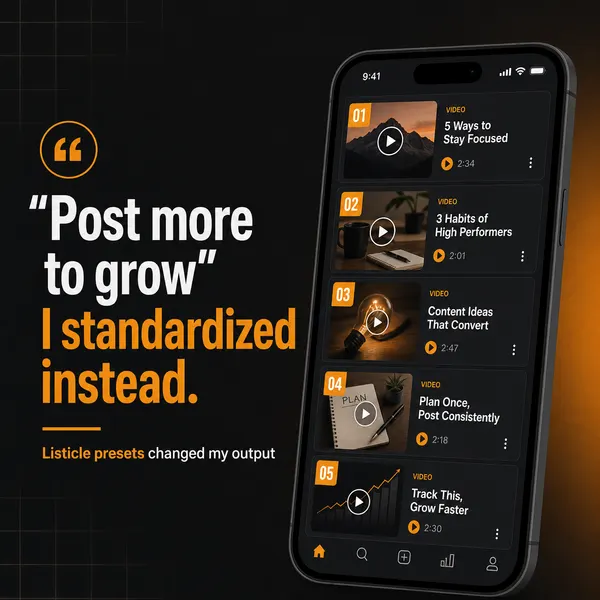
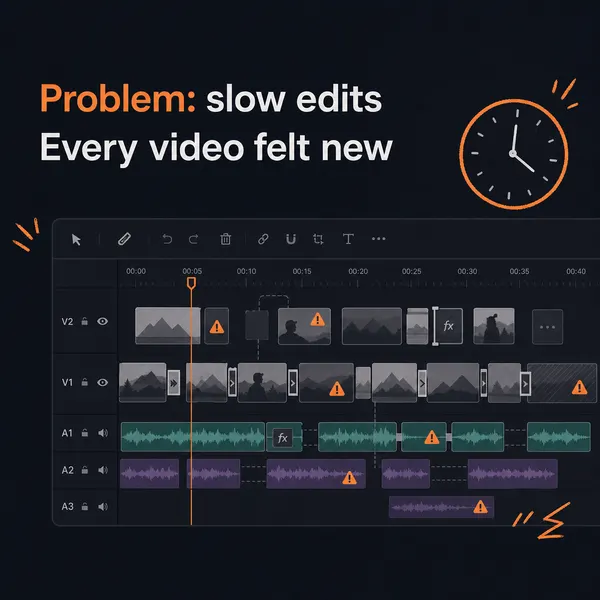
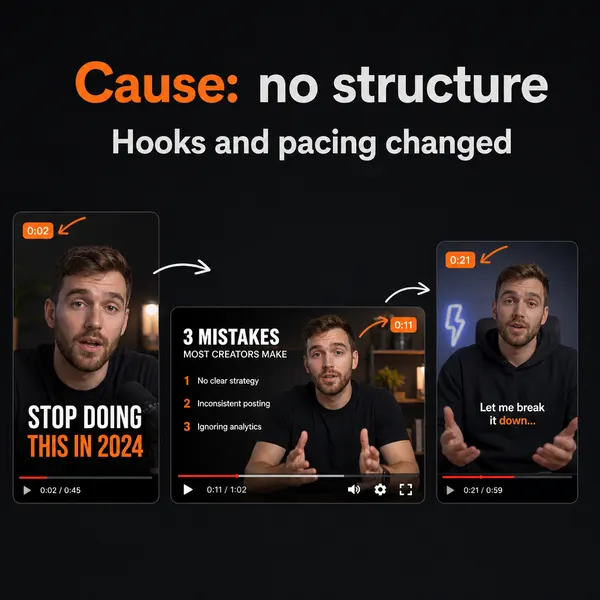
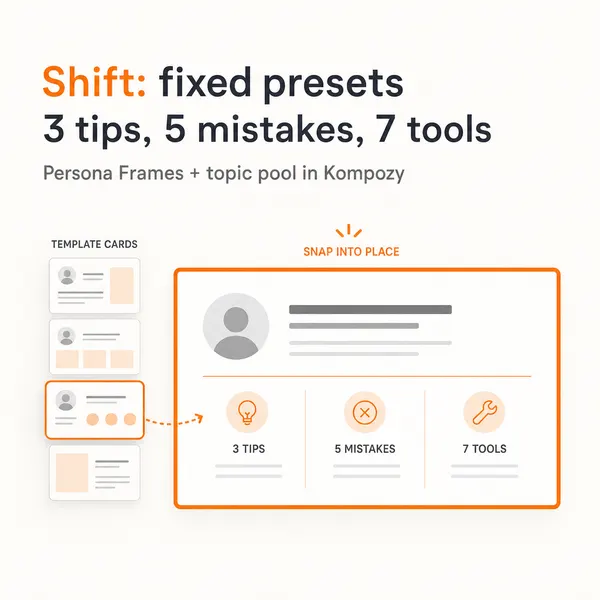
A carousel generated in the Kompozy workspace, one of the formats you can slot into a calendar next to short videos and photo posts.
Who is this for, and who should skip it?
Best for:
- Solo creators who post several times a week and keep running out of ideas
- Small teams that want one shared plan across platforms
- Creators who already know their audience and niche
Not ideal for:
- Brand-new accounts that have not done audience research yet (do that first)
- News-driven accounts where most posts react to the day's events
- Anyone hoping AI will choose the strategy for them
Frequently asked questions
How many content pillars should I have?
Three to five. With fewer, your audience gets no clear picture of what you cover; with more, you spread yourself thin.
How far ahead should I plan content?
Plan topics and formats 30 to 90 days out, and write the actual scripts and copy 7 to 14 days out. Copy written three months early usually needs rewriting once things change.
Can AI build my entire content calendar?
No. You pick the pillars, because AI does not know your audience or your business. AI is useful for angles per pillar, hook variants per angle and a critique of your spacing.
What is the best content calendar tool?
A Notion or Airtable database for the master plan, plus a scheduler that posts for you, either a platform's own or a cross-platform one like Buffer or Kompozy. Reviewing the calendar every week matters more than which tool you pick.
How do I avoid burnout with daily posting?
Batch it. Film one or two days a week, produce several posts per session and schedule them across the week instead of recording something new every day.
Should I plan the same content for all platforms?
Plan the message once and adapt the format for each platform. The pillars stay the same while the post length and format change.
How do I plan content for a new audience?
Learn the audience first. Spend a few weeks on DMs, comments, polls and competitor research before you lock pillars, because a calendar built on a guessed audience tends to miss.
How do we know this?
This page describes a planning workflow, not a measured study; the 90-minute figure is the sum of the steps listed. On 2026-10-23 we checked the Kompozy product details against kompozy.io/pricing and removed day-of-week and posting-frequency claims we could not source.
Sources
- Kompozy — Pricing (read 2026-10-23)