Fact-anchoring AI content: how Kompozy limits invented stats, and what it does not check
Kompozy has no output-time fact check. It limits invented numbers with prompt rules and a script critic. What that covers, what it misses, and how to close the gap.
Published 2026-05-18 · Updated
Short answer
Kompozy does not run a fact-anchor gate that matches claims in a finished output against your source. Every text format is generated under anti-AI-tell rules that forbid inventing numbers, dates, places or anonymous sources, and persona video scripts get a critic pass that asks for source-only numbers. Nothing verifies figures after generation, so read number-heavy formats such as newsletters before they publish.
Key takeaways
- Models invent plausible stats because they predict text, not truth.
- Kompozy limits invented figures with prompt rules, not an output-time source check.
- Persona video scripts get a critic pass that penalizes pinpoint dollar figures.
- The newsletter grader rewards specific numbers and does not check where they came from.
- Thin sources and stat-heavy reference posts are the usual cause of invented numbers.
AI models invent statistics. A line like "most marketers report..." with a precise percentage sounds authoritative and traces back to nothing. Under your brand, one of those costs more trust than a dozen good posts earn back.
An earlier version of this page described a gate that matched every number and quote in an output against the source. Kompozy does not have that gate. It has rules that steer the model away from inventing figures, plus a critic pass on video scripts. This page covers what those do, where they fall short, and how to cover the gap yourself.
Why do AI models hallucinate stats?
Large language models are trained on text that contains specific stats, quotes, and citations. When generating new content, the model pattern-matches: "Marketing content usually contains a stat early in the post." So it invents a plausible-sounding stat.
The model is not lying — it has no concept of truth. It is producing text that statistically resembles training data. The hallucination problem is structural, not behavioral.
Prompt rules reduce this but do not remove it. "Do not invent stats" works on most outputs and fails on some. Catching the rest means reading the finished output, with code, a second model, or a person.
Does Kompozy check generated claims against the source?
No. There is no step that pulls numbers, quotes or names out of a finished post and looks for them in the source. A post with an invented figure is not rejected or regenerated for that reason.
What Kompozy does happens before and during generation:
- Anti-fabrication rules on every text format. The anti-AI-tell block tells the model not to invent dollar amounts, figures, prices, percentages, counts or durations, and not to make up weekdays, times, places or anonymous experts. When the source has no number, the model is told to speak in qualitative terms.
- Source-only specificity. The same block tells the model to use specific details only when they appear in the source, on the principle that generic but honest beats specific but invented.
- A critic on persona video. Persona Short and Persona Frames scripts are scored by a second model call. Its specificity score asks for numbers from the source only, and its AI-tell score penalizes pinpoint dollar figures and anonymous-expert anchors. Any score under 6 of 10 swaps in the critic revision, once.
An admin compliance matrix decides whether each format gets the anti-AI-tell block. Every format has it on by default.
What do those rules catch?
They lower the rate of the usual fabrications:
- Round-sounding statistics with no source behind them ("a majority of marketers...")
- Dollar amounts and timeframes dropped in for color
- Anonymous anchors like "a friend in the industry told me"
- Specific weekdays, places and times the source never mentioned
What do the rules miss?
- Any fabrication the model makes anyway. A rule is an instruction, and on some outputs the model ignores it.
- Fabricated quotes and wrong attributions. Nothing compares quotes with the source.
- Outdated facts. If your source says 500 customers and you now have 1,200, the output repeats 500.
- Misleading framing built from accurate numbers, and subjective claims like "best in class," which have nothing to anchor to.
One format pulls the other way. The Email Newsletter grader rewards specific numbers as part of its style rubric. It checks that before-and-after figures use matching time windows, but not where the numbers came from. Treat newsletters as the format most likely to carry a figure you need to verify.
How should you check facts yourself?
Since Kompozy does not verify figures, the checking falls to you. A routine that keeps it manageable:
- Keep Auto-Publish Generated off in workspaces that produce number-heavy formats such as newsletters, blog articles and infographic posts, and approve those rows after reading them.
- Feed dense sources. A long transcript or a detailed article gives the model real numbers to use, so it has less reason to make some up.
- Say it in the Persona Brief. A line like "only cite figures that appear in the source" adds weight to the built-in rule.
- Spot-check after publishing. Each week, pick a few published posts and trace every figure back to its source.
What should you do when invented numbers keep showing up?
If you keep finding figures that are not in the source, the cause is usually upstream:
- The source is too thin. Short transcripts push the model to fill gaps. Use longer or denser sources.
- Your reference posts are stat-heavy. When the examples in your Persona Brief cite numbers, the model tries to match them and invents numbers when the source has none. Swap those examples out.
- Your settings ask for stats. Remove "include statistics" style instructions from the Persona Brief.
- The format asks for numbers. A "5 stats about X" post needs a source with five stats in it. Pick formats your source can fill.
How does this fit with Kompozy's other checks?
Fact control is one layer among several. Prompt rules cover every format, the newsletter has its own three-layer gate, persona scripts get the critic, and publishing enforces platform limits. See quality gates for the full map and brand safety for how prohibited keywords are handled.
Which workarounds fail to stop hallucinations?
- A stronger prompt instruction on its own. It helps, and it still fails on some outputs. Kompozy's rules have the same limit.
- Fine-tuned models sold as hallucination-free. Fine-tuning can lower the rate. No model gets it to zero.
- External fact-checking APIs. They help with well-known public claims and do little for numbers only your source could confirm.
Reading the output against the source still works best, whether a person does it or a dedicated check does. In Kompozy today, that person is you.
What does this look like in Kompozy?
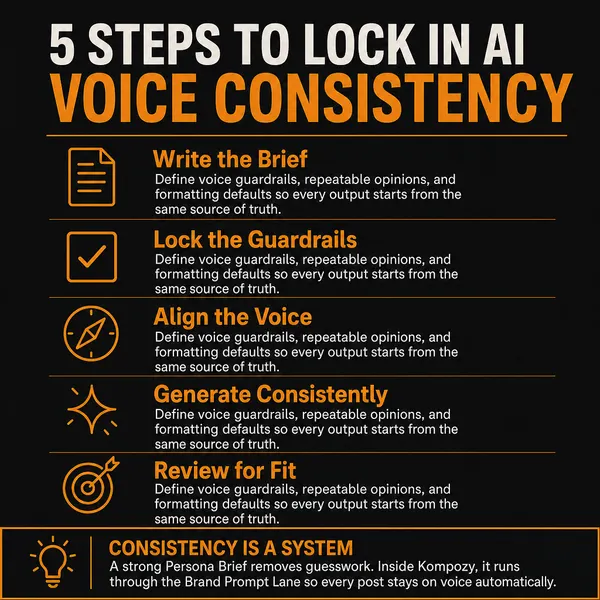
An Infographic Photo generated in the Kompozy workspace, a format where every figure on the card should trace back to the source material.
Who is this for, and who should skip it?
Best for:
- Teams publishing from transcripts, blog posts or recordings
- Brands that cannot risk a fabricated number or quote under their name
- Operators deciding which formats to keep on manual approval
Not ideal for:
- Anyone expecting Kompozy to verify figures automatically
- Catching outdated facts or misleading framing, which needs editorial review
- Subjective copy such as "best in class," which has nothing to anchor to
Frequently asked questions
Does Kompozy have a fact-anchor gate?
No. Kompozy does not compare numbers or quotes in a finished output with the source. It reduces invented figures with prompt rules on every text format and a critic pass on persona video scripts.
What stops the model from inventing a statistic?
The anti-AI-tell rules sent with every text generation tell it not to invent figures, prices, percentages, counts, durations, dates, places or anonymous sources, and to stay qualitative when the source has no number. Most outputs follow them. Some will not.
Which formats are most at risk?
The ones that reward numbers. The Email Newsletter grader scores number density as part of its style rubric, and blog articles and infographic posts tend to carry figures. Read those before they publish.
Can I add external research so the model can cite it?
Yes. Put it in the source material you generate from, so the numbers are in front of the model. Kompozy does not check citations either way, so confirm the figure came through correctly.
Does the script critic check facts?
Not against the source. It scores specificity and penalizes pinpoint dollar figures and anonymous-expert anchors. When any score is under 6 of 10, it swaps in a revised script once.
How do we know this?
We checked every product claim on this page against Kompozy's generation, autopilot and publishing code on 2026-10-23, and plan details against kompozy.io/pricing. The earlier description of an output-time claim-matching gate was removed because the code has no such gate; the page now covers the prompt rules and script critic that exist.
Sources
- Kompozy — Glossary: Quality gates (read 2026-10-23)
Which other autopilot guides should you read next?
- AI content quality gates: what Kompozy checks before a post ships — Which checks run on which formats: prompt rules everywhere, a three-layer newsletter gate, a persona script critic, publish limits, and what is not checked.
- Brand safety for autonomous AI: how Kompozy handles prohibited keywords — Prohibited keywords reach the model as an instruction and nothing scans the output. How to write a list the model follows, and when to keep approving by hand.
- Posting cadence by platform for autonomous content — Kompozy has no per-platform cap: you set posting days and posts per day for each format. Typical rhythms per platform to use when you set those limits.
- AI content autopilot: what it actually means in 2026 — Definition, mechanism, failure modes, and the brutal honest assessment of which AI tools actually achieve true autonomy.
- Founder-led marketing autopilot: scale your voice without losing it — How founders run daily content output across 9 platforms with 15 minutes of review per day.
- The 14-day manual-to-autopilot ramp methodology — How to graduate from full manual review to fully autonomous shipping in 14 days without losing voice control.
Which related topics connect to autopilot?
- AI Brand Voice & Persona — Without a Persona Brief, every AI output averages to the LLM default voice. This is the 5-section methodology that makes 100+ AI-generated posts feel like one human author wrote them.
← Back to Autonomous Content Creation overview · Get started →