The 14-day manual-to-autopilot ramp methodology
The day-by-day workflow for moving from full manual content review to fully autonomous AI publishing in 14 days without losing voice or quality.
Published 2026-05-18 · Updated
Short answer
The 14-day ramp is our recommended path from full manual review to autopilot. On days 1-3 you keep auto-publish off and edit every output. On days 4-7 you turn repeated edits into Persona Brief and Prohibited Keywords rules. On days 7-10 your edits should shrink. On days 10-14 you turn on auto-publish for one workspace with a stable source. After that, expand one source at a time.
Key takeaways
- Day-one autopilot fails because the Persona Brief is still loose.
- Every edit you make during the ramp is a rule waiting to go into the brief.
- Track the untouched-approval rate; it should climb as the brief tightens.
- Turn on auto-publish for one workspace with a stable source, then add others one at a time.
- Go back to manual if you catch a fabricated stat or a prohibited keyword in a published post.
Enabling autopilot on day one is the single most common mistake new AI content tool users make. Autopilot with a loose Persona Brief ships generic, off-voice content at volume. The ramp is the methodology that earns the right to flip the switch.
This is the exact day-by-day workflow.
Why is the 14-day ramp non-negotiable?
Two reasons day-one autopilot fails:
- The Persona Brief on day one is incomplete. You have not edited enough output yet to know what is missing. Your Prohibited Keywords list is generic. Your reference posts may not capture the voice you actually want.
- You do not trust the engine yet. Even if the output is good, you cannot tell because you have no baseline. The ramp builds your judgment alongside the brief.
Fourteen days is our recommended window, not a law. Go much shorter and the brief is usually still loose; go much longer and you keep paying for manual review you no longer need.
What happens on days 1-3 of the ramp?
You review every output by hand. Leave Auto-Publish Generated off, so finished posts wait in the pipeline as Generated until you approve them. Edit aggressively; there is no penalty for editing too much at this stage.
What to watch for:
- AI tells (hedge words, tricolons, generic openers, em-dash overuse)
- Voice drift (output sounds nothing like your reference posts)
- Fact issues (output cites something you cannot verify in the source)
- Tone mismatch (too formal, too casual, too marketing-y)
Goal: enough reviewed outputs by the end of day 3 that patterns start to repeat in your edits.
What happens on days 4-7 of the ramp?
You update the Persona Brief from your edit patterns. Mine your edits. Every time you cut a word, ask whether it belongs in your Prohibited Keywords. Every time you restructure an opener, ask whether a line in the Persona Brief would have told the model to do it that way.
Both fields are free text that the model reads as instructions on every text generation. Nothing checks the finished post against them, so the ramp is also how you find out whether the model follows what you wrote. Patterns to look for in your edits:
- Words you keep deleting: add them to Prohibited Keywords.
- Structures you keep imposing: describe them in the Persona Brief, such as "open with the result, then the how."
- Posts you keep wishing the output sounded like: paste a short example into the Persona Brief.
- Tones you keep softening or hardening: adjust the tone and personality settings, or say it in the brief.
By the end of day 7 you should have updated the brief several times, each time from a pattern you saw repeat.
What happens on days 7-10 of the ramp?
Your approval rate starts climbing. If the brief work is paying off, you should see fewer edits per output. Track your untouched-approval rate (outputs you ship verbatim, no edits, no regeneration).
What to look for:
- The untouched-approval rate rises day over day instead of bouncing around.
- The edits you still make are small (a word, a line) rather than rewrites.
- The same correction stops showing up, because it is now in the brief.
If the rate is flat or you are still rewriting outputs, the brief still has gaps. Pause expansion and keep refining.
What happens on days 10-14 of the ramp?
You turn on autopilot for one workspace. Once nearly every output ships untouched for several days in a row, switch on Auto-Publish Generated for the workspace that runs your safest, most stable source. Kompozy's autopilot switches apply to a whole workspace, so if that workspace has other sources, give the stable one a workspace of its own first. Good first candidates:
- Your own podcast or YouTube (you know the source well, voice is consistent)
- A trusted blog feed (your own RSS)
- A planned content calendar (one-off topical pieces, not breaking news)
Do NOT turn on autopilot for:
- A workspace with several sources at once (you cannot tell which one broke if something goes wrong)
- Breaking-news or trend-driven sources (autopilot timing is wrong for these)
- Sources you do not control (third-party RSS, scraped competitor feeds)
Spot-check daily, including the scheduled posts that have not gone out yet. If anything looks off, turn Auto-Publish Generated off; new posts then wait in the pipeline again while you refine the brief.
What happens after day 14?
You expand to the remaining sources, one at a time. Once the first workspace has run on autopilot for 4-7 days with no quality drops, add your next source to it or turn on Auto-Publish for the next workspace. Add one at a time and wait 3-5 days between additions.
As more sources move to autopilot, your weekly time shifts from reviewing individual outputs to reviewing aggregate metrics and tightening the brief.
When should you abort the ramp?
Stop and go back to manual review if:
- You are still editing most outputs by day 10
- You catch a fabricated stat or invented quote in any output. Kompozy tells the model not to invent figures but does not check outputs against the source, so this is a sign the source is thin or the brief invites numbers
- Voice drift increases instead of decreasing as the brief tightens (rare — usually means the reference posts are wrong)
- A word from your Prohibited Keywords shows up in a published post. Nothing scans for them, so this tells you the instruction is not holding
Aborting the ramp is not failure. It means the brief or the keyword list needs more work. Better to delay autopilot than to ship bad content.
What are the most common mistakes during the ramp?
- Editing too little in days 1-3. Aggressive editing is the input that improves the brief.
- Updating the brief but not generating new outputs to test the changes. Each brief edit needs validation.
- Flipping autopilot on too soon. Better to wait an extra week than to ship a viral-bad post.
- Expanding to multiple sources at once. One stable source on autopilot first, always.
- Ignoring failed rows. Failed generations and refused newsletter topics land in the pipeline as Failed with a reason. If the same reason keeps coming up, fix the brief or the source.
What does this look like in Kompozy?
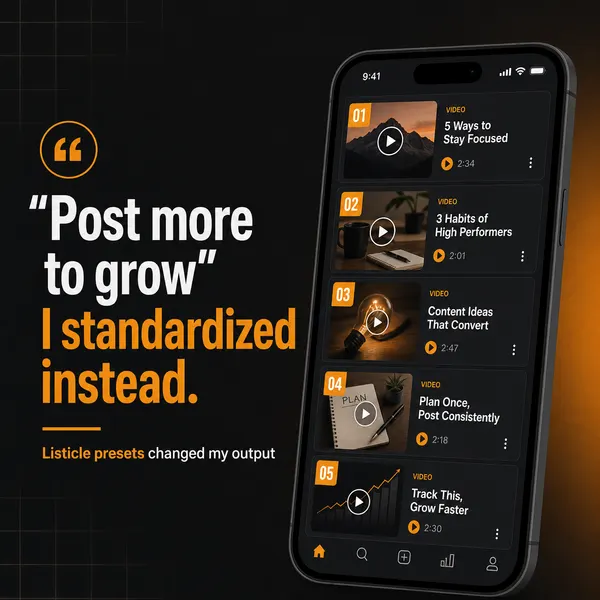
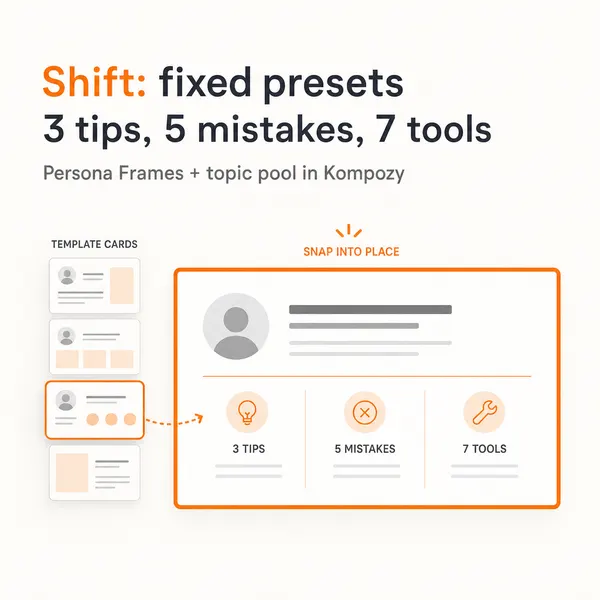
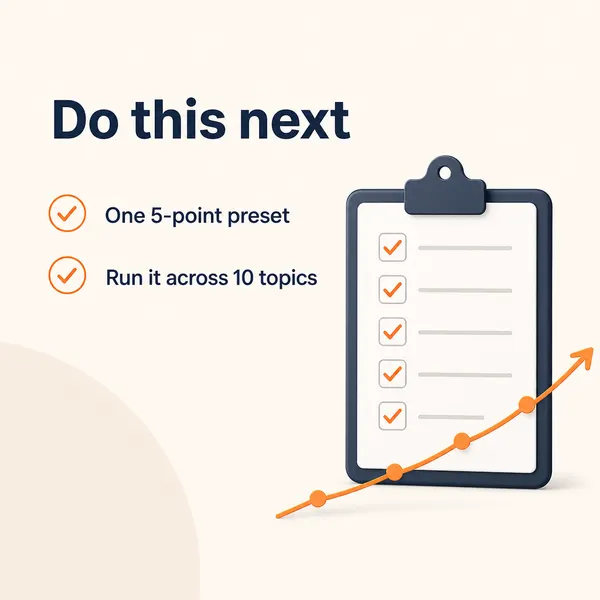
A five-slide Carousel generated in the Kompozy workspace, the kind of recurring output you review by hand during the ramp before trusting it to autopilot.

Who is this for, and who should skip it?
Best for:
- New workspaces about to try autopilot
- Teams moving from AI-assisted drafting to hands-off publishing
- Agencies onboarding a new client brand
Not ideal for:
- Regulated content that must stay on human review permanently
- Breaking-news or trend-driven sources, where autopilot timing is wrong
- Sources you do not control, such as third-party feeds
Frequently asked questions
Can the ramp be shorter than 14 days?
Sometimes. If you already have a tight Persona Brief from another platform, the ramp can be shorter. If you are new, keep the full window, because shortening it risks shipping low-quality output before the brief is dialed in.
What if my untouched-approval rate stalls?
The Persona Brief has gaps. Audit your recent edits and look for patterns that repeat, then add them to Prohibited Keywords or write them into the Persona Brief as rules or examples. If you still cannot find the gap, your voice may not be defined well enough to autopilot yet.
Does the ramp work for new accounts with no existing content?
Partially. Without existing content to use as reference posts, the brief leans more on voice descriptions and reference creators. Expect the ramp to take longer and to reach a lower untouched-approval ceiling than an account with a back catalog.
Can I run the ramp on multiple workspaces at the same time?
Yes, and each workspace runs its own ramp because each has its own Persona Brief. Keep the number small enough that you can give every brief real attention, or they all end up under-refined.
What happens if I take a break mid-ramp?
Pick up from the day you stopped, since your Persona Brief and pipeline rows are still there. After a short break that is fine; after a long one, go back to the brief-updating stage to re-calibrate before flipping anything to autopilot.
How do we know this?
This page describes our recommended ramp process; the day ranges are suggested settings, not measured results. On 2026-10-23 we removed unverified approval-rate figures, checked autopilot and review behavior against Kompozy's code, and checked plan details against kompozy.io/pricing.
Sources
- Kompozy — Pricing (plans, credits, workspaces, autopilot, HeyGen BYO) (read 2026-10-23)
- Kompozy — Glossary: Quality gates (read 2026-10-23)
Which other autopilot guides should you read next?
- AI content autopilot: what it actually means in 2026 — Definition, mechanism, failure modes, and the brutal honest assessment of which AI tools actually achieve true autonomy.
- AI content quality gates: what Kompozy checks before a post ships — Which checks run on which formats: prompt rules everywhere, a three-layer newsletter gate, a persona script critic, publish limits, and what is not checked.
- Founder-led marketing autopilot: scale your voice without losing it — How founders run daily content output across 9 platforms with 15 minutes of review per day.
- Fact-anchoring AI content: how Kompozy limits invented stats — Kompozy has no output-time fact check. How its prompt rules and script critic limit invented numbers, and how to check the rest yourself.
- When NOT to use autopilot: regulated industries and compliance risk — Medical, financial, legal, and pharma require human review forever. Why autopilot is a productivity tool, not a compliance shield.
- Brand safety for autonomous AI: how Kompozy handles prohibited keywords — Prohibited keywords reach the model as an instruction and nothing scans the output. How to write a list the model follows, and when to keep approving by hand.
Which related topics connect to autopilot?
- AI Brand Voice & Persona — Without a Persona Brief, every AI output averages to the LLM default voice. This is the 5-section methodology that makes 100+ AI-generated posts feel like one human author wrote them.
← Back to Autonomous Content Creation overview · Get started →