B2B content strategy 2026: what actually works after AI ate the SERP
A 2026 B2B content strategy framework: channel allocation by ARR stage, the modern stack with real prices, what to stop doing, and attribution math.
Published 2026-05-19 · Updated
Short answer
B2B content strategy in 2026 rests on four moats: founder content on LinkedIn, stories drawn from customer calls, comparison and alternative SEO pages, and programmatic SEO built on real data. Generic "what is X" blogging lost ground once Google put AI Overviews in front of US searchers, and Ahrefs measured a 34.5% lower CTR for top results under an Overview. Shift emphasis by company stage and measure with self-reported attribution.
Key takeaways
- AI Overviews cut clicks on informational queries; Ahrefs measured a 34.5% lower CTR for the top result.
- Founder LinkedIn, customer-call stories, comparison SEO and programmatic SEO are the surviving moats.
- Founder content leads early; paid distribution and brand content grow with the company.
- Distribute each cornerstone piece many times across formats instead of writing more pieces.
- Measure with self-reported attribution; last-touch under-credits content.
Most B2B content strategy articles published in 2026 are AI-generated, written for other AI to ingest, and contain zero specific tactics. They list "create a content calendar," "know your ICP," "measure what matters" — frameworks so generic they apply to a tax firm in 1998. This is not one of those articles.
The B2B content landscape changed materially between 2024 and 2026 in ways most articles do not acknowledge. Google began rolling AI Overviews out to everyone in the US in May 2024, and the click-through hit was measurable: Ahrefs found the top-ranking page earned a 34.5% lower average CTR on keywords with an AI Overview (March 2025 versus March 2024). LinkedIn, which now reports more than 1.3 billion members, became the default B2B distribution channel. The ZIRP-era content playbook of "publish 40 generic blog posts per month and one will rank" is not just inefficient now; it is structurally broken because the queries those posts targeted no longer return clicks.
This spoke is the operator playbook for what replaced it. Real channel allocation by ARR stage. The actual tool stack. An honest take on attribution. Specific things to stop doing. And opinionated takes on the AI-content question, the SDR-replacement question, and the "should we still blog" question — three debates that consume more B2B marketing-leader time than any other in 2026.
What changed in B2B content marketing between 2024 and 2026?
Four structural shifts reshaped B2B content since 2024, starting with AI Overviews eating the informational SERP. If your strategy is older than 2024, every one of these invalidates an assumption it was built on.
1. AI Overviews ate the informational SERP
Google began rolling AI Overviews out to everyone in the US in May 2024. The practical effect for B2B: any query phrased as a question ("what is account-based marketing", "how does product-led growth work", "benefits of a CDP") now gets answered above the fold without a click. Ahrefs published the cleanest measurement in April 2025: across 300,000 keywords, an AI Overview correlated with a 34.5% lower average CTR for the top-ranking page. Educational content built to capture top-of-funnel awareness traffic still ranks, but the traffic that rank used to produce has collapsed.
Two query types survive: commercial-intent queries (Google still wants you to click a vendor) and comparison queries (the AI summary cannot resolve "X vs Y" in a way that satisfies a buyer doing diligence). Everything else got eaten.
2. LinkedIn became the only B2B social channel that matters
LinkedIn now reports more than 1.3 billion members, and for most B2B categories it is where buyers and peers actually read. Facebook never became a serious B2B channel. Reddit matters for technical and DevTools categories, where buyers ask each other for recommendations. TikTok matters for B2B only in very specific verticals (creator-economy SaaS, design tools, e-commerce platforms).
For most B2B SaaS the channel question is no longer "which social platforms" — it is "how much of our LinkedIn budget goes to the founder versus the brand account versus paid." Strategies that spread effort across five or more platforms tend to produce five neglected accounts.
3. The 2020-2024 SEO playbook stopped compounding
The dominant B2B SEO model from 2020-2024 was the topical-cluster strategy: pick a category, build a pillar page plus a set of spoke pages, earn links, watch traffic compound. That model still works for commercial-intent and comparison content. It no longer works for educational spokes targeting informational queries because the click-through rate from the SERP has dropped below the threshold where the traffic justifies the production cost.
What replaced it: programmatic SEO targeting comparison and use-case permutations at scale. Webflow publishes a detail page per template, targeting "[template-type] template" queries, and Zapier publishes pages for "[App A] + [App B]" integration pairs. These pages rank because they answer comparison or use-case intent that AI Overviews cannot satisfy — the page IS the answer.
4. Founder content beats brand content on LinkedIn
People follow and reply to people. A founder post reads as a person with a view, while a company page post reads as marketing, and the gap compounds: founder posts earn higher comment density (which the algorithm rewards), drive more profile visits (which converts to follows of both founder AND company), and create attribution surface area that brand accounts structurally cannot (a founder reply in a thread converts; a brand-account reply reads as canned).
This is the single largest structural reason the modern B2B content strategy is built around founder-led distribution and not around "thought leadership content from the brand account."
The one hard number in this section is Ahrefs': a 34.5% lower average CTR for the top-ranking page on keywords that show an AI Overview. We have no sourced multiplier for founder versus brand reach on LinkedIn, so test it on your own accounts.
Which B2B content types drive pipeline in 2026?
Five content types survive into 2026 as primary pipeline drivers, led by daily founder content on LinkedIn. Everything else is supporting or dead weight.
- Founder content on LinkedIn — a steady cadence, one specific claim per post, written in the founder's voice. Consistency matters more than any single post.
- Technical-led content (engineering blog, deep-dive comparisons, build-in-public threads) — for technical buyers in DevTools / infra / API-first categories. Owned by engineering or PMs, not marketing.
- Customer-call-derived stories and case studies — extracted from recorded customer conversations, lightly edited, published as written stories or short videos. Highest-conversion content type for considered B2B purchases.
- Comparison and alternative pages — "[Category] alternative to [Competitor]" and "[Competitor A] vs [Competitor B]." Ranks because intent is commercial; converts because the reader is in active evaluation.
- Programmatic SEO — large-scale generation of pages targeting permutations: integrations, templates, use cases, locations. Only works if each generated page is genuinely useful, not a thin keyword stuffer.
Conspicuously absent: generic "what is X" / "how does X work" blog posts, weekly newsletters that summarize industry news, whitepapers gated behind email capture, and any content built around award lists or year-end roundups not directly tied to a buying decision. These formats still get published constantly; they do not drive pipeline in 2026.
| Content type | Time-to-impact | Pipeline role | Main cost | Verdict |
|---|---|---|---|---|
| Founder LinkedIn (daily) | Fastest of the organic channels | Primary | Founder time | Best return on founder time for most early-stage B2B |
| Comparison / alternative SEO | Months | Primary | Research and writing per page | Highest commercial intent of any content |
| Customer-call case studies | Weeks | Strong | Recording and editing per story | Converts readers in active evaluation |
| Programmatic SEO at scale | Slow | Supporting | Data source, build and maintenance | Only works at scale with genuinely useful pages |
| Technical deep-dive blog | Months | Category-dependent | Engineering time, not marketing | DevTools / infra; weak for horizontal SaaS |
| Generic educational blog | Slow | Weak | Writing per post | Stop publishing these as a primary play. |
| Gated whitepapers | Weeks | Weak | High per asset | Email captures inflate, pipeline does not |
| Weekly brand newsletter | Slow | Brand utility | Ongoing writing | Brand utility, not pipeline |
How should B2B content allocation change by ARR stage?
The right content allocation in 2026 depends almost entirely on company stage. The pre-seed founder running content alone has a different optimal mix than a Series B team with a full marketing org. Here is how the emphasis shifts:
| Stage | Founder LinkedIn | Comparison SEO | Case studies | Programmatic SEO | Paid distribution | Brand-led content | PR / events |
|---|---|---|---|---|---|---|---|
| Pre-seed (<$500k ARR) | Primary | Secondary | Light | None | None | None | None |
| Seed ($500k-3M ARR) | Primary | Primary | Secondary | Light | Light | None | None |
| Series A ($3-15M ARR) | Primary | Secondary | Secondary | Secondary | Light | Light | Light |
| Series B+ ($15-50M ARR) | Secondary | Secondary | Secondary | Secondary | Primary | Light | Light |
| Growth ($50M+ ARR) | Light | Light | Secondary | Secondary | Primary | Secondary | Secondary |
Two things to notice. First, founder LinkedIn allocation drops as ARR grows — not because founder content stops working, but because other channels scale better past Series A. Founder content compounds linearly with founder time, which is bounded. Paid distribution compounds with budget, which is not. Second, brand-led content does not become meaningful until Series B+. The "we need a brand voice" instinct at seed stage is one of the most common founder mistakes — the brand IS the founder for a long time.
What belongs in the B2B content tool stack in 2026?
A lean stack covers content composition, SEO research, CRM, prospecting, call recording and email, and it grows with the company. The B2B martech stack has fragmented into specialized layers since 2024. The all-in-one HubSpot / Salesforce Marketing Cloud model still dominates enterprise, while smaller teams often pick best-of-breed tools. Here is the stack by category and stage. Kompozy prices come from kompozy.io/pricing; for every other vendor, check its own pricing page.
| Category | Tool | 2026 starting price | Stage fit |
|---|---|---|---|
| Content composition & multi-format | Kompozy Starter | $199/mo (5,500 cr) | Seed → Series A founder-led |
| Content composition (solo) | Kompozy Starter | $199/mo (5,500 cr) | Pre-seed / bootstrapped |
| Content composition (team) | Kompozy Pro | $499/mo (18,000 cr) | Series A content team |
| Content composition (agency) | Kompozy Enterprise | Custom (pooled credits) | Agencies / Series B+ |
| SEO research | Ahrefs | See vendor pricing page | All stages |
| SEO research alternative | Semrush | See vendor pricing page | All stages |
| CRM + marketing automation | HubSpot Marketing Hub | See vendor pricing page | Series A+ |
| CRM + marketing automation | Salesforce Marketing Cloud | Custom quote | Series B+ |
| Sales intelligence / prospecting | Apollo | See vendor pricing page | Seed → Series A |
| Sales intelligence (enterprise) | ZoomInfo | Custom quote | Series A+ |
| Account-based intent | 6sense | Custom quote | Series B+ |
| Outbound + sequencing | Default | See vendor pricing page | Series A+ |
| Community / signal-based GTM | Common Room | See vendor pricing page | Series A+ |
| Website personalization | Mutiny | See vendor pricing page | Series B+ |
| Customer call recording | Grain / Otter / Gong | See vendor pricing pages | All stages |
| Email platform (newsletter) | Beehiiv / ConvertKit | See vendor pricing pages | All stages |
Notes on the stack: (1) HubSpot and Salesforce list prices are only a starting point; real all-in cost depends heavily on contact tier and seats. (2) ZoomInfo and 6sense sell on negotiated annual contracts, so ask for a quote. (3) Kompozy Starter is $199/mo for 5,500 credits on kompozy.io/pricing; size the tier against how many outputs you plan to publish.
How much pipeline does B2B content drive?
There is no reliable benchmark for that, and anyone quoting a precise share is guessing, so measure your own. Honest B2B content attribution in 2026 starts with three things most reports gloss over. First, multi-touch attribution models that claim to credit each touch precisely are pattern-matching, not measurement. Second, last-touch attribution systematically over-credits the demo-form-fill source and under-credits the LinkedIn post that drove the eventual buyer to type the URL into their browser six weeks earlier. Third, "self-reported attribution" (asking buyers in a form "how did you hear about us") tends to credit founder content and word-of-mouth more than HubSpot or Salesforce does.
The honest framing for B2B content attribution in 2026: content is a top-of-funnel awareness layer that creates dark-social influence and direct/organic traffic, plus a bottom-of-funnel commercial layer (comparison pages, case studies, pricing pages) that converts buyers in active evaluation. Trying to credit a specific LinkedIn post for a $50k deal is performative — the post built the awareness, the buyer self-routed to the comparison page, the comparison page got last-touch credit. All three were necessary.
Self-reported and last-touch numbers usually disagree, and the gap is the useful signal. Track both on your own pipeline instead of borrowing someone else's benchmark.
What to actually measure: (1) self-reported attribution on the demo / trial form — "how did you hear about us" with structured options. (2) Direct + organic-branded search traffic trend (proxy for dark-social influence). (3) Conversion rate on comparison and alternative pages specifically (the cleanest "content drove pipeline" signal). (4) LinkedIn profile-visit-to-website-visit conversion for the founder account. Skip pageview-weighted models; they will mislead you.
What role should AI play in B2B content in 2026?
AI is the production layer for B2B content in 2026, not the strategy layer. That is the operator view, not the marketing-conference one. Teams that win with AI content treat it as a force multiplier on a tight Persona Brief and an opinionated content strategy. Teams that lose treat it as a replacement for editorial judgment.
Concretely, what AI does well in B2B content production in 2026:
- Multi-format fan-out — turning one customer call into a LinkedIn post, a written case study, a tweet thread, a short video script. Tools like Kompozy are purpose-built for this fan-out shape.
- First-draft SEO content from outlines — the writer's role shifts from drafting to editing and adding original sources/data.
- Programmatic SEO page generation — when paired with a real data source (your integrations directory, your template library), AI generates pages at scale that are actually useful.
- Voice-of-customer mining — transcribing customer calls and extracting common phrases, objections, and use cases that should appear in copy.
- Repurposing — taking a long blog post and breaking it into a LinkedIn carousel, a YouTube short script, a newsletter blurb.
What AI does badly and where unedited AI output kills brand equity:
- Original opinions — AI averages the internet. Founder content lives or dies on contrarian, specific opinions. AI cannot generate those; it can only structure them once the founder has supplied the take.
- Anti-AI tells in brand voice — hedge words ("it is worth noting", "in many cases"), tricolons ("fast, cheap, and effective"), pseudo-bridges ("in today's fast-paced world"). A tight Persona Brief that bans these patterns is the difference between AI content that ranks and converts versus AI content that reads as obviously synthetic.
- Specificity — generic AI output is vague by default. Every claim should be supported by a number, a named source, or a concrete example. The Persona Brief should require this.
Google's guidance on generative AI content says using AI is not the problem; generating many pages without adding value for users can violate its spam policy on scaled content abuse. Google also tells publishers to fact-check AI output before it goes live. AI content with tight voice governance, original analysis and real fact-checking sits on the right side of that line.
We have no sourced cost-per-pipeline comparison between founder content and paid LinkedIn ads. The structural difference is still worth naming: founder content keeps working after you stop paying for it, and paid reach stops when the budget does.
Should B2B teams spend more effort on distribution than production?
Yes. The biggest shift a B2B content team can make in 2026 is to invert the production-to-distribution ratio. The old default was mostly production with a little distribution: write a great post, share it once, move on. The better ratio leans the other way. Write fewer pieces and distribute each one many times across formats, surfaces and time.
What distribution looks like in practice for a single piece of cornerstone content:
- Original long-form blog post on the site, optimized for one dual-intent keyword.
- LinkedIn post from the founder summarizing the contrarian take, linking to the post.
- LinkedIn carousel breaking down the framework visually (often higher reach than the text post linking out).
- X / Threads thread version for the secondary audience.
- Email send to the newsletter list with a personal note from the founder.
- YouTube short or vertical video — founder explaining the core insight.
- Repurposed quote graphics or pull-quote cards for IG / LinkedIn second-cycle distribution 2-3 weeks later.
- Internal link retrofit — audit existing posts on the site and add links to the new post from 2-3 relevant existing pieces.
- Outreach — when the post cites or references other operators or companies, ping them. They share when the reference is real.
- Recycle quarterly — the best posts get re-shared with new framing every few months. Readers rarely mind when the framing actually differs.
Most B2B content teams skip steps 3-10. Often the difference between content that drives pipeline and content that does not is the distribution behind it, not the piece itself.
Will AI replace SDRs in B2B sales?
Not entirely. A loud strand of 2025-2026 B2B content argues that AI agents will replace SDRs and BDRs outright, but the operator reality in B2B SaaS sales orgs is more nuanced and more useful to plan around.
What AI actually replaces or reduces in 2026:
- Cold email volume work — AI agents send and sequence cold email at higher volume than human SDRs can. Reply rates drop because everyone is doing this; the channel is in late-stage decay for most categories.
- Initial outbound research — AI agents pull firmographic + intent data faster than humans. This shrinks the SDR's "research the account" time from hours to minutes.
- Meeting scheduling and basic qualification — AI handles calendaring, BANT-style qualification questions, and routing.
- CRM hygiene — AI agents log calls, update fields, and generate next-step summaries.
What AI does not replace and where humans still own the work:
- Inbound demo qualification and discovery — buyers notice quickly whether the call is with an agent or a human.
- Relationship-building in considered B2B purchases — larger deals close on trust, not on automated sequencing.
- Strategic accounts and ABM — the named-account work that drives the largest deals is high-touch and human by structure.
- Founder DMs and replies — the entire reason founder-led content works is that the founder shows up in the conversation. An agent doing this destroys the channel.
The honest GTM math: AI agents make outbound cheaper to operate but less effective on a per-touch basis (because every buyer's inbox is saturated). Founder-led content + customer-call-driven stories + comparison SEO produce qualified inbound, which is the more durable channel in 2026. Allocating budget to the AI-SDR layer is rational; allocating budget away from founder content to fund it is not.
What should B2B teams stop doing in content marketing in 2026?
- Stop publishing generic educational blog posts targeting "what is X" queries. AI Overviews ate them. Convert that production capacity to comparison content or kill it.
- Stop running a brand-account LinkedIn page as the primary social channel. The founder account is the one people follow. Pour effort into the founder.
- Stop gating content behind email capture for "lead generation." The email captures you do get are mostly unqualified.
- Stop publishing a weekly company newsletter that summarizes industry news. Buyers already get this from Substacks they actually want to read. Brand newsletters rarely drive pipeline.
- Stop multi-channel social strategies that spread effort across 5+ platforms. LinkedIn primary, one secondary (X for some categories, YouTube for others, Reddit for DevTools), everything else cut.
- Stop measuring content via pageviews and time-on-page. Both are proxies AI Overviews already broke. Measure self-reported attribution, comparison-page conversion rate, and founder-account profile-visit-to-website traffic.
- Stop trying to "build a brand voice" while the founder is still the face of the company. The brand IS the founder. Pour effort into the Persona Brief that codifies the founder's voice, not into a separate brand voice that nobody recognizes.
- Stop quarterly content "campaigns" tied to launches or events. Daily founder-led cadence beats campaign-cycle content on every measurable metric including launch-related pipeline.
How do you ship this strategy in 90 days?
- Days 1-7: write the Persona Brief over a few short sessions. The single most-leveraged investment in the entire 90 days. See the Persona Brief structure for the template.
- Days 8-21: pick the 2 channels you will actually do (almost always LinkedIn + SEO blog for B2B SaaS). Set up scheduling and the AI stack — Kompozy or equivalent for fan-out, Claude / ChatGPT for long-form, a recording tool for customer calls.
- Days 22-50: ship daily LinkedIn from the founder + one blog post per week. Heavy manual editing of AI drafts in the first 14 days; voice calibration tightens fast.
- Days 51-80: layer in 2-3 comparison / alternative pages targeting the highest-intent commercial keywords for your category. Start the customer-call recording habit — one call per week, transcript fed into the content pipeline.
- Days 81-90: ship the first customer-call-derived case study. Audit the 80 days of content for what compounded; double down on those patterns.
- Day 90+: maintain the cadence. B2B content compounds slowly, and teams that quit after a few months usually quit before the curve shows.
See also: Kompozy pricing for the stack we recommend at each ARR stage, free B2B content tools to start without paid software, comparisons of Kompozy vs other content platforms, the full B2B content marketing cluster, AI content tools built for founders, and the autonomous founder-led marketing workflow Kompozy ships.
What does this look like in Kompozy?
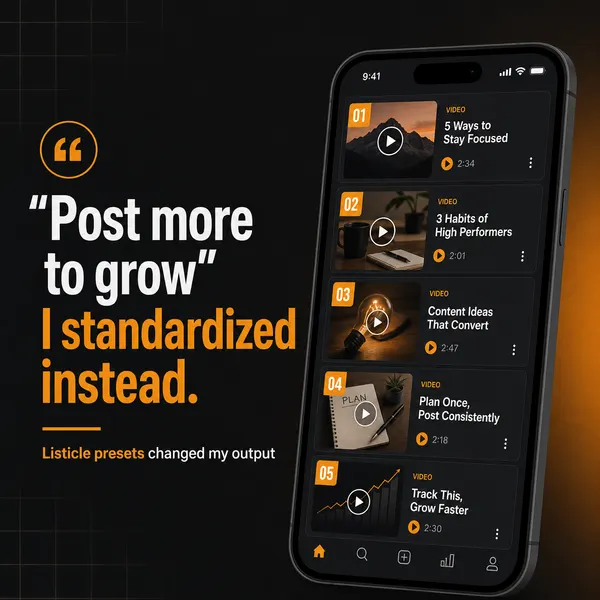
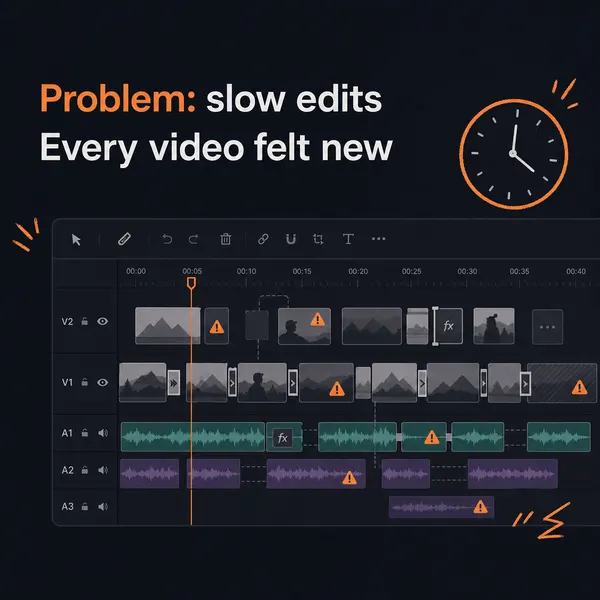
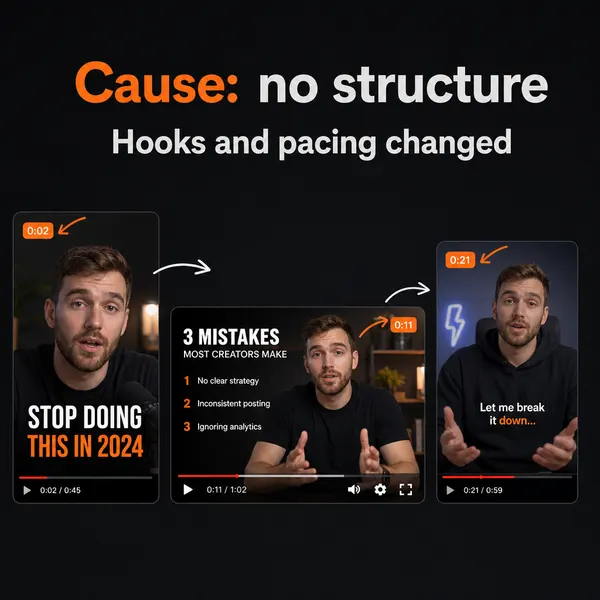
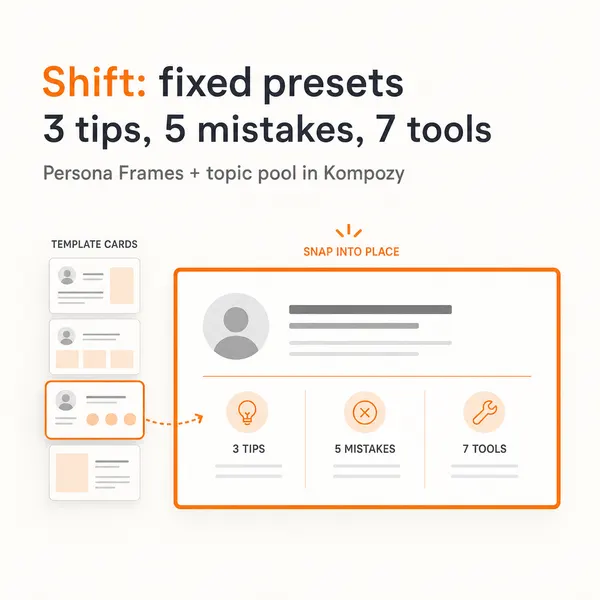
A five-slide carousel generated in the Kompozy workspace, one of the formats a single cornerstone piece can be distributed as.
Who is this for, and who should skip it?
Best for:
- B2B SaaS founders deciding where to put limited content time
- Marketing leads rebuilding a strategy built on informational blogging
- Teams willing to commit to one or two channels for the long haul
Not ideal for:
- Teams that want measurable pipeline within weeks; content compounds slowly
- Companies whose founder will not show up on LinkedIn
- Anyone looking for published benchmark percentages; this page gives editorial guidance instead
Frequently asked questions
What is the right B2B content strategy framework for 2026?
Founder content on LinkedIn, comparison and alternative SEO pages, case studies drawn from customer calls, and triggered email nurture. Early-stage teams lean hardest on founder LinkedIn; later stages add paid distribution and brand-led content.
Is generic blog content dead for B2B SEO?
As a primary acquisition play, mostly yes. Ahrefs found that an AI Overview correlated with a 34.5% lower average CTR for the top-ranking page, and informational queries are where Overviews appear. Put that budget into comparison pages and customer stories.
How should I measure B2B content pipeline?
Ask buyers how they heard about you on the demo or trial form, watch branded search, and track conversion on comparison pages. Last-touch attribution under-credits content that built awareness weeks earlier.
Should B2B founders use AI to write LinkedIn content?
For drafting and fan-out, yes. The take itself has to come from the founder, often as a short voice memo, and the founder should edit and approve every post.
Does Google penalize AI-generated B2B content?
Google's guidance says using AI is not the problem. Generating many pages without adding value for users can violate its spam policy on scaled content abuse, and Google tells publishers to fact-check AI output.
What is the biggest content strategy mistake for B2B SaaS?
Spreading effort across too many channels. Pick two, usually founder LinkedIn plus SEO, and go deep instead of running several neglected accounts.
How do we know this?
We checked every figure on this page against the sources below on 2026-10-23, including Ahrefs' AI Overviews study, Google's announcements and guidance, and LinkedIn's member count. Unsourced percentages, price ranges and multipliers were removed or turned into editorial guidance labeled as such.
Sources
- Ahrefs — AI Overviews reduce clicks by 34.5% (read 2026-10-23)
- Google — Generative AI in Search (AI Overviews rolling out to everyone in the U.S.) (read 2026-10-23)
- Google Search Central — Using generative AI content on your website (read 2026-10-23)
- LinkedIn — About us (member count) (read 2026-10-23)
- Kompozy — Pricing (read 2026-10-23)
Which other B2B content marketing guides should you read next?
- LinkedIn content strategy for B2B founders: the 2026 daily-post playbook — LinkedIn is the #1 organic B2B channel in 2026. The post structure that earns reach, the cadence (1 post/day max), and the AI-assisted workflow that runs on 15 minutes per day.
- B2B thought leadership content that actually moves pipeline — Why most "thought leadership" is corporate filler. The 4-pattern model that produces thought leadership tied directly to inbound pipeline. Plus the AI-augmented production workflow.
- Founder-led marketing for B2B SaaS: the 15-minute daily workflow — How B2B SaaS founders run daily LinkedIn + Twitter + email content output in 15 minutes per day using an AI-augmented stack. With the calibration window that makes it work.
- B2B SEO content that ranks AND converts: the 2026 dual-intent playbook — Most B2B blog content ranks for keywords nobody buys against. The dual-intent playbook targets terms with commercial intent AND high search volume. With the topical cluster model that compounds.
Which related Kompozy topics cover this next?
- Autonomous Content Creation — How Kompozy autopilot really works: one workspace switch that approves and schedules generated posts, the checks that run before they publish, and a 14-day ramp for turning it on.
- AI Brand Voice & Persona — Without a Persona Brief, every AI output averages to the LLM default voice. This is the 5-section methodology that makes 100+ AI-generated posts feel like one human author wrote them.