B2B LinkedIn strategy 2026: the founder-led playbook that actually moves pipeline
B2B LinkedIn strategy for 2026: founder vs company page, cadence, format mix, hooks, comments, posting time, and attribution that turns likes into pipeline.
Published 2026-05-19 · Updated
Short answer
B2B LinkedIn strategy in 2026 is founder-led, not company-page-led, because founder posts tend to travel further and draw replies from real prospects. Post once a day from the founder and a couple of times a week from the company page. Lean on text posts, add carousels and native video, write hooks that stop the scroll, reply to comments quickly, and measure with a self-reported "how did you hear about us" field.
Key takeaways
- The founder account is the channel; use the company page for hiring, logos and press.
- Post once a day for at least 90 days before you judge the results.
- The opening lines decide whether anyone clicks "see more."
- Reply with substance soon after posting; never use pods or auto-replies.
- Attribute with a self-reported field on the demo form, not last-click analytics.
A lot of B2B buying starts in the LinkedIn feed, not on Google. A buyer reads a few founder posts over several weeks, mentions you to a peer, then books the demo by typing your URL straight into the browser, and analytics files the visit under "direct." Much of the purchase runs invisible to last-click attribution while LinkedIn did the work.
That is the structural reason so many serious B2B SaaS teams have a founder posting on LinkedIn. It is also why "LinkedIn personal brand" advice has turned into an industry of its own, selling motivational posts, listicles, and the dopamine of follower counts. The behavior that moves pipeline is different: opinionated takes on industry shifts, customer-derived stories told first-person, technical breakdowns of decisions your audience is making this quarter, and consistent presence over months.
This is the operator-grade B2B LinkedIn playbook: which behaviors compound into pipeline, which look like LinkedIn success but produce no buyers, and the tool stack that keeps the daily work small.
Founder account or company page: which wins on LinkedIn?
The founder account, for most B2B companies. In practice the same post tends to travel further from a founder's personal profile than from a company page, and the replies differ too: founder posts draw replies from real prospects, while company pages draw more from job-seekers and vendors.
The likely mechanic: posts from people read as conversation, posts from brands read as marketing, and company-page posts mostly reach people who already follow the page. A founder's post can travel into their wider network through every reaction and comment.
- Founder posts can reach beyond the founder's own followers through their network's engagement.
- Company page posts mostly reach the page's followers unless you pay to promote them.
- Founder accounts cost nothing to run; matching their organic reach from a company page usually means paid promotion.
- Founder accounts compound. A founder who posts on a steady cadence for months builds an audience that expects them. Company pages tend to plateau whatever their cadence.
- Buyers want a face. "Who is behind this thing" is part of how B2B buyers qualify a vendor.
The strategic implication: most B2B SaaS teams need the founder posting on LinkedIn. The company page becomes a secondary surface for hiring, customer logos, press, and a little evergreen brand content. The center of gravity is the founder account. Check it on your own data by comparing reach and replies on founder posts against company posts over the same weeks.
Why post once a day, every day, for 90 days?
Because consistency is the lever you control. Accounts that show up steadily build an audience that expects them, and sporadic high-effort posting rarely catches up with consistent medium-effort posting over time. Ninety days is our recommended minimum test, long enough to see the trend instead of noise.
The cadence rules we recommend:
- One founder post a day at most. A second post in the same day competes with the first for the same audience, so you rarely gain from it.
- Daily for the full test window. Judge the channel on the trend across months, not on any single post.
- A predictable pattern beats erratic posting. Weekdays only, done every week, is better than daily with random gaps.
- Weekends are a different audience moment. Use them, if at all, for longer and more reflective posts.
- Company page: one or two posts a week is plenty. Daily company-page posting uses editorial time without much return.
The less obvious lesson: posting more consistently does not just produce more posts. It builds an audience that is there when each new post goes up, so reach per post tends to rise over time for founders who keep going.
Which LinkedIn formats work: text, carousel, or video?
LinkedIn supports five main formats: text-only posts, image posts, document carousels, native video, and polls. Each behaves differently, and a mix keeps the feed from feeling templated to the people who follow you.
The format mix we recommend:
- Text-only as the foundation, around half of what you post. The cheapest format to produce: no design, no recording.
- Document carousels (a PDF uploaded as a "document") for about a quarter. People save them, and a save is a sign someone plans to come back. Make the cover slide the hook.
- Native video for a smaller share. Founder video builds the kind of trust that helps close a demo.
- Single-image posts occasionally, for screenshots, charts, and customer wins.
- Polls rarely. They can draw engagement without telling you much about buyers.
| Format | What it is good for | Effort per post | Use it for |
|---|---|---|---|
| Text-only | Reach and conversation | Lowest | Takes, stories, frameworks |
| Document carousel | Saves and return visits | Higher (design time) | Frameworks and step-by-step breakdowns |
| Native video | Trust in the founder | Medium (recording time) | Founder perspective and demos |
| Single image | Visual proof | Low | Screenshots, charts, customer wins |
| Poll | Quick engagement | Lowest | Sparing use only |
Why does the hook line carry so much of the reach?
LinkedIn shows only the opening lines of a post before a "see more" link. Those opening lines decide whether someone scrolling clicks to read the rest. If the hook does not stop the scroll, the rest of the post is dead on arrival however good it is.
Hook patterns that work:
- Contrarian claim: "Most B2B SaaS marketing advice is wrong about [thing]." The reader expands to find out which thing.
- Specific number from your own experience: "I just spent [real amount] on [thing] so you do not have to. Three lessons." Specific real numbers read as credible; round numbers read as marketing. Only use numbers that are true.
- Customer story opener: "A customer told me [thing] this morning. It rewired how I think about [topic]." The reader is hooked on a story arc.
- Personal admission: "I was wrong about [thing] for two years. Here is what changed my mind." Candor is rare on LinkedIn and stands out.
- Pattern recognition: "I keep seeing the same mistake from founders." It signals experience without claiming it.
- Data-driven open: "We analyzed our [thing]. What surprised me." The reveal is the payoff, so do not give it away in the hook.
- Industry-shift framing: "[Industry] is changing faster than most operators realize. The signal." It positions the founder as the person reading the trend lines.
Hook patterns that do not work:
- Motivational openers: "Success is a marathon, not a sprint." LinkedIn readers have seen too many of them.
- Listicle openers: "5 things I learned about [topic]." Lists can work as a payoff, but a list-shaped hook reads as low effort.
- Vanity announcements: "I just hit 10,000 followers." These draw engagement from peer founders, not buyers.
- Question-only hooks: "What do you think about [topic]?" A question rarely stops the scroll without a strong claim in front of it.
- Buzzword-stuffed openers: "Leveraging synergies in the AI-powered B2B SaaS ecosystem..." This dies on the first line.
A quick test: read the hook aloud. If it sounds like a marketer trying to sound interesting, rewrite it. If it sounds like how you would tell a friend over coffee, ship it.
Why is comment strategy where LinkedIn reach is won or lost?
Because comments are conversation, and conversation is what carries a post further. A reply thread under your post keeps it active and puts it in front of the commenters' networks. The founder who replies to meaningful comments soon after posting gets that effect; the founder who posts and walks away does not.
The comment-loop discipline:
- Post at a time when you can stay at the computer for the next hour. The early life of a post is when replies matter most.
- Reply to every meaningful comment quickly. "Meaningful" excludes emoji-only replies and generic "great post!" comments.
- Reply with substance, not "thanks." A reply that adds information, asks a specific follow-up, or extends the idea starts new threads.
- Engage with good commenters on their own posts in the same window. Engagement that goes both ways builds the relationship.
- Do NOT auto-respond. Engagement pods, bots, and auto-reply tools are against the spirit of the platform and risk the account. The replies must come from the founder.
For many founders, the most valuable time in the content day is the stretch right after posting, when the replies happen.
When is the best time to post on LinkedIn?
Posting time matters less than cadence and hook quality, but it is free to get right. Post when your buyers are scrolling, which for most B2B audiences means the working morning in their time zone.
- Start with weekday mornings in the time zone where most of your buyers are, before their day fills with meetings.
- Midweek is a good default for your strongest posts.
- Friday afternoons are usually quiet for professional content.
- Weekends are a different mood: use them for less promotional, more reflective content, if at all.
- If your buyers are spread across regions, post for the region where your highest-value buyers concentrate.
- Scheduling: native LinkedIn scheduling is fine, and so are third-party schedulers that post through LinkedIn's integration.
Then test your own account's peak window over a month. Some founder audiences are most active in the evening or on another coast. Your LinkedIn analytics will show it.
How do engagement loops warm up your post?
Reach on LinkedIn depends partly on who is already engaging with you when you post. If you have recently had real conversations with people in your target audience, they are more likely to see and engage with your next post.
The pre-post engagement loop:
- Before you publish, spend some time commenting on posts from accounts in your target audience. Substantive comments, not "great post."
- Spread the comments across peer founders, potential buyers, and people with audiences who might reshare your work.
- After publishing, keep engaging with the same accounts and respond to comments on your own post.
- This is NOT pod behavior. Engagement pods (private groups that like each other's posts on a schedule) are coordinated. An engagement loop is organic activity in a network that happens to be relevant.
A founder who posts and immediately closes LinkedIn leaves reach on the table. The time before and after the post is where the work happens.
How should you measure LinkedIn attribution?
LinkedIn is one of the hardest B2B channels to attribute. The buyer reads founder posts over several weeks, remembers the company, and types the URL directly to book a demo. Analytics records that as "direct" traffic, and LinkedIn gets no credit in a last-click model.
The attribution model that works:
- A self-reported field on the demo form. One required question: "How did you first hear about us?" with options including LinkedIn, Google, podcast, customer referral, and other. It is the signal that survives a feed where people rarely click.
- Tracking parameters on the links you do share. Tag them with utm_source=linkedin and a campaign ID to catch the LinkedIn-sourced demos that click through.
- A branded-search proxy. Track monthly searches for your company name; LinkedIn-driven awareness tends to show up there with a lag.
- Audience overlap. Ask for the prospect's LinkedIn profile on the demo form, and check how many new demos come from people in your target ICP who already follow or engage with the founder.
- Cohort trends. Compare qualified demo volume before and after months of consistent founder posting, with other channels held steady.
Stop trying to tie individual posts to individual demos; LinkedIn does not work that way. Track cohort behavior and self-reported attribution, and the channel's contribution becomes visible.
How do you tell vanity content from pipeline content?
Many of the highest-engagement LinkedIn posts produce no pipeline at all. Vanity content optimizes for likes and follower counts. Pipeline content optimizes for the small number of qualified buyers in the feed who book a demo because of the post.
Vanity content tells:
- Posts about follower milestones ("just hit 50k!"): engagement from peer founders, not buyers.
- Motivational posts ("the only difference between successful and unsuccessful founders is..."): engagement bait with no pipeline.
- Generic productivity listicles ("10 habits of successful CEOs"): plenty of reactions, no buyers.
- Engagement-bait questions ("Comment a 1 if you agree"): reach from the wrong audience.
- Re-shares of viral posts with light commentary: easy reach, no thought leadership.
Pipeline content tells:
- Specific customer wins told first-person, with permission ("a customer in [industry] just [outcome] using [feature]"). It reads as real and attracts similar buyers.
- Technical breakdowns of decisions your buyers are making now ("we tested several approaches to [problem]; here is what we found"). It demonstrates expertise.
- Opinionated takes on industry shifts ("the [industry] CRM market is going to consolidate because..."). It positions you as the operator reading the trend lines.
- Anti-marketing posts ("our product is not for [persona]; here is who should use it instead"). Counter-intuitive credibility that filters the audience to qualified buyers.
- Behind-the-scenes founder reasoning ("we just killed [feature]. Why."). The opposite of corporate comms; buyers trust a founder thinking out loud.
The test: would a real prospective buyer read this post and think "I want to buy from this person"? If yes, it is pipeline content. If only other founders and creators would engage, it is vanity content. Both have a place, since vanity content builds the audience pipeline content converts, but keep most of your posts on the pipeline side.
Which tools make up the B2B LinkedIn stack in 2026?
The specialist category has shrunk. Shield Analytics, long a popular LinkedIn analytics dashboard, has announced it is winding down: Shield told users that "both Google and LinkedIn have made it clear that we cannot continue operating Shield as it was built," and it stopped new signups and renewals. AuthoredUp and Taplio remain the best-known LinkedIn specialists. Kompozy is a full-stack content engine that produces LinkedIn posts alongside blog, newsletter, video, and social content from a single Persona Brief.
| Tool | What it does | Pricing | Best for |
|---|---|---|---|
| Taplio | AI post drafting, a library of high-performing posts, scheduling, analytics, Chrome extension | Paid plans; see vendor page | Solo founders who want a LinkedIn-only AI specialist |
| AuthoredUp | In-feed post formatter, hook library, post analytics, draft management | See vendor page | Founders who want better formatting and analytics without an AI writing layer |
| Tweet Hunter | X-first AI writer with LinkedIn cross-posting and scheduling | Paid plans; see vendor page | Founders who lead with X and treat LinkedIn as secondary |
| Shield Analytics | LinkedIn analytics dashboard | Winding down; no new signups | No longer a viable choice |
| Hypefury | X-first scheduler with LinkedIn cross-posting | Paid plans; see vendor page | Multi-platform scheduling with an X focus |
| Postwise | AI writer for X, LinkedIn, and Threads with voice training | Paid plans; see vendor page | Multi-platform AI writing |
| LinkedIn Sales Navigator | Search filters, lead lists, InMail, buyer-intent signals, CRM integration | Paid plans; see LinkedIn | Sales teams prospecting on LinkedIn (not a content tool) |
| Kompozy | Full-stack content engine: LinkedIn plus blog, newsletter, video, and social from a single Persona Brief, with the founder voice locked across formats | Starter $199/mo (5,500 credits), Pro $499/mo (18,000 credits), Enterprise via Contact Sales | Founders who want LinkedIn as part of a full B2B content engine, not a standalone tool |
The honest framing: LinkedIn-only specialist tools optimize for LinkedIn in isolation. If LinkedIn is the only content channel you run, that fit is right. If LinkedIn is one of several channels, separate specialist tools invite voice drift between platforms: your LinkedIn voice diverges from your blog voice, which diverges from your newsletter voice. Kompozy's Persona Brief keeps one voice across every channel from a single source of truth.
What should you ship in week 1 if you have not started?
- Day 1: write a Persona Brief. Three sentences on who you are, 5-8 voice traits, a list of banned phrases, and 3-5 reference posts you admire.
- Day 2: pick hook patterns from this guide and draft hooks tied to your actual business or industry. Do not write full posts yet.
- Day 3: write your first five posts from those hooks. Use the shape: hook on line one, setup, payoff, white space throughout.
- Day 4: schedule them for the next five weekday mornings, and spend some time commenting on posts in your target network.
- Day 5 onward: post once a day. Reply to every meaningful comment. Keep going for 90 days before you judge the channel.
- Day 30: review your analytics. Find your highest-reach posts and your highest-engagement-rate posts. The patterns they share are your voice, so lean into them.
- Day 60: introduce your first carousel. Take a framework from your best text post and expand it into a short slide deck.
- Day 90: introduce your first native video: founder talking to camera, one point, captions burned in.
The compounding takes months. Founders who quit after a few weeks because "LinkedIn does not work for B2B" stop before the audience has had time to build. The discipline is showing up every day for three months before you evaluate.
What does this look like in Kompozy?
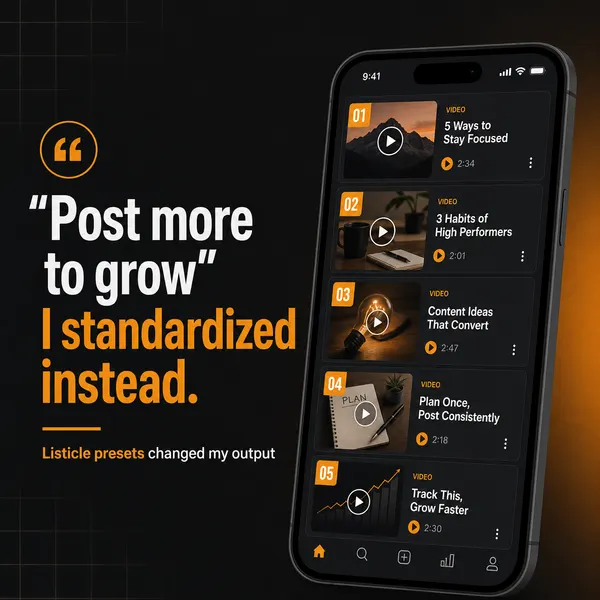
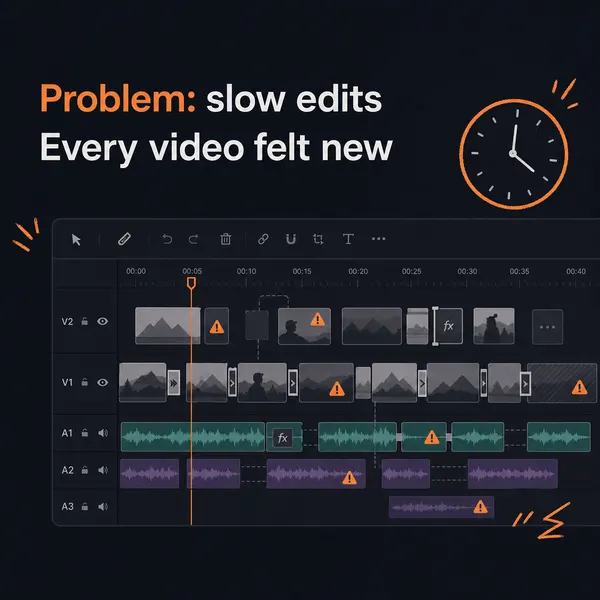
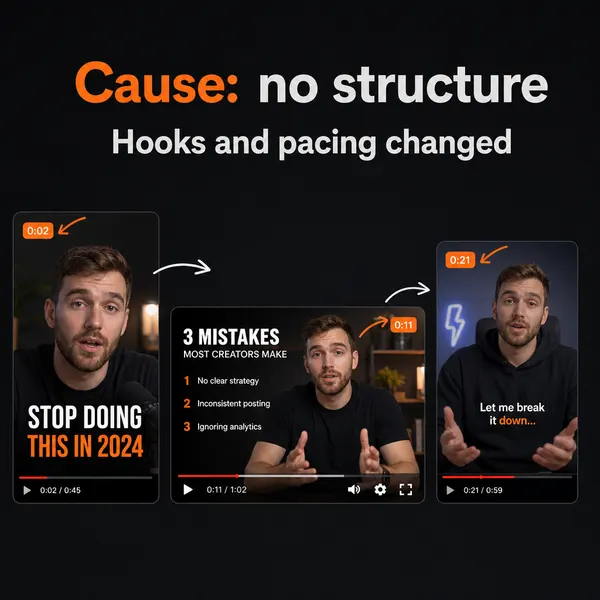
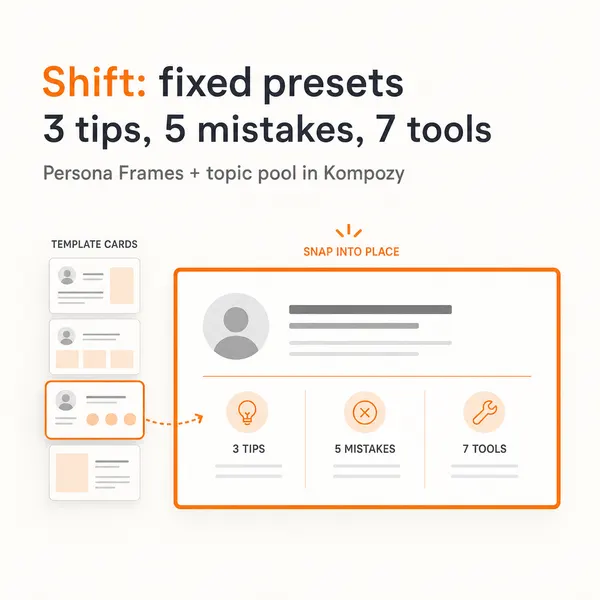
A five-slide Carousel generated in the Kompozy workspace, the document-carousel format this playbook recommends for frameworks.
Who is this for, and who should skip it?
Best for:
- B2B founders willing to post daily for months
- Teams whose buyers research vendors on LinkedIn
- Founders running LinkedIn alongside blog, newsletter and video
Not ideal for:
- Teams relying only on a company page
- Anyone expecting last-click analytics to prove LinkedIn's value
- Accounts wanting automation for replies or engagement pods
Frequently asked questions
Should the founder post on LinkedIn, or the company page?
The founder. Founder posts tend to travel further and draw replies from real prospects, so use the company page for hiring, logos and press.
How often should a B2B founder post on LinkedIn?
Once a day, every day, for at least 90 days before you evaluate. A second post in the same day mostly competes with the first.
What is the best time to post on LinkedIn for B2B?
Weekday mornings in the time zone where your best buyers are. Then test your own account's analytics for a month and adjust.
Do LinkedIn carousels work for B2B?
Yes, as part of a mix. People save carousels to come back to, which makes them useful for frameworks and step-by-step breakdowns.
How do you attribute B2B LinkedIn pipeline?
Add a required "How did you first hear about us?" field to the demo form, tag the links you share, and track branded search and cohort trends. Last-click attribution undercounts LinkedIn.
Is Shield Analytics still an option for LinkedIn analytics?
No. Shield has announced it is winding down and stopped new signups and renewals. AuthoredUp is one of the remaining LinkedIn analytics options.
How do we know this?
We removed unverified reach, engagement and format benchmarks and third-party prices from this page on 2026-10-23, checked the Shield wind-down against AuthoredUp's report of Shield's notice, and checked Kompozy details against kompozy.io/pricing.
Sources
- AuthoredUp — Shield Analytics is winding down (quotes Shield's notice) (read 2026-10-23)
- Kompozy — Pricing (plans, credits, workspaces, autopilot, HeyGen BYO) (read 2026-10-23)
Which other B2B content guides should you read next?
- B2B content marketing strategy 2026: the complete operator playbook — The full B2B content marketing strategy — positioning, channel mix, founder-led vs brand-led, SEO + LinkedIn + email cadence, and the AI stack that ships it.
- B2B thought leadership content that actually moves pipeline — Why most "thought leadership" is corporate filler. The 4-pattern model that produces thought leadership tied directly to inbound pipeline. Plus the AI-augmented production workflow.
- Founder-led marketing for B2B SaaS: the 15-minute daily workflow — How B2B SaaS founders run daily LinkedIn + Twitter + email content output in 15 minutes per day using an AI-augmented stack. With the calibration window that makes it work.
- B2B content operations: scaling output without losing voice — The org-design + tool-stack + workflow for B2B content teams producing 100+ outputs per month across channels. With the Persona Brief that prevents voice drift at scale.
- AI-augmented B2B case study production: from customer call to published case study in 90 minutes — The end-to-end workflow: customer-call transcript → quote extraction → structured case study draft → published page. AI handles 80% of the operator work; humans handle approvals and quote validation.
- B2B email nurture sequences with AI: convert demos and trials at higher rates — How to design 5-9 email nurture sequences for B2B SaaS using AI assist. With the segmentation logic, trigger architecture, and the AI-tells specifically to ban in B2B email.
Which related topics connect to B2B content?
- Autonomous Content Creation — How Kompozy autopilot really works: one workspace switch that approves and schedules generated posts, the checks that run before they publish, and a 14-day ramp for turning it on.
- AI Brand Voice & Persona — Without a Persona Brief, every AI output averages to the LLM default voice. This is the 5-section methodology that makes 100+ AI-generated posts feel like one human author wrote them.