AI brand voice for SaaS founders and product marketers
B2B SaaS Persona Brief examples: engineering-first framing, anti-thought-leader voice, specific metric citations, and balancing authority with personality.
Published 2026-05-18 · Updated
Short answer
A SaaS founder's AI brand voice should sound like an engineer who runs a company, not a marketer or a LinkedIn coach. In the Persona Brief, require a specific metric behind every product claim, ban corporate speak like "leverage", "empower" and "synergize", ban "3 lessons I learned" framing, and name reference writers such as Paul Graham or DHH. Keep fundraising and hiring posts manual.
Key takeaways
- SaaS content fails two ways: corporate marketing voice and thought-leader voice.
- Every product claim should cite a specific metric, not an adjective like fast or reliable.
- Ban corporate speak and founder-influencer framing in the Persona Brief, not after the fact.
- Same voice DNA on LinkedIn and X; only the length and pacing change.
- Fundraising and hiring posts stay manual; changelog-based product updates are safe to automate.
B2B SaaS content has two failure modes: corporate-marketing voice (sounds like every Series B blog) and influencer-thought-leader voice (sounds like every LinkedIn motivational post). The good SaaS voice avoids both — it sounds like an engineer who happens to run a company.
This is the Persona Brief template for SaaS founders who want AI content that builds technical credibility without sounding like marketing speak.
Why does most SaaS content sound wrong?
Most SaaS content falls into one of two failure modes, corporate marketing voice or thought-leader voice, and audiences tune out both:
- Corporate marketing voice. "We empower teams to leverage data-driven insights at scale." Sounds like an investor deck. Audiences instantly tune out.
- Thought-leader voice. "Three lessons I learned scaling Kompozy from 0 to 1." Sounds like every LinkedIn motivational post. Audiences tune out fast.
The voice that works: technical specificity + dry humor + engineering framing. Sounds like an engineer running a company, not a marketer or a coach.
What voice DNA traits fit a SaaS founder?
- "Engineering-first framing — every claim cites specifics (latencies, error rates, conversion numbers, line counts)"
- "Anti-thought-leader — no motivational filler, no '3 lessons learned' framing, no 'here is what they do not tell you'"
- "Dry humor over earnest enthusiasm — sounds like an engineer, not a coach"
- "Direct, no hedge words — 'this broke' not 'this sometimes had issues'"
- "Cites specific metrics on every claim — not 'better performance' but 'p99 dropped from 800ms to 120ms'"
- "Writes like Paul Graham if Paul Graham still ran companies — essay-length when long, sharp when short"
- "Conversational vocabulary, technical specifics — accessible language about deep details"
Which phrases should SaaS founders ban?
Ban corporate marketing speak such as "leverage", "empower", "unlock" and "synergize" on top of the universal banned-words list. The SaaS-specific additions:
Corporate marketing speak
- "leverage" (replace with "use")
- "empower"
- "unlock"
- "streamline"
- "value-add"
- "synergize" / "synergistic"
- "thought leadership"
- "thought leader"
- "actionable insights"
- "data-driven" (when overused)
- "best-in-class"
- "enterprise-grade"
- "mission-critical"
- "end-to-end"
- "holistic"
- "comprehensive"
Founder-influencer speak
- "3 lessons I learned"
- "5 things they do not tell you"
- "The truth nobody talks about"
- "What every founder should know"
- "PSA:"
- "Hot take:"
- "Unpopular opinion:"
SaaS marketing cliches
- "product-led growth" (when used as a buzzword, not a specific tactic)
- "flywheel"
- "customer journey" (overused)
- "north star metric" (overused)
- "10x your" (corporate-influencer cliche)
What structure should every SaaS post follow?
- Every claim about your product cites a specific metric. Not "fast" but "p99 latency of 200ms." Not "reliable" but "99.95% uptime over 12 months."
- Open with the specific moment or specific bug, not the abstract lesson. "Our queue blew up at 3am last Tuesday" beats "I learned a lot about queue management."
- Close with what the reader can do today. Not "what do you think?" but "here is the line of code that fixes it" or "here is the cohort to run."
- Include code or technical detail when relevant. SaaS audiences trust authors who show the work.
- Anti-fundraising framing — never mention valuation or capital raised in product content. Keep those signals to fundraising-specific posts.
Which reference creators fit a SaaS voice?
- Paul Graham (Y Combinator essays) — long-form, structured argument, contrarian framing
- DHH (Basecamp / 37signals) — opinionated, anti-VC, technical specifics
- Pieter Levels — operator voice, no preamble, specific revenue numbers
- Naval Ravikant — compressed authority, philosophical claims with technical grounding
- Tobi Lütke (Shopify) — engineering humility, technical specifics
- Patrick Collison (Stripe) — long-form essay voice, rigorous reasoning
Avoid referencing: VC-influencer voice (Marc Andreessen tweet-thread style for marketing content), motivational SaaS voice ("burn the boats" style).
How should the SaaS voice change on LinkedIn and X?
LinkedIn — for B2B SaaS thought leadership
- Long-form posts with technical specifics
- Story-led openers tied to specific moments or technical incidents
- Avoid "3 lessons" framing — use "here is what we changed" framing
X / Twitter — for developer / technical audience
- Compressed authority. Each post should land one idea fast.
- Threads when explaining technical depth, kept short
- Cite specific commits, latencies, error rates
YouTube long-form / podcast — for founder personality
- Story-led teaching format
- Engineering specificity ("here is the architecture diagram") balanced with personality
- Skip the lifestyle filler — no office tours, no morning routines
Newsletter — for engaged customer / prospect audience
- Product update format: what shipped, what broke, what is next
- Honest framing — "what we got wrong" is more valuable than "what we got right"
- Specific architecture changes, latency improvements, customer stories
What does a SaaS founder's Persona Brief look like?
Who you are: Founder of Kompozy, autonomous content composition platform. Audience: creators, founders, agencies running 3+ content tools, technical SaaS operators. Voice DNA: Engineering-first specifics. Anti-thought-leader. Dry humor. Direct. Writes like Paul Graham if PG still ran companies. Banned: leverage, empower, unlock, synergize, thought leader, 3 lessons, 5 things they do not tell you, hot take, PSA, product-led growth (as buzzword), 10x your. Required: Every product claim cites a metric. Open with the specific moment. Close with what the reader can do today. References: [3-5 of your best long-form posts pasted verbatim, plus 1 Paul Graham essay if you have permission to reference]
Which SaaS posts are safe to autopilot?
- Product update posts — safe for autopilot if the source is the release notes or changelog. Check feature claims against the changelog before publishing; Kompozy does not verify them automatically.
- Customer-win posts — only with consent. Same rules as customer-call-to-marketing repurposing.
- Industry commentary on planned topics — autopilot OK. Breaking news / commentary — manual only.
- Hiring posts — keep manual. Candidate-facing voice differs from product voice.
- Fundraising announcements — never autopilot. Every word matters.
What SaaS content drives pipeline?
Technical post-mortems, customer case studies with specific numbers, and architectural deep-dives consistently generate qualified SaaS leads. The patterns that work:
- Technical post-mortems — engineers trust honesty about what broke
- Customer case studies with specific numbers — buyers convert on concrete outcomes
- Architectural deep-dives — establishes technical credibility
- Anti-marketing posts — "here is what every SaaS blog gets wrong" framing works well
- Specific framework posts — "the 3-step onboarding checklist" beats "lessons in customer onboarding"
What does this look like in Kompozy?
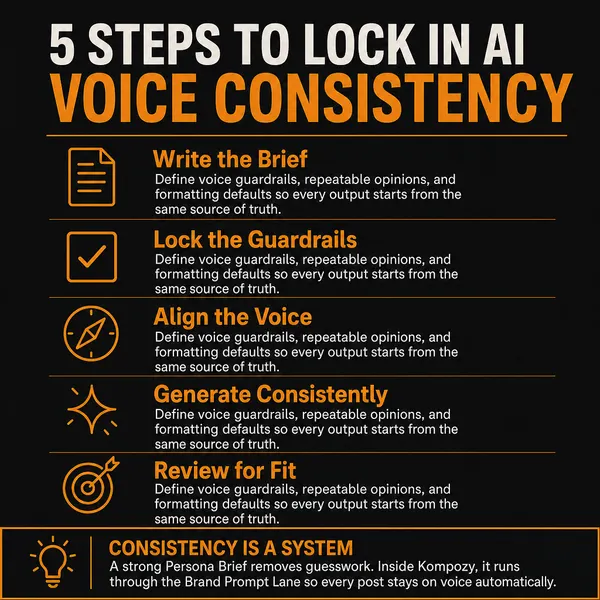
An infographic photo post generated in the Kompozy workspace, the kind of specific, metric-led asset a SaaS Persona Brief is meant to produce.
Who is this for, and who should skip it?
Best for:
- SaaS founders who want AI drafts that build technical credibility
- Product marketers writing release notes, changelogs and technical posts
- Teams selling to engineers and operators who spot generic AI copy fast
Not ideal for:
- Consumer brands that want a playful, mass-market voice
- Anything investment-adjacent, such as fundraising announcements; keep that manual and lawyer-reviewed
- Teams without real metrics to cite; the voice depends on specifics
Frequently asked questions
Should the SaaS founder voice be different on LinkedIn vs X?
Same voice DNA, different platform expressions. LinkedIn allows longer-form with the same engineering specificity. X compresses to short claims. Both share the anti-thought-leader and anti-marketing-speak rules.
How do I balance technical depth with accessibility for non-technical buyers?
Use accessible vocabulary about technical specifics. "Our queue processes 50k jobs per hour" is technical but accessible. "Our event-driven architecture leverages distributed consensus" is jargon. The first works; the second does not.
Should product marketing have a different voice than founder-led content?
Aligned but distinct. Founder-led has more personality and opinion. Product marketing is more neutral and feature-focused. Both share the anti-corporate-speak rules.
Can SaaS startups use AI autopilot for fundraising-adjacent content?
No. Fundraising-related content (valuations, capital, growth claims) can raise securities-law issues, so anything investment-adjacent needs manual review, ideally with a lawyer.
Do SaaS audiences notice AI-generated content faster than other industries?
Yes. SaaS audiences (technical buyers, engineers, operators) are sophisticated and detect AI tells quickly. The Persona Brief work matters more for SaaS than for most other industries.
How do we know this?
This page is Kompozy's Persona Brief methodology applied to SaaS; we checked its structure against kompozy.io/brand-voice on 2026-10-23. We removed unsourced length and timing figures and softened a legal claim we could not verify.
Sources
- Kompozy — Brand voice and the Persona Brief (read 2026-10-23)
- Kompozy — Autonomous content and quality gates (read 2026-10-23)
Which other brand-voice guides should you read next?
- The 5-section Persona Brief template that captures your voice — Who you are, voice DNA, banned words, required structures, reference posts — the exact template that powers Kompozy outputs.
- Voice DNA: defining the 5-8 traits that make your writing recognizable — How to extract voice traits from your existing content and codify them so AI can replicate them on demand.
- AI brand voice for coaches and consultants — Authority + warmth + framework voice. Persona Brief examples for high-ticket coaches who sell via thought leadership.
- AI voice for LinkedIn: kill the "LinkedIn influencer" sound — LinkedIn-specific banned phrases, hook patterns, and structural rules that make AI-written LinkedIn posts indistinguishable from human ones.
- How to use reference posts to fine-tune AI voice (without actually fine-tuning) — Why 3-5 well-chosen reference posts beat any amount of voice description in a prompt.
Which related Kompozy topics cover this next?
- Autonomous Content Creation — How Kompozy autopilot really works: one workspace switch that approves and schedules generated posts, the checks that run before they publish, and a 14-day ramp for turning it on.
- AI Content Repurposing — The complete methodology for turning one source into 25-35 pieces of native-format content across every platform — without producing AI slop.