Voice DNA: defining the 5-8 traits that make your writing recognizable
How to extract voice traits from your existing content and codify them so AI can replicate them on demand. The systematic process for identifying what makes your voice yours.
Published 2026-05-18 · Updated
Short answer
Voice DNA is the five to eight one-line traits that make your writing recognizable, and it is the second section of Kompozy's Persona Brief. To extract yours, collect about ten posts that sound most like you, read them back to back, note what repeats, and write each pattern as a directive the model can follow, such as "Direct, no hedge words." Name one or two reference writers for extra signal.
Key takeaways
- Voice DNA describes how you write, not your personality or brand values.
- Each trait must produce an observable behavior the AI can follow.
- Vague descriptors like "premium" or "engaging" do nothing.
- Naming a reference writer, with a modifier, gives the model a strong pattern.
- Audit the traits every quarter as your writing changes.
Voice DNA is the section of the Persona Brief that defines who you sound like. Most teams get this wrong by writing aspirational descriptors ("engaging," "premium," "authentic") that have no operational meaning to the AI.
This post is the methodology for extracting voice DNA from your actual writing and codifying it in a way that produces consistent AI output.
What is voice DNA?
Voice DNA is the set of behaviors that make your writing recognizable across multiple posts. Not your personality. Not your brand values. The specific writing-level patterns:
- Sentence length distribution (do you write short? long? mixed deliberately?)
- Vocabulary register (formal vs colloquial, technical vs accessible)
- Hook patterns (do you open with claims, stories, questions, numbers?)
- Transition style (do you use bridges, jump cuts, or implicit transitions?)
- Closing style (callbacks, provocations, CTAs, no close?)
- Specific quirks (capitalization, em-dashes, double periods, ellipses)
Which posts should you start from?
Same criteria as reference-post selection: voice-accurate first, performance second. Pick 10 posts that sound the most like you and performed well. Span platforms if possible.
How do you find your recurring patterns?
Read all 10 posts back-to-back. Look for what repeats:
- Do your sentences trend short, long, or deliberately mixed?
- Do you tend to open with the punchline or build up to it?
- Do you cite specific numbers or use general claims?
- Do you use first-person, second-person, or third-person framing?
- Are your transitions explicit ("now, here is the second point") or implicit (jump cut to the next idea)?
- How do you close? Callback to the opener? CTA? Provocation? Drop the mic?
- What words or phrases recur? What words do you NEVER use?
How do you turn a pattern into a voice DNA trait?
Write each pattern as one line that tells the model what to do. Each voice DNA trait should:
- Produce a specific, observable behavior in output
- Be unambiguous — the AI can validate compliance
- Be actionable — the AI knows what to do
Examples that work:
- "Direct, no hedge words" — produces sentences without "may," "might," "could potentially"
- "Short sentences, max 18 words" — caps sentence length
- "Specific numbers always — cite hours, dollars, percentages, never 'many' or 'a lot'" — forces concreteness
- "Contrarian openers — lead with a claim that surprises" — sets hook pattern
- "Closing is a callback to the opening, not a summary" — defines closing behavior
- "Writes like Naval Ravikant if Naval ran a B2B SaaS" — references a known author for pattern-matching
Examples that do NOT work:
- "Engaging and thought-provoking" — vague, no operational behavior
- "Premium tone" — meaningless to the AI
- "Voice of a thought leader" — no specific pattern
- "Professional but friendly" — contradictory pair, model averages to nothing
Should you name reference creators in your voice DNA?
Reference creators by name when their voice resonates with what you want. Current base models know most well-known writers. "In the style of [name]" is the single highest-signal voice instruction.
How to use it well:
- Pick creators in your industry or adjacent. Naval Ravikant for B2B founder voice, Paul Graham for SaaS startup voice, Morgan Housel for finance writing, Mark Manson for personal-development voice.
- Pair with a modifier. "Like Naval if Naval ran a B2B SaaS" beats "like Naval" because it adds your specific context.
- Avoid over-referencing. 1-2 creator references in your voice DNA section is enough. More than that produces averaging.
What are the most common voice DNA mistakes?
- Aspirational descriptors with no operational meaning ("authentic," "premium," "thought-provoking")
- Contradictory pairs ("professional but friendly," "concise yet thorough")
- Industry cliches ("data-driven," "value-focused," "results-oriented")
- Personality essays that span paragraphs (voice DNA is one-line traits)
- Too many traits (above 8, signal dilutes)
- Too few traits (below 5, voice is under-defined)
What does voice DNA look like by industry?
B2B SaaS founder
- Direct, no hedge words
- Specific numbers always
- Engineering-first framing — cites technical specifics
- Anti-thought-leader — no motivational filler
- Writes like Paul Graham if Paul Graham still ran companies
Creator / personal brand
- Story-led openers — open with a specific moment
- Short sentences mixed with long ones — deliberate rhythm
- Specific timestamps and dollar amounts
- Conversational vocabulary — uses contractions
- Closes with a provocation or callback, never a summary
Real estate investor
- Numbers-first — every claim has a dollar amount or percentage
- Operator voice, not influencer voice
- Cold-emailer mentality — direct, anti-fluff
- Specific deal references over general principles
- Closes with a tactical takeaway
Coach / consultant
- Framework names always explicit
- Client-language not industry jargon
- Story-first openers tied to a specific session or moment
- Authority + warmth balance
- Closes with an actionable next step
How does voice DNA interact with the rest of the brief?
Voice DNA is the most general layer. It is overridden by:
- Required structures (section 4) — for format-specific rules
- Reference posts (section 5) — for concrete examples that pattern-match
- Platform overrides — for platform-specific voice adaptations
Think of voice DNA as the base personality, required structures as the format rules, and reference posts as the live examples. All three reinforce each other.
How often should you update voice DNA?
Audit your voice DNA every quarter, because it changes as your writing does. The audit:
- Read 10 of your most recent best-performing posts.
- Identify any new patterns that have emerged.
- Add new traits if needed (or refine existing ones).
- Remove traits that no longer match your current voice.
Once the section settles, quarterly audits turn up small refinements rather than big shifts.
What does this look like in Kompozy?
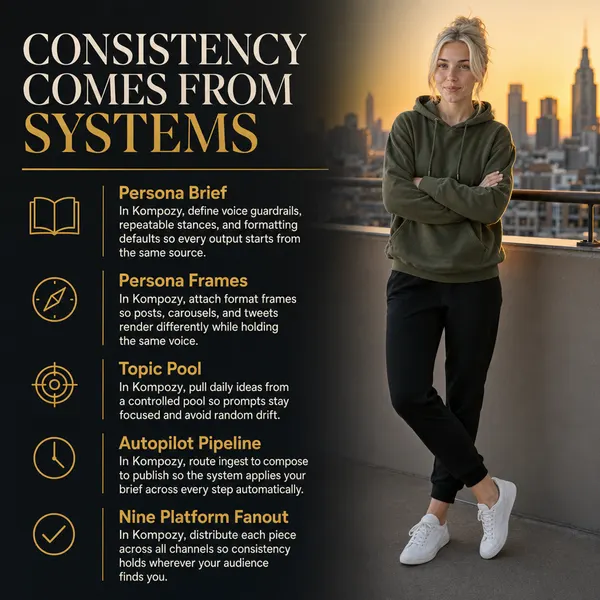
A persona infographic generated in the Kompozy workspace, written with a Persona Brief whose voice DNA section is loaded in context.
Who is this for, and who should skip it?
Best for:
- Writers and founders with enough published posts to find patterns in
- Teams whose brand voice document is all adjectives
- Anyone tuning a Persona Brief whose output still sounds generic
Not ideal for:
- People with no writing yet; start with reference posts you write deliberately
- Teams trying to capture several voices in one section; use separate workspaces
- Anyone looking for topic rules; those belong in a separate section
Frequently asked questions
How long should each voice DNA trait be?
One line. Longer traits are descriptions, not directives. The model needs unambiguous behavioral instructions.
Should I include voice DNA traits about WHAT I write about (topics) or just HOW?
Just how. Topic restrictions belong in a separate "topics covered" or "topics avoided" section. Voice DNA is style only.
Can I reference fictional characters for voice DNA?
Yes — "writes like Don Draper" or "writes like the Wire dialogue" works if base models know the reference. Less reliable than real authors but useful for distinctive voice signals.
What if I have multiple voices I want to alternate between?
Set up multiple workspaces, one per voice. Voice DNA is workspace-scoped. Trying to capture multiple voices in one DNA section produces averaging.
How do I know my voice DNA is working?
After 14 days of generating with the brief, read 10 random outputs. Do they sound recognizably like you? If yes, voice DNA is working. If no, add more specific traits and re-evaluate.
How do we know this?
This page describes Kompozy's Persona Brief method, checked against kompozy.io/brand-voice on 2026-10-23. We removed dated model names and unsourced timing figures.
Sources
- Kompozy — Brand voice and the Persona Brief (read 2026-10-23)
Which other brand-voice guides should you read next?
- The 5-section Persona Brief template that captures your voice — Who you are, voice DNA, banned words, required structures, reference posts — the exact template that powers Kompozy outputs.
- How to use reference posts to fine-tune AI voice (without actually fine-tuning) — Why 3-5 well-chosen reference posts beat any amount of voice description in a prompt.
- The complete AI banned-word library (kill every AI tell) — 120+ phrases that flag content as AI-written: hedge words, tricolons, "not just X but Y," vague authority claims. With drop-in copy-paste lists.
- AI brand voice for SaaS founders and product marketers — B2B SaaS Persona Brief examples, including how to balance authority with personality and avoid the "thought-leader AI" voice.
- AI voice for LinkedIn: kill the "LinkedIn influencer" sound — LinkedIn-specific banned phrases, hook patterns, and structural rules that make AI-written LinkedIn posts indistinguishable from human ones.
Which related Kompozy topics cover this next?
- Autonomous Content Creation — How Kompozy autopilot really works: one workspace switch that approves and schedules generated posts, the checks that run before they publish, and a 14-day ramp for turning it on.