How to get your content cited by ChatGPT (2026)
Get cited by ChatGPT in 2026: let OAI-SearchBot crawl you, structure liftable direct answers, back claims with sources, and build the entity signals it trusts.
Last verified · 2026-10-23 · by Moe Ameen
Published 2026-09-05 · Updated
Short answer
To get your content cited by ChatGPT, first allow OAI-SearchBot, the crawler ChatGPT search uses, even if you block GPTBot for training. Then build pages around the exact questions people ask ChatGPT, open each with a short direct answer, and back claims with named sources, statistics and quotes. Describe your brand the same way across your site, LinkedIn, YouTube and community sites, and re-check your prompt set monthly.
Key takeaways
- OAI-SearchBot and GPTBot are separate settings. Blocking the first removes you from ChatGPT search.
- Run the questions buyers ask ChatGPT and note who it cites today. That is your competitive map.
- Open each page with a one- or two-sentence answer that still makes sense quoted alone.
- In the GEO study, citing sources, quotes and statistics lifted visibility by up to about 40 percent.
- Index updates lag, so give an edited page weeks before you judge it.
Getting quoted by ChatGPT is a different job from ranking on Google, and treating it like SEO is why most attempts miss. When ChatGPT answers with the web, it runs its own searches, synthesizes a paragraph, and cites the handful of sources it actually used — and the sources it reaches for are not the same as Google's top results.
Profound's analysis of 680 million AI citations found that Wikipedia made up nearly half of the citations among ChatGPT's ten most-cited sources. That tells you two things at once: ChatGPT leans hard on a short list of high-trust, consistently-described entities, and for your own site to break into that mix, a passage has to be cleaner, more specific, and more trustworthy than the competition on the exact question.
This is the concrete workflow to get there. It starts by making sure ChatGPT can fetch you at all, then moves through targeting the questions people actually ask it, writing passages it can lift, backing them with the cited evidence its retrieval rewards, and building the cross-web entity signals that make it trust and name you.
The through-line: ChatGPT cites the source it can quote and attribute with the least friction, so your job is to be the most liftable, best-corroborated answer to a specific question — not the highest-ranked page.
What is the first thing to check if ChatGPT never cites you?
- Let ChatGPT's crawler reach you — do not block OAI-SearchBot. ChatGPT search fetches pages with OAI-SearchBot (the retrieval crawler that cites and links you), which is separate from GPTBot (the training crawler). Check your robots.txt and CDN rules: if you have a blanket "block all AI bots" line, you have removed yourself from ChatGPT answers entirely. Allow OAI-SearchBot even if you disallow GPTBot for training — the two are independent, and blocking the retrieval bot is a self-inflicted invisibility no on-page work can fix.
- Target the questions people actually ask ChatGPT. ChatGPT queries are conversational, specific, and full of follow-ups — closer to spoken questions than to two-word head keywords. List the real prompts a buyer or researcher in your niche would type ('is X actually good for Y', 'does X handle Z', 'best way to do W'), then run them in ChatGPT and note who it cites today. That citation list is your competitive map: it shows which question each source currently owns and where you are absent. Build pages around those specific questions, not around search volume.
- Lead every page with a liftable direct answer. ChatGPT cites the passage it can drop into an answer without rewriting. Open each page with the answer to its core question stated plainly in one or two self-contained sentences, before the context and nuance. An answer that is buried or split across paragraphs is harder to lift, so it can lose to a competitor who stated it cleanly. Then use question-shaped headings and short sections that still make sense quoted out of context.
- Back every claim with named, cited evidence. The study that named generative engine optimization (Aggarwal et al., with Princeton co-authors) found that citing sources, adding quotations and adding statistics raised a source's visibility in generative engine answers by up to about 40 percent, while keyword stuffing offered little to no improvement. ChatGPT prefers claims it can attribute and a reader can trust, so replace vague assertions with specific numbers, dates, named sources, and direct quotes. Phrase a stat so your identity rides inside it — 'in our analysis of our own customer data…' — so the passage it lifts also names you.
- Build the entity signals ChatGPT's index trusts. ChatGPT reaches for entities it recognizes — brands and authors described consistently across many trusted places. Make your brand's description identical across your site, LinkedIn, YouTube, and third-party listicles; give pages a named author with real credentials; and earn genuine mentions on the domains ChatGPT already trusts. A brand the index keeps seeing described the same way, corroborated by others, gets both mentioned and cited; an inconsistent or thin entity gets neither, no matter how good one page is.
- Earn presence on the surfaces ChatGPT cites most. Because ChatGPT leans heavily on reference and community sources such as Wikipedia and Reddit, do not optimize only your own domain. Where warranted, ensure accurate reference-page coverage; participate genuinely in the subreddits where your buyers discuss the topic (earned standing, never dropped marketing links, which get removed before any crawler sees them); and publish YouTube videos that state the answer clearly and early, with an accurate transcript, since a transcript is text an engine can read. Corroborating one answer across these surfaces beats a single-page push.
- Track a ChatGPT prompt set and refresh on a schedule. Citation is a maintained asset, not a publish-once win. Re-run your question set in ChatGPT monthly, logging both where it now mentions your brand and where it cites your link — they move independently. Refresh your pages' facts and last-updated dates when they drift, keep participating in the communities that earned you standing, and add pages as new questions emerge. ChatGPT's index also lags, so give new or updated pages weeks to be re-fetched before judging whether an edit worked.
What mistakes keep content out of ChatGPT citations?
- Blocking OAI-SearchBot with a blanket AI-bot rule. It removes you from ChatGPT answers completely, and it is invisible until you notice you are never cited — the retrieval crawler is separate from the GPTBot training crawler you may have meant to block.
- Assuming a top Google rank equals a ChatGPT citation. The overlap has largely broken; ChatGPT can cite pages that rank poorly on Google, because it weighs passage structure and entity trust over ranking position.
- Optimizing only your own site. Reference and community sites such as Wikipedia and Reddit are among ChatGPT's most-cited sources. Skip those surfaces and you compete for what is left.
- Dropping marketing links into Reddit. Promotional posts from an account with no standing are removed before any crawler reads them; the citation is earned by genuine participation, and there is no shortcut that survives moderation.
- Describing your brand differently across the web. Inconsistent entity descriptions confuse the index and suppress both mentions and citations; ChatGPT trusts the entity it keeps seeing described the same way.
- Judging an edit too fast. ChatGPT's index re-fetches on a lag, so a page you fixed today may not change how you are cited for weeks — re-check monthly, not daily.
What decides whether ChatGPT cites a brand, and how does Kompozy help?
The step that decides whether ChatGPT cites you is the one hardest to fake by hand: building the consistent, corroborated entity its index trusts. ChatGPT does not cite a single great page in isolation — it reaches for a brand it keeps encountering, described the same way, across the trusted surfaces it reads.
Producing that footprint means the same accurate description of who you are showing up on your blog, in a YouTube transcript, on LinkedIn, and in the answer-shaped pages a competitor hasn't covered — repeated for every topic you want to own. That is a cross-web publishing job, and doing it by hand is where the entity-signal step above stalls.
Kompozy is a full AI content generation and multi-platform publishing engine, and its specific value here is manufacturing that corroboration from one source instead of one surface at a time. From a single expert recording or research finding, it generates the surface-native assets ChatGPT's index reads: a Blog Article structured as a direct-answer, FAQ-shaped page for your owned site; a Persona Short or clipped video whose accurate machine-generated captions become the clean transcript an engine actually quotes, instead of garbled auto-captions; and LinkedIn posts, carousels, and text posts that repeat the same claim natively.
One Persona Brief holds your brand's description and voice identical across all of them, which is precisely the consistency the index rewards. Because YouTube and LinkedIn are among the nine social platforms Kompozy publishes to natively, one pass puts the corroborating answer everywhere ChatGPT looks at once, rather than staggered weeks apart where a gap lets a competitor's single source win.
The per-post review gate is the part that protects the citation itself: it rejects invented statistics before anything ships, so the evidence ChatGPT lifts from you is real rather than a number you later have to correct — a bad citation is worse than none.
Be exact about the limit, though: Kompozy generates and publishes the corroborating content; it does not run your ChatGPT prompt-tracking panel, edit your Wikipedia entry, or manufacture the Reddit standing that makes a community contribution citable — those stay yours. Starter ($199/mo for 5,500 credits, 4 platforms) fits a solo operator building an entity footprint around one topic cluster; Pro ($499/mo for 18,000 credits, 9 platforms and full autopilot) covers a team corroborating a growing answer library across every surface weekly; Enterprise is available through Contact Sales for agencies running ChatGPT visibility across many brands.
What does this look like in Kompozy?
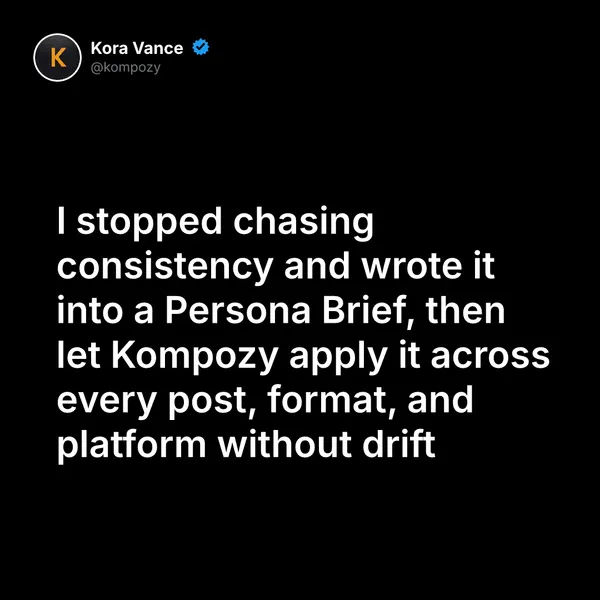
A real quote graphic made in the Kompozy workspace, shown as an example of the format. It was not made for this guide.
Who is this for, and who should skip it?
Best for:
- Sites with specific answers, original data or expert sources to cite.
- Brands that can publish on their own site plus YouTube, LinkedIn and community sites.
- Teams that will track a fixed set of ChatGPT prompts over months.
Not ideal for:
- Anyone expecting results in days. Re-crawling takes weeks.
- Teams that want Kompozy to track prompts, edit Wikipedia or build Reddit standing. It doesn't.
- Brands planning to drop marketing links into Reddit. Moderators remove those.
Frequently asked questions
Does ranking on Google get me cited by ChatGPT?
Not reliably. ChatGPT runs its own web searches and weighs passage structure, specificity, and entity authority over Google ranking, so the overlap with Google's top results has largely broken. Pages that rank low on Google can still be cited. Ranking helps you be discoverable, but a cleaner, more specific, better-attributed passage on the exact question is what actually earns the citation — which is good news for smaller sites.
Why does ChatGPT cite Wikipedia and Reddit so much?
They are high-trust, consistently-structured, heavily-corroborated sources on almost any topic, which is exactly what a retrieval system optimizes toward. Profound's analysis of 680 million citations found Wikipedia made up nearly half of the citations among ChatGPT's ten most-cited sources. The practical takeaway is not to fight them but to be present on and around them — accurate reference coverage, genuine community participation — while making your own pages the cleanest answer to specific questions those sources don't fully cover.
Do I have to be mentioned by name to count as cited?
No — they are separate outcomes. ChatGPT can lift a statistic or definition from your page and attribute it with a link while never saying your brand name in the answer text, or mention your brand as an example without linking you at all. To get both, write the citable passage so your identity is inside it — attribute your own data to yourself in the sentence — so being quoted also means being named.
How long until a page I optimized shows up in ChatGPT?
Expect weeks, not days. ChatGPT's search index re-fetches pages on a lag, so an edit or a new page needs time to be re-crawled before it can change how you are cited. Owned pages you control tend to update faster than earned surfaces like Reddit standing or a video accruing signal. Re-run your prompt set monthly and attribute movement to edits over that horizon rather than judging in the first few days.
How do we know this?
On 2026-10-23 we checked the crawler behavior, the GEO study results and the Wikipedia citation share against the sources listed below. Kompozy plan details come from kompozy.io/pricing.
Sources
- OpenAI: Overview of OpenAI crawlers (read 2026-10-23)
- arXiv: GEO: Generative Engine Optimization (Aggarwal et al.) (read 2026-10-23)
- Profound: AI platform citation patterns (read 2026-10-23)
- Kompozy: Pricing (read 2026-10-23)
Related tutorials
- How to optimize content for Perplexity citations (2026)
- How to optimize a page to get cited by AI search (2026)
- How to earn AI citations across product pages, Reddit, and YouTube (2026)
- How to measure and improve your brand's visibility in AI answers (2026)
- How to check if AI search is citing your content (2026)
- How to build a ChatGPT ads and GEO content strategy (2026)