How to optimize content for Perplexity citations (2026)
Get cited by Perplexity in 2026: unblock PerplexityBot, structure extractable answer units, back claims with sources, add authorship, and track a query set.
Last verified · 2026-10-23 · by Moe Ameen
Published 2026-09-03 · Updated
Short answer
To get cited by Perplexity, first make sure robots.txt allows PerplexityBot and the content is in the raw HTML. Then open each section with a direct answer to one real question, back claims with named statistics, quotations or sources, add a real author and matching schema, and publish the same claim on more than one surface. Track a fixed question set weekly and refresh pages that slip.
Key takeaways
- Blocking PerplexityBot removes you from Perplexity, however good the page is.
- In Ahrefs' data, only 28.6% of URLs Perplexity cited ranked in Google's top 10.
- The GEO study found quotes, statistics and citations lift visibility by up to about 40%.
- Being cited is not the same as being recommended. Check whether the answer itself names you.
Perplexity is the answer engine where citations are most winnable in 2026, because it fetches pages with its own crawler, PerplexityBot, and in an Ahrefs study of 15,000 long-tail queries only 28.6% of the URLs it cited ranked in Google's top 10. A well-structured page can be cited without a mountain of domain authority behind it. This is the concrete task version of earning that citation: a repeatable pass you run on a page so Perplexity can crawl it, lift a clean passage from it, and trust it enough to attribute the point to you.
The order matters, because the levers stack from binary to incremental. Crawl access is first and non-negotiable — if PerplexityBot can't reach the page, nothing else counts. Then you shape the content into self-contained answer units, attach the evidence that makes them trustworthy, add the authorship and schema that confirm who is behind the claim, corroborate it across more than one surface, and measure.
One caution before you start: getting cited is not the same as getting recommended, and structural tricks can get thin pages cited today only to see them displaced tomorrow — so put real substance under every lever. The strategy behind why this works, and the quality trap to avoid, is in the companion guide Perplexity citation optimization.
What is the first step to get cited by Perplexity?
- Confirm PerplexityBot can crawl the page. Check that your robots.txt does not disallow PerplexityBot, Perplexity's own web crawler — a single blocking line makes your content invisible to the engine no matter how good it is. Also confirm the content renders in the raw HTML rather than only after heavy client-side JavaScript, since the crawler may not execute your scripts. This step is binary: pass it before spending effort on anything below.
- Target the exact question a person would ask. Write for a specific natural-language query, not a keyword. Phrase your section heading the way someone would actually ask Perplexity — a full question or a precise noun phrase — because the engine matches passages to intent, and a heading that mirrors the question is easier to retrieve for it. Pick queries where a good answer is genuinely thin, and consider emerging ones, where fewer strong pages exist yet.
- Lead each section with a standalone, liftable claim. The unit Perplexity retrieves is the passage, not the page. Open each section with a direct claim in the first sentence or two that answers the question on its own, without needing the paragraph above it for context. A model can drop a self-contained sentence straight into an answer and attribute it cleanly; a claim buried mid-paragraph or dependent on your setup gets passed over for a competitor's cleaner one.
- Back every claim with a named statistic, quote, or source. This is the highest-return single move. The Princeton-led GEO study presented at KDD 2024 found that adding cited statistics, quotations from credible sources, and external citations raised a page's visibility in generative engine answers by up to about 40 percent, while keyword stuffing scored below the unedited baseline on the study's main measure. Perplexity's whole promise is accuracy, so a claim carrying a specific number and a named source is exactly the shape it prefers to quote. Attach real, verifiable evidence — never invented figures, which is how thin pages get cited and then discarded.
- Add a real named author and mirror the content with schema. Perplexity cross-references who stands behind a claim, so give the page a real named author with a verifiable bio, relevant credentials, and links to that person elsewhere. Add JSON-LD schema that reflects what a reader actually sees — Article with author attribution, Organization, and FAQPage only where a genuine question-and-answer set exists. Schema is an amplifier on content that already earns the citation, not a substitute; marking up claims a visitor cannot see is a spam signal.
- Corroborate the same claim across more than one surface. Perplexity assembles each answer from several sources and prefers claims it can see confirmed in more than one place, so a point published only once on one page is weaker than the same point present across your site, your social posts, and your newsletter archive. Publish the core claim in more than one shape, on more than one surface the crawler reads, so the engine encounters it corroborated rather than isolated.
- Track a fixed query set in Perplexity weekly and refresh. Pick a fixed set of target questions and run them through Perplexity on a weekly cadence, recording which sources it cites, in what order, and whether it names you. This tells you what is working and where a competitor owns the citation you want. Because Perplexity re-retrieves live on every query, keep winning pages current — a stale citation gets displaced the moment a fresher, better source appears.
What mistakes cost you Perplexity citations?
- A citation is not a recommendation. Perplexity can cite your page as one of several sources under an answer that still recommends a competitor — read citation count next to whether the answer actually names you, not on its own.
- Optimizing the structural signals without real substance underneath gets thin pages cited briefly, then displaced — and that population is exactly what any accuracy or quality pass tightens against first.
- Blocking PerplexityBot in robots.txt (sometimes done by accident via a broad AI-crawler block) silently removes you from Perplexity entirely; audit the file before assuming a content problem.
- Client-side-only rendering can hide your content from the crawler even when a browser shows it fine — check the raw HTML, not the rendered page.
- Invented statistics are the fastest way to lose a hard-won citation: the accuracy-first engine and its users punish unsupported numbers. Cite a real source or drop the claim.
- One perfect page is the classic-SEO instinct and it underperforms here — Perplexity rewards the same claim corroborated across surfaces more than a single isolated page.
Why is corroboration across surfaces the bottleneck, and where does Kompozy fit?
The step that quietly decides whether you win Perplexity is corroboration and speed — the same claim, well-formed, present across every surface the crawler reads, published fast enough to catch a query while it is still thin. Doing that by hand means writing the point once as a blog passage, again as social copy, again in a newsletter, in three different shapes, on three different days. That is a production bottleneck, and it is where Kompozy earns its place.
Kompozy is a content generation and multi-platform publishing engine, not a repurposing add-on. From one source — a talk, a long video, a research finding, an expert interview — it generates the long-form blog article, the text and image posts, the carousel, and the email newsletter, each shaped natively for its surface, then publishes them across nine social platforms plus blog and email as your real accounts. So a claim you want Perplexity to see corroborated exists as a properly-structured passage on your site and as native content on the other surfaces it crawls, produced in one pass instead of five — and shipped the same day, which is what lets you land a citation on an emerging query before it hardens.
The authorship and consistency the engine cross-references come from one Persona Brief governing voice and the named-author identity across every output, and every piece passes a human review gate, where you can catch an invented statistic before it publishes — so the volume you add is verifiable substance, not the thin filler that gets cited today and displaced tomorrow. Starter ($199/mo for 5,500 credits) fits a solo operator seeding one topic cluster across surfaces; Pro ($499/mo for 18,000 credits) covers a team publishing a corroborated answer library across platforms every week; Enterprise is available through Contact Sales for teams running AI-search visibility across many brands or sites.
What does this look like in Kompozy?
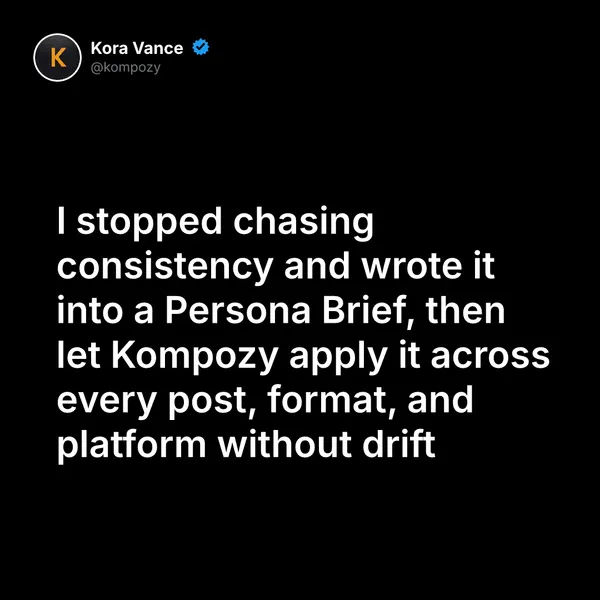
A quote graphic generated in the Kompozy workspace. It shows how one sourced claim can be repeated as its own card on another surface.
Who is this for, and who should skip it?
Best for:
- Smaller sites with well-sourced answers but little domain authority.
- Teams that can publish the same claim on their site, social and newsletter.
Not ideal for:
- Pages without real evidence. Thin pages that get cited can be displaced.
- Sites that block AI crawlers on purpose.
- Anyone expecting Kompozy to track Perplexity citations. It produces and publishes content.
Frequently asked questions
How do I get cited by Perplexity?
Let PerplexityBot crawl the page, then structure the content as self-contained answer units — a direct claim in the first line, backed by a named statistic, quotation, or cited source, under a heading that matches the question. Add a real named author, mirror the visible content with schema, and publish the same claim across more than one surface so it is corroborated. Crawl access is binary; the rest are stacking levers.
How is optimizing for Perplexity different from optimizing for Google?
Perplexity decouples citation from Google authority. In Ahrefs' study of 15,000 long-tail queries, 28.6% of the URLs Perplexity cited ranked in Google's top 10, which means most did not. So while classic SEO rewards backlinks and domain authority accumulated over time, Perplexity rewards a clean, well-sourced, extractable passage on a page it can crawl now — which makes it far more winnable for a small or new site.
Does blocking PerplexityBot matter?
Yes, completely. PerplexityBot is the crawler Perplexity uses to fetch pages for its answers, and a robots.txt rule disallowing it removes your content from the engine no matter how good it is. Blanket AI-crawler blocks sometimes catch it by accident, so audit your robots.txt as the first step before assuming your content is the problem.
How fast does Perplexity index new content?
Perplexity does not publish an indexing timeline. What you control is access: allow PerplexityBot, keep the content in the raw HTML, then re-run your target questions after you publish and note when the page starts showing up.
Is getting cited by Perplexity the same as being recommended?
No. A citation means your page was retrieved and attributed as one of the sources under an answer; the answer itself can still recommend a competitor. Treat citation as a visibility and trust signal worth earning, but always read it next to whether the answer actually names or favors you, rather than counting citations as wins on their own.
How do we know this?
We checked every figure and product claim on this page against the sources listed below on 2026-10-23, and removed or reworded claims we could not verify. Crawler behavior comes from Perplexity's documentation, the ranking overlap from Ahrefs, and the GEO figures from the KDD 2024 paper. An unsourced claim about indexing speed was removed. Kompozy plan details come from kompozy.io/pricing.
Sources
- Perplexity: Perplexity crawlers (read 2026-10-23)
- Ahrefs: AI search overlap study (15,000 long-tail queries) (read 2026-10-23)
- arXiv: GEO: Generative Engine Optimization (Aggarwal et al., KDD 2024) (read 2026-10-23)
- Kompozy: Pricing (read 2026-10-23)