AI tells detector
Paste your writing and get a score across five kinds of AI tells: vocabulary, hedges, transitions, structure and closings. You get examples from your text for each one, plus up to three suggested fixes.
Last verified · 2026-10-23 · by Moe Ameen
Published 2026-05-19 · Updated
Short answer
The AI tells detector sends your text to a language model that counts AI writing tells in five categories (vocabulary, hedges, transitions, structure and closing phrases). It returns a human score from 0 to 100, a verdict and up to three rewrite suggestions. It is free and anonymous, with a limit of 8 runs per hour per IP address. Read the score as a guide for editing. It is not proof of who wrote the text.
Key takeaways
- Five categories: vocabulary, hedges, transitions, structure and closing phrases.
- Higher is more human. The model is told to score 100 − (tells ÷ words × 600), with a floor of 0.
- Free and anonymous, up to 8 runs per hour per IP address.
- The score helps you edit. It is not evidence of authorship.
Paste any AI-generated writing. We score it on five kinds of AI tells (vocabulary, hedges, transitions, structure and closings) and suggest rewrites.
What does this look like in Kompozy?
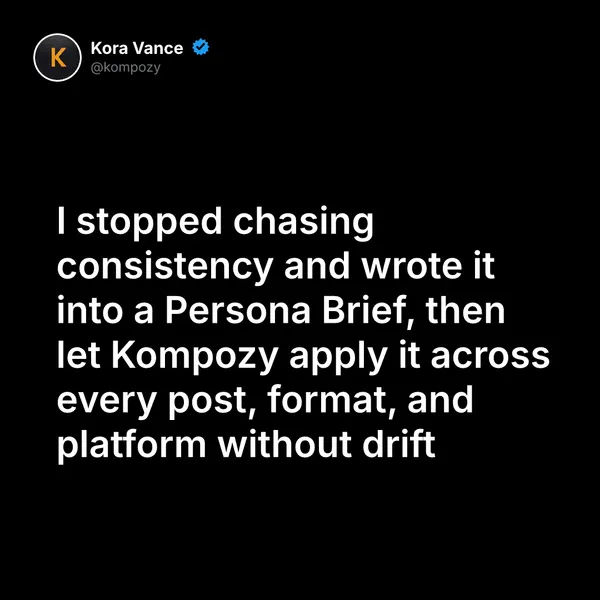
A real quote graphic generated in the Kompozy workspace. Short text formats like this are where stock AI phrasing shows up fastest.
Who is this for, and who should skip it?
Best for:
- Writers editing AI-assisted drafts before they publish
- Teams checking B2B or educational copy for stock AI phrasing
Not ideal for:
- Anyone trying to prove a person used AI; the score isn't evidence
- Fiction and poetry, where these patterns can be deliberate style
Frequently asked questions
What does the detector check?
Five kinds of tells: vocabulary (words like "delve" and "leverage"), hedges ("it's worth noting"), transitions ("furthermore"), structure (predictable shapes such as parallel bullet lists) and closings ("in conclusion"). It quotes up to three examples per category.
How is this different from the AI Tells Index?
The AI Tells Index is Kompozy's research page, a phrase list grouped into its own five archetypes such as hedge words and tricolons. The detector uses a separate set of five categories and has a language model judge your text in context instead of matching a fixed list.
How is this different from the Banned-Word Linter?
The linter is a fixed keyword scan, so it is fast and gives the same answer every time. The detector uses a language model, so it can catch patterns the list misses and suggest rewrites. Use the linter for quick passes and the detector for pieces that matter.
Can I trust the score on creative writing?
Use it with care. The detector is aimed at business, educational and informational writing. Fiction and poetry often use parallel structure and figurative words on purpose, so they can score lower than they deserve.
How do I raise my score?
Swap abstract verbs for concrete ones (leverage becomes use). Cut hedges and state the point. Drop stock transitions and start a new sentence instead. Vary sentence length, and read it aloud; if it sounds like a keynote, keep editing.
How do we know this?
We read the detector's prompt and input rules in Kompozy's source code on 2026-10-23 and compared its categories with the AI Tells Index page. The score comes from a language model following that prompt; we did not benchmark its accuracy.
Sources
- Kompozy — AI Tells Index (read 2026-10-23)
Related tools
Kompozy handles multi-format generation, brand voice, and scheduling across 9 platforms. Plans from $199/mo, cancel anytime.