AI podcast show notes in 2026: the 6-section structure that ranks and never reads like AI
AI podcast show notes that rank: the 6-section template, the AI tells to ban, Castmagic vs Descript vs Kompozy, and the Persona Brief override that fixes tone.
Published 2026-05-19 · Updated
Short answer
AI show notes rank when they follow a six-part structure instead of the default summary and chapter list. Use a two or three sentence hook, a short guest intro with a link, timestamped topics, verbatim quotes, every link mentioned and a brief call to action, around 400 to 600 words. Castmagic, Descript or Kompozy can produce it once a Persona Brief bans the usual AI phrases.
Key takeaways
- Show notes on your own site are the episode's searchable page.
- Ban phrases like "In this episode" and "Tune in to learn".
- Quotes must be verbatim and checked against the transcript.
- Castmagic Hobby is $19/mo billed yearly; Descript Hobbyist is $24/mo.
- Write the Persona Brief override once and reuse it every episode.
This guide is the operator reference: the 6-section template that ranks, the specific AI tells to strip out of podcast show notes (they differ from the tells in blog or social copy), a tool comparison with prices re-checked on 2026-10-23, and the one-time Persona Brief override that makes every future episode's show notes match your voice. Pairs with the broader ai-podcast-tools-2026 stack reference and the transcription-quality deep-dive, since show-notes quality is capped by transcript quality upstream.
Why are show notes the SEO surface of every episode?
Audio is a closed surface. When a listener finds your episode inside Apple Podcasts or Spotify, that discovery happened inside an app whose ranking signals you barely influence and whose catalog Google does not meaningfully index. The episode page on your own website is the opposite — it is open, crawlable text that a search engine reads, ranks, and routes traffic through. For a podcast that wants to grow beyond the listeners the podcast apps happen to surface, the show-notes page is the highest-leverage owned asset per episode.
The mistake most podcasters make is treating show notes as a chore to dispatch in the publishing flow rather than a ranking asset to engineer. They paste whatever Castmagic or Descript generated, hit publish, and move on. The output is a competent summary that satisfies the "did I write show notes" checkbox and ranks for nothing, because a summary-plus-chapters block does not match the shape of the queries real people type when they are looking for a specific episode. Engineering the structure to match query intent is the entire game, and it is a one-time investment that compounds across every episode you ever publish.
Two practical consequences follow. First, the transcript quality upstream sets the ceiling: misheard guest names and mis-transcribed numbers poison the highest-value parts of the show notes (the quotable moments and the guest intro). Get the transcript right first — see transcription-quality for the engine comparison. Second, the structure has to be enforced at the prompt level, not fixed by hand after generation, or you are back to spending the manual time the AI was supposed to remove.
What is the 6-section show-notes template?
The template that ranks is six sections in a fixed order. Each section earns its place by answering a question a searcher or a scanning reader actually has, and the order matters because it front-loads the two things that drive a listen decision (the hook and the guest) before the reference material.
- Hook (2-3 sentences). The single strongest claim or contrarian framing from the episode, written like a newsletter opener. Its job is to make the reader want to press play. Never open with "In this episode" — open with the actual argument the episode makes.
- Guest intro (2 sentences, with a link). Who the guest is, what they are known for, and a link to their primary online surface (LinkedIn, company site, or personal site). The guest name density here is what makes the page rank for "[guest name] interview" queries. Skip this section entirely for solo episodes.
- Key topics covered (5-7 bullets, each with a timestamp). This is the table of contents. Readers scan it to decide whether to listen and where to jump. Each bullet must name its actual content, never "Introduction" or "Main discussion".
- Quotable moments (3-5, verbatim, attributed). Direct quotes pulled from the transcript, each a self-contained idea, each attributed to the speaker. These are the lines readers screenshot and share. They must be verbatim with only filler-word cleanup — AI paraphrases of quotes are the single most damaging tell in the whole document.
- Links and resources mentioned. Every product, book, person, study, or tool referenced in the episode, each linked. This section carries outsized SEO value: it earns inbound links from the referenced sources and ranks the page for adjacent queries.
- CTA (1-2 sentences). Subscribe, follow, or join the newsletter. Brief and specific, never the performative "smash that subscribe and leave a 5-star review" pile-on.
Aim for roughly 400-600 words: long enough to cover the topic for a search engine, short enough that a person reads it. The discipline is in the order and the verbatim quotes, not the word count. A tight document in this shape matches what searchers want better than a long AI summary of the same episode.
| Section | Reader question it answers | Primary SEO value | Most common AI failure |
|---|---|---|---|
| Hook | Is this worth my time? | Topic-query relevance | Opens with "In this episode we discuss" |
| Guest intro | Who is this person? | Ranks for "[guest name]" queries | Generic "our amazing guest" with no link |
| Key topics | Where do I jump? | Long-tail sub-topic queries | Chapters named "Introduction / Conclusion" |
| Quotable moments | What actually got said? | Shareable, screenshot-ready | Paraphrases instead of verbatim quotes |
| Links mentioned | What did they reference? | Inbound links + adjacent queries | Section omitted entirely |
| CTA | What do I do next? | Conversion, not ranking | Performative subscribe-and-review pile-on |
Which AI tells show up in podcast show notes?
The generic "signs of AI writing" lists matter, but podcast show notes have their own dialect of tells — phrases every show-notes tool reaches for by default because they were trained on a decade of podcast-template boilerplate. These are worse than ordinary AI vocabulary because experienced podcast listeners have seen them ten thousand times and read them as "nobody wrote this." Ban every one of them at the Persona Brief level so they never appear in the first place.
- "In this episode, we discuss…" — the single most common opener every tool defaults to. Replace it with the actual claim the episode makes.
- "Tune in to learn…" — pure podcast-tutorial-template language. The reader knows it is a podcast; you do not need to tell them to tune in.
- "Whether you are a beginner or an expert…" — the addresses-everyone framing that kills specificity. Show notes that try to be for everyone rank for no one.
- "This episode is packed with…" — an empty intensifier. Show the substance with a real quote; do not assert that substance exists.
- Generic chapter titles ("Introduction", "Main Discussion", "Key Takeaways", "Conclusion"). Each chapter has to be named for its actual content or it carries zero search value.
- "Don't forget to subscribe and leave a 5-star review!": the performative ending. It reads as filler.
- "Deep dive", "dive into", "covering everything from X to Y" — the connective AI tissue that signals template prose to anyone paying attention.
The pattern across all of these: they are framing phrases that describe the episode instead of delivering it. A human writing show notes leads with what was actually said; an AI on default settings leads with meta-description of the conversation. Banning the phrases forces the model into the human pattern.
The override is a one-time Persona Brief edit, not per-episode work, so the improvement carries across every future episode. Any banned phrase that survives is usually inside a verbatim guest quote, which is correct to leave untouched.
Which show notes rank, and which do not?
Episode pages compete for two distinct query types, and the 6-section template is built to win both where the default format wins only one.
- Guest-specific queries: "[guest name] interview", "[guest name] podcast", "[guest name] [your show name]". These rank on URL slug, page title, and guest-name density — which is exactly what the guest-intro section and the attributed quotable moments supply. A summary that mentions the guest once does not rank here; the template, which names the guest in the intro and attributes 3-5 quotes to them, does.
- Topic queries: searches matching the episode's core theme, competing against general blog content. These rank on H2 structure, semantic richness, and inbound links — supplied by the named key-topics section and the links-mentioned section. The hook section seeds the topical relevance; the links section earns the inbound authority.
The default summary-and-chapters format only addresses the first query type, and weakly: it mentions the guest, lists generic chapters, and stops. It has no verbatim quotes to be shared (which is how episode pages earn natural links), no named topics (which is how they rank for sub-topic queries), and no links section (which is how they earn inbound authority). The 6-section template is not stylistically nicer than the default — it is structurally aimed at the queries that actually exist.
Which tools generate show notes, and how do they compare?
Three kinds of tools cover show-notes generation, and they are not interchangeable. Castmagic is a dedicated transcript-to-content engine; Descript is an editor that produces show notes as a side effect; a generation engine like Kompozy treats show notes as one of many outputs from a single Persona Brief. All three need the override below to escape the generic tone; the override is the work, the tool is the delivery.
| Tool | Entry price | What it is | Best for | Watch-out |
|---|---|---|---|---|
| Castmagic | Hobby $19/mo billed yearly | Dedicated transcript-to-content engine | Show notes as the primary output, fastest path | Default tone needs the Persona Brief-style override |
| Descript | Hobbyist $24/mo ($16 billed yearly) | Text-based audio/video editor; notes are a by-product | Podcasters who already edit in Descript | Show notes are a secondary feature with less structure control |
| Kompozy | Starter $199/mo | Generation + publishing engine; notes are one output of many | One Persona Brief driving notes, clips, blog and newsletter | Worth it once you need several output types per episode, not for notes alone |
The decision rule is simple. If show notes are the only AI output you need and you want the cleanest dedicated tool, Castmagic Hobby ($19/mo billed yearly) is the specialist. If you already edit episodes in Descript, the show notes come out of a tool you already pay for. If you turn each episode into clips, a blog draft, a newsletter and social posts in one consistent voice, a generation engine is the pick because the show notes inherit the same Persona Brief as every other output. See pricing for plans and content-repurposing for the full episode fan-out.
How does a Persona Brief override fix show-notes tone?
Generic show-notes AI does not know your podcast's voice, so it averages to the "Inc.com explainer" register that every other show also gets. The fix is a one-time Persona Brief addition that you write once and that applies to every episode forever. Four components:
- Voice instruction: "Show notes must use the [your name] / [your show] voice, not the generic-podcast voice. Write the way the host actually talks — opinionated, specific, no hedging."
- Banned-phrase list: "In this episode", "Tune in", "Whether you are", "Don't miss", "packed with", "deep dive", "dive into", "covering everything from X to Y", and the performative subscribe-and-review closer.
- Required structure: "Always use the 6-section template (hook / guest / topics / quotes / links / CTA). Each quotable moment must be verbatim from the transcript and attributed to the speaker — never paraphrase a quote."
- Tone calibration: "Match the energy of [reference show]'s show notes. Lead with the claim, not the description of the conversation."
This is the highest-ROI setup work in the whole show-notes workflow. Written once, it moves every future episode's output from generic to on-voice with no per-episode effort. Same tool, same transcript, very different output, driven by the brief.
What is the per-episode workflow once the brief is calibrated?
With the override in place, the per-episode process collapses to a short review pass. The structure is enforced by the brief, so the human is checking accuracy, not rewriting prose.
- Transcribe the episode (Whisper API or your chosen engine — see the transcription guide). Transcript quality is the ceiling on everything downstream.
- Generate show notes with your tool, using the calibrated Persona Brief. The 6-section structure and banned-phrase enforcement come for free from the brief.
- Verify the verbatim quotes against the transcript. This is the one section AI gets wrong in a way that damages credibility — a misquoted guest is worse than no quote.
- Check guest-name and proper-noun spelling. These are the highest-mis-transcription-rate words and they are exactly the words the page ranks on.
- Confirm every referenced link is present and correct in the links section. Add any the model missed from the transcript.
- Publish to a unique URL per episode on your own site.
The first episode through this workflow takes the longest review. As your transcription vocabulary and Persona Brief stabilize, the review gets shorter. That compounding is the point: structure and voice are solved once at the brief level, and every later episode rides that investment.
Where do AI show notes still need a human?
The honest limits matter because trusting the AI past them is how a credible show ships a wrong attribution to its whole audience. AI owns the operator layer of show notes — structure, drafting, formatting, link extraction. It does not own the accuracy layer.
Three things stay human. First, quote accuracy: the model will occasionally attribute a line to the wrong speaker or smooth a verbatim quote into a paraphrase, and both are fatal for a pull-quote whose entire value is that a real person said it. Second, proper-noun and number fidelity: a guest who said "$4.2 million in 11 months" must not become "around four million in under a year" — the specificity is the credibility, and the transcription layer is where it gets lost. Third, the editorial judgment of which moment is actually the hook: a clip-detection model and a show-notes model both score surface signals, and the moment your audience has been waiting for is often the one with no audio-energy spike. Reclaim the time the structure and drafting would have cost, and spend it on those three checks.
What makes podcast show notes rank?
The structure is the ranking, not the word count. The 6-section template (hook, guest, topics, quotes, links, CTA) matches the queries real searchers type; the default AI summary-and-chapters format does not. Pick a tool to deliver it: Castmagic Hobby ($19/mo billed yearly) as the specialist, Descript if you already edit there, or a generation engine if show notes are one of several outputs you produce from one content-repurposing brief. Then write the Persona Brief override once: ban the tells, force the six sections, require verbatim quotes. After that, each episode needs only a short accuracy check. Start with pricing to size the plan, or read the full stack in ai-podcast-tools-2026.
What does this look like in Kompozy?
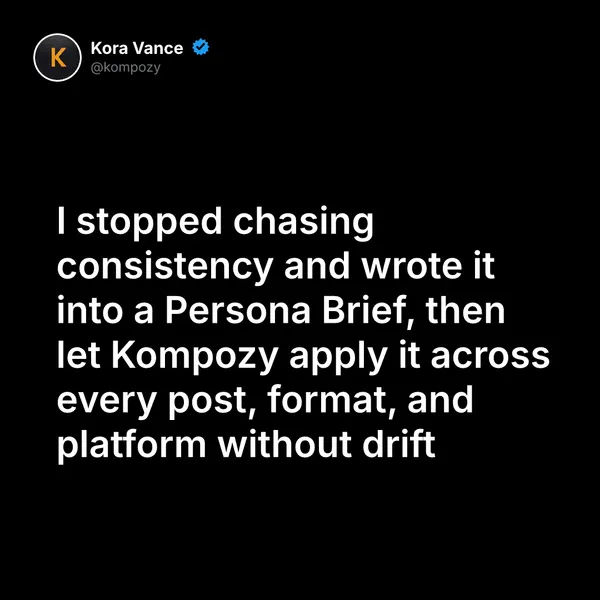
A quote graphic generated in the Kompozy workspace, the image format that pairs naturally with the verbatim quotes in a show notes page.
Who is this for, and who should skip it?
Best for:
- Podcasters who publish episode pages on their own site
- Interview shows that want to rank for guest names
- Hosts already using AI notes that read as generic
Not ideal for:
- Shows that only publish inside podcast apps
- Hosts who will not check quotes before publishing
- Teams wanting full transcripts in place of notes
Frequently asked questions
How long should podcast show notes be?
Around 400 to 600 words in the six-part structure. The structure matters more than the word count.
Do quotes in show notes need to be verbatim?
Yes. A paraphrased quote loses its value and can misrepresent the guest. Check every quote against the transcript.
Which tool should I use for AI show notes?
Castmagic if notes are your main output, Descript if you already edit there, and Kompozy if notes are one of several outputs from the same episode.
Does Google penalize AI-written show notes?
Google's guidance allows generative AI content but warns against mass-producing pages that add no value. Accurate, useful notes are fine.
How do we know this?
We checked the platform rules and tool prices on this page against the sources listed below on 2026-10-23. Benchmarks we could not trace to a published source were removed. Kompozy plan details come from kompozy.io/pricing.
Sources
- Castmagic: Pricing (read 2026-10-23)
- Descript: Pricing (read 2026-10-23)
- Kompozy: Pricing (read 2026-10-23)
- Google Search Central: Guidance on using generative AI content (read 2026-10-23)
Which other AI podcasting guides should you read next?
- Turn every podcast episode into a 1,500-word blog post automatically — The end-to-end workflow: transcript → structured outline → SEO-optimized blog draft → published HTML. Zero manual writing required after calibration.
- Best AI podcast tools 2026: the complete production + distribution stack — The 8-tool reference stack covering transcription, clipping, show notes, cover art, scheduling, and cross-platform fan-out for podcasters in 2026.
- How to get publication-grade podcast transcripts with AI in 2026 — Whisper-large-v3, Descript, AssemblyAI, Rev compared. Plus the cleanup workflow that turns 85% accuracy into 99% in 20 minutes.
- AI podcast cover art: tools and the style guide that gets approved by Apple — Midjourney, DALL-E, SDXL, Ideogram compared for podcast cover art. Plus the 1400×1400 spec, color contrast rules, and Apple submission gotchas.
- Launching a new podcast in 2026 with an AI-augmented workflow — The 30-day pre-launch checklist. Cover art, trailer, 3 evergreen episodes, distribution, repurposing pipeline — all AI-augmented.
- How AI changes podcast monetization economics in 2026 — AI voice cloning for personalized sponsor reads, AI brand-deal matching, AI-assisted membership content. The four AI-driven shifts in podcast revenue.
Which related topic clusters cover this from another angle?
- AI Brand Voice & Persona — Without a Persona Brief, every AI output averages to the LLM default voice. This is the 5-section methodology that makes 100+ AI-generated posts feel like one human author wrote them.
- AI Content Repurposing — The complete methodology for turning one source into 25-35 pieces of native-format content across every platform — without producing AI slop.