RSS-to-social automation: turn any feed into platform-native posts (2026 guide)
How RSS-to-social turns each feed item into native posts in your voice: what Kompozy reads from the feed, the checks that run, and the 14-day calibration.
Published 2026-05-19 · Updated
Short answer
RSS-to-social automation watches a feed from a podcast host, blog, newsletter or YouTube channel and catches each new item by its GUID. Kompozy checks every 15 minutes, takes the item's title and text, and writes posts in each format you allow for that source, following your Persona Brief. The posts wait for your approval or fill your posting slots. The Persona Brief and a 14-day calibration decide the quality.
Key takeaways
- RSS 2.0 has been frozen since 2009, which makes it a stable trigger.
- The GUID on each item is what stops the pipeline from processing anything twice.
- Kompozy works from the text inside the feed. It does not open links or transcribe audio.
- Connectors move fields between apps; an engine turns one item into native content.
- Kompozy polls feeds every 15 minutes. Calibrate for 14 days before autopilot.
RSS is the most underrated content-automation primitive in 2026. Every podcast host, every blog platform, every newsletter tool, and every YouTube channel quietly emits an RSS feed — a free, standardized, machine-readable signal that says "new content exists, here is where to find it." That signal is the cleanest possible trigger for an automation pipeline, because it carries no auth, no scraping risk, and no fragile UI to break. You point a tool at the feed URL and the feed does the rest of the notification work for you, forever.
The problem is that most people who wire RSS to social stop at the connector. They use a generic automation tool to take the feed title and description and dump it into a post template, then wonder why engagement is flat. A feed entry is not a social post. The title of your podcast episode is not a TikTok hook, your blog meta description is not a LinkedIn opener, and the same body text reformatted nine ways is exactly the cross-posting pattern every platform algorithm now downranks. The connector is the easy part of the problem. The hard part is the transformation layer between "new feed item exists" and "a set of platform-native pieces that sound like you."
This is the complete 2026 guide to RSS-to-social automation done at the product level rather than the plumbing level: what emits a feed, how a single feed item becomes a multi-format fan-out, which checks run before anything ships (and which do not), the 14-day calibration ramp that earns the right to run unattended, and an honest map of where a generic connector tool ends and a content engine like Kompozy begins. For the methodology behind the fan-out itself, pair this with our content-repurposing hub; for the hands-off end state, see autopilot-explained.
Why is RSS the best trigger for content automation?
RSS beats scraping, manual upload, and platform-specific APIs as a content trigger, and the choice of trigger shapes everything downstream. The competing triggers are scraping (fragile, often against terms of service, breaks every time the source redesigns), manual upload (defeats the point of automation), and platform-specific APIs (each one a separate OAuth integration that expires and rate-limits). RSS sidesteps all of it. The RSS 2.0 specification has been frozen since its last revision in 2009, so a feed parser written today reads a feed published years ago. That stability is rare in the automation world and it is the entire reason RSS is worth building on.
The second advantage is that RSS is a pull model with a push-like feel. The tool polls the feed on an interval, so there is no webhook to register on the source side, no callback URL to maintain, and nothing to break when the source platform changes its internal event system. Kompozy checks each feed every 15 minutes by default, which is plenty for a source that publishes a few times a week. A new item reaches the pipeline within that window, and you carry none of the operational weight of a real-time webhook. For the rare case where you genuinely need sub-minute latency or event types that do not fit the "new item in a feed" shape, that is what webhook pipelines are for; RSS covers the overwhelming majority of recurring-publish content sources cleanly.
The third and least-appreciated advantage is that RSS carries a stable unique identifier per item (the GUID). That GUID is what lets the pipeline guarantee it never processes the same episode or post twice, even if the feed re-serves old items, even if the poller restarts mid-run, even if the source platform reorders the feed. Idempotency is the difference between an automation you can trust unattended and one that double-publishes your launch announcement to every follower. Kompozy keys dedup on the GUID and falls back to the entry ID or link when a feed leaves the GUID out.
Which content sources emit an RSS feed?
Podcast hosts, blogs, newsletters, and YouTube channels all emit RSS. The set of content sources that emit RSS is far wider than most operators realize, because the feeds are frequently undocumented or hidden behind a non-obvious URL. Here is the practical inventory for 2026, with the gotchas that matter when you go to wire each one.
| Source type | Feed availability | Typical URL pattern | What to watch for |
|---|---|---|---|
| Podcast hosts | Standard for shows distributed by RSS | Found in the host dashboard; ends in .xml or /rss | The feed links the audio, but Kompozy's RSS source reads only the show notes text. Upload the recording to work from the audio itself |
| Blog platforms | Near-universal, auto-generated | /feed, /rss, /rss.xml, /atom.xml | Some feeds ship summaries only. Kompozy works from the text in the feed and does not open the item link, so switch to a full-text feed if you can |
| Newsletters | Common on Substack, Beehiiv, Ghost, ConvertKit | /feed on the publication root | Email-first tools sometimes gate the full post behind a paywall the feed cannot cross |
| YouTube channels | Available at a fixed URL pattern | youtube.com/feeds/videos.xml?channel_id=UCxxx | Kompozy reads only the video title from this feed, and very short titles get skipped. Run the clipper on the video link for shorts; see our YouTube RSS guide |
| Every subreddit and user | /r/<subreddit>/.rss | Best as a commentary/intelligence source, not verbatim republication | |
| X / Twitter | Via third-party RSS bridges only | Bridge-dependent | Fragile — bridges break; treat as best-effort, not load-bearing |
The pattern across that table is that the feed almost always exists, but it often doesn't carry the full content. A podcast feed gives you the episode title, the show notes and an audio URL, not a transcript. A blog feed sometimes gives you a summary instead of the article. A YouTube feed gives you a title and a link, not the video. That is the thing to understand about RSS-to-social in Kompozy: the RSS source works from the text inside the feed. It reads the item's title plus its full content, or the summary when that is all the feed has. It does not open the link, download audio or transcribe anything, so a full-text feed gives it far more to work with than a summary feed. Recordings and videos go in through uploads or the clipper instead.
How does one feed item become many native posts?
Each new item goes to every format you allow for that source, so one item can turn into several pieces across Kompozy's five buckets instead of one post. A new RSS source starts with Text Posts and Blog Articles, and you add image, video or newsletter formats in its settings. This is where the product layer parts ways with the plumbing layer. A generic connector moves text from one field to another; Kompozy writes new pieces from the item's text.
| Output bucket | Example formats | From an RSS item? | Primary destinations |
|---|---|---|---|
| Video | Persona shorts, marketing shorts, listicle video | Yes, written from the item text. Clipped shorts are not: they need a file or link in the clipper | TikTok, Reels, YouTube Shorts |
| Image | Quote graphics, carousels, photo and infographic posts | Yes, from the item text | Instagram, LinkedIn, Pinterest |
| Text | Text posts, persona tweets | Yes. Text Posts is on by default | X, LinkedIn, Threads, Facebook |
| Blog | Blog articles | Yes. On by default | Owned site, SEO |
| Newsletter | Email newsletters | Yes, once you allow it |
The reason this matters for RSS specifically is that the trigger is free and recurring, so the output compounds. Every new item feeds the same set of formats with no extra setup, and a weekly blog or newsletter becomes a run of posts instead of a single announcement. That is the real value of RSS-to-social: not "auto-post my blog title," but "turn a recurring publish event into a presence on several platforms." The connector framing undersells it. For the full methodology behind how one source becomes a five-bucket fan-out, the content-repurposing hub is the deep reference, and the podcast-specific version lives in our apple-podcasts-automation spoke.
What happens when the feed publishes a new item?
The next poll picks the new item up (Kompozy checks every 15 minutes by default) and runs the sequence below. Going through it step by step shows what Kompozy does with an item and what it leaves to you.
- Detection. The poller reads the feed and compares each item with the ones it has already stored for that source, keyed on the GUID, or on the entry ID or link when there is no GUID. A repeat item is ignored.
- Text capture. Kompozy keeps the item's title and its full content, falling back to the summary when the feed carries nothing more, and strips the HTML to plain text. It does not follow the link, download media or transcribe audio. Items with almost no usable text are skipped.
- Auto-push. With auto-push on, which is the default, the item goes straight into the pipeline for every format allowed on that source. Turn auto-push off and items wait in Raw Inbound until you push them to the pipeline yourself.
- Generation. Each format is written from the item text against your Persona Brief, so every piece follows your voice settings, Prohibited Keywords and Persona Brief rules instead of the model's default voice.
- Checks. Email newsletters get a topic refusal, a structural validator and a separate grader. Persona video scripts get a critic pass. Other formats rely on the prompt rules alone. A generation that fails outright lands as Failed and its credit is refunded.
- Routing. With Auto-Publish Generated off, which is the right setting during calibration, finished outputs wait in the pipeline for your approval. With it on, they are approved and placed into the posting days and posts-per-day slots you set for each format, so one feed item's outputs spread across days instead of going out at once.
Two limits are worth planning around. Kompozy writes from whatever text the feed carries, so a summary-only feed produces thinner pieces than a full-text one; switch the feed to full text if your platform allows it. And because the RSS source never touches audio or video, a podcast or YouTube feed only hands it show notes or a title. For the recording itself, upload the file (Kompozy transcribes uploads with Whisper) or paste the video link into the clipper.
Which checks keep RSS automation on-brand?
Automation without checks is a slop machine pointed at your audience. What makes unattended RSS-to-social trustworthy is less the model than the rules every output is written under and the few places Kompozy reads the output before it ships. It helps to know exactly which is which. The full map lives in our quality-gates spoke; the summary for RSS follows.
- Prompt rules, on every format. Your Persona Brief, voice settings, Prohibited Keywords and the built-in anti-AI-tell rules go into every generation prompt. They are instructions: nothing scans the finished post for a banned word.
- Scheduling rules you set, not platform caps. Each format has posting days and a posts-per-day limit (one a day on weekdays by default), and approved posts fill those slots. Kompozy has no built-in per-platform cap, so if a format posts to LinkedIn, keep its posts-per-day low yourself.
- No source check. The prompt tells the model not to invent figures, dates or sources, but nothing compares a finished post with the article or transcript. Check every number during calibration, and keep checking on number-heavy formats.
- Format-specific checks and publish limits. Email newsletters get a three-layer gate (topic refusal, a structural validator with one rewrite, a separate grader). Persona video scripts get a critic pass. At publish, every post is trimmed to platform character, media and video-length limits.
This matters more for RSS than for manual posting because RSS runs unattended. When you write a post by hand, you are the check. When a feed item triggers generation at 2am, the prompt rules are most of what shapes the output, which is why calibrating with Auto-Publish off matters so much here. The honest answer to "can I just wire RSS to a posting tool and walk away" is still no: a posting tool has no voice rules and no checks, so walking away means shipping whatever the model produced.
How fast is it? Kompozy checks feeds every 15 minutes, so a new item usually enters the pipeline within that window. We have not published a measured end-to-end time. The scheduler then places each output in the next open slot for its format, so the fan-out spreads over the following days instead of shipping all at once, and with manual review on, nothing ships until a person approves it.
When is it safe to put RSS-to-social on autopilot?
Wait until the 14-day calibration window is done. The single biggest mistake in RSS-to-social automation is flipping to autopilot on day one. The Persona Brief you write before you have seen a single generated output is a hypothesis, not a calibrated instrument. It will be roughly right and specifically wrong — it will capture your general voice but miss the words you actually hate, the structures you actually use, and the topics you actually avoid. The only way to close that gap is to watch the pipeline generate against real feed items and correct it. That is what the calibration window is for, and skipping it is the number one reason automation pipelines produce content the operator is embarrassed by.
- Days 1-3: review every single output and edit aggressively. Every edit you make is a signal — feed the pattern back into the Persona Brief. If you keep cutting a phrase, ban it. If you keep adding a structure, require it.
- Days 4-7: still review every output, but the edits should be getting smaller. Add anything that slipped through to your Prohibited Keywords. The goal of this phase is to drive the edit rate down.
- Days 8-10: spot-check a large share of the outputs. Track which formats need the most correction — usually the longer-form ones (blog, newsletter) drift more than short text. Add format-specific guidance where you see repeated misses.
- Days 11-14: spot-check a smaller sample. If quality holds at this sampling rate with corrections you are comfortable with, the Persona Brief is calibrated and you can flip to autopilot on day 15. If you are still making material edits, extend the window — there is no prize for flipping early.
The framing that helps operators take calibration seriously is to treat the 14 days as setup, not overhead. You would not expect a new hire to ship unsupervised on day one; the calibration window is the same onboarding for the pipeline. The reward is real: a calibrated pipeline running on autopilot-explained turns a recurring hand-built content operation into a short weekly spot-check. The cost of skipping it is shipping slop to your audience and quietly training them to ignore you.
Is a connector tool enough for RSS-to-social?
A connector is enough to post a new blog title with a link, and not enough to turn a feed item into a fan-out in your voice. A generic automation connector and a content engine are different layers, not competing products. The connector moves data between apps. The engine transforms a source into native content. You can absolutely wire RSS to social with a connector, and for the narrow job of "post my new blog title with a link," a connector is the right and cheaper tool. The moment you want the feed item turned into a fan-out that sounds like you, the connector cannot do it — not because it is badly built, but because transformation is simply not what it is for.
| Capability | Generic connector (Zapier / Make / Buffer) | Content engine (Kompozy) |
|---|---|---|
| Detect new RSS item | Yes | Yes |
| Read the item text | Forwards feed fields into a template | Uses the title plus full content or summary as source material |
| Pull audio or video behind the feed | No | No. Upload the recording (Whisper transcription) or use the clipper |
| Write several formats from one item | No | Yes, every format you allow on the source |
| Generate image cards and generated video | No | Yes. Clipped shorts come from the clipper, not RSS |
| Write in a governed brand voice | No — template fields only | Yes — Persona Brief |
| Checks before publish | No | Prompt rules on every format; extra checks on newsletters and persona scripts |
| Scheduling across days | Partial (scheduling only) | Yes — per-format posting days and posts per day |
| Representative price | Lower; see each vendor pricing page | Kompozy Starter $199/mo |
A useful way to decide: if you can describe your desired output as "take this field and put it in that field," a connector is right and you should not pay for an engine. If your desired output is "take this post and turn it into a set of platform-native pieces in my voice," no amount of connector configuration gets you there, because writing several formats in your voice from one item is a product feature, not a workflow step. Many serious operators run both: a connector for trivial notification automations and an engine for the content fan-out. See pricing for where the engine tier lands, and our autonomous hub for what the engine enables once calibrated.
How does RSS-to-social break, and how do you harden it?
Unattended automation fails silently by default, which is the dangerous part — a pipeline that stops producing posts looks identical to a pipeline with nothing to produce. Hardening an RSS-to-social setup means knowing the failure modes in advance and instrumenting against each one, because the cost of a silent failure is weeks of missing content nobody noticed.
- The poller goes quiet. Some hosts deprioritize old or aggressive RSS clients, and a feed that stops returning new items looks the same as a feed with no new items. Monitor for "no new items in N days" against the source's actual publish cadence and alert when the gap exceeds it.
- The feed URL changes. Platforms occasionally restructure permalinks or migrate feed hosts (this is how feeds silently die). Pin the exact feed URL, and re-verify it on a quarterly audit rather than assuming it is stable forever.
- The feed thins out. Kompozy writes from the text in the feed and skips items with almost no usable text, so a feed that switches to short summaries quietly produces thinner posts, or none. Open the feed now and then and check that the full text is still there.
- Encoding drift. Older feeds occasionally use non-UTF-8 encodings that mangle apostrophes and accented characters. Modern parsers handle this, but the pipeline should log encoding anomalies so a garbled output traces back to its cause instead of looking like a generation bug.
- Quality drift after calibration. Even a calibrated Persona Brief decays as your voice evolves or the source's topics shift. Schedule a monthly spot-check; if the edit rate creeps back up, the brief needs a refresh, not the pipeline a rebuild.
The meta-lesson across every failure mode is that monitoring is part of the build, not an afterthought. An RSS-to-social pipeline you cannot observe is one you cannot trust unattended, and the entire value proposition of RSS automation is that it runs unattended. Build the alerts the same week you build the wiring. For the broader catalog of automation failure modes and their detection methods, the content-automation hub covers the full set; the five above are the ones specific to feed-triggered pipelines.
How do you set up RSS-to-social?
The setup is short, and most of the time goes into the Persona Brief, not the wiring. The sequence below assumes a content engine rather than a raw connector, because the connector version is just steps one and five with nothing in between.
- Get the feed URL from your source's admin dashboard (podcast host, blog platform, or the hidden YouTube feed pattern). Verify it resolves in a browser and shows your recent items.
- Add it as a source in the engine (in Kompozy, add it as an RSS source in Settings). The 15-minute poll suits almost every recurring-publish source.
- Write the Persona Brief. This is the part that determines output quality: who you are, how you sound, the structures you want and 3-5 reference posts, plus your Prohibited Keywords. Do not shortcut it.
- Choose the formats this source feeds. A new source sends items to Text Posts and Blog Articles; add image, video or newsletter formats once you see what each item supports. The RSS source never cuts clips, since those come from the clipper.
- Choose destinations across the available platforms, matching where your audience actually is rather than checking every box.
- Leave Auto-Publish Generated off for the first 14 days so every output waits for your approval. This is the calibration ramp. Turn it on once the edit rate is low enough that you trust the pipeline.
The thing to internalize is that step three dominates the outcome. Everything else is configuration that takes minutes and rarely changes; the Persona Brief is the instrument that turns a generic generation model into your voice, and it is the only step where the time you invest directly buys output quality. Operators who rush the brief and lean on calibration to fix it spend far more total time than operators who write a tight brief up front. Start with pricing to size the tier, then the autopilot-explained spoke for the hands-off end state once calibration is done.
What does this look like in Kompozy?
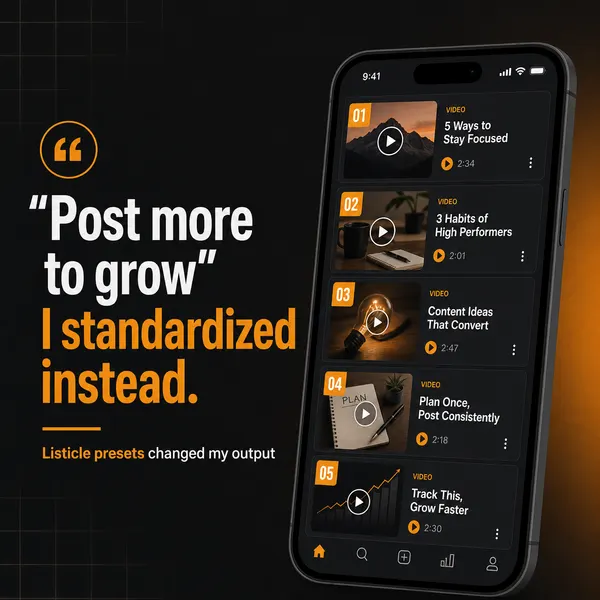
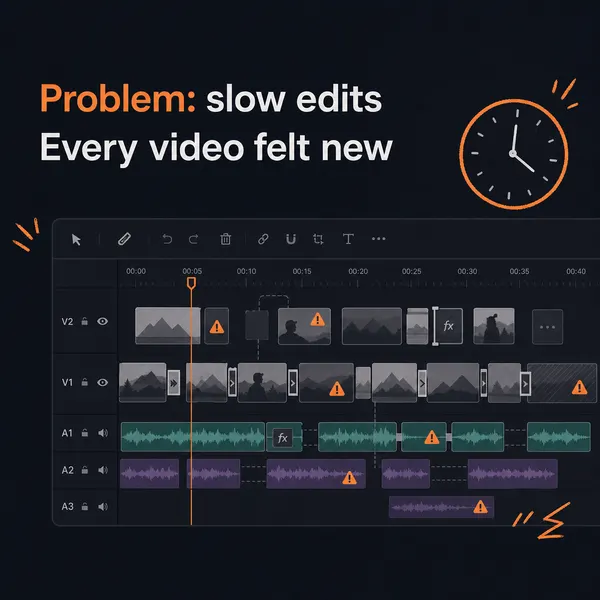
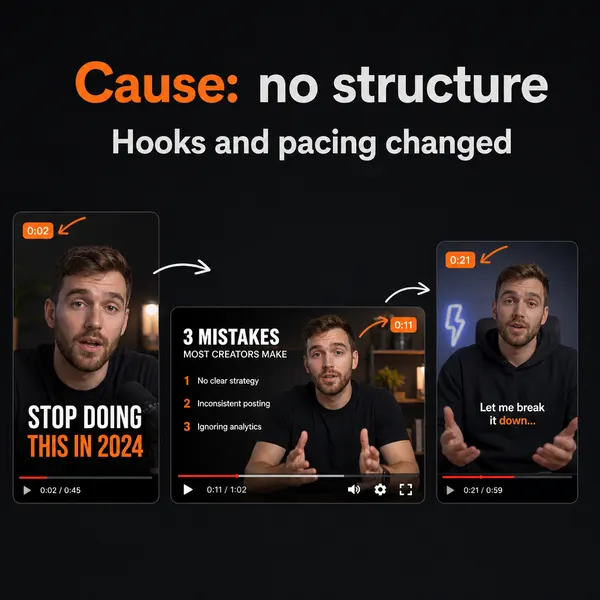
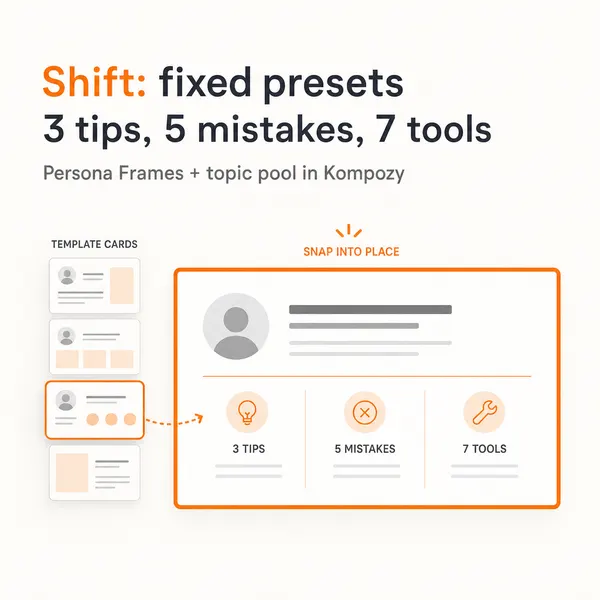
A five-slide carousel generated in the Kompozy workspace, one of the formats a single feed item can fan out into.
Who is this for, and who should skip it?
Best for:
- Podcasts, blogs and newsletters that publish on a regular schedule
- Teams that want each new item turned into multi-platform content automatically
- Operators willing to calibrate a Persona Brief before running unattended
Not ideal for:
- Anyone who only wants to post a blog title and link; a Zapier or Make connector is cheaper
- Sources without a feed, such as X, where RSS bridges are fragile
- Teams that will not review outputs during calibration
Frequently asked questions
What is RSS-to-social automation?
A pipeline that watches an RSS feed, takes the text of each new item, writes platform-native posts in your voice, and holds them for your approval or schedules them on your per-format posting limits.
Can I just wire RSS to Buffer or Zapier?
For posting a new title with a link, yes. Connectors forward feed fields; they do not write several formats in your voice from one item.
Which RSS feeds work for content automation?
Podcast hosts, most blog platforms, newsletter tools, YouTube channels through their channel-ID feed URL, and subreddit feeds. Kompozy works only from the text inside the feed, so full-text feeds give it the most to work with.
Does Kompozy transcribe podcast audio from the feed?
No. The RSS source reads the feed text, such as show notes, and never downloads the audio. Upload the recording to get a Whisper transcript, or use the clipper for shorts.
How often does Kompozy check feeds?
Every 15 minutes by default. Most feeds publish a few times a week at most, so that interval rarely matters in practice.
Why shouldn't I flip to autopilot on day one?
The Persona Brief you write before seeing any output is a guess. The 14-day calibration lets you correct it against real items before anything ships unattended.
How do we know this?
We checked the RSS specification on rssboard.org and a live YouTube channel feed on 2026-10-23. Kompozy's polling, dedup, text capture and default formats come from its RSS worker and feed parser code; check and scheduling claims come from its generation, autopilot and scheduler code. Unsourced latency, output-count and price figures were removed.
Sources
- RSS Advisory Board — RSS 2.0 Specification (read 2026-10-23)
- YouTube — Example channel RSS feed (Google channel) (read 2026-10-23)
- Kompozy — Autonomous content and quality gates (read 2026-10-23)
- Kompozy — Integrations (RSS as a source) (read 2026-10-23)
- Kompozy — Pricing (read 2026-10-23)
Which other content automation guides should you read next?
- Gmail-to-content automation: turning newsletters and emails into social posts — Forward newsletters and threads to a workspace ingest address with an allowed-senders list. Kompozy still shows inbound delivery as pending provider setup.
- YouTube RSS automation: from new upload to posts and shorts (2026) — Find your channel's hidden RSS feed, see what it carries, and turn new uploads into posts and 9:16 shorts with Kompozy's feed check and clipper.
- Apple Podcasts automation: from new episode to native posts (2026 guide) — Point Kompozy at your podcast RSS feed to draft from each new episode's show notes, and upload the recording for transcripts and clipped shorts.
- Content automation in 2026: definition, mechanics, and what it is not — What content automation is and what it is not: producing new content from source material in your voice versus scheduling with AI bolted on, plus a litmus test.
- Multi-platform scheduling automation across 9 platforms — How Kompozy schedules across 9 platforms: per-format posting days and limits, workspace time zone, native formats versus cross-posting, and avoiding cannibalization.
Which related Kompozy topics cover this next?
- Autonomous Content Creation — How Kompozy autopilot really works: one workspace switch that approves and schedules generated posts, the checks that run before they publish, and a 14-day ramp for turning it on.
- AI Content Repurposing — The complete methodology for turning one source into 25-35 pieces of native-format content across every platform — without producing AI slop.