How to prepare your brand for ChatGPT Sponsored Agents (build the content an AI agent can actually answer from, 2026)
How to prepare for ChatGPT Sponsored Agents: inventory buyer questions, turn each into extractable on-brand content, keep it current, and cover every surface.
Last verified · 2026-10-23 · by Moe Ameen
Published 2026-09-17 · Updated
Short answer
To prepare for ChatGPT Sponsored Agents, build the content an agent would answer from. OpenAI began testing the format on September 16, 2026 with select US advertisers, so most brands can't buy it yet. List the questions that decide a purchase, answer each one plainly with specs and honest comparisons, keep one voice across every surface, keep prices current, and check whether ChatGPT already names you.
Key takeaways
- OpenAI started testing Sponsored Agents on September 16, 2026, with select US advertisers only.
- Start from buyer questions: fit, specs, compatibility, comparisons, shipping and returns.
- Lead every answer with the fact, then the detail. That's what gets quoted.
- OpenAI's opt-in text customization adapts and translates your ad copy, so keep your source copy consistent.
- The same work feeds ChatGPT's unpaid answers, so it pays off even if you never buy an agent.
On September 16, 2026, OpenAI began testing Sponsored Agents — a ChatGPT ad format where a shopper opens a clearly labeled conversation with a business-sponsored AI agent instead of just seeing a card. The format is a US test with select advertisers today, so most brands can't buy one yet. But the work that makes a Sponsored Agent good — and that makes ChatGPT name you in its unpaid answers — is the same work, and you can start it now.
A Sponsored Agent exists to answer a shopper's questions about your products or services, and that only goes well when clear, accurate answers already exist in what you publish. Answer engines also cite the brands whose content most clearly covers the question. So preparing for the agent is really a content-production project.
This is the repeatable workflow: inventory the questions that actually decide a purchase, turn each into one clear extractable answer, cover specs and honest comparisons rather than only marketing, lock a single voice so every surface agrees, publish across the surfaces a model reads, keep it current, keep it honest, and measure whether you're being answered. For the broader paid-and-organic strategy this sits inside, see build a ChatGPT ads and GEO content strategy.
Where should you start preparing your brand for ChatGPT Sponsored Agents?
- Inventory the questions that actually decide a purchase. Start from the buyer, not your product page. List the real questions a shopper asks before committing in your category: dimensions and fit, compatibility, what it replaces, how it compares to the two alternatives they're weighing, shipping and returns, care and durability, edge-case use. Pull them from your sales calls, support tickets, reviews, and the objections you answer every day. This list is the spec for everything else — an agent (or an organic ChatGPT answer) is only as good as its ability to answer these, so if a question isn't on your list, no content will exist to cover it.
- Turn each question into one clear, extractable answer. For every question, produce a direct answer a model can lift cleanly: lead with the answer, then the detail. A blog page structured as a real FAQ, a specs card, a short comparison — not a paragraph that buries the number three scrolls down. Extractability is the whole game: models quote the passage that answers the question outright, so write the way you'd want to be quoted. See write an FAQ page that gets cited by AI search for the page-level pattern.
- Cover specs and honest comparisons, not just marketing. Agents and answer engines are asked practical, comparative questions, and vague brand copy can't answer them. Publish the concrete stuff: exact measurements, materials, compatibility lists, what's included, and honest side-by-sides against the alternatives people actually consider. A credible comparison that admits where a rival wins earns more trust — and more citations — than a page that pretends you win everything. This is the content that lets an agent settle a decision instead of deflecting to 'check the website.'
- Lock one voice and a banned-word list. Every surface has to tell the same story in the same voice, because a model assembles one picture of you from all of them — and OpenAI's opt-in ad text customization actively remixes and translates your existing copy, so inconsistency gets amplified, not smoothed. Define a single governing voice profile and a list of words and claims you never make, then hold every asset to it. Consistency is what turns a scattered content footprint into a coherent brand a model can represent.
- Publish across the surfaces a model reads, not just your site. Citations and agent knowledge are assembled from across the open web, not only your domain. The same answers should exist as native content on the social platforms, in a blog, in a newsletter, and where relevant on third-party surfaces like YouTube and community threads. See earn AI citations across product pages, Reddit, and YouTube. Breadth of corroboration is what tips a model toward naming you when it chooses between eligible sources.
- Keep it current — kill stale prices and dead SKUs. An agent that quotes last quarter's price, or an organic answer that recommends a discontinued option, is worse than silence — it burns trust at the exact moment of purchase intent. Put your product content on a refresh cadence so what a model reads matches what's actually true today. Currency is a maintenance job, not a one-time push, and it's the difference between a footprint that helps you and one that quietly misleads buyers on your behalf.
- Keep it honest — never invent a number. Do not publish a statistic, spec, or claim you can't stand behind. A citation only survives if the model is lifting a real fact from you; a fabricated one gets contradicted by other sources and poisons your credibility as a source. Honesty here is not a nicety — it's what makes the whole strategy durable, because both the agent and the organic answer are staking your reputation on facts a shopper can verify in seconds.
- Measure whether you are being answered and cited. Track the outcome, not just the output. Periodically ask ChatGPT (and other assistants) the buyer questions from step one and note whether your content is what answers them or gets named. Watch referral traffic and set up AI-search reporting so you can see which surfaces earn the mentions. See set up AI search performance reporting in Search Console. The list of questions you're not yet the answer to is your next content backlog.
What mistakes leave a brand unready for ChatGPT Sponsored Agents?
- Treating this as an ads task. You can't buy a Sponsored Agent yet in most markets; the work that pays off now is content, and it also feeds the free organic mention regardless of whether you ever run a paid agent.
- Answering with marketing instead of facts. 'Beautifully crafted' doesn't settle a dimensions question. Agents win on specifics; publish the numbers.
- One-and-done publishing. Product content that isn't refreshed becomes a liability the moment a price or SKU changes — an agent will confidently quote the stale version.
- Site-only thinking. If your answers live only behind your own domain, you're invisible to the corroboration a model wants; the answer has to exist across surfaces.
- Inconsistent voice across channels. When copy is remixed and translated automatically, off-brand or contradictory source material spreads the inconsistency into every adapted version.
- Chasing volume over extractability. Ten pages that bury the answer lose to one page that leads with it — write to be quoted, not to fill a content calendar.
Why is agent readiness a content production problem, and where does Kompozy fit?
Walk back through the steps and notice what they demand: for every buyer question, one clear, extractable, on-brand answer — as a blog page, a specs card, a comparison, a short video — published across many surfaces and kept current forever. The strategy is simple; the volume and the maintenance are the wall. A mid-size catalog with a dozen real buyer questions each is hundreds of answerable units that all have to stay true as prices and SKUs move. That's a production problem, and it's the exact job Kompozy is built for. It is a full AI content generation and multi-platform publishing engine, not an ad tool, so it sits upstream of whether an agent ever answers well.
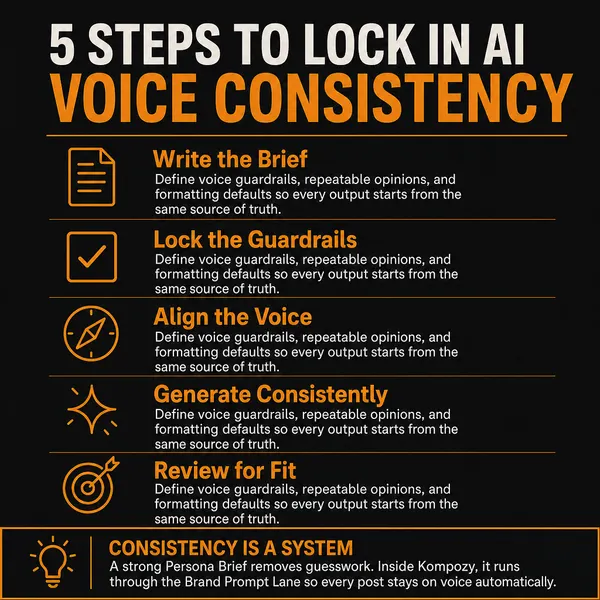
The workflow maps straight onto the steps. Take one buyer question from your inventory and Kompozy turns it into a coordinated, extractable set from a single Persona Brief: a Blog Article written as a direct FAQ answer, a brand-exact Carousel or Infographic Photo that lays out the specs or the comparison, Quote Graphics, Text Posts, and an avatar-fronted Persona Short that answers the question on camera — one voice across all of them because they descend from the same brief, which is exactly the consistency step 4 asks for. Because every asset shares that brief, your specs, claims, and offer come out identical everywhere, so a model reading you across a dozen surfaces assembles one coherent picture instead of a contradictory one.
The distribution and currency half is Autopilot: the approved batch fans across the nine social platforms plus blog and email from one queue, behind a per-post review gate where you confirm the facts before anything ships — which does double duty here, keeping the footprint current so an agent never quotes a dead SKU (step 6) and catching an invented number before it poisons a citation (step 7). Be exact on the boundary: Kompozy does not build your Sponsored Agent, bid in OpenAI's Ads Manager, or sync your Shopify catalog — the ad operations and the buyer-question research stay yours. What it removes is the reason most brands would field a weak agent conversation and lose the organic mention beside it: not enough specific, on-brand, up-to-date content for any model to answer from. Starter ($199/mo for 5,500 credits) fits a solo operator building the answerable set for one product line; Pro ($499/mo for 18,000 credits) sustains a brand or team keeping a full catalog's worth of answers current across every surface; Enterprise is available through Contact Sales for agencies running readiness across many brands.
What does this look like in Kompozy?
A real infographic photo post made in the Kompozy workspace, shown as an example of the format. It was not made for this guide.
Who is this for, and who should skip it?
Best for:
- Ecommerce and service brands whose buyers ask detailed questions before they purchase.
- Teams willing to publish real specs and honest comparisons, including where a rival wins.
- Brands that already sell across several channels and can keep facts consistent.
Not ideal for:
- Brands hoping to buy a Sponsored Agent today. Access is a limited test and OpenAI isn't taking early access requests.
- Anyone who needs ad operations handled. Kompozy doesn't build agents, bid in OpenAI's Ads Manager or sync catalogs.
- Businesses that can't keep prices and SKUs current. Stale facts hurt more than missing ones.
Frequently asked questions
What are ChatGPT Sponsored Agents and can I run one now?
They're a ChatGPT ad format OpenAI began testing on September 16, 2026, where a shopper opens a clearly labeled conversation with a business-sponsored AI agent, asks follow-ups, and clicks through to the site. At announcement it was limited to select advertisers in the United States, so most businesses can't buy one yet. The useful move for everyone is to prepare the content an agent — and ChatGPT's organic answers — would draw on, and confirm current access on OpenAI's advertising pages.
Why does preparing for an AI agent come down to content?
OpenAI keeps the Sponsored Agent conversation separate from ChatGPT's independent answers and points it at the business's products or services, so the material you've published is what good answers get built from. Deep, current, extractable content lets it settle a buyer's questions; thin content forces it to deflect. The same content decides whether ChatGPT names you in its unpaid answers, so the work pays off on both the paid and organic side.
Is preparing for Sponsored Agents different from normal GEO or SEO?
It's the same discipline pointed at a conversation. Traditional SEO optimizes for a ranked link; GEO (generative engine optimization) optimizes for being cited in an AI answer; agent-readiness optimizes for a model being able to hold a back-and-forth about your product. All three reward the same thing — clear, current, extractable, corroborated content — so a good GEO foundation is most of the work already done.
How do I know if my content is working for AI answers?
Ask the assistants the buyer questions you inventoried and see whether your content is what answers them, watch for referral traffic from ChatGPT and other AI sources, and set up AI-search performance reporting. There's no single dashboard for agent readiness, so treat the questions you're not yet the answer to as your content backlog and re-check on a cadence.
Do I need a special tool to get ready for ChatGPT agents?
You need a way to produce and maintain a lot of clear, on-brand, current content across many surfaces — that's the actual bottleneck. You can do it by hand for a small catalog; at any real scale, a content engine like Kompozy generates the answerable set from one source and keeps it current across platforms, which is what makes the readiness work sustainable rather than a one-off sprint.
How do we know this?
On 2026-10-23 we checked the Sponsored Agents launch date, availability and ad text customization details against the sources listed below. Kompozy plan details come from kompozy.io/pricing.
Sources
- OpenAI: Reimagining advertising with AI (read 2026-10-23)
- OpenAI Help Center: Sponsored Agents in ChatGPT Ads (read 2026-10-23)
- Kompozy: Pricing (read 2026-10-23)