How to prioritize content formats for AI citations (2026)
Prioritize content formats for AI citations: tag your buyers’ prompts by intent, map each to the format that wins it, find the gap, then produce and re-measure.
Last verified · 2026-10-23 · by Moe Ameen
Published 2026-09-03 · Updated
Short answer
Prioritize content formats for AI citations by your buyers' questions, not by a study's leaderboard. Tag real prompts by intent, then match each intent to the format that wins it: articles for informational, listicles and comparisons for commercial, product pages for transactional, community and video for experiential. Ten Speed found product pages took 24.1% of B2B evaluation-stage citations, while Wix found listicles took 40% of commercial-intent ones.
Key takeaways
- Tag your buyers' real prompts by intent first. That mix decides which formats to build.
- Ten Speed: product pages got 24.1% of B2B evaluation citations; Reddit, YouTube and forums got 4.2%.
- Wix: listicles took 40% of commercial-intent citations, nearly double their overall share.
- Audit which of your URLs get cited, by page type, then build where the gaps are.
- Re-measure on a schedule. AI assistants lean toward fresher sources, per Ahrefs.
Deciding what to produce for AI citations is a prioritization problem before it is a writing problem. Answer engines do not pick a winner from a ranked list of pages the way classic search did — they decide what kind of source a question needs (a comparison, a how-to, a product spec, a first-hand opinion) and retrieve passages of that shape.
So the highest-leverage move is not optimizing a single page harder; it is making sure you publish a source of the right shape for the questions your buyers actually ask. This tutorial is the concrete loop for doing that: tag your real prompts by intent, map each intent to the format that wins its citations, audit where your production mix does not match your demand mix, produce against the gap, and re-measure by format so the allocation self-corrects.
The reason format prioritization matters so much in 2026 is that the headline numbers everyone quotes are stage-specific, not universal. A widely-shared study by the agency Ten Speed found product pages took 24.1% of citations while Reddit, YouTube, and forums combined for just 4.2% — but that was measured on 220 B2B evaluation-stage prompts, the exact slice where community content is weakest.
Ten Speed itself says the result doesn't carry over to consumer, e-commerce or media brands, and Wix's larger study found that citation share shifts sharply with query intent. Copy a study's format ranking blindly and you will over-index on a format your buyers rarely trigger. The strategic frame behind this loop lives in AI citation optimization; if you want the gap-to-brief pipeline it feeds, see build an AEO content workflow.
How do you start prioritizing content formats for AI citations?
- List your buyers’ real prompts and tag each by intent. Start from the exact conversational questions buyers type into an assistant, not head keywords — pull them from sales calls, support tickets, and the searches that already convert. Then tag each one by intent: informational (“how does X work,” “how do I choose”), commercial-comparison (“best X for Y,” “X vs Z”), transactional (buyer close to a decision), or experiential (“is it worth it,” “what do real users think”). The distribution of those tags is your demand fingerprint, and it is the only leaderboard that matters for your business.
- Map each intent to the format that wins its citations. Use the pattern that holds across the 2026 studies. Informational questions are won by articles and how-to guides; commercial-comparison questions by listicles and comparison pages (listicles captured roughly 40% of commercial-comparison citations in the Wix study, nearly double their overall share); transactional questions by product and category pages (the 24% band); experiential questions by community and video — Reddit, YouTube, forums. Third-party directories like G2 and Capterra act as corroboration across all of them. Now you know which formats your tagged demand actually calls for.
- Audit which formats currently earn your citations. Run your prompt set through ChatGPT, Perplexity, Gemini, and Google’s AI Overviews and record which of your URLs get cited, tagging each cited URL by page type. This is your citation mix — the formats that are actually working for you right now. An AI-visibility tracker (Peec AI, Profound, Ahrefs Brand Radar) automates the capture at scale. Do not settle for a single overall mention rate; the per-format breakdown is the whole point, because it shows where your citations are concentrated versus where they are absent.
- Find the gap between your demand mix and your citation mix. Lay the two distributions side by side: what your buyers ask (step one) against what currently gets cited (step three). The gaps are your priorities. A common one is heavy informational demand with almost no cited articles or how-to guides, because the team poured effort into product pages after reading the 24% headline. Another is strong product-page citations but zero presence on the comparison queries that feed them. Rank the gaps by how much demand sits behind each intent, not by which format has the flashiest study number.
- Sanity-check against your own fingerprint, not the headline. Before committing production, confirm your priorities came from your demand data and not a borrowed ranking. If you are B2B selling into procurement, your buyers may genuinely live near the Ten Speed product-page-heavy fingerprint. If you are a consumer brand whose buyers ask experience and how-to questions, weighting product pages would point you at the wrong formats entirely, and the social and video surfaces you were told only earn 4% may be where most of your citations are actually decided. Treat every published study as a prior to check, never a target to hit.
- Produce against the top gaps to the extraction standard. Build the underweight formats, and build each unit to be lifted: the answer stated plainly up front, short self-contained passages with one idea each, the subject noun repeated instead of “it,” claims tied to sourced facts, valid schema, and a shape matched to the query (a table or list for a comparison, ordered steps for a how-to). A citable format only makes a page eligible; the on-page extraction work is what gets the eligible page actually chosen. See write content that performs in AI search for the structure.
- Re-measure citation share by format and rebalance. After the new units publish and engines re-crawl, run the same prompt set again and compare citation share per format to your baseline. Where a gap closed, hold the cadence and refresh the winners on a schedule — AI assistants lean toward fresher sources, so a format you win once loses to a competitor who updates theirs. Where a gap persists, feed it into the next production cycle. Format prioritization is a standing loop, not a one-time allocation, because your demand mix and the engines both drift.
What mistakes skew a content format strategy for AI citations?
- Copying a study’s format ranking without checking your own demand. The famous 24%-product-pages / 4%-Reddit split is a B2B vendor-evaluation fingerprint; Ten Speed says its result doesn't generalize to consumer brands. Your prompt tags, not a headline, set your allocation.
- Optimizing one page harder instead of adding the missing format. A perfectly structured product page still loses a comparison query, because it is the wrong shape of source. If you have no listicle or article for an intent, no amount of on-page polish earns that citation.
- Measuring only an overall mention rate. A single visibility number hides which formats earn your citations and which intents you are invisible on. Tag every cited URL by page type or you cannot see the gap you are trying to close.
- Treating community and video as negligible because one B2B study did. Reddit and YouTube answer experiential and how-to intents, and those can be a large share of a consumer brand’s demand. Judge them by your fingerprint, not by their share in an enterprise-evaluation set.
- Producing the missing format but skipping the extraction basics. Being a citable format only makes a page eligible; without a plain up-front answer, self-contained passages, schema, and current dates, the eligible page still does not get chosen.
- Running the loop once. Your demand mix shifts, competitors publish, and engines change what they reach for. A format allocation set in January is stale by spring unless you re-measure citation share and rebalance on a cadence.
Once you know which format is missing, how do you produce it at scale?
This loop produces a to-do list, not content. Once the audit says “you are invisible on comparison queries” or “you have no how-to coverage for the informational top,” someone still has to build the missing format — and the whole strategy stalls at exactly the step where a small team runs out of hands, because covering a real intent mix means shipping several different formats, not one, and keeping them current. Kompozy is a full generation-and-publishing engine, not a tracker or a single-format app, and its fit here is precise: it does not tag your prompts or decide your allocation, it executes the specific format the prioritization step flagged.
What makes the fit clean is that Kompozy selects the output format the same way this tutorial does — by the shape you need. Flag an informational gap and it produces a Blog Article with the self-contained answer engines lift; flag a commercial-comparison gap and it drafts the comparison-style and listicle posts that win those queries; flag an experiential gap — the Reddit-and-YouTube-style demand your fingerprint might weight heavily — and it generates Persona Shorts and other persona video plus the carousels and quote graphics that populate the social feeds engines increasingly cite. One Persona Brief governs voice across every format, and HyperFrames keeps the visual brand pixel-exact, so the entity and claims stay identical across formats — the cross-source consistency that decides whether an engine trusts you enough to cite you.
The payoff is that closing a format gap stops being a hiring decision. Autopilot fans each new unit across the nine social platforms plus blog and email on a recurring cadence, behind a per-post review gate where you confirm every claim before it ships — the accuracy check that matters most when the point is to be the source an engine quotes correctly, and the same reason the refresh step keeps winners current. The boundary stays honest: Kompozy will not run your visibility tracker, write your product-page schema, or force an engine to cite you. What it removes is the production ceiling that leaves prioritized format gaps sitting unbuilt. Starter ($199/mo for 5,500 credits) fits a solo operator covering one intent cluster; Pro ($499/mo for 18,000 credits) suits a team producing across a full format mix each cycle; Enterprise is available through Contact Sales for agencies running format prioritization across many clients.
What does this look like in Kompozy?
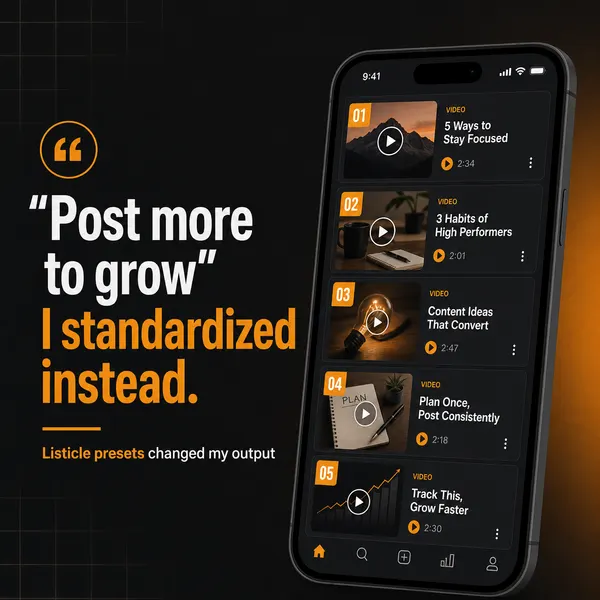
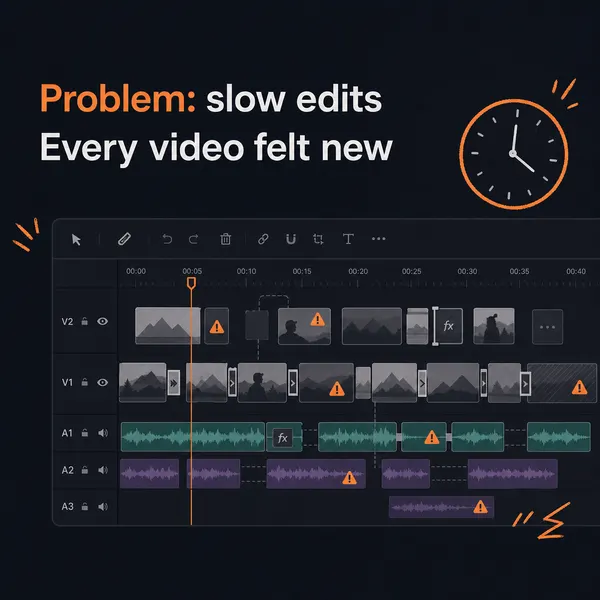
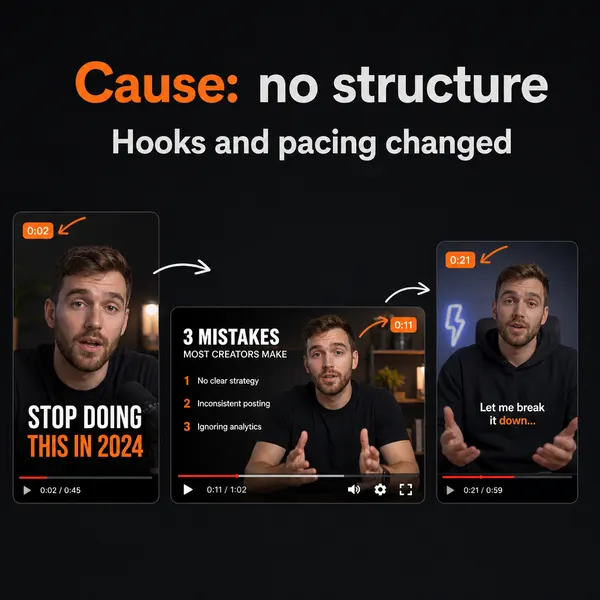
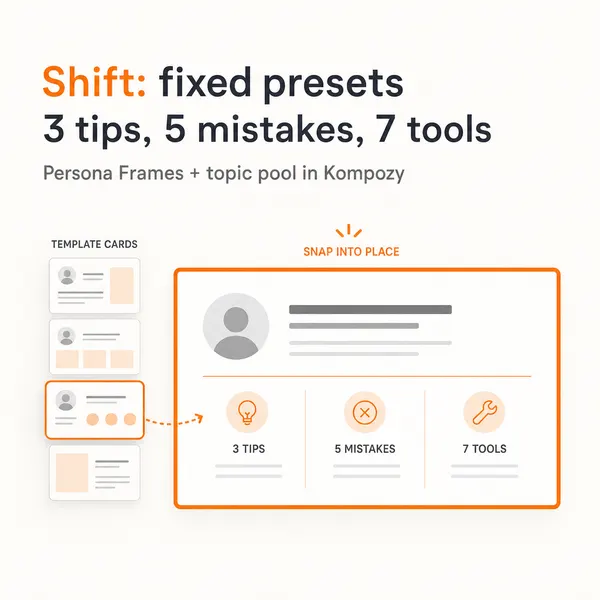
A real carousel made in the Kompozy workspace, shown as an example of the format. It was not made for this guide.
Who is this for, and who should skip it?
Best for:
- Teams with real prompt data from sales calls, support tickets or search logs.
- Brands that publish several formats and can shift production toward the gaps.
- B2B marketers trying to make sense of conflicting citation studies.
Not ideal for:
- Anyone looking for one universal format ranking to copy. The studies disagree because the queries differ.
- Teams that can't measure citations at all. You need a tracker or a manual prompt panel first.
- Buyers who want Kompozy to tag prompts or track citations. It builds the formats, it doesn't measure them.
Frequently asked questions
How do I decide which content format to produce for AI citations?
Work from demand, not a leaderboard. Tag the real questions your buyers ask an assistant by intent — informational, commercial-comparison, transactional, experiential — then map each intent to the format that wins its citations: articles and how-to guides for informational, listicles and comparison pages for commercial-comparison, product and category pages for transactional, community and video for experiential. The format you should produce is whichever one covers the intents your buyers actually trigger and where you currently get no citations.
Do product pages really get 24% of AI citations?
In one specific study, yes. The agency Ten Speed found product pages the most-cited format at 24.1% across 220 B2B evaluation-stage prompts, with Reddit, YouTube, and forums combined at 4.2%. But that measures the evaluation stage only, and the authors say it doesn't generalize to consumer, e-commerce or media brands. Wix's larger study of more than 1 million citations put product pages at 13.7%, behind listicles and articles. Treat 24% as a stage fingerprint, not a universal law.
Why do some studies say Reddit and YouTube barely get cited and others say they dominate?
Because citation share is a property of the query intent, not the source. Reddit and YouTube are weak on B2B vendor-evaluation prompts, where an engine wants product and comparison data — that is the 4% context. On consumer and informational queries, where the answer needs first-hand opinion or demonstration, the same platforms surge, and AirOps found that in Google AI Overviews, AI Mode and Perplexity, YouTube carries more citation weight than every other creator platform combined. Same platforms, opposite share, because the question changed.
How do I measure whether my format prioritization is working?
Track citation share by format, not just a single mention rate. Run a fixed set of your buyers’ prompts through the major engines on a cadence, record which of your URLs get cited, and tag each cited URL by page type. Compare that citation mix to your demand mix — the questions buyers ask — and watch the gap close as you produce the underweight formats. The per-format breakdown is what tells you which intents you are still invisible on.
Should I stop making blog articles if product pages get cited more?
No — that is the exact over-indexing trap. Product pages only win transactional, buyer-close queries; they barely place on informational ones, which articles, how-to guides, and listicles own. If your buyers ask informational and comparison questions (most funnels are top-heavy with them), cutting articles makes you invisible for the majority of your demand. Balance production to your intent mix; the goal is a portfolio that has the right-shaped source for every question, not one format optimized at the expense of the rest.
How do we know this?
On 2026-10-23 we checked the Ten Speed, Wix, AirOps and Ahrefs figures against the sources listed below. Kompozy plan details come from kompozy.io/pricing.
Sources
- Ten Speed: What AI cites at the B2B evaluation stage (read 2026-10-23)
- Wix Studio AI Search Lab: Content types most cited by LLMs (read 2026-10-23)
- AirOps: The fastest-growing source in AI search (read 2026-10-23)
- Ahrefs: AI assistants prefer to cite fresher content (17 million citations analyzed) (read 2026-10-23)
- Kompozy: Pricing (read 2026-10-23)
Related tutorials
- How to build an AEO content workflow (2026)
- How to run a GEO content audit (2026)
- How to optimize content for AI search (2026)
- How to write content that performs in AI search (2026)
- How to optimize a page to get cited by AI search (2026)
- How to set up AI search performance reporting in Google Search Console (2026)