Customer call transcripts → case studies + testimonial graphics + social proof posts
How to turn every customer call recording into a case study, 3-5 pull-quote graphics, and social-proof posts without violating consent or fabricating quotes.
Published 2026-05-18 · Updated
Short answer
One customer call recording can become a structured case study, a few pull-quote testimonial graphics, LinkedIn and X posts, and a sales one-pager. Get recording consent on the call and written consent before you publish any quote. Then pull the before, change and after story from a speaker-labeled transcript, lift short verbatim quotes, and anonymize the customer unless they agreed to be named. Never publish an AI-written quote as a customer's words.
Key takeaways
- Get written consent before any quote goes public, and say whether it will be attributed or anonymized.
- Speaker labels matter because only the customer's lines can become quotes.
- Structure the case study as before, change and after, with concrete results.
- Good anonymization removes names, unique numbers, competitor names and identifying details.
- AI-generated quotes presented as real customer quotes are fabrication. Never do it.
Sales calls and customer success calls carry the most valuable content most B2B companies record — and almost all of it dies in the call recording archive. A single good customer call can contain a complete case study, several quotable testimonials, and the results your prospects need to see.
This is the workflow for systematically extracting that content into marketing assets, with consent and anonymization rules built in.
What consent do you need before using customer calls?
You need recording consent at the start of the call and explicit written consent before publishing any quote externally. Before you process any customer call recording for marketing content:
- The customer must have agreed to the recording at the start of the call, for example through a recording notice or Zoom's consent prompt. Recording-consent rules vary by location, so check the ones that apply to you and the customer.
- For external publication of quotes, you need explicit written consent. Email is fine. Standard language: "We would like to use the following quotes from our recent call in marketing materials. Are you comfortable with us publishing these attributed / anonymized [pick one]?"
- If the customer says anonymize, you can still publish — but never name the customer or use details specific enough to identify them.
- If the customer declines, the content stays internal. No exceptions.
Skipping this is the fastest way to burn customer trust and create legal exposure. Make it a checklist item before any extraction.
Step 1: Why do you need a transcript with speaker labels?
Because only the customer's lines can become quotes. It is the same transcript hygiene as podcast repurposing, and speaker labels are non-negotiable for customer calls because the AI needs to know which lines are yours vs the customer's — only the customer's lines become quotes.
Step 2: How do you extract the case study story arc?
Sort the customer's story into three acts:
- Before: what was the situation that drove them to look for a solution? (problem framing)
- Change: what did they try, what changed, what was the inflection point? (transformation)
- After: what is different now? Quantify if possible. (result with numbers)
Scan the transcript for sentences that map to each act. The customer usually walks the rep through this naturally during discovery and during success calls. Your job is to extract and structure it.
Step 3: Which customer quotes work on testimonial graphics?
Verbatim sentences that stand on their own. Look for sentences that are:
- Complete — they stand alone without context
- Specific — name a number, a comparison, or a concrete outcome
- Conversational — read as the customer talking, not as marketing copy
- Short enough to fit a graphic — testimonial graphics live or die on tight text
The shape of a good extracted quote (illustrative examples we wrote, not real customer quotes):
- "We cut our weekly content production time from most of a day to about an hour."
- "I stopped paying for three tools and consolidated to one."
- "The Persona Brief made our AI content actually sound like us — I was skeptical until I saw it."
The shape of a bad one (too marketing-y, too long, too vague; also illustrative):
- "Kompozy is the best AI content tool out there — game-changing for our team and we love every aspect of the platform."
Step 4: Should the case study be attributed or anonymized?
Match what the customer agreed to in consent. Attributed (with name + company logo) is more persuasive, because readers can check that the customer is real. Anonymized still works if you keep the role specific ("SaaS founder, 50-person team") and the results concrete.
Step 5: What marketing assets can one customer call produce?
From one consent-cleared customer call:
- 1 structured case study (1,000-1,500 words, before / change / after structure)
- 3-5 pull-quote testimonial graphics (one per quotable line)
- 1-2 LinkedIn posts framing the case study as a story
- 1 X thread walking through the customer journey
- 1 sales-enablement one-pager (PDF) for reps to share with similar-profile prospects
How do you anonymize a customer case study?
Use role and industry instead of names, and anonymize any numbers or details that would identify the customer. When publishing anonymized case studies:
- Use role + industry, not name. "B2B SaaS founder" not "John Smith, CEO of Acme."
- Anonymize specific numbers if they would identify the customer ("from 100 customers to 1,000" if their actual numbers are unique enough to identify).
- Anonymize specific competitor mentions if the customer named one. "Switched from a competing scheduler" not "switched from Buffer."
- Strip any identifying jargon, industry codes, or geography unless generic.
Where should customer-call content be published?
- Named case studies → /case-studies on your site (high-trust, high-conversion surface)
- Pull-quote graphics → social (Instagram, LinkedIn, X — visual testimonials drive recall)
- LinkedIn story posts → LinkedIn (B2B audiences trust customer-story format)
- Sales one-pagers → internal CRM + outbound emails
What are the most common customer-call repurposing mistakes?
- Publishing without explicit consent. Legal exposure + customer trust burn.
- Editing quotes for clarity past the point of accuracy. The quote stops being the customer's.
- Generic anonymization that still identifies. "A SaaS founder in NYC running a 50-person team in fintech" is essentially named.
- Skipping the before/change/after structure. Reads as a testimonial pile instead of a story.
- Using AI-generated quotes presented as real customer quotes. This is fabrication. Hard rule: never.
What does this look like in Kompozy?
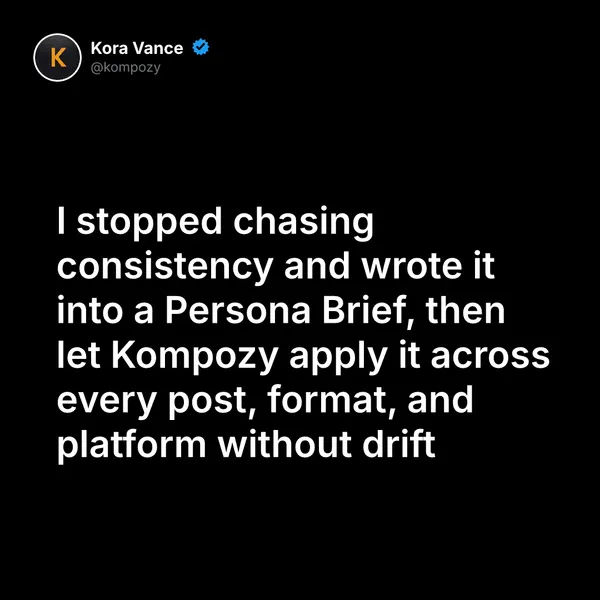
A real quote graphic made in the Kompozy workspace, shown as an example of the format. It was not made for this guide or for any customer.
Who is this for, and who should skip it?
Best for:
- B2B teams that record sales and customer success calls.
- Marketers who need case studies and social proof without hours of interviews.
- Founders who want reps to have one-pagers built from real customer stories.
Not ideal for:
- Teams without recording consent and written publishing consent from customers.
- Regulated industries that can't run outputs on autopilot. Keep manual review on every asset.
- Anyone hoping AI can write testimonials for them. Invented quotes are off the table.
Frequently asked questions
Do I need consent before processing a customer call with AI?
For internal processing (extracting notes, drafting follow-up): no, the call recording consent at the start of the call covers it. For external publication of quotes, attributed or otherwise: yes, you need explicit written consent. Email is fine but it must be on the record.
Can AI generate the case study without me editing it?
AI can generate the first draft. You must edit before publishing. Customer-facing case studies are too high-stakes to ship un-reviewed. Audit every quoted line against the transcript.
How long should a case study be?
Aim for 1,000-1,500 words. That is long enough to walk the reader through the before, change and after arc, and short enough to read in one sitting.
Are anonymized case studies less effective than named ones?
Usually, because a named customer is easier to believe. But an anonymized case study still beats no case study, so anonymize rather than not publish.
What if the customer says yes to publishing but later changes their mind?
Pull the asset immediately. Customer relationships matter more than the marketing asset. Always honor a withdraw request without negotiation.
How do we know this?
This is a workflow guide, not a data study. On 2026-10-23 we removed the unsourced conversion multiplier for named case studies, marked the example quotes as illustrative, and added a note that recording-consent rules vary by location. Kompozy details come from kompozy.io/pricing.
Sources
- Kompozy: Pricing (read 2026-10-23)
What other AI content repurposing guides should you read next?
- How to repurpose a podcast into 30+ pieces of social content — The 6-step methodology for fanning a 60-minute podcast episode into shorts, threads, carousels, a blog, and a newsletter.
- YouTube long-form to TikTok / Reels / Shorts: the complete repurposing workflow — Clip-detection, hook rewriting, platform-native captions, and scheduling cadence for YouTube long-form to short-form.
- Long-form to Instagram / LinkedIn carousels: the slide-extraction pattern — How to extract the right 6-8 ideas from a 2,000-word source and render them as brand-exact carousel slides.
- Manual repurposing vs AI-automated repurposing: when each one wins — Honest comparison of doing it yourself, hiring an agency, or running an autonomous engine. With unit economics.
- Webinar repurposing: 5-8 X threads, 4-6 LinkedIn posts, and a recap blog per session — Extract the load-bearing ideas from each webinar, fact-anchor them, and stretch one event into 30+ outputs.
Which adjacent topic clusters should you explore next?
- AI Brand Voice & Persona — Without a Persona Brief, every AI output averages to the LLM default voice. This is the 5-section methodology that makes 100+ AI-generated posts feel like one human author wrote them.