The math: how one source generates a month of content (2026 fan-out methodology)
The 5-bucket fan-out that turns four weekly sources into a month of platform-native posts: per-source allocation, credit math, and labor economics by tier.
Published 2026-05-18 · Updated
Short answer
One dense weekly source, like a podcast episode, long-form video or webinar, can fill a week of posts when you fan it across five buckets: video, image, text, blog and newsletter. Four sources fill a month. The method rests on one Persona Brief and a planned allocation per bucket, not dozens of separate writing sessions. On Kompozy, text posts cost 4 credits and clipped shorts 17, so a month of fan-out fits easily inside the Starter plan.
Key takeaways
- Treat the recording as the only creation event. Every post after it is a transform.
- Distinct ideas per minute decide how far a source stretches, not its runtime.
- Shift the bucket mix by goal: reach, search, founder authority or ad creative.
- Carousels at 24 credits a slide are the expensive line. Quote graphics cost 6 and text posts 4.
- The method breaks with too few sources, thin sources, a tiny audience or no Persona Brief.
The single-source-to-a-month-of-content number sounds like a marketing claim until you do the arithmetic on a real episode. A substantive podcast episode carries a long transcript and several load-bearing ideas. Each idea is not one post — it is a video clip, an image card, two or three text posts, a paragraph of a blog, and a line of a newsletter. The multiplication is structural: one idea, expressed natively across five surfaces, is already five-to-eight pieces. Run that across every idea in the episode and a single source has produced a week of content on its own.
The reason most operators never see this is that they treat each post as a separate act of creation. They write a tweet, then later write a LinkedIn post, then later script a Reel — three creation sessions for three pieces, all from the same underlying idea they already articulated once on the podcast. That is the labor trap. The fan-out methodology breaks it by treating the source as the only creation event and every downstream post as a transform, not a new write.
This is the operator-grade breakdown of that math — the per-source output allocation by bucket, how the allocation shifts when the goal is reach versus search versus founder authority versus paid-ad creative, the real credit costs at each Kompozy tier, the labor-collapse economics across manual, AI-assisted, and autopilot tiers, and the four conditions under which the math stops working. Full positioning disclosure: Kompozy is built around exactly this five-bucket fan-out (see the content-repurposing methodology), so the figures below are checkable against real credit costs, not hand-waved. For anyone who records a source only now and then, we will say plainly where the setup cost outweighs the leverage.
How can one source carry a month of content?
The fan-out works because a single recorded source contains far more distinct, reusable substance than a single post can hold. A YouTube long-form has dozens of candidate moments: energy spikes, complete claims, quotable lines, visual beats. A substantive podcast carries several framework-grade ideas, each with its own supporting argument and example. The substance is already created and already validated by the act of recording it; what remains is reformatting, and reformatting is mechanical in a way that creation is not.
Kompozy organizes that reformatting into five fixed buckets — Video, Image, Text, Blog, Newsletter — and every output type the engine produces maps under one of them. A clipped short and an avatar short both live in Video; a quote graphic and a carousel both live in Image; standalone posts and threads live in Text. The bucket model is what makes the math predictable: instead of asking "how many posts can I get," you ask "how many outputs does each bucket take from this source," and the buckets sum to a known per-source total. That is the difference between a vague "repurpose more" instruction and a countable production plan.
The single highest-leverage move in the whole methodology is the one most operators skip: locking voice once, at the source level, with a Persona Brief. Without it, every downstream output averages toward the LLM default register and the multiplication produces a pile of generic slop instead of posts that sound like you. The Persona Brief is the reason fan-out scales — it is written once and applied automatically to every bucket, so the marginal voice-tuning cost per post is zero. The deeper Persona-Brief discipline is covered in the podcast-to-social methodology; for the math here, treat it as the fixed cost that every output amortizes against.
The compounding effect is what changes the business case. One source a week fills a week; four sources fill a month. And the Persona Brief, the scheduler config, and the platform connections are written once and reused every week — so the per-source effort falls as source count rises. The first source carries the full setup tax; the fourth source is nearly free. This is why the methodology rewards consistency over intensity: a creator who records one disciplined source a week for a year out-produces one who batches ten sources in a sprint and then goes quiet.
How many posts does one source produce?
A plan we use for one substantive weekly source targets 25-35 platform-native pieces across the five buckets, spread like this. Treat these as planning targets, not guaranteed yields. Thin or low-information sources support fewer pieces, and dense ones support more.
- Video: 4-6 clipped shorts from the highest-energy moments + 1-2 avatar shorts with rewritten hooks for platforms where the raw clip does not land = 5-8 video outputs.
- Image: 4-8 quote graphics and carousels — frameworks become carousels, standalone claims become quote cards = 4-8 image outputs.
- Text: 12-20 standalone posts (X, LinkedIn, Threads) + 2-4 threads = 14-24 text outputs.
- Blog: 1 long-form post, 1,500-2,500 words, capturing the source's core argument for search.
- Newsletter: 1 short issue summarizing the source and linking to the blog.
That sums to 25-35 planned outputs per source. The Text bucket carries the most volume because text is the cheapest to produce and X, LinkedIn and Threads suit the highest posting frequency; Video carries the most production weight but the fewest pieces because each one needs a render. The Blog and Newsletter buckets each produce exactly one durable, owned-channel asset per source — low volume, high half-life, which is what makes them the SEO and retention anchors of the spread.
| Source type | Length | Video | Image | Text | Blog | Newsletter | Total / source |
|---|---|---|---|---|---|---|---|
| Podcast episode | 45-60 min | 5-8 | 4-8 | 14-24 | 1 | 1 | 25-35 |
| YouTube long-form | 15-25 min | 6-10 | 3-6 | 10-18 | 1 | 1 | 21-36 |
| Webinar / workshop | 45-90 min | 4-7 | 6-10 | 12-20 | 1-2 | 1 | 24-40 |
| Customer / sales call | 20-40 min | 1-3 | 3-5 | 4-8 | 1 | 0-1 | 9-18 |
| Founder Loom / voice memo | 5-15 min | 1-3 | 2-4 | 6-12 | 0-1 | 1 | 10-21 |
The table shows why source selection matters more than source volume. A dense 40-minute webinar can out-produce three thin 10-minute videos because density, not duration, drives the count — the webinar has more distinct ideas per minute and more framework-shaped material that carousels and blogs feed on. Operators chasing volume should optimize for one or two dense sources a week, not a pile of thin ones.
What decides how many pieces a source can really support? The number of distinct claims in it, not its runtime. A short clip with one idea lacks the material the Text and Image buckets draw from, so forcing a full spread out of it just restates the same idea many times.
How should you adjust the bucket mix for your goal?
Reweight the buckets by what the content is for: reach, search, authority, or ad creative. The default allocation is a starting point, not a law. The Persona Brief stays identical across all four presets; only the bucket dials move. Below are the four presets that cover most operators, with the per-source and per-month totals each produces.
Preset 1 — maximum reach (creator / personal brand)
When the goal is audience growth, weight the buckets toward the high-frequency, high-distribution surfaces: heavy Video (6-8 shorts per source) and heavy Text (15-20 posts), with Blog and Newsletter kept to one each as the owned-channel anchor. This produces about 35 outputs per source, 140 a month across four sources. The reach preset accepts that most pieces are short-lived and bets on volume plus the algorithm finding the breakout. It is the right mix for a growing creator who needs surface area more than depth.
Preset 2 — SEO and organic search (B2B SaaS)
When the goal is compounding search traffic, invert the weighting toward the high-half-life buckets: 1-2 Blog posts per source (a main piece plus a variant targeting an adjacent long-tail keyword), every blog paired with a Newsletter, and Video trimmed to 3 shorts that serve as distribution for the blog rather than the main event. This produces about 22 outputs per source, 88 a month — fewer pieces, but each can carry far more lifetime value, because a ranking blog can keep earning search traffic long after a short has been forgotten. The blog-as-anchor pattern is detailed in the twitter-thread-to-blog playbook, which applies in reverse here.
Preset 3 — founder thought leadership (founder-led marketing)
Founder-led marketing lives on LinkedIn and X, so weight there: 4-5 LinkedIn long-form posts per source, 2-3 X threads, and 3 shorts including one avatar reframe for the days the founder cannot record. This produces about 28 outputs per source, 112 a month. The founder preset trades raw volume for register — every text post is shaped to read as the founder's own argument, not a brand announcement, which is the entire point of founder-led content and the reason the Persona Brief's voice DNA matters most under this preset.
Preset 4 — paid-ad creative (DTC / ecommerce)
When the source is feeding a paid-acquisition engine, the buckets reshape around testable ad units: 8-10 Video shorts per source including POV-hook-plus-demo cuts, 6-8 Image cards for static-ad testing, and Text, Blog, and Newsletter trimmed to near-zero. This produces about 22 outputs per source, 88 a month, every piece ad-ready. The paid preset is the only one where Video and Image dominate the entire spread, because the destination is an ad account that consumes creative variants faster than any organic feed.
| Goal preset | Heaviest buckets | Per source | Per month (×4) | Optimizing for |
|---|---|---|---|---|
| Maximum reach | Video + Text | 35 | 140 | Surface area, breakout odds |
| SEO / search | Blog + Newsletter | 22 | 88 | Lifetime value per piece |
| Founder authority | LinkedIn + X threads | 28 | 112 | Register and trust |
| Paid-ad creative | Video + Image | 22 | 88 | Testable ad-unit volume |
Notice that the two highest-volume presets (reach at 140, founder at 112) and the two value-per-piece presets (SEO and paid, both 88) bracket the same source input. The methodology does not produce more substance under the reach preset — it slices the same substance into more, thinner pieces. Choosing a preset is really choosing how finely to cut a fixed amount of source material, which is why matching the preset to the goal matters more than chasing the highest output number.
What does each content bucket cost in credits?
Text outputs are cheap in credits and generated images are the expensive line, because Kompozy charges credits per output and the cost varies sharply by format. The labor case is the headline, but the credit case is what makes the unit economics checkable. Here are the per-output credit costs from kompozy.io/pricing that drive every calculation below.
| Output type | Bucket | Credits | Approx $ on Starter | Approx $ on Pro |
|---|---|---|---|---|
| Text post | Text | 4 | $0.14 | $0.11 |
| Quote graphic | Image | 6 | $0.22 | $0.17 |
| Carousel (per slide) | Image | 24 / slide | $0.87 / slide | $0.67 / slide |
| Photo post | Image | 24 | $0.87 | $0.67 |
| Blog article | Blog | 17 | $0.62 | $0.47 |
| Clipped short | Video | 17 | $0.62 | $0.47 |
| Avatar short (HeyGen, your own key) | Video | 15 | $0.54 | $0.42 |
Run those costs against a per-source spread and the monthly arithmetic falls out. A reach-preset source of 7 clipped shorts, 1 avatar short, 6 quote graphics, 18 text posts and 1 blog is 7×17 + 15 + 6×6 + 18×4 + 17 = 119 + 15 + 36 + 72 + 17 = 259 credits, plus the newsletter. Four such sources a month is about 1,036 credits, comfortably inside Starter's 5,500-credit allowance and leaving headroom for regeneration and experimentation. In dollar terms that is roughly $37.48 of the $199 plan, well under a dollar per finished post.
Generated images are the line that moves the budget. A five-slide carousel at 24 credits a slide is 120 credits, more than an entire source's worth of text posts in the example above, and each photo post is another 24. This is why the bucket allocation is an economic decision, not just a strategic one: a creator who leans on quote graphics (6 credits) for standalone claims and saves carousels for real frameworks stretches the same plan much further. The methodology rewards using the cheapest output type that achieves the goal.
The tier choice follows directly from monthly volume. On the example spread above, Starter ($199/mo, 5,500 credits) covers a weekly source with plenty of room. Pro ($499/mo, 18,000 credits) is the pick once you run several sources a week or lean heavily on carousels and photo posts, because the allowance stops being the constraint. See pricing for the current tier breakdown.
How much labor does the fan-out save?
A full month replaces days of manual labor. Credits are the visible cost; labor is the cost that actually decides whether the methodology is worth running. The three tiers below (fully manual, AI-assisted with review, and fully autonomous after the autopilot ramp) describe the same month of output produced three different ways, and the gap between them is almost entirely labor.
Tier 1 — fully manual (you plus an editor)
Producing a full spread of native pieces from one source by hand takes a working day or more: transcribing, pulling clips, reframing and captioning each short, designing each carousel in Canva or Figma, writing each text post natively per platform, drafting the blog, writing the newsletter, and scheduling everything. Across four sources that is several working days a month of skilled labor, plus subscriptions for an editor, a design tool and a scheduler. This is the cost most teams are silently paying when they "do content in-house."
Tier 2 — AI-assisted with manual review
With Kompozy generating the full fan-out and a human reviewing before publish, per-source time falls to a review session, almost all of it approvals and the occasional caption fix, not creation. Four sources a month is a few review sessions plus the $199 Starter plan, which replaces a stack of separate tools. The jump from Tier 1 to Tier 2 is where the ROI of the methodology lives: most of the labor disappears with no loss of output volume, provided the Persona Brief is dialed in.
Tier 3 — fully autonomous (after the autopilot ramp)
Once autopilot is trusted (meaning the Persona Brief has stabilized and you are approving nearly every output untouched), the human role shrinks to a short weekly spot-check. The plan moves up to Pro at $499, because full autopilot starts there. The step from Tier 2 to Tier 3 is a control trade-off more than a cost one: the dollar savings are modest next to the manual-to-assisted jump, and the real question is whether you are comfortable with outputs shipping without per-post approval. The autopilot mechanics, and the checks Kompozy does and does not run, are covered in the autonomous cluster.
| Tier | Operator hours / mo | Tool cost / mo | All-in / mo | Cost per post |
|---|---|---|---|---|
| Fully manual | Several working days | Editor + design + scheduler subscriptions | Labor + subscriptions | Highest |
| AI-assisted + review | A few review sessions | $199 | Plan + review time | Low |
| Fully autonomous | A weekly spot-check | $499 | Plan + spot-checks | Lowest |
The cost-per-acquisition view makes the tiers concrete for a B2B operator. Take your own numbers: posts per month, the share of readers who start a trial, and the share of trials that pay. Divide your monthly content cost by the customers it produces and compare that with your paid-acquisition cost. Because the AI tiers cut the cost per post so sharply, they are what can make owned content one of the cheapest acquisition channels a company has.
What does a month of fan-out look like week by week?
The abstract math is unconvincing without the operating rhythm, so here is a concrete month for a creator on the AI-assisted tier with one source recorded each Monday. The point of the sequence is that net-new creation happens once a week and everything else is review and scheduling against the fan-out the engine has already produced.
Week one, Monday: record the source — a 20-minute long-form or a 45-minute podcast. This is the only net-new creation event of the week. Tuesday: the source ingests, Kompozy fans it into the full bucket spread overnight, and the operator spends a review session approving the strong outputs, fixing captions the ASR mis-heard (brand names and jargon are the usual offenders), and discarding the few pieces that did not land. Wednesday through Sunday: the approved pieces release on the posting days and per-day limits set for each format, spaced so the operator is not blasting everything in one day and cannibalizing reach.
Weeks two through four repeat with a new source each Monday, and here is where the leverage compounds: the Persona Brief, platform connections, and scheduler rules are already configured, so the per-week setup cost is zero from week two onward. By month's end, four Monday recording sessions and a handful of review sessions have produced a full month of platform-native pieces across every surface the audience uses. The creator never sat down to "write a tweet" or "make a carousel" as a separate task — every piece traces back to one of four recordings. That is the labor trap broken in practice, not in theory.
Which sources fan out best?
Long, idea-dense, spoken sources fan out best. Choosing the wrong source is the most common reason a single-source month underperforms, and the highest-yield sources share three traits: they are long (more raw material to cut from), they are idea-dense (each minute contains a distinct claim, story, or framework rather than filler), and they are spoken or argued rather than read aloud. A 45-minute podcast where the host makes ten sharp points fans into far more usable output than a 45-minute screen-share walkthrough where the value is locked in the visuals and the audio is mostly "click here, now click there."
Ranked by realistic yield: a long-form interview or solo podcast sits at the top, because the conversational format naturally surfaces hooks and the length gives the clipper room to find them. A webinar or recorded talk is close behind, with the bonus of a built-in slide deck that converts straight to carousel frames. A written long-form (a flagship blog post or a detailed customer email) fans well into text and newsletter buckets but yields fewer video pieces without a talking-head recording to draw from. The weakest sources are short social posts and visually-dependent tutorials — the first lacks raw material, the second hides its value in pixels the text pipeline cannot read. The practical rule: if you can only record one thing a week, make it a long, idea-dense, spoken source, and let the rest of the month derive from it.
When does the single-source method break down?
It breaks with too few sources, and under the three other conditions below. The methodology is not universal, and the honest failure conditions matter as much as the success case. Four conditions break the economics, and each one is detectable before you commit a month to it.
- Too few sources. The fixed setup cost (the Persona Brief, the scheduler config, the platform connections) is identical whether you feed it one source or four. With a single source a month you still produce useful pieces, but the per-piece setup overhead is high enough that a manual or lightweight approach is often simpler. The methodology rewards consistent source volume.
- Source quality too low. The fan-out can only reformat substance that exists in the source. A thin, low-information, or single-topic source produces thin outputs no matter how the buckets are weighted — a short video with one idea does not become dozens of distinct pieces, it becomes the same idea restated over and over, which audiences detect immediately. Density of distinct claims is the input that the entire multiplication depends on.
- Audience too narrow. With a small addressable market, output volume hits diminishing returns fast. Flooding a small audience is over-saturation, not leverage; at small scale precision and relationships beat surface area, and a leaner output cadence outperforms the full fan-out.
- No Persona Brief. This is the silent killer of the unit economics. Without a Persona Brief every output averages to the LLM default register and needs heavy human editing to ship, which pushes per-post review time back up toward the manual tier and erases the cost advantage that justified the methodology. The Persona Brief is not optional polish; it is the load-bearing input the entire labor-collapse depends on.
The pattern across all four conditions is the same: the methodology is a multiplier, and a multiplier applied to a weak input produces a weak result at scale. It rewards operators with consistent, dense sources, a real addressable audience, and a dialed Persona Brief — and it punishes shortcuts on any of those by quietly returning per-post costs to manual levels. Diagnosed honestly before committing, those four conditions tell you in advance whether the math will work for your specific situation.
Where does Kompozy sit in the single-source methodology?
Kompozy is built around exactly this five-bucket fan-out: it ingests a source (RSS feed, uploaded file, pasted URL, or recorded input), runs it against the workspace Persona Brief, and generates the bucket spread — clipped and avatar shorts in Video, quote cards and carousels in Image, native posts and threads in Text, a long-form post in Blog, and an issue in Newsletter — then schedules the lot across the connected platforms on the posting limits you set for each format. The bucket allocation is configurable per source, which is how the four goal presets above are implemented in practice. The methodology and the product are the same shape because the product was designed around the methodology.
For the math above to be checkable: the example reach-preset source runs about 259 credits plus the newsletter, and four sources a month about 1,036 credits, comfortably inside Starter's 5,500-credit allowance at $199/mo. Heavier carousel and photo-post weighting pushes toward Pro ($499/mo, 18,000 credits), where the allowance stops being the binding constraint. The full tier comparison and the per-output credit table are on the pricing page; the end-to-end fan-out workflow is in the podcast-to-social methodology and the broader content-repurposing hub.
The methodology is not the right fit for every operator — the four break conditions above are real and worth diagnosing honestly before committing. But for a creator or company with consistent dense sources, a genuine addressable audience, and the discipline to build one Persona Brief, the single-source fan-out is the difference between content as a labor exercise that caps at your available hours and content as a leverage exercise that caps at your source quality. What matters is not the post count; it is that the same four recordings, sliced natively across five buckets, cover every surface your audience uses for well under a dollar of credits per finished post.
What does this look like in Kompozy?
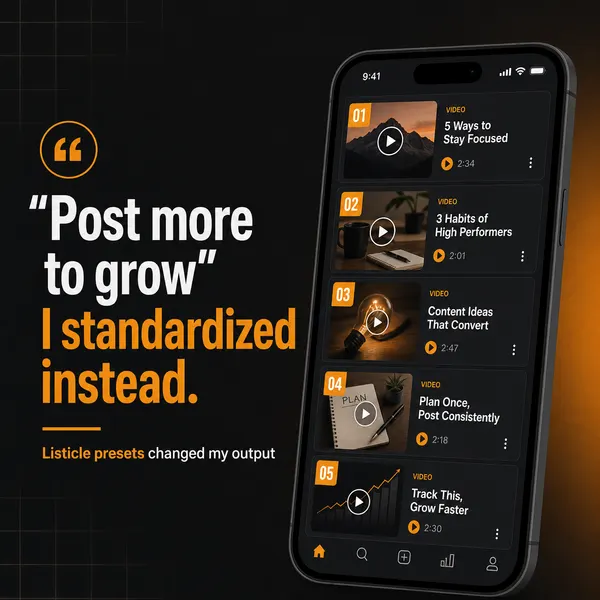
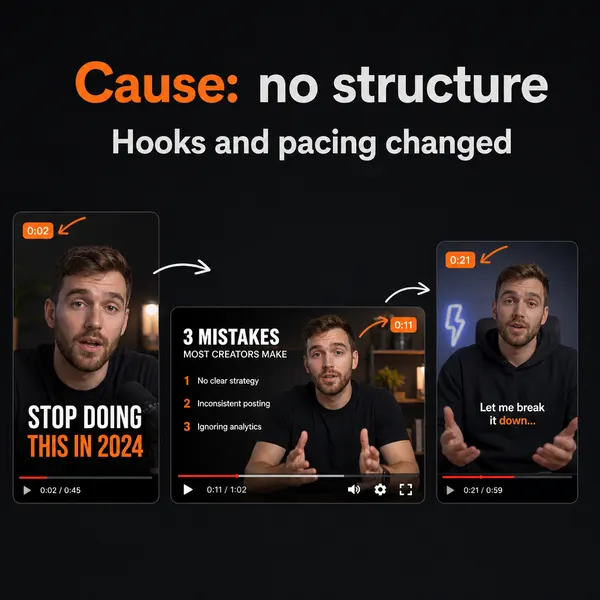
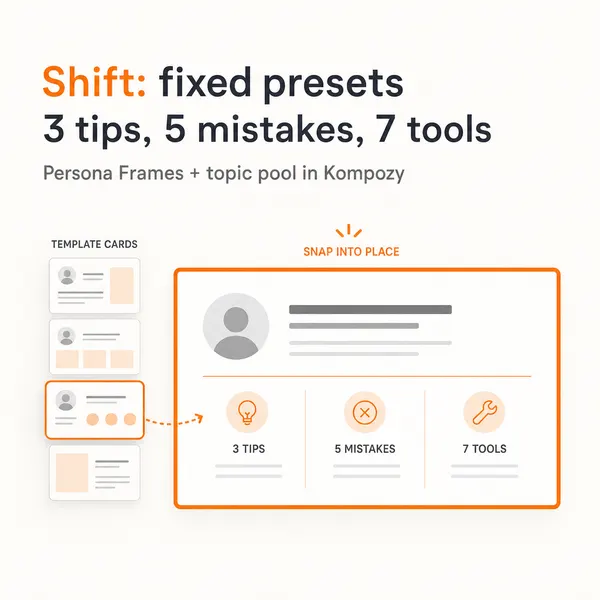
A real carousel made in the Kompozy workspace, shown as an example of the format. It was not made for this guide or for any customer.
Who is this for, and who should skip it?
Best for:
- Creators and companies who record one solid podcast, video or webinar every week.
- Teams that want a month of posts across every platform without separate writing sessions.
- Operators who want to check the credit math before they buy a plan.
Not ideal for:
- Anyone who records only occasionally. The setup cost outweighs the leverage.
- Brands with a very small addressable audience, where fewer posts work better.
- Teams that won't write a Persona Brief. The outputs will need heavy editing.
Frequently asked questions
How many posts can I get from one source?
Our planning target for a substantive weekly source is 25-35 pieces across video, image, text, blog and newsletter. Thin or single-topic sources support fewer, because the method can only reformat ideas that are actually in the source.
What does a month of fan-out cost in credits?
Our example source (7 clipped shorts, 1 avatar short, 6 quote graphics, 18 text posts and a blog) comes to 259 credits plus the newsletter. Four of those is about 1,036 credits, well inside Starter's 5,500. Carousels and photo posts at 24 credits each are what raise the bill.
Why is the cost per post so different across the three tiers?
Labor is the dominant cost. AI-assisted review and autopilot remove most of it without cutting output, as long as the Persona Brief is dialed in. The biggest saving is the move from manual to AI-assisted.
What if I only have one source a month?
You still get useful posts, but the setup cost is the same as for four sources, so each piece carries more overhead. A lighter-weight approach is often simpler at that volume.
Does output scale linearly with more sources?
Roughly, and effort scales better than that. The Persona Brief, platform connections and scheduler rules are set up once, so each extra source mostly adds review time.
Can I change the output mix for different goals?
Yes. The bucket allocation changes per source while the Persona Brief stays the same. Reach leans on video and text, search on blog and newsletter, founder authority on LinkedIn and X, and paid creative on video and image.
Do I need a Persona Brief?
Yes. Without it, every output drifts to a generic AI voice and needs heavy editing, which pushes review time back toward manual levels and erases the cost advantage.
How do we know this?
On 2026-10-23 we checked every Kompozy credit cost against kompozy.io/pricing and corrected outdated ones: text posts went from 3 to 4 credits, carousels from 8 to 24 per slide, blogs from 12 to 17, clipped shorts from 14 to 17 and avatar shorts from 106 to 15. We recomputed the worked example and removed the closed Founding tier. We also removed the labor-hour, dollar, conversion-rate and audience-size figures, which had no source, and labeled per-source counts as planning targets.
Sources
- Kompozy: Pricing (read 2026-10-23)
What other AI content repurposing guides should you read next?
- How to repurpose a podcast into 30+ pieces of social content — The 6-step methodology for fanning a 60-minute podcast episode into shorts, threads, carousels, a blog, and a newsletter.
- YouTube long-form to TikTok / Reels / Shorts: the complete repurposing workflow — Clip-detection, hook rewriting, platform-native captions, and scheduling cadence for YouTube long-form to short-form.
- Long-form to Instagram / LinkedIn carousels: the slide-extraction pattern — How to extract the right 6-8 ideas from a 2,000-word source and render them as brand-exact carousel slides.
- Manual repurposing vs AI-automated repurposing: when each one wins — Honest comparison of doing it yourself, hiring an agency, or running an autonomous engine. With unit economics.
- Webinar repurposing: 5-8 X threads, 4-6 LinkedIn posts, and a recap blog per session — Extract the load-bearing ideas from each webinar, fact-anchor them, and stretch one event into 30+ outputs.
Which adjacent topic clusters should you explore next?
- Autonomous Content Creation — How Kompozy autopilot really works: one workspace switch that approves and schedules generated posts, the checks that run before they publish, and a 14-day ramp for turning it on.
- AI Brand Voice & Persona — Without a Persona Brief, every AI output averages to the LLM default voice. This is the 5-section methodology that makes 100+ AI-generated posts feel like one human author wrote them.