Customer research as content seed: mining sales calls, support, and reviews for B2B content
Every sales call, support ticket, and review is content seed competitors cannot copy. How to mine it for LinkedIn, blog, and email, with consent built in.
Published 2026-05-19 · Updated
Short answer
Customer research is the B2B content seed competitors cannot copy: recorded sales calls, support tickets, churn interviews and product reviews. Capture calls with consent, transcribe them, let AI pull candidate quotes, objections and frameworks, sort them by channel, then have a human check every quote word for word and get separate public-use consent. One good call can feed LinkedIn posts, blog seeds, email examples and case studies.
Key takeaways
- Mine four sources: sales calls, support tickets, churn interviews and public reviews.
- Support tickets arrive as text in volume and map onto real search questions.
- Recording consent is not publication consent; ask for both, separately.
- AI extracts candidates; a human validates every quote against the transcript.
- Tag content by call type so sales objections and churn lessons stay separate.
Most B2B SaaS teams sit on the best content seed they will ever have access to and never touch it. Sales calls, support tickets, customer-success conversations, churn interviews, product reviews — every one of them contains the exact words real buyers use to describe their problem, the real objections that stall deals, and the specific use-case stories that no AI can invent. This material is the one content source a competitor literally cannot copy, because it comes out of your customers' mouths.
The reason it sits unused is not that teams do not value it — it is that turning an hour-long call into publishable content used to take more operator time than anyone had. Listen back, transcribe, find the quotable moments, draft around them, check the quotes, get permission. Multiply by every call and the workflow collapses under its own weight, so the recordings pile up in Gong and Zoom and nothing ships. AI removes the extraction bottleneck — a transcript that took ages to mine by hand now yields candidate quotes and frameworks in minutes — which is exactly why customer-research content is becoming a primary B2B channel in 2026 rather than a nice-to-have.
This is the operator-grade workflow for mining customer research into content: the full source map (not just sales calls), the extraction pipeline, the consent model that keeps it legal, the call-type yield matrix, and the AI tells that destroy the one thing customer-research content has going for it — authenticity. It pairs with our b2b-email-nurture spoke, where the objections you extract become the nurture sequences, and it sits inside the broader content mix mapped in our b2b-content-strategy-2026 spoke.
Why can't competitors copy customer research content?
Every other content source is replicable. A competitor can read the same industry report, react to the same news, and run the same AI prompt you did. What they cannot replicate is what your customers told you on a call last Tuesday. Customer research is the only proprietary content seed in B2B, and it carries five things no other source has:
- Verbatim customer language. The exact words your prospects use to describe their problem — worth more than any phrasing a writer or an AI can invent, because it mirrors the reader back to themselves.
- Real objections and the responses that work. The actual reasons buyers hesitate, and how your team handles them. This is the raw material for both content and the email-nurture objection-handlers.
- Use-case stories in the customer's own framing. The specific, often surprising way customers actually use the product — not the way the product team imagined it.
- Industry context you would not otherwise have. What is shifting in your customers' world, surfaced by people living it, weeks before it reaches a trend report.
- Quotable moments. The exact moment where a customer says something more compelling than your whole landing page.
The credibility differential is the whole point. A post that opens with "a customer told me this on a call this morning" carries trust that a post opening with "here are some tips" never will. This is why customer-derived content is one of the four founder content pillars in our b2b-founder-led-content playbook — it is the highest-credibility material a founder has.
Which customer research sources should you mine?
Most teams that do mine customer research mine only sales calls. That leaves the majority of the seed on the floor. Four sources feed the pipeline, each with a different yield profile and a different consent posture.
| Source | What it yields best | Volume | Consent friction |
|---|---|---|---|
| Sales calls (discovery, demo) | Objections, ICP language, use-case framings | High — recorded by default in most teams | Recording consent at call start; public-use consent separately |
| Support tickets / chats | Pain points, feature gaps, "how do I" patterns | Very high — every ticket is a signal | Lower — often already text; anonymize and you avoid most issues |
| Churn / cancellation interviews | Anti-case studies, the most honest feedback | Low — rare, but the highest-learning per source | High — sensitive; publish only with explicit consent, often anonymized |
| Product reviews (G2, app stores, public) | Already-public quotes, comparison language | Medium — depends on review volume | Lowest — public reviews are quotable with attribution to the platform |
The non-obvious high-yield source is support. Support tickets and chats arrive already as text (no transcription hop), in enormous volume, and they map almost one-to-one onto search demand — the "how do I do X" patterns in your support queue are the exact long-tail queries your blog and help content should answer. Churn interviews are the rarest but produce the most honest content per source; they require the most careful consent handling, and the resulting "what we should have done differently" posts are unusually credible precisely because they are uncomfortable.
How does the extraction pipeline work?
The pipeline is the same regardless of source — capture, transcribe, extract, categorize, validate, consent. AI compresses the middle three steps; humans own the two on the ends. The full sequence for a recorded call:
- Capture with consent. Record the call with a one-line consent script at the top. Grain, Gong, Otter, Fireflies, and Zoom's native recording all work; their recording, transcription, retention features, and pricing vary, so confirm on each vendor's current page.
- Transcribe. Most recording tools auto-transcribe; clean up brand names and jargon the ASR mishears.
- AI extraction pass. A capable model reads the transcript and pulls quotable moments with speaker attribution, plus the frameworks, claims, and recurring objections. Run a second pass with more specific prompting for the deeper material — first passes skew toward the obvious quotable lines.
- Categorize by destination. Each extraction routes somewhere: LinkedIn post, blog seed (if a framework emerged), email-nurture example (if an objection was handled), case-study draft (if a strong outcome surfaced).
- Human validation, verbatim. Every quote checked against the transcript word-for-word; every claim and number checked for accuracy. This step is non-negotiable — see the AI-tells section.
- Public-use consent before publishing. A separate ask from recording consent. The customer is told the intended use and approves attribution (or chooses anonymization).
One good call can feed several pieces across LinkedIn, blog, email, and case studies. Discovery and demo calls are usually the richest, because they are dense with objections and ICP language; routine check-ins yield the least. The constraint is rarely the source. It is operator time to extract and the consent cycle to publish, and AI only shortens the first of those.
What does each call type yield?
Different conversations produce structurally different content. Routing by call type keeps the output sharp — sales-objection content and churn-reason content serve different audiences and should not be blended.
| Call type | Primary content output | Best channel |
|---|---|---|
| Sales discovery | Objection-handling posts, "5 questions prospects ask", ICP data points | LinkedIn + email nurture |
| Demo | Feature-value framings, ROI examples, use-case stories | Blog + sales enablement |
| Customer success | Case-study seed, expansion use-cases, product feedback | Case studies + LinkedIn |
| Churn / cancellation | Anti-case studies ("what we'd do differently"), segment risks | LinkedIn (founder voice) + product roadmap |
| Expansion | Upgrade-path content, "how X uses [feature]", champion narratives | Email expansion sequence + case studies |
How should consent and privacy work?
Customer-research content lives or dies on consent. Recording consent is not publication consent — conflating the two is the fastest way to lose customer trust and create legal exposure. The model has five layers:
- Recording consent at call start. A one-line script: "Mind if I record this so we can review the key points later?" In some places it is legally mandatory, not just polite: California's Penal Code section 632, for example, prohibits recording a confidential communication without the consent of all parties. Check the law where you and your customer are before relying on one-party consent.
- Public-use consent, separate and explicit. "Would you be open to us using a quote from this call in a case study or post?" A different ask, captured separately.
- Quote-level approval. Every quote shown to the customer before publication; they approve, edit, or reject each one. Track approvals so you have an audit trail.
- Anonymization option. Customers who will share the insight but not their name. Anonymized quotes and case studies still work. They carry less weight than a named peer, but they are usually still worth publishing.
- Audit trail. Keep records of consent and quote approvals. This is your legal protection and it costs nothing to maintain.
The practical rule: never let recording consent imply publication consent in your own head. They are two gates, and the second one is the slower of the two — the consent cycle, not the extraction, is what caps how much customer-named content you can ship. Plan the named-vs-anonymized mix accordingly.
Which AI tells destroy customer-research content?
Customer-research content has exactly one advantage — authenticity — and AI has exactly one way to destroy it: paraphrasing. The whole value of a customer quote is that the customer said it. The moment AI smooths it into "plausible customer-sounding language," the content becomes indistinguishable from invented testimonial, which is worse than no quote at all.
- AI paraphrases quotes. The cardinal sin. AI rewrites a customer's blunt, specific sentence into polished marketing-speak. Always validate verbatim against the transcript — the rough edges are the credibility.
- AI invents numbers. A model will infer a plausible-but-wrong metric from context ("grew 3x") when the customer never said it. Every number must trace to something the customer can confirm.
- AI mis-attributes roles and companies. Models occasionally swap or invent a title or company. Verify attribution before publishing.
- AI compresses timelines. "Within months" when the customer said "nine months." Specific timeframes are part of the credibility; do not let them get rounded away.
- AI generic-izes the language. "Game-changing," "transformative," "revolutionary" — ban these via the Persona Brief, the same banned-phrase discipline used across founder content and email nurture.
- AI pulls only the shallow quotes. First extraction passes skew to the obvious lines. The objections, hesitations, and frameworks — the high-value material — need a second, more specific pass.
The discipline is simple and absolute: AI extracts candidate quotes; a human validates every one verbatim against the transcript before it ships. This is the same human-in-the-loop rule that governs case-study production — the extraction is automatable, the validation is not.
What are the most common customer-research mistakes?
- Mining only sales calls. Support tickets are higher-volume and lower-friction; churn interviews are the most honest. A complete program works all four sources.
- Treating recording consent as publication consent. Two separate gates. Publishing a quote on recording consent alone is a trust and legal hazard.
- Letting AI paraphrase quotes. Destroys the one thing customer-research content has. Verbatim or nothing.
- Stopping at the shallow extraction. The most-quotable lines are not the most valuable. Run a second pass for objections, frameworks, and hesitations.
- Over-publishing "our customers say." Too much customer-derived content reads as mass-produced. Cap at 2-3 customer-derived pieces a week and mix with founder-voice and SEO content.
- Not tagging by call type. Sales-objection content and churn-reason content serve different audiences. Tag at the source and route deliberately.
What should you ship this week?
- Today: pull your three most recent recorded sales calls and run one through the extraction pipeline: transcribe, AI-extract candidate quotes plus frameworks, and validate the best two verbatim.
- This week: add a public-use consent line to your call process and a quote-level approval step, so the next batch of extractions is publishable, not just interesting.
- Route the objections you extract into your email-nurture sequences — the objection-handlers in b2b-email-nurture should come straight from real calls.
- Set the cap: 2-3 customer-derived pieces a week, mixed with founder-voice and SEO content, so the channel reads as authentic rather than mass-produced.
The fastest measurable win is running one existing call through the pipeline end-to-end — most teams discover they have months of un-mined seed sitting in their recording tool. To fan a single validated source across LinkedIn, blog, and email from one Persona Brief, see content-repurposing; to size a multi-format engine that produces all of it, see pricing. The objection material flows straight into b2b-email-nurture, and the customer-derived pillar it feeds is detailed in b2b-founder-led-content.
What does this look like in Kompozy?
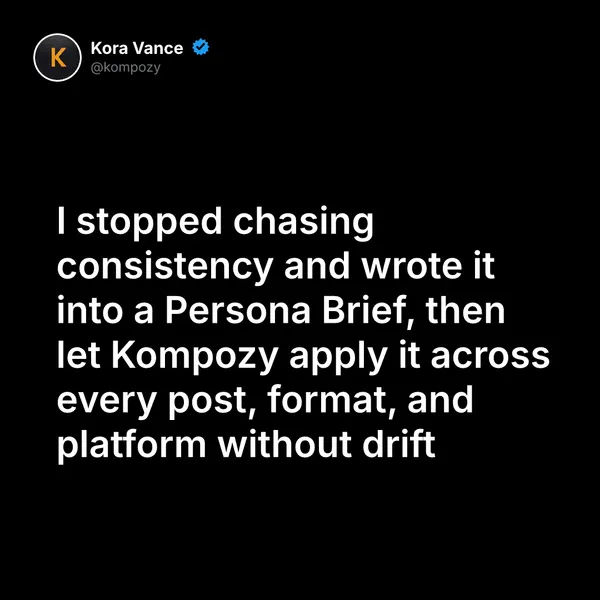
A Quote Graphic generated in the Kompozy workspace, the pull-quote card format a validated customer quote can become.
Who is this for, and who should skip it?
Best for:
- B2B teams with recorded calls sitting unused in Gong or Zoom
- Founders who want credible, customer-derived posts
- Email teams that need real objection language for nurture sequences
Not ideal for:
- Teams without a consent process for recordings and quotes
- Anyone tempted to let AI polish customer quotes
- Brands that would publish customer stories every day, which reads as mass-produced
Frequently asked questions
What is customer-research content in B2B?
Content built from what customers actually say in sales calls, support tickets, churn interviews and reviews. It carries real language and objections a competitor cannot copy.
Which customer sources should I mine besides sales calls?
Support tickets and chats, churn or cancellation interviews, and public product reviews. Support is high-volume and already text; churn interviews are rare but the most honest.
Do I need customer consent to use call content publicly?
Yes, and recording consent is not publication consent. Some states require every party's consent to record; California's Penal Code section 632 is one example.
Can AI reliably extract customer-call content?
Yes for extraction, no for validation. AI pulls candidate quotes and frameworks quickly, but a human must check every quote word for word before it ships.
Should I anonymize customer-research content?
When the customer will share the insight but not their name, yes. Anonymized versions carry less weight than named ones but are usually still worth publishing.
How often should B2B teams publish customer-derived content?
A few pieces a week at most, mixed with founder-voice and SEO content, so it reads as genuine proof rather than a drumbeat.
How do we know this?
We removed unverified yield and conversion figures from this page on 2026-10-23, checked the recording-consent reference against California Penal Code section 632, and checked Kompozy details against kompozy.io/pricing.
Sources
- California Penal Code § 632 (FindLaw) (read 2026-10-23)
- Kompozy — Pricing (plans, credits, workspaces, autopilot, HeyGen BYO) (read 2026-10-23)
Which other B2B content guides should you read next?
- AI-augmented B2B case study production: from customer call to published case study in 90 minutes — The end-to-end workflow: customer-call transcript → quote extraction → structured case study draft → published page. AI handles 80% of the operator work; humans handle approvals and quote validation.
- B2B thought leadership content that actually moves pipeline — Why most "thought leadership" is corporate filler. The 4-pattern model that produces thought leadership tied directly to inbound pipeline. Plus the AI-augmented production workflow.
- B2B content marketing strategy 2026: the complete operator playbook — The full B2B content marketing strategy — positioning, channel mix, founder-led vs brand-led, SEO + LinkedIn + email cadence, and the AI stack that ships it.
- B2B content operations: scaling output without losing voice — The org-design + tool-stack + workflow for B2B content teams producing 100+ outputs per month across channels. With the Persona Brief that prevents voice drift at scale.
- B2B email nurture sequences with AI: convert demos and trials at higher rates — How to design 5-9 email nurture sequences for B2B SaaS using AI assist. With the segmentation logic, trigger architecture, and the AI-tells specifically to ban in B2B email.
- Founder-led marketing for B2B SaaS: the 15-minute daily workflow — How B2B SaaS founders run daily LinkedIn + Twitter + email content output in 15 minutes per day using an AI-augmented stack. With the calibration window that makes it work.
Which related topics connect to B2B content?
- AI Content Repurposing — The complete methodology for turning one source into 25-35 pieces of native-format content across every platform — without producing AI slop.
- Autonomous Content Creation — How Kompozy autopilot really works: one workspace switch that approves and schedules generated posts, the checks that run before they publish, and a 14-day ramp for turning it on.