B2B content operations: the operating system for a 2-person content team that ships like a much bigger one
How a 2-person B2B content team plus AI ships like a much bigger one: the role split, weekly cadence, review gates, and a repurposing engine that holds voice.
Published 2026-05-19 · Updated
Short answer
B2B content operations is an operating system, not a tool purchase. A strategist owns the angle and the Persona Brief, an operator owns daily execution, and an AI stack handles assembly and fan-out across LinkedIn, blog, email and case studies. It runs on a fixed weekly cadence, a review gate set per content type, a repurposing engine that turns one source into many outputs, and one versioned Persona Brief.
Key takeaways
- Two humans plus AI: the strategist decides, the operator executes, the AI assembles.
- If the strategist drafts every post, output caps at what one person can write.
- Set the review gate per content type; keep case studies and SEO on human review.
- The Persona Brief is what keeps voice consistent at volume. Update it every week.
- When quality slips at your volume, hire a second operator before specialists.
The bottleneck in B2B content is almost never ideas — it is operations. Most teams can think of more to publish than they can ship, and the gap between the two is where content strategies quietly die. The teams that out-publish their competitors in 2026 are not the ones with the most headcount or the biggest tool budget; they are the ones with an operating system clean enough that a 2-person team plus an AI stack runs at the cadence a much larger team used to.
Content ops is the unglamorous layer underneath the strategy. The strategy tells you to run founder-led LinkedIn plus comparison SEO plus customer-call case studies; content ops is what makes that actually happen every week without the founder becoming the bottleneck, without the voice drifting to generic AI output, and without the team shipping volume nobody reviews. Get the operating system right and a small team compounds; get it wrong and you either cap at what one person can draft (the strategist writes everything) or you ship a pile of mush (nobody owns the voice).
This is the operator-grade playbook for the operating system itself: the org design and where each role's authority starts and stops, the weekly cadence that keeps production moving, the review gate that trades manual editing for autopilot at the right moment, the repurposing engine that turns one source into many outputs, and the Persona Brief discipline that is the single thing standing between high volume and high-volume slop. Pairs with the b2b-content-strategy-2026 playbook that decides what to ship and the b2b-case-studies-ai pipeline that feeds the highest-converting asset into this machine.
How is a 2-person + AI content org structured?
The modern B2B content org collapses to three roles, two of them human. What used to be a larger team (a writer, an editor, a social manager, a designer) becomes a strategist, an operator, and an AI stack that absorbs the assembly work the other three used to split. The structure only works if each role's authority is drawn cleanly; the most common failure is a strategist who cannot stop drafting and an operator who has no mandate.
| Role | Owns (decision authority) | Does NOT own | Time commitment |
|---|---|---|---|
| Strategist (founder or content lead) | The angle, the Persona Brief, weekly themes, the customer-call-to-content pipeline, what NOT to publish | Daily drafting, scheduling, formatting | A few hours a week |
| Operator (FT or contract) | Daily LinkedIn execution, blog publication, email sends, scheduling, comment replies, first-pass AI drafts | Editorial direction, voice decisions, publication consent | Most of a working week |
| AI stack | Drafting, multi-format fan-out, reformatting, scheduling assists, light analytics | Original opinions, the angle, truth-checking, approvals | n/a |
The authority boundaries are the whole point of the table. When the strategist drafts every post, output caps at what one person can write, because it is bottlenecked on one person's writing time — the most expensive person's writing time. When the operator makes voice decisions without a brief, the output drifts because nobody is accountable for what the brand sounds like. The AI sits underneath both, accelerating the operator and never substituting for the strategist's judgment. This is the same assembly-vs-judgment line that governs the case-study pipeline — AI assembles, humans decide.
What is the weekly content ops cadence?
A content team without a fixed weekly rhythm reverts to reactive publishing — whatever feels urgent on a given morning. The operating cadence replaces that with a predictable loop: plan once, produce in the middle, review at the end, and keep a daily founder-input habit running underneath. The specific days matter less than the discipline of having them.
- Monday — plan (60 min, strategist + operator together). Pick the week's theme, the one blog target, the LinkedIn posts plan, and which email sequence gets attention. Decide what NOT to ship this week as explicitly as what to ship.
- Tuesday-Thursday — produce. The operator drafts via the AI stack against the Persona Brief; the strategist reviews on a rolling basis, not in a single bottleneck. Target: 5-10 LinkedIn drafts, one blog draft, one case study advanced a stage.
- Friday — review (45 min). Look at the week's performance, harvest editing patterns back into the Persona Brief, and pre-plan next week so Monday starts warm.
- Daily — input + presence. The founder records 1-2 voice memos (the raw material for the week's founder content); the operator publishes the day's LinkedIn post and replies to comments inside the first hour.
The daily founder-input habit is the part teams skip and the part that decides whether the content has a point of view. A few minutes of founder voice memo a day is what separates content that sounds like the founder from content that sounds like the internet averaged. The operator can produce volume from those memos all week; the memos are the seed the whole machine grows from. The founder-side mechanics of this live in the b2b-linkedin-strategy playbook.
How should the content review gate work?
The review gate is where teams either build trust in the AI output or never do. The mistake at both extremes is the same — treating the gate as a fixed setting. Teams that manually approve every output forever cap at whatever one reviewer can get through; teams that flip everything to autopilot on day one ship drift. The answer is a gate that tightens early and loosens deliberately, per content type.
| Content type | Calibration phase (days 1-14) | Steady state | Why |
|---|---|---|---|
| Routine LinkedIn posts | Heavy edit, every post | Selective autopilot, spot-check | High volume, low individual risk, fast voice calibration |
| Email nurture | Heavy edit, every send | Autopilot after sequence is proven | Templated structure; risk is in the offer, not the prose |
| Blog / SEO spokes | Full human edit | Full human edit, indefinitely | Ranks on quality + original analysis AI cannot originate |
| Case studies | Full human validation | Full human validation, indefinitely | Verbatim quotes + verified numbers; never autopilot |
| Thought leadership | Founder-authored | Founder-authored, AI fan-out only | The contrarian take has to come from the human |
The 14-day calibration window is the mechanism that makes autopilot safe. For the first two weeks on any new content type, the operator edits heavily and — this is the load-bearing habit — every time they rewrite an AI draft they note why. Those notes feed the Persona Brief, the drafts get closer to the voice, and by day 15 the routine formats can run on spot-check instead of full edit. Skip the calibration and autopilot just ships the model's default voice at volume; do the calibration and autopilot ships your voice at volume.
How does the repurposing engine turn one source into many outputs?
The math of a 2-person team only works because production and distribution are not the same job. The old default was one piece, published once; the 2026 operating model is fewer source pieces, each fanned into many outputs across formats and surfaces. The strategist produces a small number of high-quality sources — a founder voice memo, a customer call, a cornerstone blog post — and the operator plus the AI stack fan each one out.
- A founder voice memo becomes a LinkedIn text post, an X thread, and a newsletter section — same take, three surfaces.
- A cornerstone blog post becomes a LinkedIn carousel, a short founder video script, three pull-quote cards, and an email blurb.
- A customer call becomes a case study, a LinkedIn excerpt, a sales-deck slide, and an objection-handling email example.
- A single framework becomes a carousel, a thread, and a long-form spoke that ranks for the head term.
This is the leverage point where the tool selection actually matters. Maintaining a separate writing tool per platform means the operator burns time moving copy between tabs and the voice averages to mush because every tool has a different prompt template. An orchestration layer collapses that: Kompozy reads one Persona Brief and fans a single source into platform-native outputs off one credit pool, so the voice holds across every surface. That is the difference between a 2-person team shipping coherent output at volume and the same team shipping the same volume in five slightly different voices. See content-repurposing for the full fan-out methodology.
How does the Persona Brief prevent drift at scale?
Every AI content tool produces generic output by default. At low volume a human edits the generic out by hand; at high volume that is not possible, so the only thing standing between high volume and high-volume slop is a tight Persona Brief, a structured document the tool reads on every generation. Without it, AI output at scale drifts to LLM-average voice within weeks. With it, the voice holds across hundreds of pieces. This is the strategist's single most important asset, and it is a versioned document, not a one-time setup.
- Who we are (3 sentences). A positioning statement, not a bio — the one thing the brand is known for.
- Voice DNA (5-8 traits). Concrete adjectives and contrast pairs: "Direct but warm. Specific over abstract. Numbers over adjectives."
- Banned words and phrases (exhaustive). The highest-leverage section. Every AI tell the brand hates — "leverage," "delve," "in today's fast-paced world," "unlock," tricolons, hedge phrases. In our experience this section moves output quality more than any other prompt tweak.
- Required structures. The patterns the brand uses repeatedly — hook conventions, CTA rules, post anatomy.
- Three to five reference pieces. Real published work that exemplifies the voice; the tool uses them as few-shot anchors, not templates to copy.
- Topic boundaries. What the brand talks about and what it does not — keeps the engine in its lane.
The discipline that keeps the brief alive is the Friday harvest: every week, the operator's edit notes (the "why did I rewrite this" from the calibration habit) get folded back into the brief. A brief that worked on five posts will not automatically work on fifty — drift shows up at volume, so stress-test by generating volume early and tightening the brief against what breaks. Treat it as the team's most-versioned document, because it is the only thing that makes the AI stack safe to run at scale.
The 2-person model has a real ceiling. When quality starts slipping at your current volume, that is the signal to hire (a second operator first, then specialists), not to push the existing two harder. The capacity gain comes from the AI absorbing assembly and fan-out, not from the humans working more hours; the human hours shift from drafting to judgment and review.
Which tools does content ops need?
The content ops stack is deliberately small. Every extra tool adds coordination overhead that eats the time the tools were supposed to save, because the operator spends the saved hours moving copy between logins. Most of the leverage sits in two layers: generation and fan-out, and the email platform.
| Layer | Tool | Pricing | Role in the ops machine |
|---|---|---|---|
| Multi-format fan-out | Kompozy Starter / Pro | $199/mo (5,500 credits) or $499/mo (18,000 credits) | One Persona Brief turned into platform-native outputs from one credit pool |
| Long-form drafting | Claude or ChatGPT | Paid plans; see vendor page | Blog and long-form first drafts against the brief |
| Customer-call capture | Grain, Otter, or Fireflies | Paid plans; see vendor page | Feeds the case-study and voice-of-customer pipeline |
| Scheduling | Buffer, native LinkedIn, or Kompozy | Free and paid options | Cross-platform queue; native LinkedIn is fine for founder posts |
| Email platform | Kit (ConvertKit), Beehiiv, or HubSpot | Paid plans; see vendor page | Trigger-based nurture sends and list management |
| Calendar + Persona Brief | Notion | Free and paid plans | Editorial calendar, content state, and the versioned Persona Brief |
Kompozy's own plans are listed above and on the pricing page; size the tier against your monthly output target. For the LinkedIn layer specifically, specialist tools such as Taplio and AuthoredUp exist if LinkedIn is the only channel you run; see b2b-linkedin-strategy.
How does content ops fail at scale?
The failure modes are predictable and each maps to a part of the operating system being skipped. Naming them is how a team self-diagnoses when output quality or volume stalls.
- No Persona Brief. Output drifts to generic AI voice within weeks. The single most common and most fatal failure — without the brief, scale just means more mush.
- Strategist owns execution. When the most expensive person drafts every post, output caps at what that one person can write. Scale requires delegating routine drafting to the operator + AI and reserving the strategist for angle and review.
- No customer-call pipeline. Without customer calls feeding the engine, output decays into generic best-practice content with no proof and no specificity.
- No measurement. Teams that do not track LinkedIn engagement, blog ranking, and email conversion cannot calibrate the brief or the cadence. Make the dashboard the Monday meeting agenda.
- Over-tooling. Every extra tool adds coordination overhead that eats the saved time. Consolidate the fan-out layer especially.
- No autopilot ramp. Teams that manually approve every output forever cap at what one reviewer can clear. The 14-day calibration window followed by selective per-type autopilot is what lifts that ceiling.
When should you hire, and in what order?
The 2-person + AI model has a real ceiling: past a certain volume, quality degrades. Hitting that ceiling is a hiring signal, not a "push harder" signal. The order matters: throughput first, then specialization.
- Second operator — when the first operator is at capacity on execution. Throughput is the first thing that breaks; relieve it before adding specialists.
- Content designer — when carousels and image-card production become the bottleneck. The format with the highest save rate is also the most design-intensive.
- SEO specialist — when blog volume justifies dedicated keyword research and link-building. The strategist cannot own both voice and SEO depth past a certain volume.
- Video editor — when long-form video (YouTube, podcast) becomes a weekly commitment rather than an occasional one.
Many B2B SaaS companies can run the 2-person model for a long time, with the AI stack absorbing what used to be the middle of a content team. As the company grows, content ops becomes a real team — but the operating system does not change, it just gets more people running the same loop: judgment at the top, assembly underneath, one Persona Brief governing the voice. For the strategic layer that decides what this machine should produce at each ARR stage, see b2b-content-strategy-2026.
What does this look like in Kompozy?
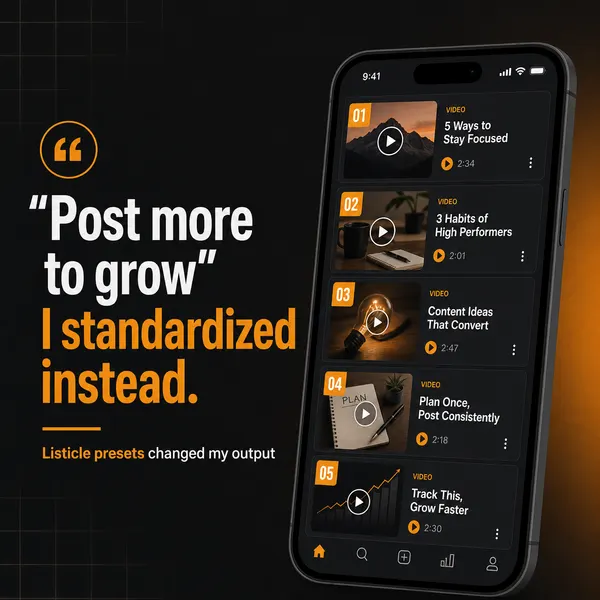
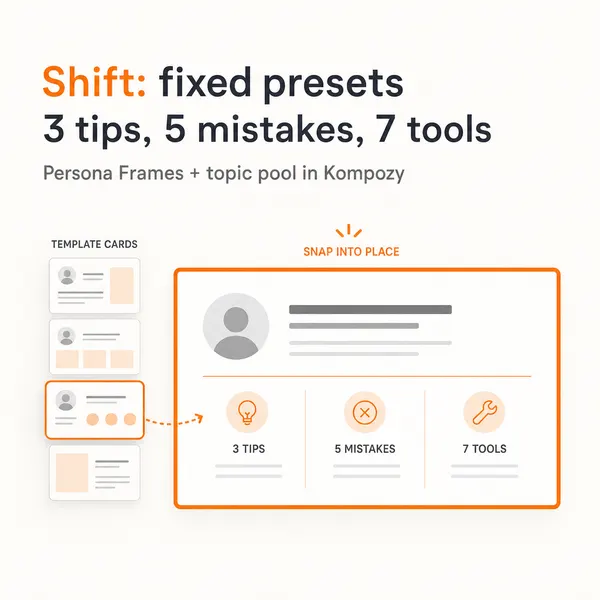
A five-slide Carousel generated in the Kompozy workspace, one of the platform-native outputs a single source can be turned into.
Who is this for, and who should skip it?
Best for:
- B2B SaaS teams with a founder or content lead and one operator
- Teams producing LinkedIn, blog, email and case studies from the same sources
- Content leads who are the bottleneck because they draft everything
Not ideal for:
- Teams without anyone who owns the voice and the angle
- Companies that need a large specialist team for video or SEO depth
- Anyone hoping AI will originate the strategy
Frequently asked questions
How big should a B2B content team be?
Many B2B companies can start with a strategist, often the founder, plus one operator and an AI stack. As volume and complexity grow, add a second operator, then specialists such as SEO or design.
Can a single founder run B2B content operations alone?
For a while, with AI doing the assembly. Daily execution, scheduling and replies eventually become the bottleneck, and the first content operator is often the most valuable content hire.
What is the biggest failure mode in B2B content ops at scale?
Running without a Persona Brief. At high volume no one can edit the generic out by hand, so without the brief the output drifts to average AI voice.
When should B2B content run on autopilot?
After a calibration window, and only for the routine work. In Kompozy autopilot is switched per workspace, so run routine LinkedIn posts and proven email sequences in a workspace with auto-publish on, and keep blog, case studies and thought leadership where a person approves each one.
What does a B2B content ops tool stack include?
A multi-format engine such as Kompozy, a long-form LLM, a call-recording tool, a scheduler, an email platform, and Notion for the calendar and Persona Brief. Keep it small, because every extra tool adds coordination work.
How does the Persona Brief stay accurate as the team scales?
Through a weekly harvest: the operator notes why each AI draft was rewritten, and those notes go back into the brief every Friday. Test the brief at volume early, because drift shows up at scale.
How do we know this?
We removed unverified output-volume, team-size and third-party pricing figures from this page on 2026-10-23 and checked the Kompozy plan prices and credits against kompozy.io/pricing.
Sources
- Kompozy — Pricing (plans, credits, workspaces, autopilot, HeyGen BYO) (read 2026-10-23)
Which other B2B content guides should you read next?
- B2B content marketing strategy 2026: the complete operator playbook — The full B2B content marketing strategy — positioning, channel mix, founder-led vs brand-led, SEO + LinkedIn + email cadence, and the AI stack that ships it.
- Using customer calls as content seed: B2B content marketing's underrated channel — Every customer call is 30 minutes of free content seed. The transcription + extraction + repurposing workflow that converts call recordings into LinkedIn, blog, and email content.
- B2B email nurture sequences with AI: convert demos and trials at higher rates — How to design 5-9 email nurture sequences for B2B SaaS using AI assist. With the segmentation logic, trigger architecture, and the AI-tells specifically to ban in B2B email.
- AI-augmented B2B case study production: from customer call to published case study in 90 minutes — The end-to-end workflow: customer-call transcript → quote extraction → structured case study draft → published page. AI handles 80% of the operator work; humans handle approvals and quote validation.
- Founder-led marketing for B2B SaaS: the 15-minute daily workflow — How B2B SaaS founders run daily LinkedIn + Twitter + email content output in 15 minutes per day using an AI-augmented stack. With the calibration window that makes it work.
- LinkedIn content strategy for B2B founders: the 2026 daily-post playbook — LinkedIn is the #1 organic B2B channel in 2026. The post structure that earns reach, the cadence (1 post/day max), and the AI-assisted workflow that runs on 15 minutes per day.
Which related topics connect to B2B content?
- Autonomous Content Creation — How Kompozy autopilot really works: one workspace switch that approves and schedules generated posts, the checks that run before they publish, and a 14-day ramp for turning it on.
- Content Automation — Daily publishing as engineering, not willpower. RSS feeds, webhooks, scrapers, Persona Briefs, and 9-platform scheduling, wired into pipelines that run without you.