B2B email nurture sequences in 2026: trigger-based pipeline conversion with AI
B2B email nurture in 2026 is trigger-based, not blast-based: the five core sequences, trigger setup, four-axis segmentation, AI drafting, and tells to ban.
Published 2026-05-19 · Updated
Short answer
B2B email nurture works best when it is trigger-based: each email fires on a user action, not a calendar date. Five sequences cover most programs: demo follow-up, trial activation, feature adoption, re-engagement and customer expansion. Segment by lifecycle stage, persona, company size and behavior. Send plain-text emails from a real person with one call to action each. AI can draft, but a banned-phrase list and a human edit keep it from sounding like a template.
Key takeaways
- Tie each email to a user action instead of a calendar date.
- Build demo follow-up and trial activation first; they sit on the highest-intent moments.
- Segment on four axes: lifecycle stage, persona, company size and behavior.
- Send plain text from a named person with exactly one call to action.
- Ban template phrases like "I hope this email finds you well" before AI drafts anything.
Most B2B email programs are weekly newsletter blasts that nobody opens. The teams winning at B2B email in 2026 abandoned the calendar entirely and moved to trigger-based nurture — emails tied to a specific user action: a booked demo, a started trial, a usage milestone, 30 days of silence. The reason is relevance: a message that arrives the moment a buyer does something is relevant by construction, while a Tuesday newsletter is relevant by luck.
The reason most teams still blast is that trigger-based nurture used to be expensive to build — every sequence is a small content project, and a serious program runs five or more of them across multiple segments. AI collapses the drafting cost, which is exactly why the calendar-to-trigger shift is happening now. But AI also introduces a new failure mode: the same large language model that drafts the sequence in minutes defaults to the precise sales-email voice that buyers have been trained to delete on sight.
This is the operator-grade playbook for B2B email nurture in 2026: the five sequences every B2B SaaS needs, the trigger architecture, the four-axis segmentation model, the AI-augmented drafting workflow, and the specific AI tells to ban before a single email ships. It pairs with our b2b-customer-research-content spoke — the objection-handling material that makes nurture emails land comes straight out of sales calls.
Why do trigger-based emails beat calendar blasts?
The foundational shift in B2B email is from "send on a schedule" to "send on a signal." A blast goes to everyone at the same time regardless of where they are in their relationship with you. A trigger fires for one person at the moment a specific action makes a specific message relevant. The relevance gap is the entire performance gap.
| Dimension | Blast / newsletter | Trigger-based nurture |
|---|---|---|
| Send logic | Calendar date (every Tuesday) | User action (booked demo, started trial) |
| Relevance | By luck — timing is arbitrary | By construction — fires on intent |
| Where it earns its keep | Keeping an engaged list warm | Moving a buyer at a decision point |
| Build cost | Low (one email, send once) | Higher upfront, runs forever once built |
| Best use | Genuine weekly value to an engaged list | Demo, trial, adoption, churn-risk, expansion |
Measure the difference on your own list rather than trusting anyone's benchmark: compare open, click, and conversion rates for each sequence against your newsletter. The gap tends to be widest on the first email of a sequence, sent right after the trigger action when intent is highest.
What are the five essential B2B nurture sequences?
A complete B2B nurture program is not one mega-sequence — it is five purpose-built sequences, each tied to a distinct lifecycle moment. Most teams build one (a demo follow-up) and stop; the conversion ceiling lifts as each additional sequence comes online. The architecture, with triggers and spacing:
- Demo follow-up (5 emails, 14 days). Trigger: a demo is booked. Email 1 — confirmation + prep doc (immediate). Email 2 — thanks + recap of what was discussed (day 1). Email 3 — a relevant case study (day 4). Email 4 — an ROI calculator or decision framework (day 8). Email 5 — direct ask + a low-friction alternative CTA (day 14).
- Trial activation (4 emails, 7 days, behavior-gated). Trigger: a trial starts. Email 1 — getting started (day 0). Email 2 — first-value action, gated on whether the user has completed it yet (day 1). Email 3 — feature spotlight tied to their use case (day 3). Email 4 — trial-end nudge with the upgrade path (day 6).
- Feature-adoption (3 emails per major feature). Trigger: a user hits a qualifying behavior but has not used an adjacent major feature within 7 days. Email 1 — why the feature exists. Email 2 — a 2-minute tutorial. Email 3 — the ROI of adopting it.
- Re-engagement (2 emails). Trigger: 30 days inactive. Email 1 — "we missed you" + a genuinely new feature highlight. Email 2 — direct ask paired with an easy cancel link (surfacing the exit signals respect, which can help re-engagement).
- Customer-expansion (3 emails). Trigger: an active account crosses expansion-eligible usage metrics. Email 1 — a feature relevant to their current usage pattern. Email 2 — a case study from a structurally similar account. Email 3 — a direct ask to upgrade or expand.
The two highest-ROI sequences to build first are demo follow-up and trial activation, because they sit on the highest-intent moments in the funnel — a buyer who just booked a demo or started a trial is closer to a decision than anyone else on your list. The behavior-gating on trial activation (sending Email 2 only if the user has not yet completed the first-value action) is the detail most teams skip and the one that most separates a sequence that helps from one that nags.
Which segmentation drives nurture results?
A sequence is only as good as the segment it fires for. Most B2B programs segment on one or two axes (lifecycle stage and maybe persona) and leave the rest of the relevance on the table. The top performers segment on four axes simultaneously — and the four together are what let AI draft something specific rather than something generic.
| Axis | Segments | What it drives |
|---|---|---|
| Lifecycle stage | lead → trial → customer → expansion-eligible → churn-risk | Which sequence fires at all |
| Persona | founder / marketer / ops / analyst | Tone and the ROI framing |
| Company size | solo / SMB / mid-market / enterprise | The CTA and the offer |
| Behavior signals | feature usage, login recency, milestone hits | The trigger timing within a sequence |
Lifecycle stage selects which sequence runs; persona and company size shape the message and the offer (a founder at a 5-person company needs a different ROI framing and a different CTA than an analyst at an enterprise); behavior signals decide the timing within the sequence. Most email platforms automate the mechanics of segmentation, but no platform decides the model for you — that is the operator's job, and it is where the actual leverage sits.
What tone and structure work for B2B email?
The structural decisions matter as much as the copy. A B2B nurture email that reads like a personal note from a human outperforms a polished HTML template that reads like marketing — every time, across every metric. The rules:
| Element | Rule | Why |
|---|---|---|
| From | A real person — founder, AE, or CSM | An email from a person reads as a conversation; one from a brand reads as a campaign |
| Subject line | Short (under 50 characters), specific not clever | Short subjects are less likely to get cut off; specificity beats hype |
| Preview text | Extends the subject, never "view in browser" | It is free subject-line real estate |
| Formatting | Plain text, no HTML template | Plain text reads as a real email; HTML reads as a campaign |
| Length | 50-150 words | Under 50 feels lazy; over 150 does not get read |
| CTA | Exactly one per email | Multiple CTAs equal no CTA — pick the action and ask for it |
Which AI tells should you ban in B2B email?
AI drafts B2B email faster than any human, and it drafts in exactly the voice buyers have been conditioned to delete. The single most important step in the AI-augmented workflow is the banned-phrase list — the same mechanism that governs founder content, applied to email. Ban these outright:
- "I hope this email finds you well." Kill it. It signals a template before the first real sentence.
- "I wanted to reach out to..." Kill it. Say the thing directly.
- "At [Company], we believe..." Generic corporate-speak that buyers skim past.
- "Whether you're a [persona A] or [persona B]..." Addresses-everyone framing — the opposite of the four-axis segmentation that should have already narrowed the audience.
- "Tune in / dive into / unlock the potential of..." Template verbs that announce the email is automated.
- Long signatures stacked with social handles, phone, Calendly link, and a disclaimer. Reads as mass-send; a real person signs with a name.
- Tricolons and rule-of-three stacks ("fast, simple, and powerful"). A reliable AI tell that humans rarely write under pressure.
The banned-phrase list lives in the Persona Brief and is enforced on every generation — the same discipline that keeps founder-led content from sounding like an LLM. Without it, AI-drafted nurture averages to default sales-email voice, the voice buyers delete. With it, the drafts are difficult to distinguish from emails a careful human wrote.
How does the AI-augmented drafting workflow run?
AI does not replace the email operator — it collapses the drafting hop while the operator keeps the judgment. The workflow that produces nurture emails indistinguishable from human-written:
- Define the sequence on paper: trigger, audience segment (all four axes), number of emails, day spacing, and the one CTA per email.
- Generate first drafts with a Persona Brief override — the same brief that governs founder voice, with the email banned-phrase list active.
- Edit aggressively: cut hedge words, add specificity (real numbers, real customer language pulled from sales calls), and validate every claim.
- Wire the triggers in your email platform (HubSpot, Customer.io, Intercom, or Kit, formerly ConvertKit). Trigger builders and pricing vary, so confirm both on each vendor's current pages before committing.
- Run a 30-day A/B test against your current baseline: measure open rate, click rate, and conversion — not vanity opens alone.
- Iterate subject lines monthly; refresh email bodies quarterly.
The customer-language step is the one that turns a competent sequence into a converting one. The exact words a prospect uses to describe their problem — and the exact objections they raise on sales calls — are worth more than any phrasing AI can invent. Mining calls for that raw material is its own workflow, covered in b2b-customer-research-content; for fanning the same source content across email, social, and blog, see content-repurposing. A full multi-format engine that produces nurture email alongside the founder's social and blog from one Persona Brief is what pricing sizes — Kompozy Starter ($199/mo for 5,500 credits) at lower volume, Pro ($499/mo for 18,000 credits) once your monthly output outgrows Starter's credits.
What are the most common B2B nurture mistakes?
- Blasting instead of triggering. The default failure. A weekly newsletter is not a nurture program, because it reaches people at random moments instead of decision points.
- Building one sequence and stopping. Most teams build a demo follow-up and never add trial activation, adoption, re-engagement, or expansion. The conversion ceiling lifts with each sequence that comes online.
- Skipping behavior-gating. Sending Email 2 of a trial sequence to a user who already completed the action it pushes reads as a tool that is not paying attention — and trains the buyer to ignore the rest.
- Letting AI ship without the banned-phrase list. Unedited AI nurture defaults to delete-on-sight sales voice.
- Brand-account sender. Emails from "[Company] Team" read as marketing. Send from a named person, and make the reply-to a real person too.
- Stacking multiple CTAs. Two asks in one email produce zero clear actions. One email, one CTA.
- HTML templates for nurture. Heavy templates read as marketing and trip promotional inbox filters. Plain text reads as a real email and lands in the primary inbox.
What should you ship this week?
- Today: build the demo follow-up sequence (5 emails, 14 days). It sits on your highest-intent moment and is the fastest path to measurable lift.
- This week: add the email banned-phrase list to your Persona Brief and draft the trial-activation sequence with behavior-gating on Email 2.
- Switch every nurture email to a named-person sender in plain text — the single change with the largest open-rate impact.
- In 30 days: A/B the new sequences against your old baseline on open, click, and conversion, and retire any newsletter that consistently trails your sequences.
The fastest measurable win in B2B email is moving the demo follow-up off the calendar and onto the trigger, with a named-person sender in plain text. Everything else compounds from there. Size a multi-format content engine on pricing, and pull the objection-handling raw material for your sequences from b2b-customer-research-content.
What does this look like in Kompozy?
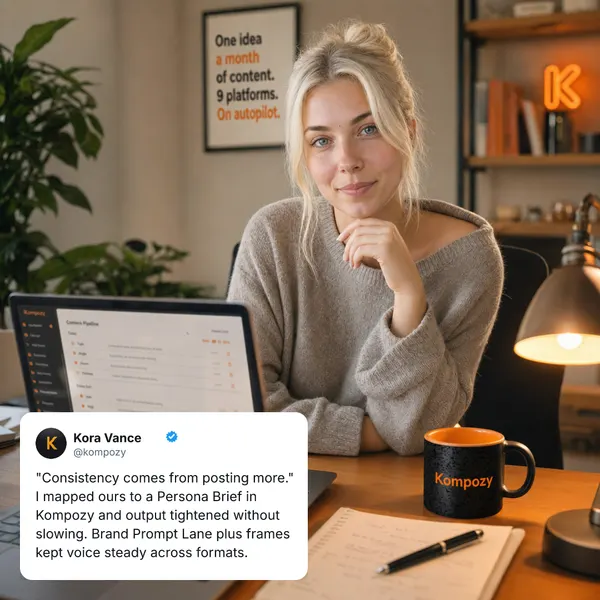
A Persona Tweet generated in the Kompozy workspace: short copy in a named person's voice, the same voice a plain-text nurture email should carry.
Who is this for, and who should skip it?
Best for:
- B2B SaaS teams with demos, trials or usage data to trigger on
- Teams replacing a low-engagement newsletter with lifecycle email
- Operators using AI to draft sequences under a Persona Brief
Not ideal for:
- Companies with no product events or CRM data to trigger from
- Teams that want one weekly blast to do everything
- Anyone planning to ship AI drafts without a human edit
Frequently asked questions
What is trigger-based B2B email nurture?
Each email fires off a specific user action, such as a booked demo, a started trial, a usage milestone or a long stretch of inactivity. Because it arrives when the buyer acts, it is relevant by construction.
What are the essential B2B nurture sequences?
Demo follow-up, trial activation, feature adoption, re-engagement and customer expansion. Build demo follow-up and trial activation first.
Should B2B SaaS still send a weekly newsletter?
Only if you have genuinely useful weekly material and an engaged list. Compare it against your sequences on opens, clicks and conversions, and retire it if it keeps trailing them.
Can AI write B2B nurture emails that do not sound like AI?
Yes, with a Persona Brief, a banned-phrase list and an editing pass that adds real customer language. Without those, AI defaults to the sales-email voice buyers delete.
Should B2B emails come from a person or the brand?
A real person, such as the founder, AE or CSM, with a reply-to that reaches a human. Emails from a brand account read as campaigns.
Plain text or HTML for nurture emails?
Plain text. It reads like a real email from a person, while heavy HTML templates read like marketing. Save HTML for newsletters where layout adds value.
How do we know this?
We removed unverified open-rate, conversion and reply-rate figures from this page on 2026-10-23 and checked Kompozy plan details against kompozy.io/pricing. The sequence lengths and timings are recommended settings, not measured results.
Sources
- Kompozy — Pricing (plans, credits, workspaces, autopilot, HeyGen BYO) (read 2026-10-23)
Which other B2B content guides should you read next?
- B2B content marketing strategy 2026: the complete operator playbook — The full B2B content marketing strategy — positioning, channel mix, founder-led vs brand-led, SEO + LinkedIn + email cadence, and the AI stack that ships it.
- B2B content operations: scaling output without losing voice — The org-design + tool-stack + workflow for B2B content teams producing 100+ outputs per month across channels. With the Persona Brief that prevents voice drift at scale.
- Using customer calls as content seed: B2B content marketing's underrated channel — Every customer call is 30 minutes of free content seed. The transcription + extraction + repurposing workflow that converts call recordings into LinkedIn, blog, and email content.
- AI-augmented B2B case study production: from customer call to published case study in 90 minutes — The end-to-end workflow: customer-call transcript → quote extraction → structured case study draft → published page. AI handles 80% of the operator work; humans handle approvals and quote validation.
- Founder-led marketing for B2B SaaS: the 15-minute daily workflow — How B2B SaaS founders run daily LinkedIn + Twitter + email content output in 15 minutes per day using an AI-augmented stack. With the calibration window that makes it work.
- LinkedIn content strategy for B2B founders: the 2026 daily-post playbook — LinkedIn is the #1 organic B2B channel in 2026. The post structure that earns reach, the cadence (1 post/day max), and the AI-assisted workflow that runs on 15 minutes per day.
Which related topics connect to B2B content?
- Content Automation — Daily publishing as engineering, not willpower. RSS feeds, webhooks, scrapers, Persona Briefs, and 9-platform scheduling, wired into pipelines that run without you.
- Autonomous Content Creation — How Kompozy autopilot really works: one workspace switch that approves and schedules generated posts, the checks that run before they publish, and a 14-day ramp for turning it on.