AI case study production for B2B: turning customer calls into the highest-converting content you own
How B2B teams cut case study production from weeks of writer time to a short workflow: the call-to-publish pipeline, structure, quote checks, approvals.
Published 2026-05-19 · Updated
Short answer
AI shrinks B2B case study production from weeks of writer time to a short operator workflow, while customer approval still runs on the customer's clock. Record the call with consent, transcribe it, and let AI pull candidate quotes and the challenge, solution and results arc. A human then checks every quote word for word and every number against a source, and the customer signs off. AI owns the assembly; humans own the truth.
Key takeaways
- AI owns transcription, extraction, drafting and fan-out; humans own the truth.
- Validate every quote word for word and every number against a source.
- Recording consent and publication consent are two separate asks.
- Lead with the hero metric, then context, challenge, solution, results and quotes.
- Approval throughput, not drafting speed, caps how many studies you can publish.
Case studies are the content type B2B buyers trust most and B2B teams produce least. The reason is not strategy — every operator knows a named customer story converts better than a feature page. The reason is production cost. A traditional case study takes weeks: schedule the interview, wait for a writer, draft, route to the customer, wait, revise, route to legal, wait, publish. At that cost, most teams ship one a quarter and the highest-conversion asset they own stays permanently undersupplied.
AI changes the cost structure, not the trust structure. It collapses the operator time (transcription, quote extraction, first-draft assembly, multi-format fan-out) from days to a single working session. It does not, and must not, touch the parts that earn the trust: a quote has to be verbatim, a number has to trace to something the customer can confirm, and the customer has to sign off on what their name is attached to. A case study that ships a paraphrased quote or an invented metric is worse than no case study, because it burns the one customer relationship that produced it.
This is the operator-grade pipeline for producing B2B case studies at a much higher cadence without lowering the credibility bar. It maps the call-to-publish workflow, the structure that actually converts, the RACI that keeps legal and the customer in lockstep, and the specific failure modes AI introduces. The throughline: AI owns the assembly; humans own the truth. Pairs with our b2b-content-strategy-2026 channel-allocation playbook and the b2b-content-ops operating model that schedules this work.
Why are case studies the asset worth automating?
Case studies sit at the bottom of the funnel where buyers are in active evaluation, and they carry a kind of proof no other content type can: a named peer, in a recognizable situation, saying the thing worked. That is why they are such strong converters and why undersupplying them is the most expensive content mistake most teams make — they leave the highest-converting asset starved while over-producing top-of-funnel posts that AI Overviews already ate.
The automation case is a supply problem, not a quality shortcut. Manual production keeps most teams to a handful of studies a year; an AI-augmented pipeline lets a solo operator, or a small content team, publish far more often. More studies means more ICP-specific proof — a story for the healthcare buyer, one for the agency buyer, one for the mid-market ops lead — so a larger share of your pipeline sees a peer who looks like them. The leverage is breadth of proof, produced at a cadence that manual production cannot reach.
What does the call-to-publish pipeline look like?
The pipeline has seven stages. Three are operator work that AI accelerates, two are pure human judgment that AI must never own, and two run on a separate clock (the customer and legal). Mapping them this way is the whole discipline — it tells you exactly where to trust the tool and where to gate it.
| Stage | Owner | AI role | Human role | Relative time |
|---|---|---|---|---|
| 1. Record the customer call | AE / CSM | None | Relationship, plus recording consent | The length of the call |
| 2. Transcribe | Recording tool | Auto-transcript (a Whisper-class pass for accuracy) | Spot-check names and jargon | Minutes |
| 3. Extract quotable moments | Operator | Pull candidate quotes plus the challenge/solution/results arc | Pick which moments tell the story | Minutes |
| 4. Draft the structured case study | Operator | Assemble the Challenge/Solution/Results/Quote draft | Set the angle and the hero metric | Minutes |
| 5. Validate | Operator | None, gated off | Every quote verbatim, every number to a source, every title confirmed | The longest operator step |
| 6. Customer approval | AE / CSM + customer | None | Quote-by-quote sign-off, edits, publication consent | Days to weeks, in parallel |
| 7. Publish + fan out | Operator | Generate the LinkedIn excerpt, sales-deck slide, email blurb | Final read and scheduling | Minutes |
The single most important line in that table is stage 5. Everything above it is assembly that AI does faster than a human; stage 5 is verification that AI does worse than a human and sometimes actively sabotages. Teams that win at automated case studies treat stage 5 as non-negotiable and resource it; teams that lose collapse stage 5 into "the AI draft looked right" and ship a paraphrased quote that ends the customer relationship.
What is the operator workflow, step by step?
Here is the actual sequence, and what the operator does versus what the tool does. The customer-approval window runs alongside it and does not use operator time.
- Customer call (scheduled separately). Recorded with a consent-capable tool such as Grain, Otter, Fireflies, or your conferencing platform's native recording. Capture recording consent verbally at the top of the call and case-study-use consent before you hang up.
- Transcribe (automatic). The recording tool generates the transcript. Run a Whisper-class pass if the auto-transcript mangles names or product terms — accuracy here saves rework downstream.
- Extract (compute). The model reads the transcript and returns candidate quotes with speaker attribution plus a first pass at the challenge/solution/results arc. The operator picks which moments actually tell the story.
- Draft (compute). The model assembles a structured draft in the Challenge/Solution/Results/Quote format. The operator supplies the angle and the hero metric the story leads with.
- Validate (human work). The non-negotiable gate: every quote checked verbatim against the transcript, every number traced to a source the customer can confirm, every title and company name verified. This step is longer than all the AI steps combined, on purpose.
- Customer approval (runs in parallel). Send the draft plus a separate quote sheet. The customer approves, edits, or rejects each quote and grants publication consent.
- Publish + fan out. Post to the case-studies section, then let the tool generate the LinkedIn excerpt, the sales-deck slide, and the email-nurture blurb from the same approved source.
Notice the inversion versus manual production: the AI steps (extract, draft, fan out) are quick, while the human validation step takes longer than all of them together. That is the correct ratio. If your validation step is shorter than your drafting step, you are not validating — you are rubber-stamping, and the next paraphrased quote is already in the queue.
What case study structure converts?
Most B2B case studies bury the conversion in flowery setup. The structure that converts is blunt and front-loaded — the buyer skimming on a phone between meetings should get the payoff in the first two sentences and the proof in the quotes. Lead with the outcome, then earn it.
- Hero metric / outcome (1-2 sentences). The single most compelling result, up top. "Customer X grew qualified pipeline 3.4x in 11 months." Specific, dated, attributable.
- Customer context (2-3 sentences). Industry, role, company size — enough for a similar buyer to recognize themselves and think "that is me."
- The challenge (200-300 words). What they were doing before and why it broke. Specifics, not "they struggled with efficiency."
- The solution (200-400 words). What they did with the product, how they configured it, which decision mattered most.
- The results (200-300 words). Outcomes with numbers and time periods, plus context on why those numbers mattered to that business.
- Direct quotes (3-5 throughout). Verbatim, attributed by name and role. The quotes are the proof; everything else is connective tissue.
- CTA (1 line). "See how this could work for your team ->" linking to a demo or to pricing.
A useful test for whether the structure is working: cut everything but the hero metric and the quotes and read what remains. If that skeleton still makes the case, the study converts. If the skeleton is vague without the prose, the prose is doing work the proof should be doing — which usually means the numbers are soft or the quotes are weak, and no amount of writing fixes that.
What should AI own, and what should humans own?
The cleanest mental model for the whole pipeline is a hard line between assembly and truth. AI is allowed to assemble; only humans certify truth. Crossing that line is where automated case studies go wrong.
| Task | AI owns | Human owns | Why the line sits here |
|---|---|---|---|
| Transcription | Yes | Spot-check | Mechanical; errors are visible and cheap to fix |
| Quote extraction (candidates) | Yes | Selection | AI finds candidates fast; human picks what tells the story |
| Quote wording (final) | No | Yes — verbatim | A paraphrased quote attributed to a real person is a trust breach |
| Numbers / metrics | No | Yes — to a source | AI infers plausible-but-wrong numbers from context |
| Draft structure + prose | Yes | Edit | Assembly is the AI's strength; angle is the human's |
| Title / company attribution | No | Yes — confirm | AI occasionally swaps or invents roles |
| Multi-format fan-out | Yes | Final read | Reformatting approved content is safe to automate |
| Publication consent | No | Yes | Legal + relationship; never a tool decision |
The pattern across every "No" row: AI is barred wherever an error would put words or numbers in a named customer's mouth that they did not say. That is not a quality preference, it is a relationship and legal boundary. The customer agreed to vouch for their actual words and actual results; a tool that quietly improves the quote or rounds the number has violated that agreement on the customer's behalf.
What failure modes does AI introduce?
Automation does not just speed up the old workflow — it introduces new failure modes that manual production never had. A human writer rarely invents a number; a model will, confidently, if the transcript implies one. Know these five and gate against each in stage 5.
- Paraphrased quotes. The model tightens a rambling customer sentence into a crisp one and attributes the crisp version. Always restore verbatim. This is the single fastest way to lose a customer.
- Invented numbers. The model infers "roughly 40% faster" from context where the customer never gave a figure. Every metric must trace to a source the customer can confirm or it does not ship.
- Promotional language. "Game-changing," "transformative," "revolutionary" creep in from training data. Ban them in the Persona Brief; real customers rarely talk like a press release.
- Role and company drift. The model occasionally swaps a title or mis-states the company. Confirm attribution against the customer's own profile, not the transcript's auto-labels.
- Timeline compression. The customer said "9 months"; the draft says "within months." Specific timeframes are load-bearing for credibility — a vague timeline reads as a softened one.
Keep the time savings in perspective. The compression is in operator and writer time, not in the customer-approval clock, which stays human-paced and should not be rushed. The real ceiling on how many studies you publish is customer willingness and approval throughput, not drafting capacity.
How should case study approvals and RACI work?
The part of case study production that kills timelines is not drafting — it is approvals that stall because nobody owns them. A clear RACI prevents the study from dying in a customer's inbox or a legal review queue. Assign every column before you record the call, not after the draft is done.
| Step | Responsible | Accountable | Consulted | Informed |
|---|---|---|---|---|
| Recording consent | AE / CSM | AE / CSM | Legal (policy) | Marketing |
| Draft production | Content operator | Content lead | AE who ran the call | Founder |
| Quote validation | Content operator | Content lead | Customer | — |
| Number / claim verification | Content operator | Content lead | AE / CSM | Finance (if revenue claims) |
| Customer sign-off | AE / CSM | Customer | Legal | Content lead |
| Publication consent / release | Legal | Legal | Customer | Marketing |
| Publish + distribute | Content operator | Content lead | — | Sales (deck update) |
Two rows are non-delegable: the customer is the single Accountable party for sign-off, and Legal is the single Accountable party for the release form. A content team can be Responsible for moving those steps along, but it cannot certify them — which is exactly why no AI step appears in those rows. The fastest-shipping teams send the consent form before the call and the quote sheet alongside the draft, so the customer never has to hunt for what they are approving.
How many assets can one customer call produce?
A recorded customer call is the most expensive content seed your team produces (it costs a relationship and a customer's time), so extracting one asset from it is waste. The same approved transcript should feed the case study plus a stack of derived assets, each shaped for a different surface, off one source of truth.
- The written case study — the canonical asset on the site.
- A LinkedIn excerpt from the founder — the hero metric plus one verbatim quote, linking to the full study.
- A sales-deck slide — the logo, the hero metric, and one quote, dropped straight into the deck reps already use.
- An email-nurture blurb — a short version for the demo-follow-up sequence aimed at similar-profile prospects.
- A pull-quote graphic — one strong line set as an image card for second-cycle social distribution weeks later.
This is where an orchestration tool earns its place specifically. Kompozy reads one Persona Brief and turns the approved case study into the LinkedIn excerpt, the slide, and the email blurb without re-drafting each by hand and without the voice drifting across formats. The win is not "AI writes the case study" — humans still own the truth in it — the win is that one approved source fans into five surfaces off one credit pool instead of five separate manual rewrites. See content-repurposing for the full fan-out methodology and how the same source feeds multiple channels.
What can't this pipeline do?
The honest limits matter, because believing the pipeline does more than it does is how a team ends up shipping a fabricated quote at speed. AI compresses the assembly and the fan-out; it does not manufacture the things that make a case study worth reading.
It cannot capture the customer relationship — the call still requires a human who has earned the right to ask. It cannot certify a quote or a number — that is verification, and verification against reality is exactly the thing a language model cannot do. And it cannot grant consent on the customer's behalf, which means the customer-approval clock is a hard floor on calendar time no matter how fast the drafting gets. Use the pipeline to reclaim the operator hours that drafting and formatting used to eat, then spend those hours on the relationship and the validation — the two things that actually decide whether the study converts. Teams that automate the truth-checking to chase cadence have the leverage exactly backwards. For where case studies sit in the broader channel mix, see b2b-content-strategy-2026; for the LinkedIn distribution that gives a published study its reach, see b2b-linkedin-strategy.
What does this look like in Kompozy?
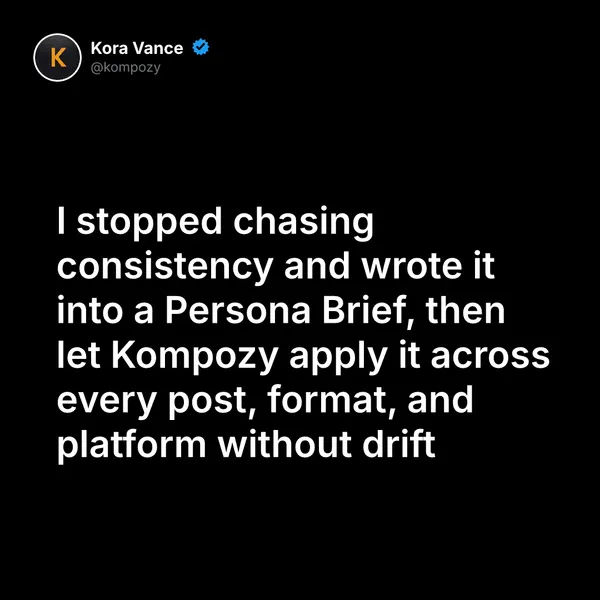
A Quote Graphic generated in the Kompozy workspace, the pull-quote format an approved customer quote can be turned into.
Who is this for, and who should skip it?
Best for:
- B2B teams with happy customers but few published case studies
- Content operators who can own a strict validation step
- Sales teams that want deck slides and email blurbs from the same story
Not ideal for:
- Teams tempted to let AI tidy up customer quotes
- Companies without a process for customer and legal sign-off
- Stories with no numbers the customer can confirm
Frequently asked questions
How long does AI-augmented case study production take?
The operator work fits in a single working session, but customer approval runs in parallel on the customer's schedule and usually decides the publish date. Do not rush that part.
Can AI write a B2B case study from a call transcript?
It can write the first draft and the structure. It cannot be trusted with verbatim quotes or numbers, so a human checks every quote against the transcript and every metric against a source.
What is the biggest risk of using AI for case studies?
Attaching a falsehood to a real customer's name, through a paraphrased quote or an invented number. Either one can end the relationship that produced the study.
What case study structure converts best?
Front-load it: the hero metric first, then customer context, challenge, solution and results, with verbatim attributed quotes throughout and one call to action.
Do customer call recordings have legal implications?
Yes. Some states require every party's consent; California's Penal Code section 632, for example, prohibits recording a confidential communication without the consent of all parties. Recording consent is also separate from consent to be quoted publicly.
What if a customer will not let you use their name?
Publish an anonymized version. It carries less weight than a named peer, but it is still better than no case study.
How do we know this?
We removed unverified production-time and conversion figures from this page on 2026-10-23, checked the recording-consent reference against California Penal Code section 632, and checked Kompozy details against kompozy.io/pricing.
Sources
- California Penal Code § 632 (FindLaw) (read 2026-10-23)
- Kompozy — Pricing (plans, credits, workspaces, autopilot, HeyGen BYO) (read 2026-10-23)
Which other B2B content guides should you read next?
- Using customer calls as content seed: B2B content marketing's underrated channel — Every customer call is 30 minutes of free content seed. The transcription + extraction + repurposing workflow that converts call recordings into LinkedIn, blog, and email content.
- B2B content marketing strategy 2026: the complete operator playbook — The full B2B content marketing strategy — positioning, channel mix, founder-led vs brand-led, SEO + LinkedIn + email cadence, and the AI stack that ships it.
- B2B content operations: scaling output without losing voice — The org-design + tool-stack + workflow for B2B content teams producing 100+ outputs per month across channels. With the Persona Brief that prevents voice drift at scale.
- B2B email nurture sequences with AI: convert demos and trials at higher rates — How to design 5-9 email nurture sequences for B2B SaaS using AI assist. With the segmentation logic, trigger architecture, and the AI-tells specifically to ban in B2B email.
- Founder-led marketing for B2B SaaS: the 15-minute daily workflow — How B2B SaaS founders run daily LinkedIn + Twitter + email content output in 15 minutes per day using an AI-augmented stack. With the calibration window that makes it work.
- LinkedIn content strategy for B2B founders: the 2026 daily-post playbook — LinkedIn is the #1 organic B2B channel in 2026. The post structure that earns reach, the cadence (1 post/day max), and the AI-assisted workflow that runs on 15 minutes per day.
Which related topics connect to B2B content?
- AI Content Repurposing — The complete methodology for turning one source into 25-35 pieces of native-format content across every platform — without producing AI slop.
- Autonomous Content Creation — How Kompozy autopilot really works: one workspace switch that approves and schedules generated posts, the checks that run before they publish, and a 14-day ramp for turning it on.