B2B SEO content that ranks AND converts: the 2026 dual-intent playbook
B2B SEO in 2026: target commercial and comparison queries AI Overviews cannot resolve, build topical clusters, and scale AI production without losing voice.
Published 2026-05-19 · Updated
Short answer
B2B SEO in 2026 works best on dual-intent queries: terms with commercial intent such as "best", "vs", "alternative" and "for [use case]" that still get searched. AI Overviews answer many "what is X" queries above the fold, and Ahrefs found an Overview correlated with a 34.5% lower CTR for the top result. Build topical clusters, add programmatic pages only with real data, and keep AI drafts governed and fact-checked.
Key takeaways
- Ahrefs found an AI Overview correlated with a 34.5% lower average CTR for the top-ranking page (March 2025 vs March 2024).
- Comparison, alternative and use-case pages are the queries an AI summary cannot satisfy for a buyer.
- A pillar plus interlinked spokes concentrates authority; scattered posts dilute it.
- Programmatic SEO only works with a real data source and genuinely useful pages.
- Google's issue is scaled content without value, not AI itself. Fact-check AI drafts before they go live.
Most B2B blog content ranks for keywords nobody buys against. The 2020-2024 playbook — "rank for educational queries, fill the top of the funnel" — failed on two counts: educational rankings never converted well, and AI Overviews now take many of the clicks they did earn. Google began rolling AI Overviews out to everyone in the US in May 2024, and many question-style queries now get answered above the fold. Ahrefs found that an AI Overview correlated with a 34.5% lower average CTR for the top-ranking page (March 2025 versus March 2024). The "what is account-based marketing" post loses clicks, and few of those readers were going to buy anyway.
The 2026 era is dual-intent. Target queries with BOTH commercial intent AND volume — the terms AI Overviews cannot satisfy because the buyer needs to compare vendors, not read a definition. Combine that with topical-cluster architecture and AI-augmented production, and B2B SEO still ranks, still compounds, and converts at materially higher rates than the educational content it replaces.
This is the operator-grade B2B SEO playbook for 2026 — which query types survive, the cluster model that compounds, the production workflow that keeps the voice human, and the measurement that tells you it is working. It pairs with the b2b-content-strategy-2026 spoke for the broader channel mix and the b2b-linkedin-strategy spoke for the distribution layer that feeds rankings with link equity and dark-social demand.
What did AI Overviews change about B2B SEO?
The single largest shift in B2B SEO since 2024 was Google putting AI Overviews in front of every US searcher. The practical effect is binary by query type. Any query phrased as a question — "what is a CDP", "how does product-led growth work", "benefits of account-based marketing" — now gets a synthesized answer above the fold, and the click that used to flow to the ranking page evaporates. Ahrefs published the cleanest measurement in April 2025: a 34.5% lower average CTR for the top-ranking page on keywords with an AI Overview.
Two query types survive the cull, and the entire 2026 playbook is built on them. Commercial-intent queries survive because Google still wants the searcher to click through to a vendor — the AI summary is not the destination when the searcher is trying to buy. Comparison queries survive because an AI summary cannot resolve "X vs Y" in a way that satisfies a buyer doing real diligence; the buyer wants the side-by-side, the gotchas, and the migration path, not a paragraph. Everything in between — the educational middle that the 2020 playbook was built on — got eaten.
The Ahrefs figure is the one to cite. Across 300,000 keywords, the presence of an AI Overview correlated with a 34.5% lower average CTR for the top-ranking page, comparing March 2025 with March 2024. The loss concentrates on informational intent; commercial and comparison queries hold up better because the summary is no substitute for clicking a vendor mid-purchase.
What is the dual-intent keyword model?
B2B SEO keywords fall on two axes: search volume (how many people search per month) and commercial intent (how close the searcher is to buying). The old model chased the high-volume, low-intent corner — the educational queries — and tried to convert that traffic down the funnel over months. AI Overviews destroyed the economics of that corner. Dual-intent targets the upper-right quadrant instead: high volume AND high commercial intent, the terms that still return clicks because the searcher needs to evaluate vendors.
| Query pattern | Volume | Commercial intent | Survives AI Overviews? | Priority |
|---|---|---|---|---|
| "best [category] tool" | High | High | Yes — Google routes to vendors | Primary |
| "[competitor] alternative" | Medium | Very high | Yes — summary cannot resolve fit | Primary |
| "[competitor A] vs [competitor B]" | Medium | Very high | Yes — buyer wants the side-by-side | Primary |
| "[category] for [use case/vertical]" | Medium | Medium-high | Mostly — use-case fit needs a page | Secondary |
| "migrate from [competitor]" | Low | Very high | Yes — late-stage, high conversion | Secondary |
| "what is [concept]" / "how does X work" | High | Low | No — answered above the fold | Avoid as primary |
The discipline this enforces is uncomfortable for teams trained on the old playbook: stop producing educational content as a primary acquisition play. It can still serve as supporting context inside a cluster, or as raw material an AI Overview cites (which builds brand familiarity even without a click), but it should not be where the production budget goes. Re-allocate that budget to comparison and alternative pages, where the intent is commercial and the AI summary cannot do the buyer's job for them.
Which B2B SEO page types still earn clicks?
The pages that still earn clicks are the ones that are the answer an AI summary cannot give, starting with "X vs Y" comparison pages. Dual-intent is the targeting principle and these page types carry it out, each mapped to a specific point in the buyer's evaluation.
- "X vs Y" comparison pages — the dominant pattern for B2B SaaS. Each "vs" page targets comparison-shopping traffic from buyers actively evaluating two named options. Highest commercial intent of any content type.
- "[competitor] alternative" pages — lower volume than "vs" but even higher intent. The searcher has already decided the competitor is wrong for them and is shopping for the replacement.
- Use-case pages — "[category] for [vertical/use case]". Captures vertical-specific demand and lets you speak the buyer's domain language, which the generic category page cannot.
- Migration guides — "migrate from [competitor]". Late-stage, high-conversion content for buyers who have already chosen to switch and need the path de-risked.
- Tool roundups — "best [category] tools 2026". Captures both top-of-funnel discovery and bottom-of-funnel shortlist-building; ranks because Google routes "best" queries to vendor and editorial pages.
- Pricing-comparison pages — high commercial intent; readers are typically days from a purchase decision and want the cost picture before the demo.
The pattern across all six: the page exists because a buyer in active evaluation needs something an AI summary structurally cannot provide — a defensible side-by-side, a fit judgment, a migration path, a real cost comparison. That is what makes these pages durable against the same Overview rollout that gutted educational content.
How do topical clusters help B2B content rank?
Topical clusters rank in 2026 because they build the topical authority Google rewards. Random blog posts on unrelated topics never accumulate it. A cluster is a pillar page plus a set of deep spokes that cover one category exhaustively and interlink, and the cluster ranks as a group: each spoke borrows authority from the pillar and the siblings, and the pillar borrows relevance from every spoke.
- Pick the pillar topic — the category you want to own SEO for. Broad enough to support a full set of spokes, specific enough that ranking is achievable.
- Write the pillar page: a definitive overview targeting the head term. It is the hub every spoke links back to.
- Write the spoke pages, each targeting one dual-intent long-tail query within the category. Comparison, alternative, and use-case spokes are the highest-priority slots.
- Interlink rigorously: every spoke links to the pillar and to 2-3 sibling spokes; the pillar links to every spoke. This is the mechanism that makes the cluster rank as a unit.
- Earn external links over time to the pillar and the strongest spokes; the link equity distributes across the whole cluster through the internal links, raising every page.
The compounding is the point. A cluster tends to outrank the same word count spread across scattered, unrelated posts, because the internal-link structure concentrates authority instead of dissipating it. The note this spoke lives inside is itself a cluster spoke — the B2B content marketing pillar plus its siblings is the architecture in practice. One caveat carried over from the broader b2b-content-strategy-2026 analysis: the cluster model still compounds for commercial-intent and comparison spokes; it no longer compounds for educational spokes, because the CTR on those queries fell below the threshold that justifies the production cost.
When does programmatic SEO make sense for B2B?
Above a certain scale, the best B2B SEO move is programmatic generation of pages that target permutations no team could write by hand, rather than another hand-written cluster. The model: take a real data source you own (an integrations directory, a template library, a use-case matrix) and generate one page per permutation. Webflow runs thousands of template-detail pages, each targeting a "[template-type] template" query; Zapier runs many thousands of "[App A] + [App B] integration" pages. These rank because each page answers a comparison or use-case intent that AI Overviews cannot satisfy — the page IS the answer the buyer needs.
| Approach | Page count | Time-to-impact | Best fit | Failure mode |
|---|---|---|---|---|
| Hand-written cluster (pillar + spokes) | Tens | Months | Core category authority, comparison/alternative depth | Slow to scale beyond the core category |
| Programmatic SEO (permutations) | Hundreds or more | Longer | Integrations, templates, use-case and location permutations | Thin pages — only works if each page is genuinely useful |
| Educational top-of-funnel | Any | Months | Brand familiarity, AI-Overview citation | CTR gutted by AI Overviews; not a primary play |
The hard constraint on programmatic SEO is that each generated page has to be genuinely useful, not a thin keyword stuffer. Google's spam systems and the Helpful Content guidance both target thin doorway pages; a programmatic page that is a template with two variables swapped and no real content is exactly what gets de-indexed. The pattern works when the page genuinely resolves the permutation's intent — the specific integration's setup steps, the specific template's preview and fields, the specific use case's fit. AI generation paired with a real data source produces that; AI generation with no data source produces the thin pages that get penalized.
How does a small team ship SEO content at volume?
A small team ships at volume by keeping humans on the judgment steps and letting AI carry the rest. Dual-intent targeting and cluster architecture decide what to produce; this workflow keeps the output from collapsing into generic AI sludge.
- Keyword research: identify the dual-intent queries for your category using your SEO research tool (Ahrefs, Semrush or similar). Filter for commercial intent and AI-Overview resistance, not raw volume.
- Cluster planning: outline one cluster (a pillar plus its spokes) per quarter, prioritizing comparison, alternative, and use-case spokes in the highest-intent slots.
- Draft generation: generate each spoke draft against a tight Persona Brief — a quick generation pass plus a real human edit per spoke. The edit is where the original sources, data, and opinion get added; the draft is scaffolding.
- Internal linking: enforce it as a rule, not a hope — every spoke links to its pillar and 2-3 siblings on publish. This is the step teams skip and the reason their clusters do not compound.
- Schema and metadata: Article + FAQPage + BreadcrumbList JSON-LD on every spoke, plus auto-generated title tag, meta description, and OG image per page. Eligibility for rich results is free reach.
- Internal-link retrofit: when a new spoke ships, audit existing spokes for natural link opportunities and add 1-2 links per audit. The cluster gets denser and stronger with every addition.
The volume this enables, with consistent voice, is real, but it is gated entirely on the Persona Brief and the human edit. Skip either and the output is the generic AI content the next section is about. The fan-out tooling that runs this end-to-end (one source, multiple cluster-shaped outputs, voice held across them) is what Kompozy is built for; see the b2b-content-strategy-2026 spoke for how the SEO motion fits the rest of the channel mix.
How do you keep AI SEO content from reading like AI?
The single highest-leverage quality fix in AI-augmented SEO is a tight Persona Brief governing the voice. Without it, AI-generated B2B content plateaus at LLM-average — competent, structurally fine, and instantly recognizable as machine-written, which both readers and increasingly the ranking systems discount. With it, the drafts start to read like one specific writer.
- Ban hedge words: "it is worth noting", "in many cases", "generally speaking", "it is important to understand". These are the load-bearing tells of AI prose.
- Ban tricolons: stacks of three like "fast, cheap, and effective" or "plan, execute, and measure". The rule-of-three cadence is an AI fingerprint.
- Ban pseudo-bridges: "in today's fast-paced world", "when it comes to", "in the ever-evolving landscape of". They add words and zero information.
- Require specificity: every claim supported by a number, a named source, or a concrete example. Generic AI output is vague by default; the brief forces it to commit.
- Require a point of view: every spoke should make at least one claim that contradicts conventional wisdom in the category. Averaged-internet content ranks worse and converts worse than opinionated content.
Google's guidance says using generative AI is not the problem; generating many pages without adding value for users can violate its spam policy on scaled content abuse, and AI output should be fact-checked before it goes live. So the real risk is shipping vague, opinion-free AI sludge, which fails on quality regardless of who or what wrote it.
We have no sourced timeline to quote for B2B SEO. In practice it is the slowest B2B channel to show results and the one that compounds most once it does, and comparison and alternative pages usually move first. Pair SEO with founder-led LinkedIn for earlier pipeline while the SEO motion matures.
How should you measure B2B SEO content in 2026?
Track the metrics that survive a click-suppressed SERP and connect to revenue, starting with conversion rate on comparison and alternative pages. The old scorecard (pageviews, time-on-page, keyword rankings in isolation) is partly broken by AI Overviews and never measured pipeline well in the first place.
- Conversion rate on comparison and alternative pages specifically — the cleanest "content drove pipeline" signal in B2B SEO, because the traffic is mid-evaluation by definition.
- Self-reported attribution on the demo or trial form — "how did you first hear about us?" with structured options. The only signal that captures the buyer who read a comparison page, left, and returned via direct traffic weeks later.
- Branded-search trend — rising branded search is the proxy for the brand familiarity that AI Overview citations and educational content build even without a click.
- Ranking position on dual-intent terms — track the commercial-intent and comparison keywords, not the educational ones whose rankings no longer convert to clicks.
- Cluster-level authority — whether the cluster as a group is climbing, not whether one spoke ranks. The cluster is the unit that compounds.
What to stop measuring: pageview-weighted attribution models and time-on-page as a quality proxy. AI Overviews broke both — a page can be cited in an Overview, build familiarity, and influence a purchase without ever registering a pageview. Self-reported attribution usually credits content more than last-touch does, and that gap shows how much influence last-touch misses. Measure the way the b2b-content-strategy-2026 spoke lays out, and treat SEO as one compounding layer in a motion that also runs founder-led distribution — the two reinforce each other, with LinkedIn feeding link equity and demand into the pages SEO ranks.
What does this look like in Kompozy?
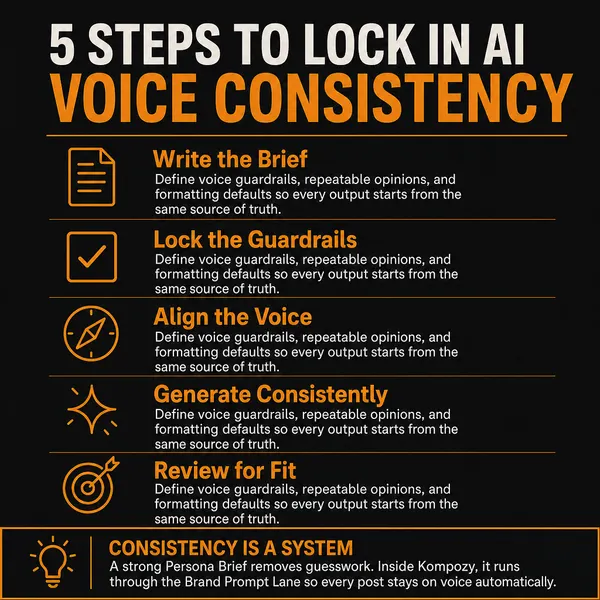
An infographic photo post generated in the Kompozy workspace, the kind of supporting asset you can cut from a cluster page and share on social.
Who is this for, and who should skip it?
Best for:
- B2B SaaS teams with identifiable competitors who can publish comparison and alternative pages
- Small teams that want to produce SEO content at volume without losing a consistent voice
- Companies that own a real data source (integrations, templates, use cases) for programmatic pages
Not ideal for:
- Teams that need pipeline this quarter; SEO is slow, so start founder-led LinkedIn alongside it
- Anyone planning to mass-generate thin pages with no added value, which risks Google's scaled content abuse policy
- Brands whose buyers do not search for the category at all
Frequently asked questions
Did AI Overviews kill B2B SEO?
They hurt informational queries most. Ahrefs found that an AI Overview correlated with a 34.5% lower average CTR for the top-ranking page. Commercial and comparison queries hold up better because a summary cannot do a buyer's vendor comparison for them.
What are dual-intent keywords?
Queries with both real search demand and high commercial intent, such as "best [category] tool", "[competitor] alternative", "[A] vs [B]" and "[category] for [use case]". They are the targets that still earn clicks from people who are evaluating vendors.
How important are comparison pages for B2B SEO?
Very, for any B2B SaaS with identifiable competitors. Comparison and alternative pages carry the highest commercial intent of any content type, and readers on them are already evaluating options.
When does programmatic SEO make sense?
Once you own a real data source, such as an integrations directory, a template library or a use-case matrix, and each generated page genuinely answers its permutation. Thin template pages with swapped variables are exactly what spam policies target.
Does Google penalize AI-generated SEO content?
Google's guidance says using generative AI is not the problem. Generating many pages without adding value for users can violate its spam policy on scaled content abuse, and Google tells publishers to fact-check AI output before publishing.
How do we know this?
We checked every figure on this page against the sources below on 2026-10-23, including Ahrefs' AI Overviews study and Google's own guidance on AI content and the AI Overviews rollout. Figures we could not source, such as timelines and ranking multipliers, were removed.
Sources
- Ahrefs — AI Overviews reduce clicks by 34.5% (read 2026-10-23)
- Google — Generative AI in Search (AI Overviews rolling out to everyone in the U.S.) (read 2026-10-23)
- Google Search Central — Using generative AI content on your website (read 2026-10-23)
- Kompozy — Pricing (read 2026-10-23)
Which other B2B content marketing guides should you read next?
- B2B content marketing strategy 2026: the complete operator playbook — The full B2B content marketing strategy — positioning, channel mix, founder-led vs brand-led, SEO + LinkedIn + email cadence, and the AI stack that ships it.
- B2B thought leadership content that actually moves pipeline — Why most "thought leadership" is corporate filler. The 4-pattern model that produces thought leadership tied directly to inbound pipeline. Plus the AI-augmented production workflow.
- B2B content operations: scaling output without losing voice — The org-design + tool-stack + workflow for B2B content teams producing 100+ outputs per month across channels. With the Persona Brief that prevents voice drift at scale.
Which related Kompozy topics cover this next?
- Autonomous Content Creation — How Kompozy autopilot really works: one workspace switch that approves and schedules generated posts, the checks that run before they publish, and a 14-day ramp for turning it on.
- AI Content Tools — The opinionated 2026 map of every AI content tool that matters — across 8 categories — with decision frameworks for podcasters, YouTubers, founders, and agencies.