AI email marketing 2026: subject lines, sequences, deliverability, and the stack that actually converts
Email is the only channel you own. Here is the AI-augmented playbook that ships subject lines, sequences, and deliverability that converts — without sounding like a 2015 marketing automation template.
Published 2026-05-19 · Updated
Short answer
AI email marketing in 2026 runs on four formats: broadcast, newsletter, trigger-based nurture, and transactional. AI drafts subject lines and sequences, and a person checks tone, claims, and the offer. Deliverability comes first. Gmail requires bulk senders of 5,000+ messages a day to use SPF, DKIM, and DMARC, offer one-click unsubscribe, and keep reported spam below 0.30%. Then pick a platform that fits, such as Beehiiv, ConvertKit, Customer.io, HubSpot, or Klaviyo.
Key takeaways
- Four formats: broadcast, newsletter, trigger-based nurture, and transactional. Most lists need more than one.
- Gmail bulk senders (5,000+ a day) need SPF, DKIM, DMARC, one-click unsubscribe, and spam below 0.30%.
- Let AI draft. Have a person check tone, claims, and the offer before anything sends.
- Google Postmaster Tools shows spam rate and reputation for mail sent to personal Gmail accounts.
Why is email the channel you actually own?
LinkedIn can change its algorithm. TikTok can change its rules. Your email list is yours — exportable, portable, owned. That's why every serious creator and B2B SaaS team invests in email marketing as a primary channel. The hard part isn't acquiring tools; it's executing the workflows that compound.
This cluster covers the practical side of email marketing in 2026: subject lines, sequences, deliverability, and segmentation.
What are the 4 email formats?
| Format | Best for | Cadence |
|---|---|---|
| Broadcast | Announcements, launches, time-sensitive | Ad-hoc |
| Newsletter | Audience-building, retention | Weekly/biweekly |
| Trigger-based nurture | Conversion (lead → customer) | Event-driven |
| Transactional | Utility (receipts, confirmations) | Real-time |
Which email marketing skills matter most?
- Subject lines. The first thing people see in the inbox. The 5 subject-line patterns.
- Sequence design. The 4 essential nurture sequences (welcome, nurture, win-back, retention) — full playbook.
- Deliverability. Technical setup + content rules + sender reputation — 2026 deliverability playbook.
- Segmentation. The 4-axis model (lifecycle / persona / company size / behavior) — strategy guide.
What is the AI stack for email marketing?
- Email platform: Beehiiv (newsletter creator), ConvertKit (multi-product creator), Customer.io (behavioral B2B), HubSpot (CRM-tied), or Klaviyo (ecommerce). Full comparison.
- AI drafting: Claude or ChatGPT for sequence drafts. Persona Brief governs voice across all sends.
- Subject-line generation: platform-native AI or Claude — generate a batch of variants per send, shortlist a few, and A/B test them.
- Deliverability monitoring: Google Postmaster Tools (data for mail sent to personal Gmail accounts) and Microsoft SNDS. Check them before a problem shows up in your open rates.
- Personalization: tier 2-3 (segment-specific dynamic blocks + behavior triggers). Tier 4 (AI-generated paragraphs per recipient) is frontier work with deliverability risk.
What are the most common email marketing mistakes?
- Only running a newsletter. No conversion sequences = no systematic way to convert subscribers into customers.
- Only running nurture sequences. No newsletter = no audience-building flywheel.
- {{first_name}}-only personalization. An old trick. Real personalization is tier 2-3 (behavior + segment).
- Ignoring deliverability. Plenty of senders only open Google Postmaster Tools after inbox placement has already dropped.
- Generic AI subject lines. AI can draft many variants in seconds, yet the first suggestion often ships unchanged.
- Sending from main domain. Burns deliverability for everything. Always use a sending subdomain.
How do you get started with AI email marketing?
- Pick the right platform for your stage. For newsletter-first creators: Beehiiv. For B2B SaaS: Customer.io or HubSpot.
- Set up technical deliverability: SPF, DKIM, DMARC, separate sending subdomain.
- Write a Persona Brief governing AI-generated email voice.
- Set up the 4 essential sequences (welcome, nurture, win-back, retention) with AI-generated drafts + human edits.
- Implement 4-axis segmentation (lifecycle / persona / company size / behavior).
- Review every send by hand at first, and update the Persona Brief from your edits.
- Flip routine sends to autopilot. Keep manual review on broadcast announcements and high-stakes launches.
Where can you go deeper on each email marketing topic?
This is the canonical entry point. Each sub-topic below has (or will have) its own deep-dive guide.
Which related guides cover nearby topics?
Topically adjacent guides on the same domain. Each links into a full cluster of its own.
- B2B Content Marketing — B2B content marketing in 2026 is founder-led, AI-augmented, and conversion-tuned. This is the playbook for B2B SaaS teams shipping daily across LinkedIn, blog, and email — without diluting brand voice.
- Content Automation — Daily publishing as engineering, not willpower: RSS feeds, webhooks, scrapers, Persona Briefs, and multi-platform scheduling wired into pipelines that run without you.
- Autonomous Content Creation — How quality gates and a calibration period make autopilot output safe to publish, and how to decide when to flip the switch.
- AI Brand Voice & Persona — Without a Persona Brief, AI output drifts toward the default LLM voice. This is the 5-section method that keeps AI posts sounding like one author.
- Creator Economy Tools — The creator economy in 2026 is more tooled than ever. This is the operator-grade map: which tools win which categories, where the consolidation is happening, and the minimum stack that builds a durable creator business.
What does this look like in Kompozy?
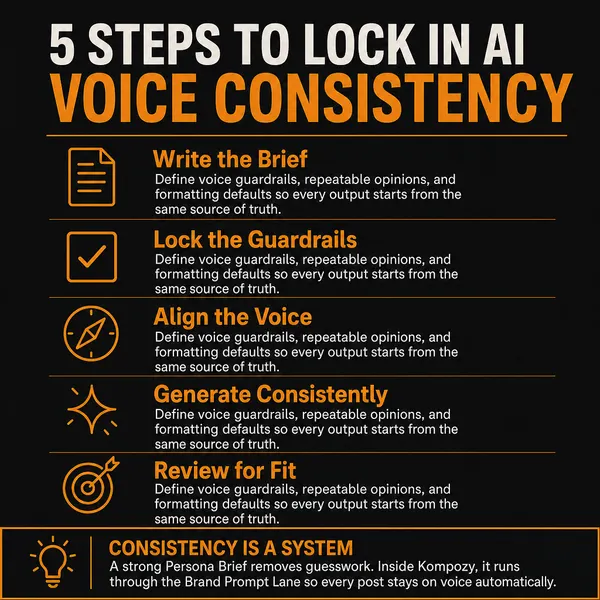
An infographic post made in the Kompozy workspace, the kind of visual you can pair with a newsletter issue. It shows the format only.
Who is this for, and who should skip it?
Best for:
- Creators and B2B teams building a list they own
- Senders setting up SPF, DKIM, and DMARC for the first time
- Teams that want AI drafts but keep a human review step
Not ideal for:
- Anyone looking for open-rate benchmarks. This hub does not publish them
- High-volume cold email programs, which Gmail sender rules make risky
- Ecommerce flows that need deep store integrations. A tool like Klaviyo fits that job better
What do people ask about AI email marketing?
What's the best AI email marketing tool in 2026?
Depends on the use case. Beehiiv for newsletter operators, ConvertKit for multi-product creators, Customer.io for behavioral B2B SaaS, HubSpot for CRM-tied nurture, Klaviyo for ecommerce. Pick on automation depth and deliverability, not on the AI writing button.
Can AI write entire email sequences?
AI writes the drafts. Humans calibrate tone, validate claims, set offer logic. We would not ship a full AI sequence without a human read. AI drafts plus human edits is the workflow we recommend.
What's the right email open rate in 2026?
There is no single target. Benchmarks vary by industry and by how opens are counted, so compare against your own list over time. If opens drop suddenly, check deliverability first: Google Postmaster Tools shows spam rate and domain reputation for mail sent to personal Gmail accounts.
Are email blasts still effective?
For announcements: yes. For nurture and conversion, trigger-based sequences are the better tool because they reach people right after they act. The 4-format architecture (broadcast + newsletter + nurture + transactional) is the operator-grade approach.
How important is email deliverability in 2026?
Critical. Gmail requires bulk senders (5,000+ messages a day) to set up SPF, DKIM, and DMARC, support one-click unsubscribe, and keep the spam rate reported in Postmaster Tools below 0.30%. Miss those and your mail is likely to land in spam.
Should I focus on cold email or list building?
List building, for most operators. People who opted in asked to hear from you; cold recipients did not. Cold email still has a place in high-ticket B2B sales, but sender rules from Gmail and other inbox providers make sloppy cold sending risky.
What email segmentation matters most?
Behavior signals (feature usage, engagement recency, recent actions) are usually the strongest segmentation signal. Plenty of teams segment by lifecycle stage and stop there, which leaves behavior unused.
How do we know this?
We checked the Gmail sender requirements and Postmaster Tools details on this page against Google's help pages on 2026-10-23. We removed open-rate and conversion-lift figures we could not trace to a source.
Sources
- Google Workspace Admin Help: Email sender guidelines (read 2026-10-23)
- Gmail Help: Get started with Postmaster Tools (read 2026-10-23)
Get started with Kompozy → · See pricing · Compare Kompozy vs other tools