AI-augmented email list growth in 2026: the 6 sources that work and the ones that don't
Six email list-growth sources that work in 2026, ranked by conversion, with cost per subscriber, ESP growth tools, and the tactics that hurt deliverability.
Published 2026-05-19 · Updated
Short answer
Six sources grow an email list well in 2026: content upgrades tied to a specific post, gated original research, lead magnets on a landing page, exit-intent overlays, partnerships and referrals, and social opt-ins. Content upgrades lead because the reader is already on the topic. Use organic sources fully before paying for subscribers, and avoid bought lists, which damage deliverability for everyone.
Key takeaways
- Placement and relevance beat a fancier lead magnet.
- AI makes a content upgrade for every post affordable.
- Pay for subscribers only once you know what one is worth.
- beehiiv includes a referral program on its Lite and Pro plans.
- A smaller engaged list beats a big list of bought addresses.
Most email list-growth advice is recycled older tactics with "AI" stapled on the front. The mechanics that move a list have shifted, and not in the direction the listicles claim. Generic lead magnets converted when they were rare; now that AI lets anyone produce a polished PDF in an afternoon, the lead magnet itself is no longer the moat. Specificity and placement are. A checklist attached to the exact blog post a reader is already engaged with converts far better than the same checklist behind a cold landing page.
The other shift is economic. AI cut the production cost of every list-growth asset (lead magnets, content upgrades, gated reports, landing-page copy) from a multi-week project to a few hours of generation and editing. That changes which tactics are worth running: content upgrades on every cluster page used to be too expensive to produce; now they are nearly free to generate and they are the strongest source on the list.
This is the operator playbook: the six sources that work, how they compare on intent, cost and speed, the platform features that run them (with ESP prices re-checked on 2026-10-23), and the tactics that quietly destroy deliverability however many addresses they add. Pairs with our email-marketing-tools-2026 comparison and email-vs-newsletter format framework.
Which six list-growth sources work?
List growth works as a portfolio of sources, each with different intent, cost and subscriber quality. The mistake most operators make is running one source hard (usually a single lead magnet) and wondering why growth plateaus. The sources, before the nuance on each:
| Source | Reader intent | Cost to run | Subscriber quality | Best for |
|---|---|---|---|---|
| Content upgrade (post-specific) | High: already reading the topic | Production time only | High | SEO-heavy content programs |
| Gated long-form (reports, data) | High: chose to go deeper | Production time only | High | Original research, in-depth guides |
| AI lead magnet (landing page) | Depends on traffic: low from cold ads, higher from warm readers | Production time; ad spend if paid | Medium to high | B2B SaaS, course creators, consultants |
| Exit-intent overlay | Mixed: the visitor is leaving | Tool cost only | Medium | High-traffic sites |
| Partnerships / referrals | High: vouched for by someone they trust | Relationships, or paid placement | High | Established creators |
| Social-driven opt-ins | Very high once they click | Time, not cash | Very high, slow | Creators with an audience already |
Two patterns to read off the table. First, results track intent and placement, not asset quality: the content upgrade wins because the reader is already engaged with that exact topic, not because the PDF is better. Second, the highest-quality sources (partnerships, social) are the slowest and cannot be brute-forced, and the fastest sources (content upgrades, exit-intent) depend on traffic you already have. A balanced portfolio pairs a fast on-site source with a slow trust-based one.
Source 1: why do content upgrades on cluster pages convert best?
A content upgrade is a lead magnet tied to one specific blog post: the template, checklist or framework that extends the exact thing the reader just read. It is the strongest source on the list for a structural reason: the reader has already self-selected into the topic by reading the post, so the relevance objection that kills generic lead magnets is gone.
This is the source AI changed most. Producing a bespoke upgrade for every blog post used to be too expensive to justify, so operators shipped one generic lead magnet across the whole site and ate the lower conversion. Now an upgrade can be generated from the post's own content in minutes and edited in a few more, which makes per-post upgrades the default rather than the exception. A content program with a cluster architecture — say nine hub pages with nine spokes each — has roughly 90 candidate pages, each able to carry its own upgrade. That is 90 high-converting on-ramps generated at near-zero marginal cost. The production engine for this is the same one that writes the posts; see content-repurposing for turning one source into both the post and its upgrade.
Source 2: when should you gate long-form content?
For genuinely high-value long-form (original research, proprietary data, in-depth guides) an email gate captures high-intent opt-ins from readers who reach it. The pattern that works: show a substantial part of the content openly and gate the rest. The visible part has to prove the gated part is worth an email; gate too early and the reader bounces before they believe there is value behind the wall.
The real risk with gating is SEO, not conversion. If Google cannot crawl the full content, the page does not rank, and a page that does not rank has no readers to convert. The discipline is to keep the gated content server-rendered and crawlable (so search engines see all of it) while gating it visually for human readers, and to reserve gating for assets where the trade is worth it — original data and research, never routine blog posts. Gating a standard how-to post sacrifices the ranking that would have driven the traffic in the first place. Use it surgically.
Source 3: how did AI change lead magnets?
A lead magnet on a dedicated landing page is the classic source, and AI changed its economics rather than its conversion. Warm traffic (blog readers, social referrals, your existing audience) converts much better than cold traffic. What changed is cost: AI produces a polished PDF guide, template, checklist or framework in hours rather than the weeks a designed asset used to take.
The downstream economics: organic placement acquires subscribers at almost no cash cost, while paid traffic costs real money per subscriber. That gap is why the honest advice is to exhaust organic placement (content upgrades, on-site magnets, social) before opening a paid budget; paid list growth only makes sense once you know what a subscriber is worth and it clearly exceeds the acquisition cost. Lead magnets work best for B2B SaaS, course creators and consultants, where a downloadable asset maps to a real buying motion; for B2C ecommerce, a discount code usually beats a PDF.
Source 4: do exit-intent overlays still work?
Exit-intent is an old tactic that still works, but most implementations are bad. The overlay fires when the user moves to close the tab or hit back, offering a last-chance opt-in. It only captures a small share of exits, but that adds up across visitors who were otherwise leaving with nothing. The difference between a weak and a decent result is almost entirely the offer: a specific lead magnet, trial or discount converts; a generic "get our newsletter" does not.
The implementation failures are predictable. Firing too early (before the user has read anything) feels aggressive and trains visitors to dismiss reflexively. Generic offers convert worst. Multi-step flows that ask for more than an email address lose people at every step. Most ESPs offer embeddable forms, and dedicated overlay tools (OptinMonster, ConvertBox and similar) cover deeper targeting and testing; check current pricing before committing to any of them.
Source 5: why do partnerships and referrals pay off for established creators?
Partnerships are the strongest source for established creators, because the subscriber arrives vouched for by someone they already trust. Four sub-tactics: newsletter swaps (trade mentions with a creator in an adjacent niche), paid recommendation networks (you pay for placement in other newsletters), co-created lead magnets (build a joint asset so both lists grow) and podcast guest spots (appear on relevant shows and capture signups through the show notes).
Partnerships are slow to start and hard to brute-force: they depend on having something a partner wants in return, which is why they reward established lists. Paid recommendation networks are the exception that scales with cash rather than relationships; they are more predictable than swaps but can bring slightly lower-intent subscribers. The platform matters here. beehiiv includes a Recommendation Network on its free plan (up to 2,500 subscribers) and a full referral program with milestone rewards on Lite ($59/mo) and Pro ($109/mo). Kit is free up to 10,000 subscribers, with Creator from $33/mo; referral programs there usually run through a third-party tool. The full comparison is in email-marketing-tools-2026.
Source 6: are social-driven opt-ins worth it?
Social-to-email converts a small fraction of impressions but tends to produce the most committed subscribers, because anyone who leaves a frictionless feed to give you an email address has made a real choice. It is slow and cannot be rushed, which is why it suits creators who already have a social audience. The platform reality:
- TikTok / Reels / Shorts: CTA in the bio or a pinned comment driving to a landing page. Low conversion on impressions, but the subscribers who do convert are high-intent and durable.
- LinkedIn: a strong B2B social-to-email channel. Pin the newsletter CTA on your profile and link it from your best posts.
- X / Twitter: useful as a secondary channel for most B2B senders, rarely the primary one.
- YouTube: end-card and description CTAs drive mid-volume, high-quality signups, especially from long-form where the viewer has invested real attention.
- Best practice across all of them: a dedicated, UTM-tagged landing page per platform, so you can see which channel actually drives subscribers (and customers) rather than guessing. The same source recording can feed all of these at once — the fan-out methodology is in content-repurposing.
What does each source cost per subscriber?
Growth advice that ignores cost is incomplete, because two sources that both "work" can differ enormously in what they cost. Here is how the six compare on cost, speed and when each is worth running:
| Source | Cash cost | Speed | Scales with | Worth it when |
|---|---|---|---|---|
| Content upgrade | Near zero beyond production | Fast (uses existing traffic) | Number of content pages | You already publish content |
| Gated long-form | Near zero beyond production | Medium | Volume of original research | You produce proprietary data |
| AI lead magnet (organic) | Near zero beyond production | Fast | Traffic + offer relevance | Almost always; the cheapest on-ramp |
| AI lead magnet (paid) | Ad spend per subscriber | Fast (cash-gated) | Ad budget | You know subscriber value and it beats the cost |
| Partnerships / referrals | Relationships or paid placement | Slow to start | Relationships + budget | Your list has trade value |
| Social opt-ins | Time, not cash | Slow | Existing social audience | You already create social content |
The strategic read: organic on-site sources (content upgrades, lead magnets, exit-intent) are nearly free and should be saturated first; trust-based sources (partnerships, social) compound slowly but produce the best subscribers; paid is the lever you pull only after subscriber value is proven. A common, expensive mistake is buying subscribers before knowing whether one is worth the price; running paid traffic into an unmonetized list burns cash to grow a number that does not pay back.
What does NOT work in 2026, and what quietly hurts you?
Some tactics do not just under-perform — they actively damage the asset. The distinction matters: a low-converting tactic wastes effort, but a deliverability-damaging tactic poisons every future send to the whole list. The ones to avoid:
- Generic "subscribe to our newsletter" CTAs. There is no value proposition, so there is no reason to opt in. Always offer something specific.
- Pop-ups that fire on page load. They interrupt before the reader has seen any value, annoy visitors and hurt the page experience, especially on mobile. Exit-intent timing converts better at a fraction of the cost to the experience.
- Bought email lists. The single most destructive tactic. Sending to addresses that never opted in generates spam complaints and hard bounces that damage your sending domain reputation permanently — it can poison deliverability for the subscribers who did opt in. Never.
- Broad giveaways. A giveaway for general traffic attracts low-intent opt-ins who unsubscribe the moment the prize is awarded, inflating the list with addresses that drag down open rates and engagement signals. Niche-specific giveaways (an industry tool license, course access) perform better, but broad ones are a net negative.
- List-building / scraping services. Most violate platform terms of service and produce unverified, low-quality contacts that bounce and complain — the same deliverability damage as bought lists, dressed differently.
The throughline: list quality beats list size on every metric that matters. A smaller list built from content upgrades and partnerships out-earns a bigger list inflated by giveaways and bought addresses, because deliverability and engagement are reputation effects that a low-quality list damages for everyone on it.
Where do AI and Kompozy fit in list growth?
AI's role in list growth is not a magic acquisition channel — it is a production-cost collapse that makes the high-converting organic sources economically viable to run at scale. The reason content upgrades are now the top source is that AI made per-page upgrade production nearly free; the reason a small team can run social-to-email across five platforms is that one source recording can be fanned out by AI into platform-native posts. The growth tactics did not change; the cost of executing them did.
Kompozy sits on the production side, upstream of the ESP that captures and stores the subscribers. The same Persona Brief that voices a blog post also generates the content upgrade attached to it, the social posts that drive opt-ins and the newsletter that keeps subscribers once they join, all in one voice, so the asset that wins a subscriber sounds like the newsletter that keeps them. Kompozy Starter ($199/mo, 5,500 credits) covers a solo or small operation; Pro ($499/mo, 18,000 credits) and Agency ($999/mo, 55,000 credits) cover heavier output. See pricing for current plans. Capture, storage and sending stay with your ESP: Kompozy answers "produce the growth assets on-voice at scale," and the comparison in email-marketing-tools-2026 answers "which ESP to run them on."
How does email list growth progress over time?
List growth moves in stages, and each stage has a different job. Assuming consistent content and a few of the sources above running together:
- The first stage is about proving the offer converts, not volume. Consistent content plus content upgrades and one or two on-site sources is enough.
- The middle stage is where partnerships and referrals start paying back, because the list is now big enough to have trade value. How long it takes depends on niche and content quality.
- Paid acquisition is worth testing once organic growth is steady and you know what a subscriber is worth; before that, optimize organic.
- The plateau signal: when a source stops adding net subscribers (gross adds minus unsubscribes flatten), the fix is adding a source, not pushing the existing one harder. Single-source programs plateau; multi-source portfolios compound.
The compounding comes from the portfolio, not any single tactic. Content upgrades feed off content you publish anyway, partnerships feed off the list size content upgrades built, and social feeds off the content you fan out — each source makes the next one cheaper. That is the difference between a list that grows for a quarter and one that grows for years.
What does this look like in Kompozy?
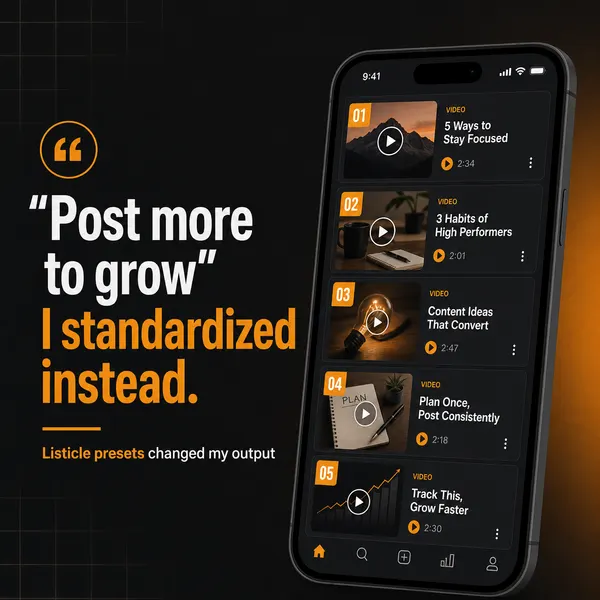
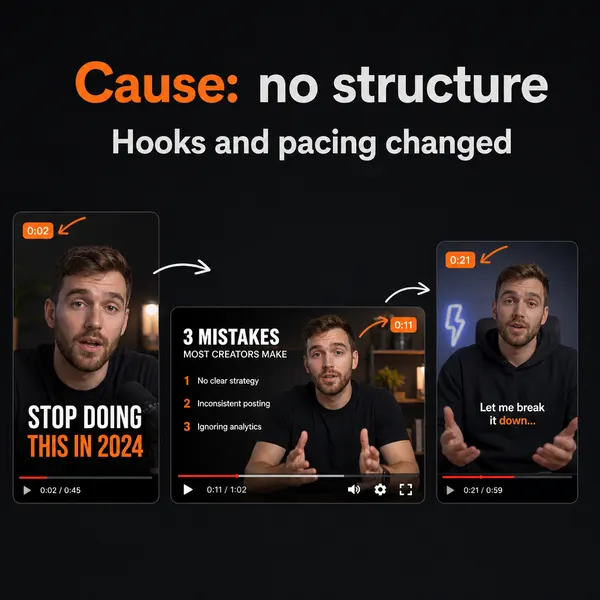
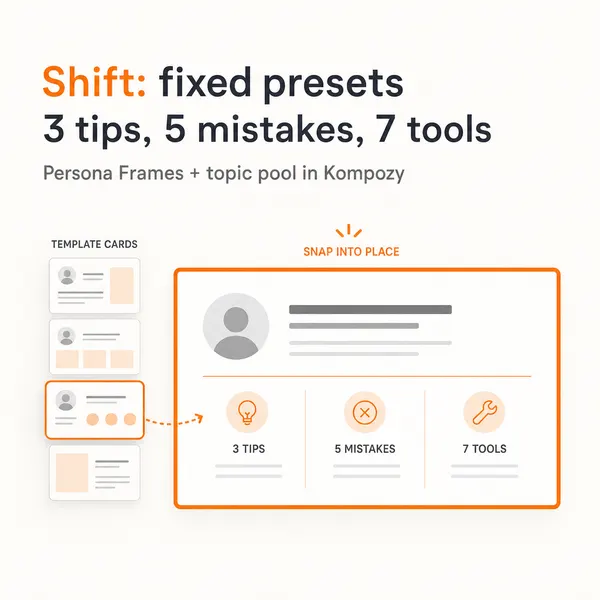
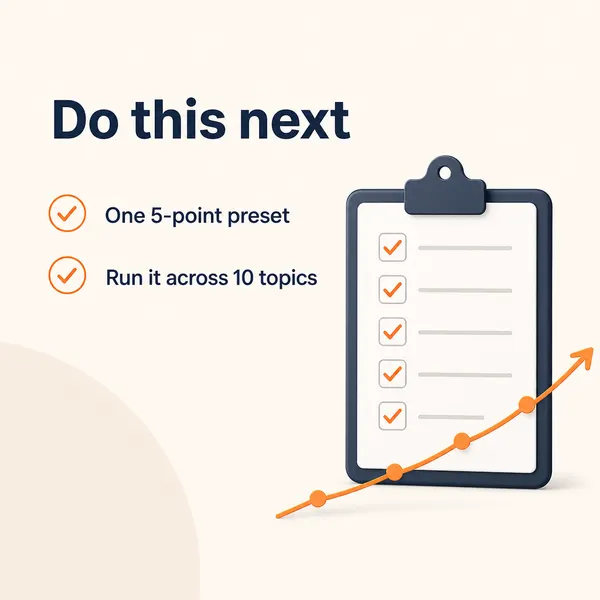
A five-slide carousel generated in the Kompozy workspace, a format that works as a social teaser for a content upgrade or lead magnet.

Who is this for, and who should skip it?
Best for:
- Content-led businesses with existing blog traffic
- Creators with a social audience to convert
- B2B SaaS and consultants with a clear lead magnet
Not ideal for:
- Ecommerce stores, where a discount code usually beats a PDF
- Brand-new sites with no traffic yet
- Anyone looking to buy a list
Frequently asked questions
What is the best list-growth tactic?
A content upgrade tied to one specific post, because the reader has already shown interest in the topic.
Should I run paid ads to grow my list?
Only after organic sources are working and you know what a subscriber is worth. Paying into an unmonetized list burns cash.
Does gating content hurt SEO?
It can if search engines cannot read the full content. Gate only high-value research and keep routine posts open.
How does AI change list growth?
It makes the assets cheap to produce: upgrades, lead magnets and social posts. The tactics are the same; running them at scale is now affordable.
How do we know this?
We reviewed this page on 2026-10-23 and removed conversion rates and cost-per-subscriber ranges that had no published source. ESP plan details were checked against beehiiv's and Kit's pricing pages; Kompozy details come from kompozy.io/pricing.
Sources
- beehiiv: Pricing (read 2026-10-23)
- Kit: Pricing (read 2026-10-23)
- Kompozy: Pricing (read 2026-10-23)
Which other AI email marketing guides should you read next?
- Designing email sequences with AI: welcome, nurture, win-back, retention — The 4 essential email sequence templates for 2026, the trigger architecture each requires, and the AI-augmented production workflow that ships them in days not weeks.
- Best AI email marketing tools 2026: ConvertKit, Beehiiv, Customer.io, HubSpot compared — The five leading AI-augmented email platforms in 2026 compared on automation depth, segmentation, AI-assist features, and price-per-active-subscriber.
- Email segmentation that drives conversion: behavioral + demographic + lifecycle — The 4-axis segmentation model (lifecycle / persona / company size / behavior signals) and how to set it up in ConvertKit, Beehiiv, HubSpot, or Customer.io. With the segmentation that drives the highest conversion lift.
- AI subject lines that earn 40%+ open rates in 2026 — The 5 subject-line patterns that work in 2026, the AI workflow for generating variants, and the banned phrases that tank open rates instantly.
- Email deliverability in 2026: staying out of spam in the AI-content era — How spam filters changed in 2026 to detect AI-generated email at scale, the technical setup (SPF, DKIM, DMARC, BIMI) that still matters, and the content rules that determine inbox placement.
- Email personalization beyond {{first_name}}: behavioral + dynamic at scale — How to do real email personalization in 2026 — behavior-triggered content, dynamic blocks per segment, AI-generated paragraphs personalized to the recipient. With deliverability guardrails.
Which related topic clusters cover this from another angle?
- Content Automation — Daily publishing as engineering, not willpower. RSS feeds, webhooks, scrapers, Persona Briefs, and 9-platform scheduling, wired into pipelines that run without you.
- Creator Economy Tools — The creator economy in 2026 is more tooled than ever. This is the operator-grade map: which tools win which categories, where the consolidation is happening, and the minimum stack that builds a durable creator business.