Email personalization at scale in 2026: beyond {{first_name}} to behavioral and dynamic content
The four tiers of email personalization in 2026, from name merge to AI-written paragraphs: the data each tier needs and where most teams should stop.
Published 2026-05-19 · Updated
Short answer
Email personalization works in four tiers: name merge fields, segment-specific content blocks, behavior-triggered content and AI-written paragraphs per recipient. Most teams should build up to tier three, where emails respond to what a subscriber just did, and stop there. Tier four adds the most risk, because near-identical AI copy at volume earns weak engagement. Kompozy writes the variants; your ESP handles triggers and sending.
Key takeaways
- A first-name merge field is table stakes, not a strategy.
- Segment blocks give the best return for the effort.
- Behavior triggers only work when the data is recent.
- Run AI-written paragraphs as a test against a control group.
- Personalization is mostly a data problem; the copy is the easy part.
First-name personalization is an old idea wearing a new badge. {{first_name}}, the merge field every marketer reaches for first, moves results only a little, and many recipients now read it as the tell of an automated blast rather than a personal touch. The personalization that compounds is layered: segment, then behavior, then dynamic block, then (carefully) AI-generated copy. Done well, it makes each email feel written for its reader. Done badly (AI paragraphs that invent a company name, behavior triggers firing on month-old data) it hurts trust and engagement in the same send.
This guide covers which level of personalization is worth the setup at your stage, what infrastructure each tier needs, and the guardrails that separate "personalized at scale" from "flagged at scale." The hard truth underneath it: personalization is a segmentation and data problem first and a copy problem second. The copy is the easy part; the data plumbing decides whether any of it lands. It pairs with our email-sequence-design-ai spoke for the sequences personalization rides inside, and our email-marketing-tools-2026 comparison for picking an ESP that supports your target tier.
What are the four tiers of email personalization?
Personalization is a ladder, and each rung needs more infrastructure than the last. The common mistake is jumping to the top rung (AI paragraphs) before building the bottom two (clean segments, behavior data). That produces the worst outcome: high effort, deliverability risk, and results a simple segment block would have delivered at a fraction of the risk. Effort mapped to payoff:
| Tier | What it is | Typical payoff | Infrastructure required | Deliverability risk |
|---|---|---|---|---|
| Tier 1: name merge | {{first_name}}, {{company}} tokens | Small | Clean contact fields | None |
| Tier 2: segment blocks | Different paragraphs shown to different segments | Meaningful relevance gain | Solid upstream segmentation | None |
| Tier 3: behavior-triggered | Content varies by a recent user action | The biggest step up, because it arrives at the moment of intent | Event tracking + triggered automation | Low |
| Tier 4: AI paragraphs | AI writes a per-recipient block | Highest in theory | All of the above + a generation pipeline + QA | Real at volume |
Read the deliverability column carefully. Tiers 1 through 3 carry essentially no incremental spam risk because the content variance they introduce is human-authored and bounded. Tier 4 is the only rung where the personalization mechanism itself can hurt you — which is why the right default for almost every team is "build to tier 3, master it, and treat tier 4 as an experiment, not a standard." The sections below walk each rung in order, because skipping a rung is the most reliable way to waste the spend on the rung above it.
Tier 1: why did the name merge stop working?
The {{first_name}} merge field earned its reputation when seeing your own name in an inbox was novel. Now it is one of the most recognizable signatures of an automated send, and savvy audiences discount it. The gain is small and mostly front-loaded into the open: a personalized subject line earns the open, then a generic body wastes the attention it bought. Worse, merge fields fail loudly. A missing first name renders "Hey ,", a mis-cased import renders "hey jOHN", and a company field from a free-text form renders "Acme Inc.!!!", each more impersonal than no personalization at all.
Treat tier 1 as table stakes, not strategy. Use a fallback default for every merge token ("Hey there," when first name is null), normalize casing on import, and never let a merge field carry the weight of the personalization claim. The job of tier 1 is to not look broken; the lift comes from the tiers above it. If your "personalization program" is a {{first_name}} in the subject line, you do not have a personalization program — you have a merge field.
Tier 2: why should most teams use segment dynamic blocks?
Tier 2 is the rung most teams stop short of, and it has the best risk-adjusted return. The mechanic is simple: write a few versions of the same paragraph or CTA, then show the right one to the right segment with your ESP's conditional content blocks. No new data infrastructure beyond the segmentation you should already have, just the willingness to write the variants and wire the conditions. The gain comes from relevance: a founder reads a founder-framed paragraph and an ops lead reads an ops-framed one, from the same broadcast.
- Persona variants on a nurture email: founder vs ops vs analyst framing of the same value proposition, swapped by a role field or a tag.
- Company-size variants on the CTA section: SMB ("start free in 5 minutes"), mid-market ("book a 20-minute walkthrough"), enterprise ("talk to our team about a pilot").
- Lifecycle variants on the body: active user, new trial, and returning churn-risk each see a different middle block while the header and footer stay shared.
- Geography or timezone variants on send-time references ("this week's session" vs an absolute date) so the copy never contradicts the recipient's reality.
Most serious ESPs support conditional content blocks or segment-targeted sends; check how yours does it before you plan the variants. The constraint is rarely the tool; it is the discipline to write and maintain the variants. This is where a generation engine earns its keep: producing several brand-voiced variants of a block in one pass instead of an operator writing each by hand. See content-repurposing for how one source fans into multiple voice-matched variants, and pricing to size the plan you need.
Tier 3: why build toward behavior-triggered content?
Tier 3 is where personalization stops being about who the recipient is and starts being about what they just did. The content varies based on a recent, specific action (a pricing-page visit, a feature used several times this week, a run of opened newsletters), and that recency is the point. Behavior-triggered content beats calendar sends because it arrives at the moment of intent. It is the biggest step up on the ladder, and it carries little deliverability risk because the variants are still written by people.
- "You visited our pricing page yesterday — here are the three questions most teams ask when they do." Specific behavior, targeted content, tight recency window.
- "You've used Feature X three times this week. Here's the advanced workflow most users miss." Usage trigger paired with a value-add, not a sales push.
- "You've opened four of our last five newsletters — here's the post nobody clicks but everyone bookmarks." Engagement-based content match that rewards the reader.
The cost of tier 3 is infrastructure, not copy. It needs behavior tracking (Customer.io, Segment, Mixpanel or your product's own event stream) plus event-triggered automation in the ESP. Event-based ESPs handle this natively; tag-based ESPs usually reach it through an integration. Build the event pipeline once and every future sequence draws on it, which is why tier 3 is worth building toward even though it costs more to stand up than tier 2.
| Trigger signal | Email content shift | Recency |
|---|---|---|
| Pricing-page visit | Objection-handling + social proof block | Act while the visit is fresh |
| Feature used repeatedly | Advanced-workflow / power-user tip | Within the same week |
| Engagement streak | Reward content + community or referral ask | While the streak is current |
| Cart or trial inactivity | Re-engagement + a specific next action | Soon after the activity stops |
Tier 4: what is the deliverability risk of AI-generated paragraphs?
Tier 4 is the frontier: AI synthesizes a one-to-two-paragraph block per recipient from their segment, behavior, attributes, and history, then inserts it into a standard template. The theoretical lift is the highest on the ladder because every recipient gets copy written for their exact context. The practical problem is that this is the only tier where the personalization mechanism itself can land you in spam — and the failure mode is silent until your inbox-placement rate has already cratered.
- Pre-send: the model takes user data (segment, behavior, recent actions, attributes) and generates a 1-2 paragraph personalized block.
- Validate: every generated block passes quality checks — length bounds, no PII leakage, no hallucinated facts or wrong company names, and a brand-voice match against the Persona Brief.
- Insert: the validated block drops into the standard, human-authored email template so the surrounding structure stays consistent.
- Track: monitor deliverability impact, open rate, and conversion separately for the AI-personalized cohort versus a held-out control.
The deliverability risk is real. Sending thousands of messages whose AI-generated bodies are near-duplicates of each other produces exactly the low-variance bulk pattern that earns weak engagement, and engagement drives reputation. The mitigation is real content variance (the generated blocks must differ, not paraphrase one template), gradual rollout, IP warming and continuous reputation monitoring with Google Postmaster Tools. Tier 4 is an experiment to run against a control cohort, never a default for the whole list. If you cannot monitor reputation closely and roll back fast, you are not ready for tier 4.
What infrastructure does each personalization tier require?
Each tier sits on a foundation, and the foundation is where programs quietly fail. You cannot do tier 2 without trustworthy segments, you cannot do tier 3 without an event stream, and you cannot do tier 4 without both plus a generation-and-QA pipeline. Mapping the stack honestly prevents the most common failure: buying a tier-4 capability while sitting on tier-1 data.
- Clean contact data (all tiers): normalized merge fields, deduped records, and a fallback for every token. Tier 1 fails loudly without it.
- Segmentation layer (tier 2+): durable segments based on role, company size, lifecycle, and source — maintained, not set-and-forgotten. Tag-based (Kit, ActiveCampaign) or profile-based (Klaviyo, HubSpot).
- Event tracking (tier 3+): a behavior stream from Customer.io, Segment, Mixpanel, or your product, with recency timestamps the ESP can read at send time.
- Generation + QA pipeline (tier 4): a brand-voiced content engine plus an automated validation gate for length, PII, hallucination, and voice — before any block reaches a recipient.
- Deliverability monitoring (tier 3+, mandatory at tier 4): Google Postmaster Tools and Microsoft SNDS wired up, with a rollback plan if placement drops.
The honest read of this stack: most teams over-invest in the top (a shiny AI-personalization feature) and under-invest in the bottom (clean segments, reliable events). Reverse the order. A team with immaculate segments and a clean event stream running tier 3 will out-convert a team with messy data running tier 4 — and will not risk its sender reputation doing it.
When should you NOT escalate personalization?
Escalating up the ladder is not always the right move. There are specific conditions where a higher tier costs more than it returns, or actively backfires — and recognizing them is what separates a disciplined program from a busy one.
- Without segmentation infrastructure. Personalization without real segments is just name-merge with extra steps and more places to break.
- Without deliverability monitoring. Tier 4 can damage sender reputation faster than you can detect it if you are not watching Postmaster Tools.
- For very small lists. On a small list the extra gain from tier 3 and up rarely justifies the setup: the absolute number of conversions is too small to pay back the plumbing.
- For transactional email. Receipts, password resets, and account notifications should not be personalized beyond name and the transactional content itself — anything more reads as creepy or risks a compliance problem.
- When recency cannot be guaranteed. A behavior trigger firing on month-old data is worse than no trigger; if your event stream lags, stay at tier 2 until it does not.
What are the most common personalization mistakes?
- Personalizing for the sake of it. Adding {{first_name}} to a generic blast does not make it personalized — it makes it a generic blast with a name on it.
- Behavior triggers that fire on stale data. If you trigger on "visited pricing 30 days ago," the user has moved on; the email reads as surveillance, not service. Recency is the whole value.
- AI-generated paragraphs without validation. A hallucinated fact or a wrong company name tanks trust instantly and is unrecoverable in that relationship.
- Over-personalizing the CTA. A personal-feeling subject line paired with an impersonal, templated CTA reads as bait-and-switch and depresses the click.
- Ignoring disengagement signals. Continuing to personalize to someone who has clearly checked out is creepy, not clever — and it drags your engagement-based deliverability down.
- Same content to every persona. Sending one nurture to founders, ops, and analysts alike leaves the tier-2 lift on the table for no reason other than not writing the variants.
Where does Kompozy fit in email personalization?
Kompozy is not an ESP and does not manage your list, your segments, or your sending infrastructure. What Kompozy does is solve the copy half of the personalization problem: generating the segment-specific blocks, the variant paragraphs, and the brand-voiced body that tiers 2 through 4 depend on — all from one Persona Brief so every variant sounds like you, not like a generic LLM default.
The division of labor is clean. Kompozy produces the content variants (founder, ops and analyst framings, SMB and enterprise CTAs, behavior-keyed value blocks) in your voice. Kompozy can send a newsletter through a connected Mailchimp account; for triggered sequences and conditional blocks, you load the drafts into the ESP that runs your automation. Your ESP (Customer.io, HubSpot, Klaviyo, ActiveCampaign, Kit, beehiiv) handles the segmentation, trigger logic, conditional rendering and the send. Making one tool do both, leaning on an ESP's built-in AI to also write brand-voiced copy, tends to produce thin output. Generate the copy where the brand voice lives; send it where the infrastructure lives. See pricing for plans and cold-email-2026 for the cold-list version of this generate-here, send-there split.
What does this look like in Kompozy?
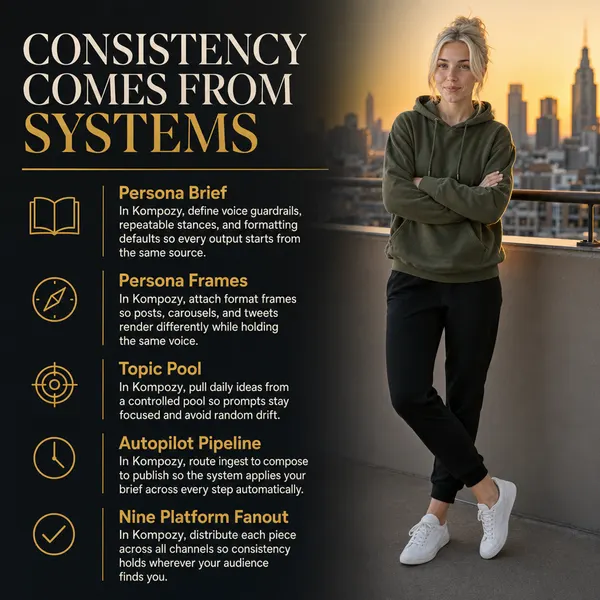
A persona infographic generated in the Kompozy workspace. Like an email variant, it is written from a Persona Brief for a specific audience.
Who is this for, and who should skip it?
Best for:
- Teams with clean segments that want more relevant email
- SaaS companies with product event data
- Marketers writing several variants of the same email
Not ideal for:
- Small lists where setup costs outweigh the gain
- Teams without event tracking who want behavior triggers now
- Transactional email, which should stay plain
Frequently asked questions
Does first-name personalization still work?
It helps a little, mostly on the open, and it looks broken when the field is empty. Use a fallback and put your effort into segment and behavior personalization.
Which personalization tier is worth the most?
Behavior-triggered content, because it arrives right after the subscriber acts. If you lack event tracking, segment blocks come first.
Is AI-written personalization risky?
Yes, at volume. Near-identical AI paragraphs read as bulk mail and can include wrong facts. Validate every block and test against a control group.
How does Kompozy fit in?
Kompozy writes the variant copy in your voice. It can send newsletters through a connected Mailchimp account; for triggered sequences, you load the drafts into the ESP that runs your automation.
How do we know this?
We reviewed every claim on this page on 2026-10-23 and removed lift percentages that had no published source; the tiers are now described qualitatively. Kompozy details come from kompozy.io/pricing and the product's Mailchimp publishing integration.
Sources
- Kompozy: Pricing (read 2026-10-23)
- Google Workspace Admin Help: Email sender guidelines (read 2026-10-23)
Which other AI email marketing guides should you read next?
- Email segmentation that drives conversion: behavioral + demographic + lifecycle — The 4-axis segmentation model (lifecycle / persona / company size / behavior signals) and how to set it up in ConvertKit, Beehiiv, HubSpot, or Customer.io. With the segmentation that drives the highest conversion lift.
- Designing email sequences with AI: welcome, nurture, win-back, retention — The 4 essential email sequence templates for 2026, the trigger architecture each requires, and the AI-augmented production workflow that ships them in days not weeks.
- Email deliverability in 2026: staying out of spam in the AI-content era — How spam filters changed in 2026 to detect AI-generated email at scale, the technical setup (SPF, DKIM, DMARC, BIMI) that still matters, and the content rules that determine inbox placement.
- AI subject lines that earn 40%+ open rates in 2026 — The 5 subject-line patterns that work in 2026, the AI workflow for generating variants, and the banned phrases that tank open rates instantly.
- Email vs newsletter vs nurture vs transactional: when each format wins — The 4 email formats every operator uses (broadcast email, newsletter, trigger-based nurture, transactional) — when each one wins, when each one fails, and how to architect them together without overlap.
- AI-augmented email list growth: lead magnets, opt-ins, and the new sources that work — The 6 list-growth tactics that work in 2026 — AI-generated lead magnets, exit-intent overlays, content upgrades, gated content, partnerships, social-driven opt-ins. With expected per-source conversion rates.
Which related topic clusters cover this from another angle?
- AI Brand Voice & Persona — Without a Persona Brief, every AI output averages to the LLM default voice. This is the 5-section methodology that makes 100+ AI-generated posts feel like one human author wrote them.
- Autonomous Content Creation — How Kompozy autopilot really works: one workspace switch that approves and schedules generated posts, the checks that run before they publish, and a 14-day ramp for turning it on.